Case:
The State of Uttar Pradesh & Anr. v. Brij Pal Singh & Anr. Citation: 2026 INSC 901
Criminal Appeal No.:
2938 of 2025
Bench:
Justice Sanjay Karol and Justice Nongmeikapam Kotiswar Singh Date of Judgment: 20 August 2026
INTRODUCTION
The Pre-conception and Pre-natal Diagnostic Techniques (Prohibition of Sex Selection) Act, 1994 (“PCPNDT Act”) was enacted to prevent the misuse of diagnostic techniques for sex selection and to address the social evil of female foeticide. While the substantive prohibition under the Act has been settled for decades, an important procedural question remained unresolved: when an offence under the PCPNDT Act is cognizable, can the police register an FIR and independently investigate it?
The Supreme Court has now answered this question in The State of Uttar Pradesh & Anr. v. Brij Pal Singh & Anr., 2026 INSC 901.
A Division Bench comprising Justice Sanjay Karol and Justice Nongmeikapam Kotiswar Singh held that the police are not meant to be the investigators for offences under the PCPNDT Act. The investigation is entrusted to the statutory Appropriate Authority under Section 17 of the Act. The police may assist the Appropriate Authority when required, but cannot independently take over investigation of a PCPNDT offence. The Court further held that a Magistrate cannot take cognizance of a PCPNDT offence merely on the basis of a police chargesheet because Section 28 prescribes a specific statutory mechanism for taking cognizance.
The judgment is significant because it resolves conflicting approaches adopted by various High Courts and clarifies the relationship between the PCPNDT Act's specialised enforcement mechanism and the general criminal-law powers of the police.
Importantly, the judgment should not be read as granting blanket immunity from police action. Where the same facts disclose an independent offence under the IPC, Bharatiya Nyaya Sanhita,
2023 (BNS), or another general penal law, the police can investigate that independent offence. What is restricted is the police-led investigation of the PCPNDT offence itself.
FACTUAL BACKGROUND
The proceedings arose from allegations concerning illegal determination of the sex of a foetus.
The District Magistrate, Bulandshahar, who was the Appropriate Authority under the PCPNDT Act, received secret information regarding alleged illegal sex determination. A decoy operation was consequently organised through an authorised officer. The operation was followed by a raid at the concerned medical establishment.
An FIR was subsequently registered, and the police investigated the matter. A chargesheet was filed alleging offences under Sections 315 and 511 of the Indian Penal Code, 1860, along with provisions of the PCPNDT Act, including Sections 4, 5(2), 6(a), 23 and 25.
The accused approached the Allahabad High Court under Section 482 of the Code of Criminal Procedure, 1973, seeking quashing of the proceedings.
The Allahabad High Court noticed that different High Courts had taken conflicting positions on whether police authorities could register FIRs and conduct investigations for offences under the PCPNDT Act. It therefore certified questions of law for consideration by the Supreme Court.
The Supreme Court was consequently required to settle the legal position.
QUESTIONS BEFORE THE SUPREME COURT
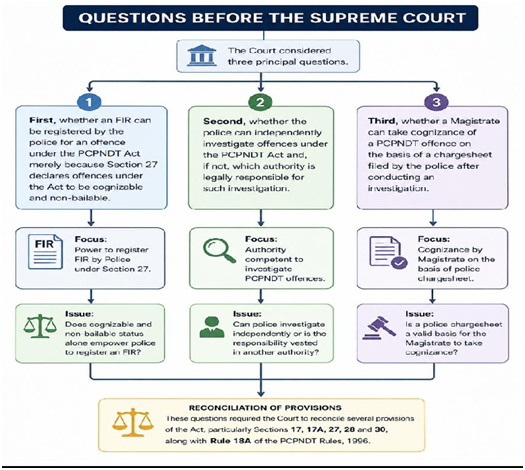
The Court considered three principal questions.
First, whether an FIR can be registered by the police for an offence under the PCPNDT Act merely because Section 27 declares offences under the Act to be cognizable and non-bailable.
Second, whether the police can independently investigate offences under the PCPNDT Act and, if not, which authority is legally responsible for such investigation.
Third, whether a Magistrate can take cognizance of a PCPNDT offence on the basis of a chargesheet filed by the police after conducting an investigation.
These questions required the Court to reconcile several provisions of the Act, particularly Sections 17, 17A, 27, 28 and 30, along with Rule 18A of the PCPNDT Rules, 1996.
THE PCPNDT ACT AND ITS SPECIALISED ENFORCEMENT MECHANISM
The PCPNDT Act does not merely prohibit sex selection. It creates a specialised institutional mechanism for implementing that prohibition.
One of the most important components of this mechanism is the Appropriate Authority. Section 17: Functions of the Appropriate Authority
Section 17 provides for the appointment and constitution of Appropriate Authorities and prescribes their functions.
Section 17(4) is particularly important. It assigns the Appropriate Authority the responsibility of taking appropriate legal action against violations and investigating complaints concerning breaches of the Act and the Rules.
The Supreme Court treated this provision as central to determining who is legally responsible for investigation.
The Court rejected the idea that the Appropriate Authority merely performs an administrative or regulatory function and subsequently hands over the substantive investigation to the police.
The statutory scheme instead demonstrates that the Authority itself has investigative responsibilities.
Section 17A: Powers of the Appropriate Authority Section 17A further strengthens this conclusion.
The provision gives the Appropriate Authority powers to obtain information, summon persons, require production of documents and material objects, and take other investigative measures.
These powers are important because PCPNDT violations frequently involve technical medical evidence, diagnostic records, registration documents and other specialised material.
The existence of these investigative powers demonstrates that Parliament intended the Appropriate Authority to play an active role in enforcement.
SECTION 27: WHY DOES “COGNIZABLE” NOT AUTOMATICALLY MEAN POLICE INVESTIGATION?
The State's principal argument centred on Section 27.
Section 27 provides that offences under the PCPNDT Act are cognizable, non-bailable and non-compoundable.
Ordinarily, a cognizable offence can be investigated by the police without a warrant.
The State therefore argued that the use of the expression “cognizable” necessarily brought the ordinary police-investigation mechanism into operation.
The Supreme Court rejected such an isolated reading.
The Court held that Section 27 cannot be interpreted independently of the other provisions of the PCPNDT Act. It must be read together with Sections 17, 17A, 28 and 30 and the relevant Rules.
The Court emphasised that the PCPNDT Act is a special legislation with a specialised enforcement structure.
Consequently, merely describing an offence as cognizable does not automatically override a special statutory procedure governing investigation and cognizance.
The Court's approach was therefore one of harmonious construction.
Section 27 determines the nature of the offence, but it cannot be used to erase the specific investigative and complaint mechanism created elsewhere in the Act.
SECTION 28: THE COGNIZANCE MECHANISM
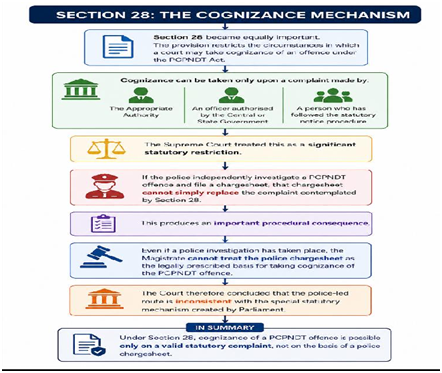
Section 28 became equally important.
The provision restricts the circumstances in which a court may take cognizance of an offence under the PCPNDT Act.
Cognizance can be taken only upon a complaint made by the Appropriate Authority, an officer authorised by the Central or State Government, or a person who has followed the statutory notice procedure.
The Supreme Court treated this as a significant statutory restriction.
If the police independently investigate a PCPNDT offence and file a chargesheet, that chargesheet cannot simply replace the complaint contemplated by Section 28.
This produces an important procedural consequence.
Even if a police investigation has taken place, the Magistrate cannot treat the police chargesheet as the legally prescribed basis for taking cognizance of the PCPNDT offence.
The Court therefore concluded that the police-led route is inconsistent with the special statutory mechanism created by Parliament.
RULE 18A AND THE ROLE OF THE POLICE
The Court also examined Rule 18A(3)(iv) of the PCPNDT Rules, 1996.
The provision requires the Appropriate Authority, as far as possible, to avoid involving the police in investigating cases under the Act because such cases are to be tried as complaint cases.
The expression “as far as possible” was important to the dispute.
It does not mean that the police are completely irrelevant.
Instead, the Supreme Court understood the provision as preserving a limited and supplementary role for the police.
The Appropriate Authority remains the principal investigative authority.
Where assistance is necessary, the police can assist the Authority. But police assistance cannot be converted into an independent police investigation.
This distinction is central to the judgment. There is a difference between:
Police-led investigation of a PCPNDT offence impermissible; And Police assistance during an Appropriate Authority-led investigation permissible where required.
The Court therefore did not eliminate police involvement. It placed that involvement within the statutory hierarchy created by the PCPNDT Act.
THE SUPREME COURT'S HOLDING
The Supreme Court answered the three questions by giving effect to the specialised statutory mechanism.
The Court held that police are not meant to be investigators for offences under the PCPNDT Act. Section 17(4) places investigative responsibility upon the Appropriate Authority, while Rule 18A reinforces the limited role of police assistance.
The Court further held that a Magistrate cannot take cognizance of a PCPNDT offence merely on the basis of a police chargesheet because Section 28 provides a specific route for cognizance.
The judgment therefore establishes a clear sequence:
Information regarding PCPNDT violation → Appropriate Authority → Investigation → Statutory complaint → Cognizance by Court.
Police assistance can occur where required, but the police do not become the principal investigating authority merely because the offence is cognizable.
WHAT IF THE SAME FACTS INVOLVE AN IPC OR BNS OFFENCE?
This is perhaps the most important qualification to the judgment.
The Supreme Court did not hold that the police lose jurisdiction over every criminal offence connected with a PCPNDT allegation.
Suppose a factual situation involves both:
an offence under the PCPNDT Act; and
an independent offence under the IPC or BNS.
The two offences do not automatically become one.
The Appropriate Authority remains responsible for the PCPNDT offence.
The police can independently investigate the separate offence under general criminal law.
This distinction is particularly important after the enactment of the BNS, which replaced the IPC for offences committed after its commencement.
The judgment therefore creates a system of parallel but legally distinct jurisdiction.
The police cannot use the existence of an independent general offence as a reason to take over the PCPNDT investigation itself.
At the same time, the PCPNDT Act cannot be interpreted as preventing the police from exercising their ordinary statutory powers concerning a separate cognizable offence.
PRECEDENTS CONSIDERED BY THE COURT
The Supreme Court's conclusion was also informed by precedent concerning other special statutes.
The Court referred to Jeewan Kumar Raut v. CBI, (2009) 7 SCC 526, concerning the Transplantation of Human Organs Act, 1994. The decision illustrates the distinction between
offences governed by a special statutory mechanism and independent offences under the general criminal law.
The Court also considered Union of India v. Ashok Kumar Sharma, (2021) 12 SCC 674, involving the Drugs and Cosmetics Act, 1940.
These cases supported the broader proposition that the classification of an offence as cognizable does not necessarily mean that ordinary police investigation must prevail where Parliament has created a special enforcement procedure.
The Court also considered the conflicting High Court decisions concerning the PCPNDT Act itself.
The Supreme Court's intervention was therefore necessary not merely to decide the particular prosecution before it, but to settle an important procedural question affecting PCPNDT prosecutions across the country.
WHY THE JUDGMENT MATTERS
The PCPNDT Act addresses a particularly sensitive area of law.
Sex selection is not merely a regulatory violation. It has consequences for gender discrimination, reproductive practices and India's long-standing struggle against female foeticide.
At the same time, PCPNDT investigations frequently involve medical professionals, diagnostic centres, technical procedures and specialised records.
The Supreme Court's decision reflects the view that these matters should be investigated through the institutional mechanism specifically created by Parliament.
The judgment therefore raises a broader principle:
The effectiveness of criminal law depends not merely on the existence of an offence, but also on following the legally prescribed mechanism for investigating and prosecuting that offence.
A cognizable offence does not give the police unlimited authority to disregard a special statute's investigative architecture.
DOES THIS DECISION WEAKEN ENFORCEMENT?
That criticism would be too simplistic.
The decision does not decriminalise sex selection.
It does not remove the offences under the PCPNDT Act.
It does not prevent searches, seizures, investigations or prosecution. Instead, it identifies the authority that must perform those functions. The Appropriate Authority retains substantial statutory powers.
However, the judgment does expose a practical concern: whether Appropriate Authorities across States possess sufficient manpower, expertise and investigative capacity to discharge the responsibilities assigned to them.
A specialised investigative framework is useful only if the specialised authority is capable of using it.
If Appropriate Authorities lack adequate resources, the judgment could unintentionally create delays in enforcement.
That is therefore an implementation issue that governments will have to address.
The answer cannot simply be to revert to police-led investigation, because the Supreme Court has now clarified that the statutory design places the investigative responsibility elsewhere.
IMPACT ON MEDICAL PROFESSIONALS
The judgment also has implications for doctors, diagnostic centres and other medical establishments regulated under the Act.
A PCPNDT allegation can have serious consequences even before trial, including investigation, search, seizure, suspension or cancellation of registration and criminal proceedings.
By requiring the statutory Appropriate Authority to lead the investigation, the judgment reinforces the importance of specialised decision-making in cases involving technical medical questions.
However, this should not be misunderstood as a procedural shield for medical professionals.
Where the evidence establishes a PCPNDT violation, the Appropriate Authority remains fully empowered to investigate and initiate prosecution in accordance with law.
The judgment is therefore about procedural legality, not exemption from liability.
THE CONCURRING OPINION OF JUSTICE KOTISWAR SINGH
Justice Nongmeikapam Kotiswar Singh concurred with the principal judgment while providing additional clarification concerning coordination between different investigative authorities.
His opinion is particularly useful in cases where a factual transaction involves both PCPNDT offences and offences under general criminal law.
The police may investigate the independent offence, while the Appropriate Authority handles the PCPNDT component.
This approach prevents two opposite errors.
The first would be allowing police authorities to assume control over a PCPNDT investigation merely because another offence is involved.
The second would be interpreting the PCPNDT Act so broadly that police become incapable of investigating an independent offence that falls squarely within their jurisdiction.
The concurring opinion therefore reinforces institutional coordination without collapsing the separate statutory jurisdictions.
A PRACTICAL LEGAL FRAMEWORK AFTER THE JUDGMENT
Following this judgment, the position can be understood through four situations.
If the information discloses only a PCPNDT offence, the matter should be placed before the Appropriate Authority rather than independently investigated by the police.
If the facts disclose a PCPNDT offence as well as an independent IPC/BNS offence, the Appropriate Authority handles the PCPNDT offence while the police may investigate the separate general criminal offence.
If the police discover evidence of a PCPNDT violation while lawfully investigating another offence, that material should be communicated to the Appropriate Authority rather than being treated as authority to commence an independent PCPNDT investigation.
Finally, where the Appropriate Authority requires police assistance, such assistance may be provided, but the investigation remains under the Authority's statutory control.
CONCLUSION
The Supreme Court's judgment in The State of Uttar Pradesh & Anr. v. Brij Pal Singh & Anr. is significant because it settles a procedural conflict that had persisted across different High Courts.
The Court has made it clear that “cognizable” does not automatically mean “police-investigated” when a special statute creates a distinct investigative mechanism.
Under the PCPNDT Act, the Appropriate Authority is the principal investigative authority. The police may assist when required, but cannot independently investigate PCPNDT offences as though they were ordinary offences under general criminal law.
Section 28 further ensures that prosecution follows the statutory complaint mechanism and that a Magistrate cannot simply take cognizance of a PCPNDT offence on the basis of a police chargesheet.
At the same time, the judgment carefully preserves police powers concerning independent offences under the IPC, BNS or other general penal legislation.
The decision can therefore be reduced to one central proposition:
For offences under the PCPNDT Act, the Appropriate Authority leads the investigation, the police may assist, and the prosecution must follow the special cognizance mechanism prescribed by Section 28.
The judgment does not dilute the PCPNDT Act's objective of preventing sex selection. Instead, it reinforces the proposition that even socially urgent criminal laws must be enforced through the procedure Parliament has prescribed.