Case Title
Sanjay Sharma @ Sanjay Bhardwaj v. Krishnadhan Khaware and Ors.
Case No.
Civil Appeal No. __ of 2026, arising out of SLP (C) No. 13473 of 2022
Date of Order
15 July 2026
Bench
Justice Sanjay Karol and Justice Vipul M. Pancholi (judgment authored by Karol, J.)
Parties
Appellant: Sanjay Sharma @ Sanjay Bhardwaj | Respondents: Krishnadhan Khaware and Ors.
Courts Below
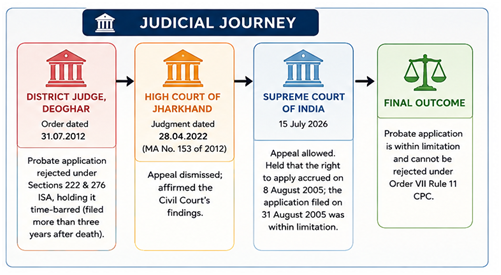
District Judge, Deoghar (order dated 31.07.2012); High Court of Jharkhand (judgment dated 28.04.2022 in MA No. 153 of 2012)
SUBJECT
The judgment concerns the law of succession, specifically the limitation period applicable to an application for probate of a Will under the Indian Succession Act, 1925 (“ISA”), read with the residuary Article 137 of the Limitation Act, 1963 (“1963 Act”). It also touches upon the scope of the court’s power to reject a plaint/petition under Order VII Rule 11 of the Code of Civil Procedure, 1908 (“CPC”) where the question of limitation is disputed.
Master The Transfer of Property Law: Theory, Practice and Procedure by Adv. Roma Bhagat. Enroll Now!
IMPORTANT PROVISIONS
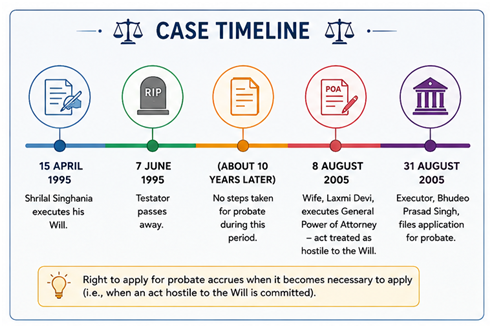
- Section 222, Indian Succession Act, 1925 , Probate can be granted only to an executor appointed under the Will.
- Section 276, Indian Succession Act, 1925 , Prescribes the contents of a petition for probate.
- Article 137, Limitation Act, 1963 , Residuary provision prescribing a three-year limitation period for “any other application for which no period of limitation is provided elsewhere,” running from the date the right to apply accrues.
- Order VII Rule 11, Code of Civil Procedure, 1908 , Empowers a court to reject a plaint (or, by extension, a petition) at the threshold, including on the ground of being barred by law.
OVERVIEW
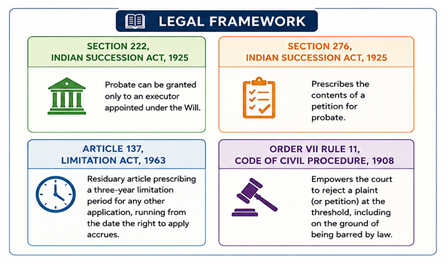
Shrilal Singhania executed a Will on 15 April 1995 and passed away on 7 June 1995. A decade later, on 31 August 2005, Bhudeo Prasad Singh, the executor named in the Will, filed an application for probate. The objectors-respondents moved an application under Order VII Rule 11 CPC contending that the probate petition was time-barred, since it was filed more than three years after the testator’s death.
The District Judge, Deoghar accepted this contention and rejected the probate application under Sections 222 and 276 of the ISA by order dated 31 July 2012. The High Court of Jharkhand, in MA No. 153 of 2012, dismissed the appeal and affirmed the Civil Court’s findings by judgment dated 28 April 2022. Aggrieved, the matter reached the Supreme Court by way of Special Leave Petition (C) No. 13473 of 2022, on which leave was granted and the present appeal was heard by a bench of Justice Sanjay Karol and Justice Vipul M. Pancholi.
The Supreme Court reversed the concurrent findings of the courts below, holding that the right to apply for probate is a continuing right that accrues not on the date of the testator’s death but on the date it becomes necessary to apply , here, the date on which the wife of the testator, Laxmi Devi, executed a General Power of Attorney (8 August 2005), an act treated as hostile to the position established by the Will. Since the probate application was filed on 31 August 2005, within three years of that date, it was held to be within limitation.
ISSUES RAISED
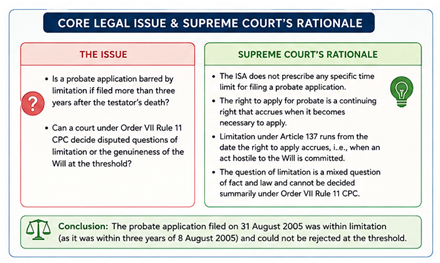
- Whether an application for probate of a Will is barred by limitation under Article 137 of the Limitation Act, 1963, if it is not filed within three years of the testator’s death.
- Whether, in an application under Order VII Rule 11 CPC, a court can return findings touching the merits or genuineness of the Will itself, or decide a disputed question of limitation summarily.
ARGUMENTS ADVANCED BY THE APPELLANT
- The Indian Succession Act does not prescribe any specific time limit within which a probate application must be filed; consequently, the rigid three-year-from-death approach applied by the courts below was erroneous.
- The right to seek probate is a continuous right exercisable at any time so long as the object of the Will subsists, since a probate petition merely seeks the court’s imprimatur on a legal duty already created by the Will.
- Limitation under Article 137 of the 1963 Act runs from the date the right to apply “accrues,” which is the date it becomes necessary to apply , here, the execution of the General Power of Attorney by the testator’s widow on 8 August 2005, an act hostile to the Will , and not from the date of the testator’s death (7 June 1995).
- Since the petition was filed on 31 August 2005, barely three weeks after the hostile act, it was squarely within the three-year period and ought not to have been rejected at the threshold.
- The question of when the cause/right to apply arose was itself a disputed question of fact, and could not be summarily adjudicated in proceedings under Order VII Rule 11 CPC without evidence.
ARGUMENTS ADVANCED BY THE RESPONDENTS
- The probate application was filed only on 31 August 2005 , more than ten years after the testator’s death on 7 June 1995 , and this decade-long delay was unexplained and unjustified.
- Article 137 of the Limitation Act, 1963 prescribes a three-year period, and on the respondents’ reading this period ought to be reckoned from the date of the testator’s death, rendering the application hopelessly time-barred.
- The application was accordingly liable to be rejected at the threshold under Order VII Rule 11 CPC as being barred by law, without the need for a full trial.
- The long, unexplained delay in seeking probate also cast suspicion on the genuineness of the Will itself, a position that found favour with both the District Judge and the High Court of Jharkhand, which returned adverse findings going to the merits of the Will.
JUDGMENT ANALYSIS
1. No limitation runs from the date of death , probate is a continuing right
The Court began by noting that the ISA prescribes no specific period for filing a probate application, so the residuary Article 137 of the 1963 Act applies by default, carrying a three-year period that runs “when the right to apply accrues.” The Court then explained the three-fold purpose of probate , it is a judicial stamp of approval on the genuineness of the Will, it acknowledges the appointment of an executor, and it clothes the executor with authority to act under the Will. Viewed this way, probate is sought not to enforce a stale claim but to obtain the court’s continuing recognition of a legal duty already created by the Will.
Relying on the Bombay High Court’s decision in Vasudev Daulatram Sadarangani v. Sajni Prem Lalwani (1983 SCC OnLine Bom 54), as approved by the Supreme Court in Kunvarjeet Singh Khandpur v. Kirandeep Kaur, (2008) 8 SCC 463 and Sameer Kapoor v. State, (2020) 12 SCC 480, the Court reaffirmed that the proposition that the right to apply necessarily accrues on the date of the testator’s death is unwarranted (this specific conclusion in Vasudev Daulatram was expressly held incorrect), while the proposition that a probate application is a continuous right, exercisable any time after death so long as the object of the Will survives, is the correct position of law.
On this footing, the Court held that the right to apply accrued only when it became “necessary to apply” , that is, when the respondents took action hostile to the Will by having the testator’s widow execute a General Power of Attorney on 8 August 2005. Since the probate petition followed within weeks, on 31 August 2005, it was held to be within the three-year limitation period, and the concurrent findings of the courts below to the contrary were set aside.
2. Order VII Rule 11 CPC cannot be used to adjudicate the merits of the Will or a disputed question of limitation
The second strand of reasoning addressed whether, in a summary proceeding under Order VII Rule 11 CPC triggered by the objectors, the High Court could return findings on whether the Will itself was suspicious. The Court held this was impermissible: the genuineness of a Will goes to its very sanctity, and such a finding cannot be rendered without appreciation of evidence, which a summary, threshold proceeding does not permit.
The Court relied on Salim D. Agboatwala v. Shamalji Oddhavji Thakkar, (2021) 17 SCC 100 (in turn following P.V. Guru Raj Reddy v. P. Neeradha Reddy, (2015) 8 SCC 331 and the three-judge bench decision in Chhotanben v. Kiritbhai Jalkrushnabhai Thakkar, (2018) 6 SCC 422) for the proposition that rejection of a plaint under Order VII Rule 11, particularly on the ground of limitation, is a “drastic power” attracting stringent preconditions; where a plaintiff pleads a specific date of knowledge bearing on limitation, that plea must be accepted at the Order VII Rule 11 stage and tested at trial, not disbelieved at the threshold.
The Court also invoked its recent decision in P. Kumarakurubaran v. P. Narayanan, 2025 SCC OnLine SC 975 (2025 LiveLaw (SC) 509), authored by Mahadevan, J., holding that once a specifically pleaded date of knowledge forms the basis of the cause of action, limitation becomes a mixed question of law and fact that cannot be adjudicated summarily under Order VII Rule 11 CPC, and that rejecting a plaint on limitation without permitting evidence is legally unsustainable.
Applying both strands together, the Court held that the courts below had erred both in treating the three-year period as running from the date of death, and in resolving what was in truth a disputed, fact-dependent question of limitation at the Order VII Rule 11 stage itself.
CONCLUSION
The Supreme Court allowed the appeal, set aside the order dated 31 July 2012 passed by the District Judge, Deoghar and the judgment dated 28 April 2022 passed by the High Court of Jharkhand, and restored the matter to the concerned Civil Court to proceed in accordance with law , meaning the probate petition must now be tried on merits, with the parties permitted to lead evidence, rather than being disposed of at the threshold on limitation. No order as to costs was made.