Citation:
2026: JHHC:19082; Criminal Appeal (S.J.) No. 726 of 2009
Date of Judgment:
30 June 2026
Bench:
Hon'ble Mr. Justice Pradeep Kumar Srivastava
Parties:
Appellant: Sunil Kumar Singh
Respondent: State of Jharkhand
SUBJECT
- Narcotic Drugs and Psychotropic Substances Act, 1985
- Cannabis (Hemp)
- Bhang
- Criminal Prosecution under the NDPS Act
IMPORTANT PROVISIONS
- Narcotic Drugs and Psychotropic Substances Act, 1985
- Section 2(iii) – Definition of "Cannabis (Hemp)"
- Section 20 – Punishment relating to cannabis plant and cannabis
- Section 22 – Punishment for offences relating to psychotropic substances
- Section 8 – Prohibition of certain operations
- Principle of Strict Interpretation of Penal Statutes
OVERVIEW
One of the most severe criminal laws in India is the Narcotic Drugs and Psychotropic Substances Act, 1985 (NDPS Act) which aims to control and ban the use and misuse of narcotic drugs and psychotropic substances. The severe penalties provided for in the Act have made it clear that the Act should be read in strict terms and that no criminal liability should be attached to an action which is not clearly provided for within the Act. This is, however, incorrect and many people think that when a product contains cannabis it is automatically covered under the NDPS Act.
Sunil Kumar Singh vs State of Jharkhand is an important clarification on this misconception by the Jharkhand High Court. The Court considered whether the possession of bhang, a preparation typically consisting of the leaves of the cannabis plant, is covered by the statutory definition of "cannabis (hemp)" in Section 2(iii) of the NDPS Act. The High Court held that the trial court, under various provisions of the Act, had convicting the appellant, was in complete ignorance of the fact that the seized substance was bhang and not ganja, as evident from the report issued by the Forensic Science Laboratory (FSL).
The judgment does not just hold importance for the acquittal of the appellant, but it also restates a fundamental rule of criminal law which is that the scope of a penal statute cannot be enlarged by judicial interpretation. The term “cannabis (hemp)” was specifically defined in Parliament in a certain way, based on Section 2(iii), excluding the seeds and leaves without the flowering or fruiting tops. The Court thus concluded that if the legislature had “deliberately” not included bhang in the definition, it would not have been possible to impute criminal liability under the NDPS Act just because it is of the cannabis plant.
The ruling also states that the drugs which are excluded in the NDPS act doesn't necessarily mean that they have legal freedom. Although bhang could not attract criminal liability based on the Act in the facts and circumstances before the Court, its manufacture, possession and sale may be regulated under the State Excise laws. The judgment is therefore a significant precedent in interpreting the statute, the intention of the legislators and the scope of criminal prosecution under the Indian narcotics regime.
ISSUES RAISED
- Whether bhang comes under the ambit of definition of “cannabis (hemp)” under the provisions of Section 2(iii) of Narcotic Drugs and Psychotropic Substances Act, 1985?
- Whether, mere possession of bhang is an offence under NDPS Act?
- Whether the conviction of the appellant can be upheld in view of the report issued by the Forensic Science Laboratory, that it was bhang and not ganja?
- Whether the NDPS Act can be given a meaning that excludes known substances from its definition and still be criminal?
ARGUMENTS ADVANCED BY THE APPELLANT
The main objections raised by the appellant against the conviction was that the prosecution had failed to prove that the recovered substance came within the ambit of the definition of "cannabis (hemp)" as provided under the NDPS Act.
The appellant argued that the trial court did not take note of the results of the report from the Forensic Science Laboratory. The FSL report specifically mentioned the seized substance was bhang, and not ganja. The leaves and seeds of the cannabis plant are exempted from the definition under the NDPS Act under section 2(iii); and Prosecution for the use of bhang under the NDPS Act was legally not possible because bhang is not considered to be a form of cannabis (hemp) under the Act. The conviction was thus in violation with the express terms of the statute and could be overturned. In addition, the appellant argued that Criminal laws are strict and cannot be given a wider interpretation than what Parliament intended when they enacted the Act, and that if they intended to exclude a substance the term should have been deleted.
ARGUMENTS ADVANCED BY THE RESPONDENT
The State relied upon the judgment of conviction passed by the Special Judge and contended that there was adequate evidence in support of its case for recovery of the contraband in the possession of the accused.
It was proposed that all the prosecution witnesses consistently testified to the confiscation of the substance and the conviction obtained by the Trial Court was not justifiable to be interfered and there was admissible evidence on record to establish the commission of the offences under the NDPS Act.
The main challenge for the prosecution was the report of the Forensic Science Laboratory. After the recovered material was scientifically determined to be the substance bhang, the State had to show how the substance was still within the definition of cannabis (hemp) created by the statute. The High Court rejected such an argument on the basis of the unambiguous language of Section 2(iii).
JUDGMENT ANALYSIS
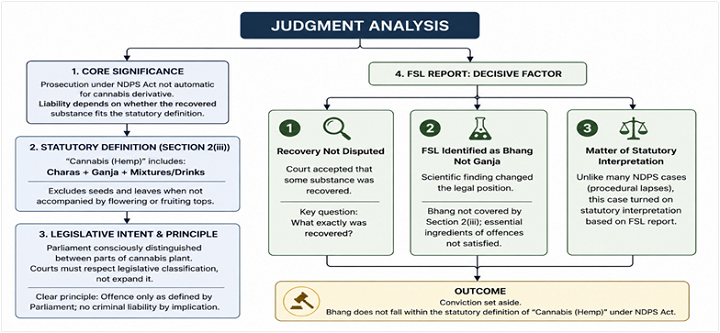
Its significance lies in the fact that it shows that prosecution for a substance under the NDPS Act is not allowed to be brought simply on the basis that it is a product of the cannabis plant. Rather, it is based on whether the recovered material meets the specific definition provided in the statute by Parliament.
The term cannabis (hemp) is defined under section 2(iii) to mean charas, ganja and mixtures or drinks made with either of these. The provision explicitly withholds from coverage seeds and leaves if they are not provided along with the flowering or fruiting tops. This exclusion was the basis of the High Court's logic.
The Court carefully considered the statute's language rather than expansively interpreting it in accordance with the overall purpose of drug law enforcement. It acknowledged that the legislature had made a conscious decision to distinguish among parts of the cannabis plant, and had not decided to criminalize possession of all the derivatives. As a result, courts were obliged to accept the classification of the legislature and not apply more liberal interpretations of public policy. It is a long-established principle of criminal law that, when Parliament has laid down a clear definition of an offence, the courts are bound by that definition, as it stands. Criminal liability can only be found through express or clear words when legislating a crime.
The Forensic Science Laboratory Report became decisive due to the following reasons :-
- A significant part of the case was the fact that the High Court did not interfere with the finding of facts as regards recovery. The Court has accepted that some substance has been recovered from the appellant. But what exactly had been retrieved was the key issue.
- The Forensic Science Laboratory report said that the substance seized was bhang and not ganja. It was a scientific finding which completely changed the legal picture as the retrieved substance was no longer covered by Section 2(iii) and the essential ingredients of the offences with which the appellant was convicted were no longer met.
- In many NDPS cases procedural shortcomings in search, seizure or compliance with mandatory safeguards were the issue, whereas in the present case it was largely a matter of statutory interpretation. The Court was not asked to reconsider the credibility of witnesses or the legality of the search, however, but to decide what legal implications arose from the FSL report.
THE DOCTRINE OF STRICT CONSTRUCTION OF PENAL STATUTES
An important feature of the judgment is its affirmation of the maxim that a penal statute must be construed narrowly. A person is not guilty of committing an offence if a substance is similar in appearance to another banned substance, and is derived from the same plant. Judges do not or should not broaden the definition of an offence by interpreting the law, unless the legislature has specifically added a substance to the meaning of an offence.
The NDPS Act sets out stiff penalties, such as long prison sentences and hefty fines. This has implications which cannot be ignored and prosecution must ensure it meets the requirements of the law. The High Court acknowledged that the function of the Judiciary is to interpret the law made by the Legislature and not to rewrite the law based on its perceived objectives.
In section 2(iii), it clearly differentiates the various cannabis products. The Parliament intentionally excluded seeds and leaves from the definition of "cannabis (hemp)" when not accompanied by the flowering or fruiting tops.The Parliament also chose to exclude seeds and leaves from the definition of "cannabis (hemp)" when they are not accompanied by the flowering or fruiting tops. This exclusion is not incidental or incidental. It is a deliberate legislative decision and the courts have a duty to honor that decision.
The High Court therefore rightly found that the seized substance was scientifically determined to be bhang and the prosecution cannot rely on provisions which are applicable only to substances falling under the statutory definition of cannabis (hemp) as bhang. It would be judicial creation of an offence which Parliament had refused to create to hold otherwise.
Another important distinction in the law that is often missed by the public is noted in the judgment. Under section 2(iii)(b), the term “ganja” only means the flowering tops and the fruit of the plant of cannabis, but not the leaves of the plant when they are not in the flowering tops and fruit. On the other hand, bhang is typically made of the leaves of the cannabis plant. Leaves are not, on their own, considered to be part of cannabis (hemp) and bhang is therefore not typically covered by the NDPS Act.
This separation is not just a technical one. The liability to be charged under the NDPS Act is based exclusively on the definition given by the law. The legislature was aware that not all parts of the plant should enjoy the same harsh criminal penalties envisioned by the Act.
The Court's reasoning shows that as much as the act of recovery is significant, so is the identification of the substance seized. If the narcotics are recovered and the recovery is complete, conviction is impossible if the recovered substance is not one of those specifically enumerated in the Act.
The decision thus underscores the role of forensic evidence in drug cases. The Forensic Science Laboratory report was not only a corroborative piece of evidence, it was evidence that would render any essential element of the offence to be absent.
THE COURT'S FINDINGS
The High Court, after examining the provisions of the statute and evidence on record, decided that the conviction recorded by the Special Judge was not sustainable.
The Court noted that the report of the Forensic Science Laboratory that formed the basis of prosecution was that the substance recovered was bhang. The appellant, therefore, could not be convicted under the provisions invoked by the prosecution as bhang was not included in the statutory definition of ‘cannabis (hemp)' as provided in Section 2(iii). In view thereof, the High Court granted the appeal, overturned the judgment of conviction and the sentence passed by the trial court and discharged the appellant from the charges under the NDPS Act.
The finding has highlighted that the success of prosecution under the NDPS Act depends not just on proving possession but also establishing that the substance seized falls under the specific definition of the act which Parliament had created.
The judgment is important as a reaffirmation of the general approach to the interpretation of criminal statutes. The High Court, however, did not take a liberal interpretation of the NDPS Act, as it aims to tackle drug abuse, but rather followed the words used by Parliament. This would be in line with the well-established rule that penal laws should be construed strictly.
The judgment also sheds light on a misunderstanding about the legal status of cannabis products in India. The terms bhang, ganja, charas and marijuana are used interchangeably in public discourse. The NDPS Act, however, provides careful definitions of these substances and criminal liability is based on these definitions, not on popular perception.
The Court did not say that cannabis should be legal in India, nor did it water down the tough law of the NDPS Act. Ganja, charas and other prohibited cannabis derivatives are still attracting criminal liability when the statutory requirements are met. The decision simply acknowledges that Parliament did not include leaves in the statutory definition of cannabis (hemp) without the presence of flowering or fruiting tops. One of the other important implications relates to the use of forensic evidence. It is important that the investigating agency correctly determine the nature of the substance before applying penal provision of the NDPS Act. Mechanical prosecution is risky if it is not scientifically verified, as it can lead to false convictions and jeopardize criminal investigations.
The judgment also demonstrates the constitutional significance of the supremacy of the legislature over criminal law. Parliament has the sole responsibility for deciding on the nature of the offence. The purpose of a statute is not to be served by expanding the scope of the penalties provided for. The intent of a statute is not to be realized by a "purposive interpretation," especially if the statute's language is clear and unambiguous.
Last but not least, it should be noted that the exclusion from the NDPS Act does not necessarily imply that something is permissible in other respects. The manufacture, possession, sale and distribution of bhang may still be regulated by various State Excise laws. It is therefore evident that mere possession of bhang in a case of its kind is not sufficient to entitle prosecution under the NDPS Act but the person may be liable to other statutory provisions as per the law of the respective State.
CONCLUSION
The decision in Sunil Kumar Singh v. State of Jharkhand is an important contribution to the jurisprudence under the Narcotic Drugs and Psychotropic Substances Act, 1985. The Jharkhand High Court thus confirmed that the conviction of the appellant must be based on the clear words of the statute and not be based on popular perceptions of drugs.
It is noted that Section 2(iii) of the NDPS Act was intended to restrict the definition of "cannabis (hemp)" to the listed substances and expressly exclude the leaves when not used with the flowering or fruiting tops. As a result, the prosecution failed to prove up an essential ingredient of the offence when the recovered substance was identified as bhang by the Forensic Science Laboratory.
The decision has had a ripple effect throughout the criminal justice system, affirming key tenets of criminal law: literal interpretation of criminal statutes, the importance of scientific evidence to the trial process, and the principle that the law must be followed by judges. The judgment comes at a time when prosecution under the NDPS Act is closely under judicial review and reminds them that the struggle against narcotic offences must not be fought at the price of straying from the exact wording provided by Parliament. Assuring the proper application of criminal law involves not only being alert to illegal behavior, but also to following the restrictions set by law ,no one can be punished for doing something that is not forbidden by the law itself.