Case Title:
Shishu Pal @ Shish Ram & Ors. v. Surjeet & Ors.
Case Number:
SLP (C) No. 33915 of 2025
Date of Judgment:
11 June 2026
Bench:
Justice Sanjay Karol and Justice N. Kotiswar Singh
Parties:
Appellants: Shishu Pal @ Shish Ram and other legal representatives of the deceased.
Respondents: Surjeet and Others.
SUBJECT
Motor Accident Compensation, Homemakers' Economic Contribution, Loss of Domestic Care, Delay in Compensation Proceedings, Just Compensation under the Motor Vehicles Act, Gender Justice.
IMPORTANT PROVISIONS
- Motor Vehicles Act, 1988
- Section 166 – Application for compensation.
- Section 168 – Award of just compensation.
- Article 14 of the Constitution of India.
- Article 15 of the Constitution of India.
- Article 21 of the Constitution of India.
IMPORTANT CASES REFERRED
- National Insurance Co. Ltd. v. Pranay Sethi (2017)
- Kirti & Anr. v. Oriental Insurance Co. Ltd. (2021)
- Arun Kumar Agrawal v. National Insurance Co. Ltd. (2010)
- Lata Wadhwa v. State of Bihar (2001)
OVERVIEW
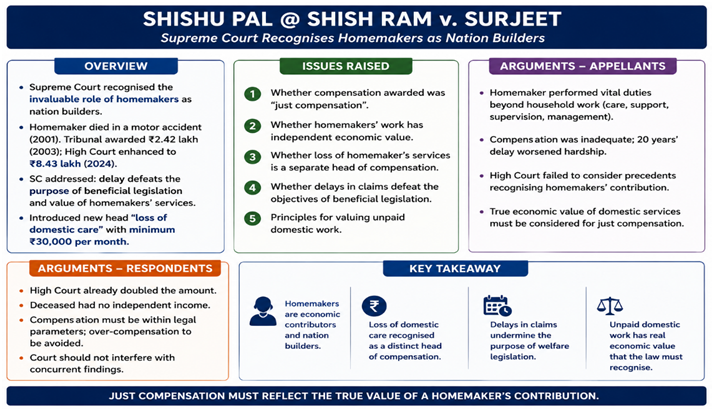
In Shishu Pal @ Shish Ram v. Surjeet the Supreme Court made a seminal decision that appreciated the unmeasurable but extremely significant role of homemakers in Indian society, because homemakers are not just dependants in a family setting but builders of the nation, whose contributions hold families together, nurture future generations, and have indirect economic impacts.
The case arose from a motor accident that occurred on 25 November 2001, resulting in the death of a homemaker. Her family filed a claim with the Motor Accident Claims Tribunal for damages. The Tribunal awarded merely ₹2.42 lakh in 2003. Not satisfied by the inadequate quantum, the claimants turned to the Punjab and Haryana High Court which in 2024, after almost two decades of pendency, increased the compensation to a sum of ₹8.43 lakh. The claimants then appealed to the Supreme Court, where they are still unhappy.
While examining the appeal, the Supreme Court addressed two important questions. First, it reviewed and examined how much delay in the payment of motor accident compensation cases nullifies the benefit of good legislation. Secondly, and more important, it looked into the issue of the value of services provided by homemakers in the calculation of compensation.
It finally reshaped the jurisprudence of compensation by introducing a new and distinct category of 'loss of domestic care' and established a minimum compensation of ₹30,000 per month for homemakers. Whereas, the economic value of unpaid domestic labour cannot be ignored by the law, the Court noted.
ISSUES RAISED
- Whether the compensation awarded by the High Court was "just compensation" under the Motor Vehicles Act.
- Whether the work done by the homemakers has an independent economic value that can be monetized.
- Whether the demise of a homemaker's service should be considered a separate head of compensation.
- Whether prolonged delays in adjudicating motor accident claims undermine the objectives of beneficial legislation.
- What are the principles to be followed in the valuation of unpaid domestic work of homemakers?
ARGUMENTS ADVANCED BY THE APPELLANTS
The appellants argued that the Tribunal and High Court had underestimated the contributions of the deceased.
The Appellants contend that:
The deceased was a homemaker who went beyond the normal duties of a housewife. She took care of children, offered emotional support, supervision, guidance and management of the household. The compensation provided was inadequate to the actual loss to the family. The long wait of almost 20 years compounded the plight of the dependants. There was a failure on the part of the High Court to take cognisance of the previous judicial decisions which have recognized the contribution of homemakers.
True value of domestic services should be considered when determining just compensation under the Motor Vehicles Act. The appellants, therefore, asked for enhancement of compensation, by placing proper economic value on the services rendered by the deceased.
ARGUMENTS ADVANCED BY THE RESPONDENTS
The respondents upheld the payment of the compensation by the High Court and contended that:
The High Court had already doubled the amount. Deceased did not have any independent source of income. The compensation must be within motor accident jurisprudence parameters. Over-compensation would be a departure from the established guidelines for compensation. The Court should be wary of concurrent findings. The respondents thus submitted that there was no need for any further enhancement.
JUDGMENT ANALYSIS
Delay Defeats Beneficial Legislation. The Supreme Court in the very beginning said that it was very concerned at the extraordinary delay of the claimants.
The Court pointed out that the appeal was filed in the High Court in 2004, but decided only in 2024. Some of this delay was due to a fire in the records of the Punjab and Haryana High Court. The Court noted, however, that the delays in the institutions have an adverse effect on the credibility of the justice delivery system.
The Court highlighted that the motor accident law is a welfare law which is meant to afford prompt relief to a victim and his/her family. A compensation pay-out after decades of suffering for dependants cannot truly compensate for their suffering. The Court noted that the concept of "just compensation" becomes much weakened by compensation actions that can take decades.
Homemakers: The Invisible Economic Force
The most important aspect of this judgment is that homemakers are recognized as economic contributors.
The Court noted that homemakers have a variety of functions such as:
- cooking,
- cleaning,
- childcare,
- elder care,
- household administration,
- educational supervision,
- emotional caregiving,
- social coordination.
These activities generate income for families and allow labour force members to be part of the formal sector. However, domestic labour has been historically ignored because of the absence of any monetary returns.
The Court rejected this old concept that wages are the same as value, as it was not the only way to measure value. The Court did not accept this old doctrine that the absence of a wage implied the absence of a value, because it was not the only way to measure value. According to the judgment, homemakers are "nation builders" as they foster the next generation of citizens and help to maintain society's social fabric.
This recognition is not merely symbolic, but also recognises the economic reality of unpaid domestic work.
Judicial Evolution of Homemaker Compensation
The Court charted the evolution of law on the question of homemakers. Supreme Court in Lata Wadhwa v State of Bihar acknowledged the substantial contribution of housewives towards the welfare of the family and that they deserve compensation.
In Arun Kumar Agrawal v National Insurance Co. Ltd, the Court declared that housewives' gratuitous services do not become worthless because it is without compensation.
The Court in Kirti & Anr. v Oriental Insurance Co did not accept any assumption based on the patriarchal assumption that domestic work has no economic value.
Following these precedents, the present judgment seeks to develop the law with a more concrete structure. Whereas in prior rulings the Court only acknowledged the contributions homemakers make in theory, the Court aimed to set standards in practice for future compensation cases.
Quantifying the Contribution of a Nation Builder
The issue with valuation was one of the toughest before the Court. The Court recognized that there is no amount of compensation that could ever make up for the emotional and personal loss of a homemaker to a family. But there should be a pragmatic approach to compensation law.
The Court pointed out that if the services of a homemaker were to be substituted, a number of persons would have to be engaged to carry out the various tasks such as cooking, care taking, supervision, and child care. So it isn't feasible or fair to lower a homemaker's contribution to nominal levels. Given the importance of uniformity, the Court decided that:
The lowest amount to be considered for domestic care loss shall be of ₹30000/- per month. This amount is a guideline, not an absolute figure. Depending on the facts of each case, courts may find amounts above that to be warranted where such is warranted. Importantly, the Court clarified that such a valuation does not constitute a domestic employee treatment of homemakers. Rather, it's an admission of the economic effects of losing their services.
The Loss of Domestic Care: A Distinct Head Of Compensation.
The most revolutionary part of the judgment is the establishment of a separate head of compensation. The Court determined that "loss of domestic care" should be considered separately when determining compensation.
Under the traditional motor accident law, the heads of compensation include:
- loss of dependency,
- funeral expenses,
- loss of consortium,
- loss of estate.
The Court noted that these heads do not truly reflect the deprivation resulting from the absence of domestic care. Dependency is not the only aspect of domestic care. It is about caring, supervision, emotional support, home management and so much more that helps maintain family connections.
Loss of domestic care, therefore, must be given its own recognition. The Court also explained that if the homemaker has any independent income, then she will receive the compensation under this head along with her actual income. This method will avoid underestimating women's contributions when they work for pay and care for others in their home.
Gender Justice and Constitutional Values
The judgment is framed in the context of motor accident law but holds relevance for gender equality. Women are still primarily responsible for unpaid care workloads. If domestic labour is not recognised then the stereotype of the dependent economically unproductive homemakers is reinforced.
The Court's reasoning is in keeping with the constitutional values of equality and dignity. Unpaid labour is recognised to foster substantive equality, and to reflect social realities rather than just formal categorisations. The judgment, therefore, makes a significant contribution in feminist legal jurisprudence in India.
Application to the Present Facts
On the basis of these principles, the Supreme Court decided that the compensation accorded by the High Court was inadequate and thus called for an increase.
The Court took the care of the deceased homemaker as an additional head and calculated the amount accordingly, and also gave proper value to the contribution of the deceased homemaker. The Bench therefore increased the compensation to be paid to the claimants and ordered the compensation to be paid based on its new calculations.

THE INSTRUCTIONS GIVEN BY THE COURT.
The Supreme Court ruled that: Homemakers are "nation builders" and their contributions should be recognized in law. Domestic care is a separate claim for damages. The domestic care will be valued in accordance with at least a benchmark of ₹30,000 per month.
The above amount may be increased as it may be found to be appropriate based on the circumstances of each case. Where a homemaker, in the same employment also earns, compensation under this head shall be awarded in addition to the actual earnings.
Motor accident courts need to be realistic, taking a realistic view that is consistent with the goal of just compensation.
CONCLUSION
In Shishu Pal @ Shish Ram v. Surjeet, it has been a turning point in Indian compensation jurisprudence. The Supreme Court's attempt to remediate decades of legal invisibility of unpaid domestic work is significant because the recognition of homemakers as nation builders and the acknowledgment of loss of domestic care as a separate line of compensation.
The judgment goes beyond mere token recognition and sets out to establish standards that can be applied uniformly. The standard of ₹30,000 per month assumes that a household's operations are primarily based on labour, which is typically unpaid but never redundant.
The Court's condemnation of institutional delay is also significant. There may be a time lag of decades between enactment of beneficial legislation and relief to the victims and their families, and in the meantime, the law's effectiveness diminishes considerably. The judgment thus reminds us that access to justice must not only be fair, but timely.
The judgment in the end alters the whole concept of “value” within the legal realm. It signifies that caring, nurturing and running households are not economically insignificant activities. They are essential assets, which influence families, communities and the country.
The Supreme Court has not only strengthened the compensation of homemakers, it has also emphasized their role as “nation builders.” It has brought respectability into a travail of which no one ever wanted to see.