

Case Title:
Nazibul Rahim Khan & Ors. v. State of Uttar Pradesh & Anr.
Bench:
Justice Ahsanuddin Amanullah and Justice R. Mahadevan
SUBJECT
Criminal Procedure, Abuse of Process of Law, Quashing of FIR, Civil and Criminal Proceedings, Delay in Criminal Prosecution, Property Disputes, Section 482 CrPC.
IMPORTANT PROVISIONS
- 1.Section 482, Code of Criminal Procedure, 1973
- Sections 420, 467, 468, 471 and 506, Indian Penal Code, 1860
- Article 226 of the Constitution of India
- Principles governing abuse of criminal process
- Law relating to simultaneous civil and criminal proceedings
OVERVIEW
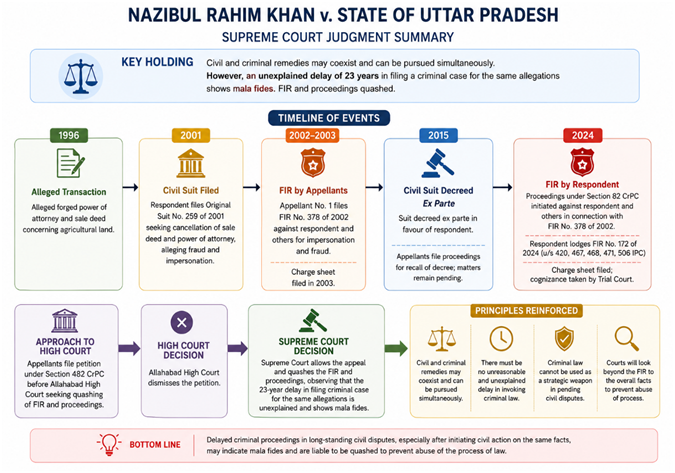
In a significant judgment concerning the misuse of criminal proceedings in long-standing civil disputes, the Supreme Court in Nazibul Rahim Khan v. State of Uttar Pradesh quashed a FIR lodged nearly twenty-three years after the complainant had already initiated civil proceedings based on the very same allegations. The Court held that although civil and criminal remedies may coexist and may be pursued simultaneously, there cannot be an unreasonable and unexplained gap between invoking the two remedies.
The decision is important because it addresses a recurring problem in Indian litigation parties attempting to convert old civil disputes into criminal cases after years or even decades of litigation. While courts have repeatedly held that the existence of a civil dispute does not automatically bar criminal prosecution, the present judgment adds an important qualification. The Court emphasized that delayed criminal proceedings may indicate mala fides, particularly where the complainant had knowledge of the alleged offence for years but chose not to invoke criminal law.
The dispute arose from competing claims regarding agricultural land and allegations of impersonation, forged powers of attorney and fraudulent sale deeds. The complainant had filed a civil suit as early as 2001 alleging that the accused had fabricated a power of attorney and illegally transferred her land. Despite having knowledge of the alleged fraud, she did not lodge a criminal complaint until 2024.
The Supreme Court found this delay fatal. It observed that criminal law cannot be employed as a strategic weapon to gain leverage in pending civil disputes. If an aggrieved person genuinely believes that criminal offences have been committed, criminal remedies should ordinarily be pursued within a reasonable period after acquiring knowledge of such offences.
The judgment reinforces the doctrine that criminal proceedings should not become instruments of harassment and that courts exercising inherent powers must look beyond the allegations in the FIR to examine the overall factual matrix and surrounding circumstances.
FACTUAL BACKGROUND
The litigation between the parties had a long and complicated history spanning more than two decades. The controversy revolved around approximately thirteen acres of land and allegations concerning forged documents and impersonation.
The second respondent, Khatoon Jahan, instituted Original Suit No. 259 of 2001 seeking cancellation of a sale deed dated 2 February 1996 and cancellation of a power of attorney. She alleged that Appellants Nos. 1 and 2 had conspired with Appellant No. 3 and had projected Appellant No. 3 as an impersonator of the respondent. According to her, a forged power of attorney was created and used to execute a sale deed concerning her land.
In response, the appellants maintained that the respondent herself was an impersonator. According to them, the actual Khatoon Jahan was the widow of appellant No. 1's cousin brother and had inherited agricultural land. They alleged that the respondent falsely represented herself as that Khatoon Jahan and illegally transferred land. Consequently, appellant No. 1 lodged FIR No. 378 of 2002 accusing the respondent and others of impersonation and fraud.
After investigation, a charge sheet was filed against the respondent and other accused persons in 2003. Meanwhile, the civil suit filed by the respondent was decreed ex parte in 2015. The appellants later sought recall of the ex parte decree and initiated several proceedings before different forums. These proceedings remained pending.
The turning point came in 2024. Proceedings under Section 82 CrPC had been initiated against the respondent and others in connection with FIR No. 378 of 2002 because of their non-appearance before the court. Shortly thereafter, the respondent lodged FIR No. 172 of 2024 alleging offences under Sections 420, 467, 468, 471 and 506 IPC. The allegations were substantially similar to those raised in her civil suit filed twenty-three years earlier.
A charge sheet was filed against the appellants, and cognizance was taken by the Trial Court. The appellants approached the Allahabad High Court under Section 482 CrPC seeking quashing of the proceedings. The High Court dismissed their application. Aggrieved thereby, they approached the Supreme Court.
ISSUES RAISED
- Whether civil and criminal proceedings can be maintained simultaneously on the same cause of action?
- Whether the FIR lodged by the respondent after approximately twenty-three years was liable to be quashed?
- Whether the delay in initiating criminal proceedings indicated mala fide intent and abuse of process?
- Whether the High Court was justified in refusing to exercise jurisdiction under Section 482 CrPC?
- Whether the criminal proceedings constituted a counterblast to the proceedings initiated by the appellants?
ARGUMENTS ADVANCED BY THE APPELLANTS
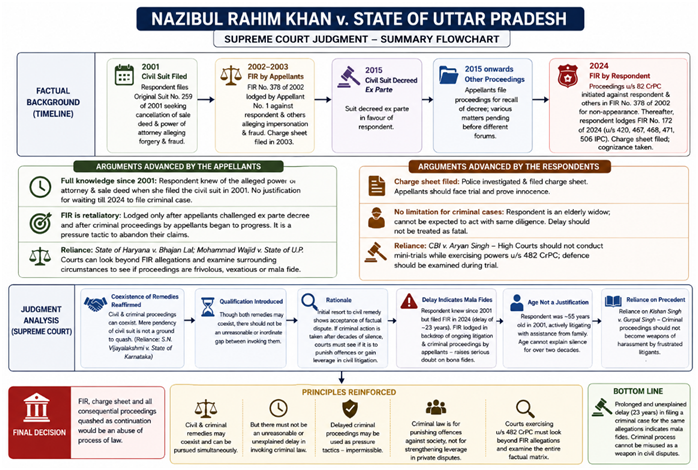
The appellants contended that the FIR was a classic example of abuse of the criminal justice system. They argued that the respondent had full knowledge of the alleged power of attorney and sale deed since at least 2001 when she filed the civil suit seeking cancellation of those documents. Therefore, there was no justification whatsoever for waiting until 2024 to initiate criminal proceedings.
The appellants submitted that the timing of the FIR was highly suspicious. According to them, it was lodged only after the appellants pursued proceedings challenging the ex parte decree and after criminal proceedings initiated by them against the respondent had begun to progress. Thus, the FIR was merely a retaliatory measure intended to pressure them into abandoning their claims.
Reliance was placed upon State of Haryana v. Bhajan Lal and Mohammad Wajid v. State of Uttar Pradesh. The appellants argued that courts are empowered to look beyond the bare allegations in the FIR and examine the surrounding circumstances to determine whether criminal proceedings are frivolous, vexatious or motivated by ulterior considerations.
ARGUMENTS ADVANCED BY THE RESPONDENTS
The State opposed the appeal and submitted that the police had investigated and filed a charge sheet. Therefore, the appellants should face trial and establish their innocence through the ordinary criminal process.
The respondent further argued that there is no strict limitation period governing the initiation of criminal proceedings. It was contended that the respondent was an elderly widow and could not be expected to act with the same diligence and promptness as an ordinary litigant. Consequently, the delay by itself should not be treated as fatal.
Reliance was placed upon CBI v. Aryan Singh, where the Supreme Court cautioned High Courts against conducting mini-trials while exercising powers under Section 482 CrPC. It was argued that the defence raised by the appellants ought to be examined during trial rather than at the quashing stage.
JUDGMENT ANALYSIS
The Supreme Court allowed the appeal and quashed the FIR. The reasoning adopted by the Court is significant because it clarifies the relationship between civil and criminal remedies and simultaneously strengthens safeguards against abuse of criminal process.
The Court began by noting an undisputed fact. The respondent had already alleged forgery of the power of attorney and misuse thereof in her civil suit filed in 2001. The allegations made in the FIR lodged in 2024 were essentially identical. Therefore, the central question was not whether the allegations disclosed criminal offences. Rather, the crucial issue was why the respondent waited for approximately twenty-three years before invoking criminal law.
The Court reaffirmed the settled principle that civil and criminal proceedings can coexist. The same transaction may simultaneously give rise to civil liability and criminal culpability. Thus, the mere existence of a civil suit is not a ground for quashing criminal proceedings. The Court specifically referred to its earlier decision in S.N. Vijayalakshmi v. State of Karnataka and reiterated that both remedies may be pursued on the same facts.
However, the Court introduced an important qualification. Although both remedies may coexist, there should not be an unreasonable or inordinate gap between invoking them. This observation constitutes the most important contribution of the judgment.
The rationale behind this principle is straightforward. When a litigant first approaches a civil court, it indicates acceptance that a factual dispute exists requiring adjudication through evidence and trial. Such a litigant is not barred from subsequently invoking criminal law. Nevertheless, if criminal proceedings are initiated after decades of silence, courts must carefully examine whether the prosecution is genuinely intended to punish criminal conduct or merely to gain leverage in civil litigation.
The Court recognized that delayed criminal proceedings can operate as pressure tactics. A litigant may initially pursue civil remedies and, upon encountering setbacks or delays, resort to criminal prosecution as a means of intimidating the opposing party. Such conduct undermines the integrity of the criminal justice system. Criminal law exists to punish offences against society, not to strengthen negotiating positions in private disputes.
Another significant aspect of the judgment is its emphasis on bona fides. The Court observed that the timing of the FIR raised serious concerns. The respondent had been aware of the alleged forgery since at least 2001. Yet no criminal complaint was filed until 2024. Moreover, the FIR was lodged against the backdrop of ongoing litigation between the parties, including criminal proceedings initiated by the appellants. These circumstances made the delay particularly suspect.
The respondent attempted to justify the delay by emphasizing her age and status as a childless widow. The Court was not persuaded. It noted that she was approximately fifty-five years old when she instituted the civil suit and was actively pursuing litigation with assistance from family members. Therefore, age could not explain the failure to initiate criminal proceedings for over two decades.
Perhaps the most important part of the judgment is the Court's reliance on Kishan Singh v. Gurpal Singh. In that case, the Supreme Court warned against permitting frustrated litigants to invoke criminal jurisdiction merely to harass opponents after failing to secure favourable outcomes elsewhere. The Court reproduced the relevant passage emphasizing that criminal proceedings should not degenerate into weapons of harassment and persecution.
The reference to Kishan Singh case is particularly important because it situates the present judgment within a broader line of authority concerning abuse of process. The Supreme Court has repeatedly held that courts possess inherent powers to prevent misuse of criminal law. The present decision strengthens that jurisprudence by identifying prolonged and unexplained delay as a relevant indicator of mala fide intent.
The judgment also indirectly reinforces the principles laid down in Bhajan Lal case. One of the recognised categories for quashing criminal proceedings arises where prosecution is manifestly attended with mala fides or instituted with ulterior motives. Although the Court did not explicitly conduct a category-wise Bhajan Lal analysis, the reasoning clearly reflects that framework.
From a policy perspective, the judgment strikes an appropriate balance. Had the Court adopted the view that any civil dispute automatically bars criminal prosecution, genuine victims of fraud would be left without criminal remedies. Conversely, allowing criminal proceedings to be initiated decades later without explanation would encourage misuse of the criminal justice system.
The Court therefore adopted a middle path. It reaffirmed the coexistence of civil and criminal remedies while insisting that criminal law must be invoked bona fide and within a reasonable period after knowledge of the offence. This approach preserves access to criminal justice while preventing its exploitation for collateral purposes.
The decision is also important for High Courts exercising jurisdiction under Section 482 CrPC. The judgment makes clear that courts should not confine themselves to the allegations contained in the FIR. Instead, they must examine the entire factual background, including prior litigation, chronology of events and surrounding circumstances. This broader inquiry is essential for identifying abuse of process.
Ultimately, the Supreme Court concluded that the FIR represented a misuse of criminal law. Given the extraordinary delay and the surrounding circumstances, continuation of the prosecution would amount to abuse of process. Consequently, the FIR, charge sheet and all consequential proceedings were quashed.
CONCLUSION
The judgment in Nazibul Rahim Khan v. State of Uttar Pradesh is a significant addition to the jurisprudence governing parallel civil and criminal proceedings. While reaffirming the established principle that both remedies may coexist, the Supreme Court introduced an important safeguard against abuse. The Court clarified that litigants cannot keep criminal proceedings in reserve for decades and then deploy them as strategic tools in ongoing civil disputes.
The ruling recognizes that criminal law carries serious consequences and therefore must not be used as an instrument of private pressure or retaliation. By quashing a FIR lodged twenty-three years after the complainant acquired knowledge of the alleged fraud, the Court reinforced the principle that bona fides and promptness are essential considerations when invoking criminal jurisdiction.
The decision strengthens the integrity of the criminal justice system, protects individuals from vexatious prosecution and provides valuable guidance for courts confronted with delayed criminal complaints arising out of long-standing civil disputes. Most importantly, it sends a clear message that while civil and criminal remedies may travel together, criminal law cannot be weaponized after decades of silence merely to secure an advantage in private litigation.


