

CASE TITLE:
Punjab National Bank v. M/s. Shree Jyoti Education and Management Trust World & Ors.
CITATION:
2026 INSC 836
DATE OF JUDGMENT:
12 August 2026
BENCH:
Justice Sanjay Kumar and Justice Sanjeev Sachdeva
CASE NUMBER:
Special Leave Petition (C) Nos. 27363-27364 of 2024
AREA OF LAW:
Banking Law, Recovery of Debts, NPA Accounts and Interest
IMPORTANT PROVISIONS:
- Section 2(g), Recovery of Debts due to Banks and Financial Institutions Act, 1993
- Section 19(20), Recovery of Debts due to Banks and Financial Institutions Act, 1993
- Section 21A, Banking Regulation Act, 1949
IMPORTANT CASES REFERRED:
- Central Bank of India v. Ravindra, (2002) 1 SCC 367
- Union of India v. Association of Unified Telecom Service Providers of India, (2020) 3 SCC 525
OVERVIEW
The judgment arose out of a dispute concerning the outstanding dues under a Rs.5 crore loan sanctioned by United Bank of India to M/s. Shree Jyoti Education and Management Trust World, a charitable trust, for construction of a college building. Tara Prasad Satpathy, the managing trustee, along with other trustees, was also involved in the loan arrangement. The account was subsequently classified as a Non-Performing Asset on 30 June 2017, following which the manner in which interest was reflected in the Bank's books became central to the dispute.
United Bank of India, which was subsequently amalgamated with Punjab National Bank (PNB), initiated proceedings before the Debts Recovery Tribunal (DRT), Cuttack, claiming Rs.75,56,680 as outstanding as on 4 May 2018. The DRT substantially reduced the amount, but the DRAT subsequently determined the liability at Rs.54,90,413 with 9% interest. The Orissa High Court later reduced the liability further by relying upon a Bank certificate showing Rs.31.99 lakh as outstanding. The Supreme Court ultimately found that the High Court had overlooked the separate interest component maintained in the suspense account and restored the DRAT's determination.
Master Insolvency and Bankruptcy Code IBC Certificate Course by Adv. Amrita Kharkar. Enroll Now!
FACTUAL BACKGROUND
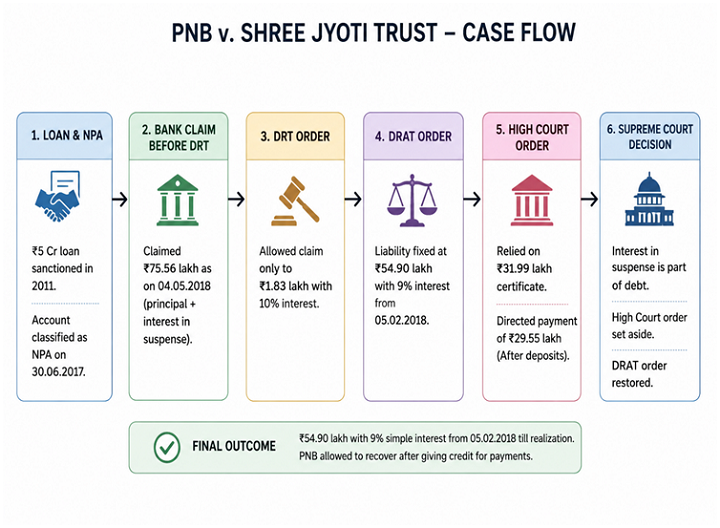
United Bank of India sanctioned a Rs.5 crore loan to the Trust through a letter dated 27 June 2011 for construction of a college building. On 22 June 2017, the Bank informed the Trust that the balance amount due and payable was Rs.1,27,33,669. On 30 June 2017, the loan account was classified as a Non-Performing Asset.
The Bank thereafter initiated proceedings before the DRT, Cuttack, seeking recovery of Rs.75,56,680 as on 4 May 2018, together with future interest. The amount comprised Rs.64,25,915 reflected in the loan account and Rs.11,30,765 towards interest maintained separately in the suspense account. The latter represented interest accruing after the account was classified as an NPA.
PROCEEDINGS BEFORE THE DRT
By judgment dated 5 February 2021, the DRT allowed the Bank's claim only to the extent of Rs.1,83,268, together with pendente lite and future simple interest at 10% per annum. In arriving at this figure, the DRT took the original claim of Rs.75,56,680, added simple interest at 10% per annum from 6 May 2018 to 5 February 2021, and arrived at a total of Rs.95,71,784. It then deducted Rs.93,88,516 paid by the Trust and its trustees after the account had become an NPA, leaving Rs.1,83,268 as the balance payable.
PNB challenged the DRT's determination before the Debts Recovery Appellate Tribunal, Kolkata. By order dated 1 September 2023, the DRAT partly allowed the Bank's appeal and determined that the Trust and its trustees were liable to pay Rs.54,90,413, together with pendente lite and future simple interest at 9% per annum from 5 February 2018 until realization. The DRAT also took into account payments made after the DRT's judgment. PNB accepted the DRAT's order without demur.
PROCEEDINGS BEFORE THE ORISSA HIGH COURT
The Trust and Tara Prasad Satpathy challenged the DRAT's order before the Orissa High Court. During those proceedings, reliance was placed upon a certificate issued by PNB dated 24 December 2020, which stated that the outstanding loan amount as on 13 October 2020 stood at Rs.31,99,000.
The Trust subsequently deposited Rs.59,321.98 on 28 December 2020 and Rs.1,84,000 on 11 February 2021, totalling Rs.2,43,321.98. The High Court accepted the Trust's contention that these payments should be deducted from Rs.31,99,000, leaving Rs.29,55,678.02. By order dated 11 January 2024, it directed the Trust and its managing trustee to pay that amount in full and final settlement of their dues and for closure of the loan account. PNB's subsequent application seeking recall or modification of the order was dismissed on 14 May 2024, leading to the appeals before the Supreme Court.
ISSUES BEFORE THE SUPREME COURT
The principal question before the Supreme Court was whether the High Court had correctly treated the Rs.31.99 lakh figure mentioned in PNB's certificate as the complete outstanding liability while disregarding the interest maintained separately in the suspense account after NPA classification.
The Court was consequently required to determine whether such interest continued to constitute part of the recoverable "debt" and whether the DRAT's determination of Rs.54,90,413 ought to be restored.
SUPREME COURT'S ANALYSIS
1. Accounting Treatment After NPA Classification
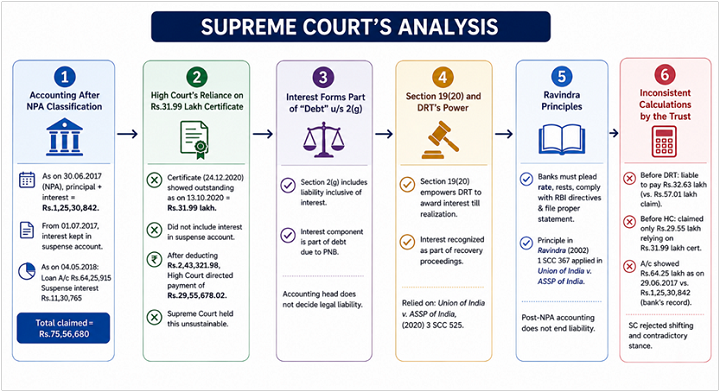
The Supreme Court examined the affidavit dated 3 December 2024 filed by the Chief Manager of PNB, Circle SASTRA Centre, Cuttack, along with the statement of account of the Trust maintained with United Bank of India from 22 February 2012 onwards. The Court found that, as on 30 June 2017, the date on which the account was classified as an NPA, the principal loan amount due together with interest calculated up to that date stood at Rs.1,25,30,842.
The Court noted that, in accordance with the accounting system followed by banks under applicable guidelines, interest was applied only until the date of NPA classification. From 1 July 2017, the Bank maintained a separate suspense account for interest due on the outstanding loan amount. Consequently, that interest no longer appeared in the ordinary loan account statement. As on 4 May 2018, the loan account reflected Rs.64,25,915, while Rs.11,30,765 stood as interest in the suspense account, together amounting to the Rs.75,56,680 originally claimed by United Bank of India.
2. The High Court's Reliance on the Rs.31.99 Lakh Certificate
The Supreme Court held that the High Court's reliance upon the Rs.31.99 lakh certificate, without considering the suspense account, amounted to an oversimplification of the calculation. The certificate dated 24 December 2020 had to be understood in light of the accounting system followed after the loan account became an NPA. The Rs.31.99 lakh figure did not take into account the interest component reflected separately in the suspense account.
Therefore, the High Court could not treat Rs.31.99 lakh as the complete outstanding liability and simply deduct the Rs.2,43,321.98 subsequently paid by the Trust. The Supreme Court found that this approach ignored a material component of the Bank's claim and consequently could not be sustained.
3. Interest Forms Part of "Debt" Under Section 2(g)
The Supreme Court then examined Section 2(g) of the 1993 Act, which defines "debt" to include, among other things, any liability inclusive of interest claimed as due from a person by a bank or financial institution.
In light of this statutory definition, the Court observed that there could be no dispute that the interest component formed part of the debt due to PNB. The fact that the interest was maintained under a separate accounting head did not alter its legal character.
The judgment therefore establishes an important distinction: the accounting location of an amount is not determinative of whether the amount forms part of the legally recoverable debt. Where interest is otherwise due, transferring it to a suspense account following NPA classification does not, by itself, extinguish the borrower's liability.
4. Section 19(20) and the DRT's Power to Award Interest
The Court also referred to Section 19(20) of the 1993 Act, which empowers the DRT to pass an interim or final order including an order for payment of interest from the date on which payment is found due until realization or actual payment.
The provision is significant in the context of recovery proceedings because it recognizes interest as a component that may be awarded by the DRT in determining the amount recoverable by a bank. The Supreme Court also referred to Union of India v. Association of Unified Telecom Service Providers of India, where this principle was applied.
5. Reference to Central Bank of India v. Ravindra
The Supreme Court referred to the Constitution Bench decision in Central Bank of India v. Ravindra, (2002) 1 SCC 367, concerning the charging and capitalization of interest by banks. The Court noted the importance of appropriate pleadings regarding the rate of interest and periodic rests, consistency with applicable RBI directives, and proper statements of account disclosing relevant debit entries and the rate and period for which interest was charged.
The Court also noted that the principle in Ravindra was subsequently applied by a three-Judge Bench in Union of India v. Association of Unified Telecom Service Providers of India, (2020) 3 SCC 525. These authorities reinforce that interest claims remain subject to the applicable contractual and regulatory framework, but the accounting treatment adopted after NPA classification does not by itself extinguish an existing liability.
6. Inconsistent Calculations by the Trust
The Supreme Court also considered the different calculations advanced by the Trust and its trustees. The Court noted that the statement of account produced by them before the Supreme Court showed the principal amount due as on 29 June 2017 as Rs.64,25,915, whereas the running account statement produced by the Bank showed the principal amount together with interest calculated up to that date as Rs.1,25,30,842.
The Court further noted that before the DRT, the Trust had challenged the rate of interest as excessive and stated that it was liable to pay Rs.32,63,899.65, rather than the claimed amount of Rs.57,01,917.32. Before the High Court, however, it relied upon the Rs.31.99 lakh certificate to contend that only Rs.29,55,678.02 was payable. The Supreme Court rejected this shifting approach and held that the Trust and its trustees could not ignore the applicable accounting system and advance different calculations at different stages to suit their interests.
7. The Court Rejected the "Negative Balance" Calculation
The Supreme Court also dealt with a statement of account produced by the Trust which attempted to show that, after accounting for its payments, the account had reached a negative balance of Rs.93,981.40 as on 4 June 2018. On that basis, the Trust claimed that it had made an excess payment of Rs.57,12,857 and sought refund of the same from PNB.
The Court rejected this calculation as contrary to the record. It characterized the attempt to arrive at such a negative balance by treating Rs.64,25,915 as the relevant amount, while ignoring the interest component and the Bank's running account statement, as "patently erroneous and mischievous". This further reinforced the Court's conclusion that the complete accounting position had to be considered rather than a selectively constructed calculation.
WHAT DID THE SUPREME COURT FINALLY HOLD?
The Supreme Court expressly held that PNB was entitled to claim the interest due, which had been calculated and maintained in a separate suspense account, in addition to the outstanding principal loan amount.
Accordingly, the Court restored the calculation made by the DRAT in its order dated 1 September 2023 in Appeal No. 16 of 2021. Since PNB had accepted that order, the Court directed that pendente lite and future simple interest be charged at the reduced rate of 9% per annum on Rs.54,90,413 from 5 February 2018 until realization.
The Supreme Court consequently allowed PNB's appeals, set aside the Orissa High Court's orders dated 11 January 2024 and 14 May 2024, and restored the DRAT's order dated 1 September 2023. PNB was permitted to pursue recovery of its dues through appropriate proceedings after giving credit for any amounts paid by the Trust and its trustees after the DRAT's order. The parties were directed to bear their own costs.
WHY IS THIS JUDGMENT IMPORTANT?
The judgment is important because it clarifies the distinction between accounting treatment and substantive legal liability in NPA accounts. Once an account becomes an NPA, the interest component may no longer be reflected in the regular loan account in the same manner and may instead be maintained in a suspense account. However, such accounting treatment does not automatically amount to waiver, abandonment or extinguishment of interest that remains legally due.
The decision is particularly relevant to DRT and DRAT proceedings, where the outstanding liability may consist of principal, accrued interest, payments made by the borrower and further interest awarded during the proceedings. It also emphasizes that courts and borrowers cannot determine the legal liability by selectively relying upon one certificate or account figure while disregarding the accounting history explaining that figure.
At the same time, the judgment should not be interpreted as granting banks an unrestricted right to recover every amount described as "suspense interest". The Court's conclusion rests upon the interest being legally due and forming part of the statutory concept of "debt". The accounting treatment did not create the liability; it merely determined how the already-existing interest was reflected in the Bank's books.
LAWYER'S OPINION
The judgment is significant because it draws a clear distinction between the accounting treatment of a liability and its substantive legal existence. In our view, merely transferring interest to a suspense account after an account is classified as an NPA cannot be treated as a waiver or extinguishment of the borrower's liability, provided that the interest is otherwise legally due and has been calculated in accordance with the applicable contractual and regulatory framework. The Supreme Court's approach also rightly emphasizes that the determination of outstanding dues must be based on the complete statement of account rather than an isolated balance figure or certificate.
At the same time, the judgment should not be interpreted as giving banks an unrestricted right to recover every amount described as "suspense interest". Banks must still establish the basis, period and rate of interest claimed and comply with applicable RBI directives and contractual terms. For borrowers, the decision highlights the importance of examining the complete loan account and the manner in which post-NPA interest has been calculated. Overall, the ruling provides useful clarity for DRT and DRAT proceedings, where disputes frequently arise regarding the treatment and recoverability of interest after an account is classified as an NPA.
CONCLUSION
The Supreme Court's decision in Punjab National Bank v. M/s. Shree Jyoti Education and Management Trust World & Ors. provides an important clarification on the treatment of interest after a loan account is classified as an NPA.
The Court held that interest which remains legally due does not cease to form part of the recoverable debt merely because, after NPA classification, it is maintained separately in a suspense account rather than reflected in the ordinary loan account. The High Court therefore erred in treating the Rs.31.99 lakh figure mentioned in the Bank's certificate as the complete liability without considering the separate interest component.
By restoring the DRAT's determination of Rs.54,90,413 with 9% interest, the Supreme Court reaffirmed that a borrower's liability must be determined on the basis of the complete account and the substantive debt legally due, rather than an isolated accounting figure. The judgment consequently draws a clear line between where a bank records a liability and whether that liability legally exists. A change in accounting treatment following NPA classification does not, by itself, make an existing debt disappear


