Case Title :
Aiyappa M.B. & Ors. v. State of Karnataka & Anr.
Date of Order :
16 June 2023
Bench :
Hon’ble Mr. Justice M. Nagaprasanna (Single Judge)
Provision Invoked :
Section 482, Code of Criminal Procedure, 1973 (petition to quash proceedings)
Parties Petitioners:
Aiyappa M.B. (husband) and his parents (in-laws) | Respondents: State of Karnataka (Respondent 1) and the complainant-wife (Respondent 2)
Appearances For Petitioner: Mr. M.R.C. Manohar, Advocate | For Respondent 1 (State): Ms. K.P. Yashodha, HCGP | For Respondent 2: Mr. K.S. Karthik Kiran, Advocate
SUBJECT
Criminal law ,matrimonial cruelty, scope and ingredients of Section 498-A of the Penal Code, 1860 (IPC),distinction between ‘cruelty’ as a civil/matrimonial ground for annulment or divorce under Section 12(1)(a) of the Hindu Marriage Act, 1955 (HMA) and ‘cruelty’ as a penal offence under Section 498-A IPC,non-consummation of marriage owing to a spouse’s spiritual or religious conviction,quashing of criminal proceedings under Section 482 CrPC,vicarious criminal liability of in-laws not residing with the couple.
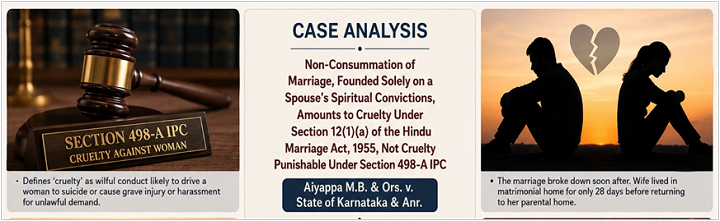
IMPORTANT PROVISIONS
- Section 498-A, Penal Code, 1860,Husband or relative of husband of a woman subjecting her to cruelty (defines ‘cruelty’ as (i) wilful conduct likely to drive a woman to suicide or cause grave injury/danger to life, limb or health, whether mental or physical; or (ii) harassment to coerce her, or her relatives, into meeting an unlawful demand).
- Section 34, Penal Code, 1860,Acts done by several persons in furtherance of common intention.
- Section 4, Dowry Prohibition Act, 1961,Penalty for demanding dowry.
- Section 12(1)(a), Hindu Marriage Act, 1955,Voidable marriages; a marriage may be annulled where its consummation is rendered impossible by reason of the impotence, incapacity, or in judicial interpretation, the persistent and unjustified refusal of a spouse to consummate it, treated as a species of cruelty for matrimonial relief.
- Section 482, Code of Criminal Procedure, 1973,Inherent powers of the High Court to prevent abuse of the process of court and to secure the ends of justice, including quashing of criminal proceedings.
OVERVIEW
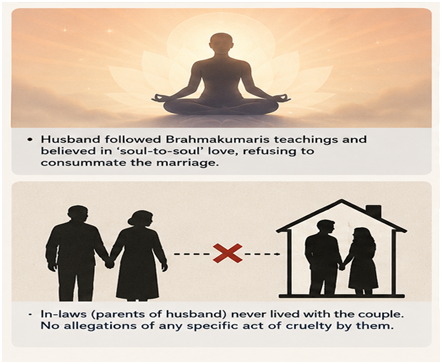
The petitioners, the husband and his parents, approached the Karnataka High Court under Section 482 CrPC seeking quashment of a criminal complaint and the consequent charge-sheet registered against them under Section 498-A read with Section 34 IPC and Section 4 of the Dowry Prohibition Act, 1961. The parties were married in December 2019. The marriage broke down almost immediately, and the wife resided in the matrimonial home for barely 28 days before returning to her parental home. In February 2020, she lodged a criminal complaint alleging cruelty and dowry harassment. Simultaneously, she filed a petition under Section 12(1)(a) of the Hindu Marriage Act seeking annulment of the marriage on the ground of cruelty, asserting that the husband,who was inclined towards the teachings of the Brahmakumaris and believed in ‘soul-to-soul’ rather than physical love,had persistently refused to consummate the marriage.
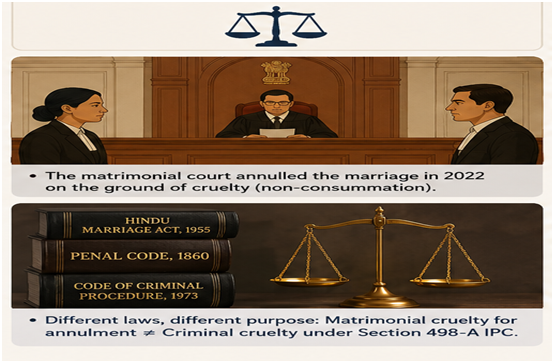
The matrimonial court eventually annulled the marriage in 2022, a decree the husband did not contest. However, the criminal proceedings under Section 498-A IPC and the Dowry Prohibition Act continued independently, prompting the petitioners to invoke the High Court’s inherent jurisdiction to quash them. The core question before the Court was whether the same set of facts, non-consummation of marriage owing to the husband’s spiritual beliefs, which had already been treated as ‘cruelty’ sufficient to annul the marriage under the Hindu Marriage Act, could simultaneously sustain a criminal prosecution for ‘cruelty’ under Section 498-A IPC.
Master Complete Hindu Laws / Family Laws Course. Enroll Now!
ISSUES RAISED
- Whether non-consummation of marriage, attributable to a spouse’s spiritual or religious conviction, by itself discloses the statutory ingredients of ‘cruelty’ under Section 498-A IPC.
- Whether the complaint and the summary of the charge-sheet disclosed any specific act of wilful conduct likely to drive the wife to suicide/grave injury, or harassment linked to an unlawful demand, as contemplated under Section 498-A IPC.
- Whether criminal proceedings under Section 498-A IPC and the Dowry Prohibition Act could be sustained against the husband’s parents, who admittedly never resided with the couple.
- Whether continuation of the criminal proceedings, once the marriage stood annulled on the very same ground of ‘cruelty’ under the Hindu Marriage Act, would amount to an abuse of the process of the court warranting exercise of inherent power under Section 482 CrPC.
ARGUMENTS ADVANCED BY THE PETITIONERS (HUSBAND AND IN-LAWS)
Counsel for the petitioners, Mr. M.R.C. Manohar, contended that the allegations in the complaint and the charge-sheet, even if taken at face value, did not satisfy any of the statutory ingredients of Section 498-A IPC. It was submitted that the wife had cohabited with the husband for a mere 28 days, and the singular grievance running through the complaint was the husband’s unwillingness to consummate the marriage owing to his spiritual leanings towards the Brahmakumari philosophy, a matter that, at best, constituted a ground for matrimonial relief and not a criminal offence. It was further argued that the husband’s parents had been arraigned as accused without any specific or particularized allegation of cruelty or dowry demand attributable to them individually, and that they had never resided with the couple, rendering their prosecution wholly unjustified and an instance of the routine, indiscriminate implication of in-laws that Indian courts have repeatedly cautioned against.
ARGUMENTS ADVANCED BY THE RESPONDENTS (STATE AND COMPLAINANT-WIFE)
The State, represented by the High Court Government Pleader, and the complainant, represented by Mr. K.S. Karthik Kiran, opposed the quashment petition. It was contended that the husband’s parents had actively facilitated and encouraged the marriage despite being aware of their son’s spiritual inclinations and disinterest in consummating the marriage, and had thereby contributed to the wife’s ordeal. It was urged that since parallel proceedings, the criminal complaint under Section 498-A IPC and the matrimonial petition under Section 12(1)(a) of the Hindu Marriage Act, were both premised on the husband’s conduct, the criminal case ought to be allowed to proceed to trial rather than being short-circuited at the threshold, and that the truth of the rival contentions was a matter for evidence, not for a Section 482 CrPC petition.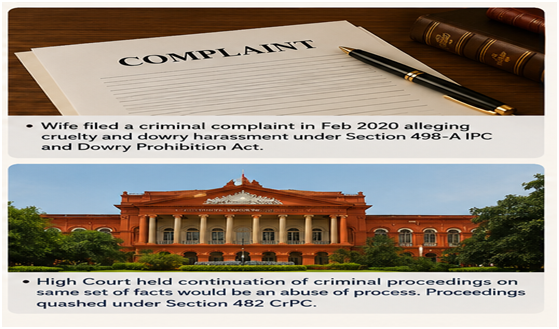
JUDGMENT ANALYSIS
Justice M. Nagaprasanna undertook a bifurcated analysis, examining the case against the husband separately from the case against his parents.
On the husband: The Court held that Section 498-A IPC comprises two independent limbs of ‘cruelty’, first, wilful conduct of a nature likely to drive a woman to commit suicide or to cause grave injury or danger to her life, limb or health (whether mental or physical); and second, harassment intended to coerce her, or a person related to her, into meeting an unlawful demand. Scrutinising the complaint and the summary charge-sheet, the Court found that neither document disclosed any specific incident answering to either limb. The sole substantive allegation was that the husband, under the influence of Brahmakumari teachings, believed in a ‘soul-to-soul’ union and declined to physically consummate the marriage. The Court held that such conduct,however unusual or distressing to the wife, squarely fell within the conception of ‘cruelty’ recognised under Section 12(1)(a) of the Hindu Marriage Act, 1955 as a ground for annulment, and not within the penal conception of cruelty under Section 498-A IPC, which demands conduct of a distinctly more aggravated character.
The Court was categorical that mere non-consummation of marriage, without more, cannot be elevated into a criminal offence by merely invoking the language of Section 498-A. It observed that permitting the proceedings to continue on such a foundation would degenerate into harassment of the husband, amount to an abuse of the process of the court, and ultimately result in a miscarriage of justice, particularly where the wife herself had already obtained, and the husband had not contested, a decree of annulment on the identical factual matrix under matrimonial law.
On the in-laws: The Court noted that it was an admitted position that the husband’s parents never resided with the couple during the subsistence of the marriage. The allegations against them, of having engineered the marriage and of demanding dowry,were found to be general, unparticularized, and omnibus in nature, unsupported by any specific instance of cruelty or unlawful demand attributable to them. Relying on the Supreme Court’s decision in Kahkashan Kausar v. State of Bihar, (2022) 6 SCC 599,which cautions against the mechanical and undiscriminating implication of a husband’s relatives in matrimonial complaints absent specific, particularized allegations, the Court held that continuation of proceedings against the parents would equally constitute an abuse of process.
Accordingly, the Court allowed the petition in its entirety and quashed the criminal proceedings,including the FIR, the charge-sheet, and all consequent proceedings, against the husband as well as his parents, arising out of the complaint registered under Section 498-A read with Section 34 IPC and Section 4 of the Dowry Prohibition Act, 1961.
CONCLUSION
The judgment draws a doctrinally significant line between civil/matrimonial cruelty and criminal cruelty. It reaffirms that Section 498-A IPC, being a penal provision that visits an accused with imprisonment, cannot be construed so expansively as to criminalise every instance of matrimonial discord, incompatibility, or a spouse’s personal or spiritual choices that a court, sitting in its matrimonial jurisdiction, may independently recognise as a ground for divorce or annulment. The ruling operates as a caution against the conflation of remedies, a fact situation sufficient for civil relief under the Hindu Marriage Act does not automatically translate into an offence under the IPC unless its specific statutory ingredients are independently made out on the face of the complaint and the charge-sheet. The decision also reinforces the Supreme Court’s consistent jurisprudence (traceable through Kahkashan Kausar and its predecessors) discouraging the indiscriminate arraignment of in-laws in matrimonial cruelty complaints in the absence of specific, particularized allegations.
LAWYER’S INSIGHT - Pratham Kindra
The following is a practitioner’s perspective on the judgment and is offered as illustrative professional commentary rather than an authoritative or verbatim statement of any named advocate.
“This order is a useful, if modest, corrective to a recurring pattern in matrimonial litigation before Indian courts, the tendency to treat Section 498-A IPC as an all-purpose remedy for every species of marital unhappiness. Justice Nagaprasanna’s reasoning is sound because it takes the statutory text of Section 498-A seriously: the provision was designed to address conduct of a particular gravity, conduct that endangers life, limb, or mental health, or that is coercive in furtherance of an unlawful demand. Sexual incompatibility or a spouse’s deeply held personal or spiritual convictions, however painful their consequences for the other partner, do not automatically rise to that threshold merely because the aggrieved party frames them in the vocabulary of ‘cruelty.’
“What practitioners should take from this ruling is a drafting and strategic lesson as much as a substantive one. For complainants, it underscores that a Section 498-A complaint must be built on particularized, specific instances of conduct, vague or omnibus allegations, or allegations that merely restate a matrimonial grievance in criminal-sounding language, invite quashment at the threshold. For defence counsel representing husbands and in-laws, this judgment, read alongside Kahkashan Kausar, remains a valuable precedent to argue for quashment where relatives who never cohabited with the couple are roped in without specific particulars. At the same time, the decision should not be over-read: it does not hold that non-consummation can never form part of a cruelty case under Section 498-A; it holds only that, on these facts, absent any other aggravating conduct, the threshold was not met. Courts will continue to examine each complaint on its own particulars.”