CASE TITLE:
Md Sarif Anwar @ Shareef Anwar v. Noorjahan Khatoon @ Noorjahan Khatun
DATE OF ORDER:
31st August, 2026
BENCH:
Hon'ble Mr. Justice Bibek Chaudhuri and Hon'ble Mr. Justice Rana Vikram Singh
PARTIES:
Appellant: Md Sarif Anwar @ Shareef Anwar (husband)
Respondent: Noorjahan Khatoon @ Noorjahan Khatun (wife)
SUBJECT
The judgment deals with the scope and content of a Muslim husband's right to dissolve his marriage under uncodified Mahomedan personal law, and clarifies the interplay between the husband's extra-judicial right of Talaq, the different recognised modes of pronouncing Talaq, and the constitutional invalidation of instant triple talaq (Talaq-i-bidaat) by the Supreme Court in Shayara Bano v. Union of India. The Division Bench was called upon to decide whether a husband seeking a formal decree of divorce from a Family Court is obliged to plead and prove a specific matrimonial ground such as cruelty or desertion, or whether the unilateral, extra-judicial character of Talaq under Muslim law dispenses with any such requirement, subject only to the bar on Talaq-i-bidaat.
IMPORTANT PROVISIONS
- Dissolution of Muslim Marriages Act, 1939 - Section 2 (grounds available to a Muslim wife for judicial divorce)
- Muslim Women (Protection of Rights on Marriage) Act, 2019 (statutory bar on pronouncement of Talaq-i-bidaat, enacted post Shayara Bano)
- Mulla's Principles of Mahomedan Law, 19th Edn., Reprint 2021 - Chapter XVI (modes of dissolution of a Muslim marriage)
- Family Courts Act, 1984 (jurisdiction of the Family Court in matrimonial proceedings)
- Article 141 of the Constitution of India (binding nature of the law declared in Shayara Bano v. Union of India)
OVERVIEW
The judgment must be read against the backdrop of a decade-long shift in the law governing Talaq in India. In Shamim Ara v. State of U.P., the Supreme Court had earlier held that the mere existence of a Talaqnama, or the assertion of divorce in the written statement of a matrimonial proceeding, does not by itself prove that a valid Talaq was pronounced; the factum of pronouncement, according to that line of authority, must be established by cogent evidence, and an unproved or arbitrary pronouncement cannot dissolve the marriage. Subsequently, in Shayara Bano v. Union of India, a majority of a five-judge Constitution Bench declared the practice of instant triple talaq, or Talaq-i-bidaat, to be unconstitutional and violative of Article 14, being manifestly arbitrary. Parliament thereafter enacted the Muslim Women (Protection of Rights on Marriage) Act, 2019, which criminalises the pronouncement of Talaq-i-bidaat. It is against this evolving matrix - proof of pronouncement on one hand, and the constitutional invalidity of the instantaneous triple-talaq form on the other - that the Patna High Court was called upon to examine the appellant's claim of divorce by successive pronouncements of Talak.
The marriage between the appellant, Md Sarif Anwar, and the respondent, Noorjahan Khatoon, was solemnised on 7th April, 1999 in accordance with Muslim rites and rituals. According to the appellant's case, the respondent began treating him with cruelty and left the matrimonial home permanently on 14th October, 2008 to reside with her parents. Despite the appellant's efforts at reconciliation, the respondent refused to return and expressed a desire that the marriage be dissolved by a decree of divorce. The appellant thereafter claims to have divorced the respondent through successive pronouncements of Talak and, upon this basis, instituted M.M. Case No. 53 of 2021 before the Principal Judge, Family Court, Madhubani, seeking a formal decree of divorce.
The respondent did not appear despite due service of summons, and the matter proceeded ex parte before the Family Court. Evidence on record indicated that the respondent was, by that stage, residing in Bangalore, having contracted a second marriage, while the appellant too had remarried following his pronouncement of Talak. The Family Court examined the Supreme Court's decision in Shayara Bano v. Union of India, (2017) 9 SCC 2, which struck down the practice of instantaneous triple talaq as unconstitutional, and concluded that the appellant had not validly divorced the respondent in accordance with law. Consequently, the Family Court dismissed the divorce suit.
Aggrieved, the appellant preferred the present Miscellaneous Appeal before the Patna High Court. The respondent, once again, did not enter appearance despite service of notice, and the appeal was heard and decided without any contest from her side.
ISSUES RAISED
- Whether a Muslim husband seeking a decree of divorce is required to plead and prove a specific matrimonial ground, such as cruelty or desertion, before a civil or Family Court?
- Whether the successive pronouncements of Talak relied upon by the appellant amounted to Talak-i-bidaat (instant triple talaq), which stands declared unconstitutional by the Supreme Court in Shayara Bano, or whether they could be treated as a valid and complete mode of divorce recognised under Muslim law?
- Whether the Family Court was justified in dismissing the appellant's suit for a decree of divorce on the footing that the divorce had not been validly effected in accordance with law?
ARGUMENTS ADVANCED BY THE APPELLANT
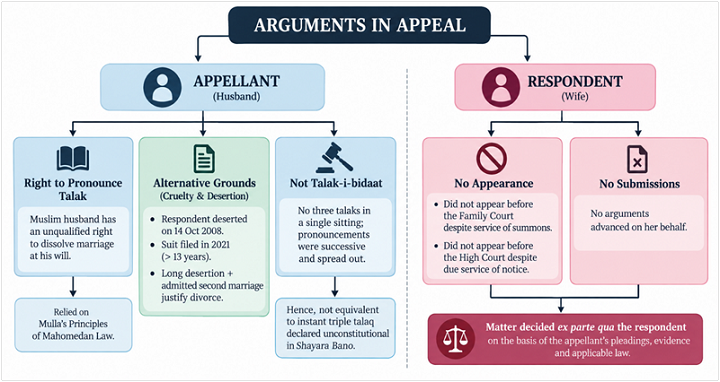
Learned counsel for the appellant placed reliance on the principles of Mahomedan Law as codified in Mulla's Principles of Mahomedan Law, contending that a Muslim husband possesses an unqualified right to dissolve his marriage at his own will, without the intervention of any court, and that no specific ground or cause need be established for the exercise of this right. It was submitted that the appellant had validly exercised this right by pronouncing Talak upon the respondent after she deserted him and refused all attempts at reconciliation.
In the alternative, and without prejudice to the plea founded on Talak, it was argued on behalf of the appellant that the suit for divorce could also be sustained independently on the grounds of cruelty and desertion. Counsel pointed out that the respondent had deserted the matrimonial home as far back as 14th October, 2008, and that the appellant had approached the Family Court only in 2021, after the statutory period of desertion had been satisfied several times over, being a gap of more than thirteen years. It was urged that this long, uninterrupted desertion, coupled with the respondent's admitted second marriage, ought to have persuaded the Family Court to grant a decree of divorce even independent of the question of Talak.
The appellant further contended that his case did not fall within the mischief of Talak-i-bidaat, since he had not claimed to have pronounced three talaks in a single sitting; rather, his pronouncements were successive and spread out, and therefore, according to the appellant, ought not to be equated with the form of instant triple talaq that was declared unconstitutional in Shayara Bano.
ARGUMENTS ADVANCED BY THE RESPONDENT
The respondent did not appear before the Family Court despite service of summons, nor did she enter appearance before the High Court in the present appeal despite due service of notice. Consequently, no submissions were advanced on her behalf, and both the Family Court and the High Court proceeded to decide the matter ex parte qua the respondent, on the basis of the appellant's own pleadings and evidence and the applicable law.
JUDGEMENT ANALYSIS
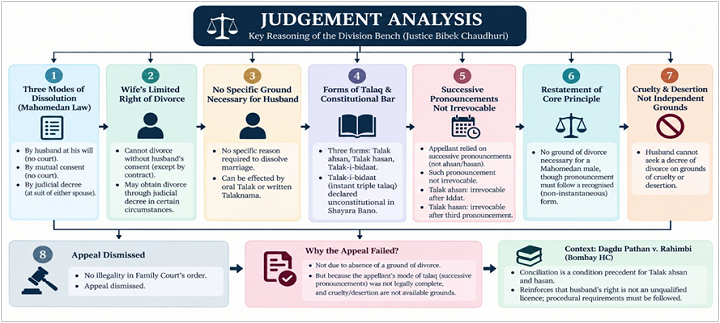
The Division Bench, speaking through Justice Bibek Chaudhuri, undertook a structured examination of the modes of dissolution of a Muslim marriage before applying them to the facts at hand. The reasoning proceeds thematically as follows:
1. The Three Modes of Dissolution Recognised Under Mahomedan Law
The Court referred to Chapter XVI of Mulla's Principles of Mahomedan Law (19th Edition, Reprint 2021) to set out the three recognised modes by which a marriage under Mahomedan Law can be dissolved by the husband: first, by the husband at his will, without the intervention of a court; second, by mutual consent of the husband and wife, again without court intervention; and third, by a judicial decree at the suit of either the husband or the wife.
2. The Wife's Comparatively Limited Right of Divorce
The Bench clarified the corresponding, more limited position of the wife, noting that she cannot divorce her husband without his consent except under a contract entered into before or after marriage, though she may, in certain circumstances, obtain a divorce through a judicial decree.
3. No Specific Ground Necessary for Divorce by the Husband
This paragraph is pivotal to the Court's reasoning. Having noted that the grounds available to a Muslim wife for a judicial decree of dissolution are separately codified under Section 2 of the Dissolution of Muslim Marriages Act, 1939, the Bench recorded, relying on Mulla, that no specific reason for divorce is necessary for dissolution of marriage by the husband, and that such dissolution can be effected either by an oral pronouncement of Talak or through a written Talaknama. The paragraph draws out the essential asymmetry in classical Muslim law between the husband's extra-judicial, will-based right of divorce and the wife's comparatively circumscribed, ground-based right of judicial divorce.
4. Classification of Talaq and the Constitutional Bar on Talaq-i-Bidaat
The Court turned to the classification of Talak into three recognised forms: Talak ahsan, Talak hasan, and Talak-ul-bidaat or Talak-i-badai, the last being characterised by three successive pronouncements of Talak. The Bench recorded that Talak-i-badai stands declared unconstitutional by the Supreme Court in Shayara Bano v. Union of India.
5. Successive Pronouncements of Talaq Held Not Irrevocable
Significantly, the Bench observed that it was not the appellant's case that he had pronounced Talak by way of Talak ahsan or Talak hasan; his case rested squarely on successive pronouncements of Talak. On this footing, the Court held that a declaration of divorce made by successive pronouncement of Talak, without following the ahsan or hasan procedure, cannot be treated as irrevocable. The Bench supplied the doctrinal explanation for this conclusion: a Talak ahsan becomes irrevocable and complete only upon the expiry of the Iddat period, while a Talak hasan becomes irrevocable and complete upon the third pronouncement, irrespective of Iddat. Since the appellant's pronouncements fitted neither of these structured, time-bound procedures, the divorce claimed by him could not be said to have attained finality or irrevocability in law.
6. Restatement of the Core Principle - No Ground of Divorce Necessary
Having thus disposed of the specific question of whether the appellant's Talak was legally complete, the Bench restated the broader principle with which the analysis had begun: in order to dissolve a marriage by a Mahomedan male, no ground of divorce is necessary. This paragraph operates as the ratio on the first issue framed above - it affirms that the husband's right to pronounce Talak is not contingent upon establishing fault, cruelty, or any other cause, even while implicitly underscoring that the manner of pronouncement must still conform to one of the recognised, non-instantaneous forms of Talak recognised in law.
7. Rejection of Cruelty and Desertion as Independent Grounds
The Court directly addressed the appellant's alternative submission founded on cruelty and desertion, holding that the argument advanced by his counsel was misconceived, since a husband cannot dissolve a Muslim marriage through a decree of divorce on the ground of cruelty or desertion. This finding forecloses any attempt to import fault-based, decree-oriented grounds of divorce (of the kind ordinarily associated with codified matrimonial statutes) into the husband's right of Talak under Muslim personal law, which operates on an altogether different, extra-judicial and will-based footing.
8. Dismissal of the Appeal
On this reasoning, the Bench concluded that no illegality could be found in the order of the Family Court dismissing the appellant's suit, and the appeal was accordingly dismissed. Read as a whole, the judgment does not disturb the outcome reached by the Family Court, but it meaningfully clarifies the analytical route by which that outcome is to be reached: the husband's suit did not fail because a ground of divorce was required and had not been proved; it failed because the mode of Talak pleaded by him, being neither Talak ahsan nor Talak hasan, had not attained the irrevocability necessary to constitute a completed and legally recognised divorce, and because cruelty and desertion are, in any event, not independent grounds available to a Muslim husband for a decree of divorce.
It is also worth situating the present decision alongside the Bombay High Court's earlier ruling in Dagdu Pathan v. Rahimbi, where a Full Bench had held that conciliation between the spouses, through arbitrators appointed from each side, is a condition precedent to the effective pronouncement of Talaq in its ahsan and hasan forms, and that a husband cannot repudiate the marriage entirely at will without following that process. The Patna High Court's judgment does not directly engage with this conciliation requirement, since the appellant's case did not rest on Talak ahsan or Talak hasan in the first place; the Bench's finding was confined to holding that, absent a claim of either of these two structured forms, the appellant's successive pronouncements could not be treated as irrevocable. Read together, the two lines of authority suggest that the extra-judicial character of Talaq recognised by Mulla is not an unqualified licence: the mode of pronouncement chosen by the husband still has to satisfy the specific procedural markers - whether that be the Iddat-linked irrevocability of Talak ahsan, the third-pronouncement irrevocability of Talak hasan, or, on some authorities, prior conciliation - failing which the claimed divorce will not be recognised as legally complete, whatever the underlying cause for the estrangement between the parties.
PRACTITIONER'S PERSPECTIVE
From a practitioner's perspective, practising at Delhi High Court says that this judgement is significant because it draws a clear distinction between the right to seek dissolution and the validity of the mode adopted to dissolve the marriage. The Court reaffirmed that a Muslim husband need not plead or prove a specific matrimonial ground such as cruelty or desertion to exercise his right of Talaq. However, this does not mean that a mere assertion of Talaq is sufficient to establish a legally completed divorce.
The judgment therefore places considerable importance on identifying the precise form of Talaq and demonstrating compliance with its procedural requirements. In the present case, the appellant relied upon successive pronouncements but did not establish that they constituted either Talaq ahsan or Talaq hasan. Consequently, the pronouncements could not be treated as having attained the necessary irrevocability.
For practitioners, the decision is also a reminder that cruelty and desertion cannot simply be added as alternative grounds for obtaining a decree of divorce by a Muslim husband. The safer approach in litigation is therefore to plead the exact mode of Talaq, set out the relevant pronouncements and establish the procedural steps necessary for that mode to become legally effective.
In short, the judgment teaches an important drafting and litigation lesson: while a specific “cause” may not be necessary for Talaq, a legally recognised “method” is.
RELATED LAWYERSCLUBINDIA COURSE
Readers interested in exploring the legal principles behind this judgment can refer to LAWyersClubIndia's “Muslim Laws – Indian Judiciary Special Course” by Adv. Uday Singh Rathore. The course is particularly relevant for understanding the broader framework of Muslim Personal Law, Nikah, Talaq and the functioning of these principles within the Indian judicial system.
For law students and young practitioners, the course provides useful background for understanding judgments such as Md Sarif Anwar v. Noorjahan Khatoon, where traditional Muslim personal law principles intersect with judicial interpretation and constitutional limitations.
Read more about it: https://www.lawyersclubindia.com/learning/muslim-laws-indian-judiciary-special-course-63.asp.
CONCLUSION
The decision in Md Sarif Anwar v. Noorjahan Khatoon is a useful reaffirmation of two related but distinct propositions of Muslim personal law. First, consistent with Mulla's Principles of Mahomedan Law, a Muslim husband's right to dissolve his marriage by Talak remains, in substance, a unilateral and extra-judicial right exercisable at his will, for which no specific cause such as cruelty or desertion needs to be pleaded or proved before a court; those fault-based grounds belong to the separate statutory scheme governing a wife's judicial divorce under the Dissolution of Muslim Marriages Act, 1939, and cannot be transplanted into a husband's claim for a decree recognising his Talak.
Second, and equally important in the post-Shayara Bano landscape, the judgment illustrates that not every claim of successive pronouncements of Talak will be treated as complete or irrevocable merely because it is not instant triple talaq. Where a husband's own case does not bring his pronouncement within the structured, time-bound procedures of Talak ahsan or Talak hasan, the pronouncement cannot automatically be treated as irrevocable, and a Family Court is entitled to decline to record a formal decree on that basis. The Patna High Court's approach therefore steers a careful middle path: it neither imports a fault-based requirement into the husband's right of Talak, nor does it treat every assertion of successive Talak as automatically valid, thereby preserving both the constitutional prohibition on Talak-i-bidaat laid down in Shayara Bano and the settled uncodified principles governing the ahsan and hasan forms of divorce recognised under Mahomedan Law.