Date of Order:
20 August 2026
Bench:
Surya Kant, CJI; B.V. Nagarathna, P.S. Narasimha, Dipankar Datta, Ujjal Bhuyan, Satish Chandra Sharma, Joymalya Bagchi, Alok Aradhe and Vipul M. Pancholi, JJ.
Opinions:
(i) Surya Kant, CJI (for himself, Sharma, Aradhe and Pancholi, JJ.); (ii) Narasimha, J.; (iii) Nagarathna, J.; (iv) Datta, J. (for himself and Bhuyan, J.); (v) Bagchi, J.
Parties:
Appellant: State of Uttar Pradesh (Social Forestry Department) along with the employer-side appellants in the connected matters. Respondent: Jai Bir Singh and the workmen in the connected matters.
Counsel (as reported):
R. Venkataramani, Attorney General; K.M. Nataraj, ASG; Senior Advocates Shekhar Naphade, Indira Jaising, C.U. Singh and Sanjay Hegde
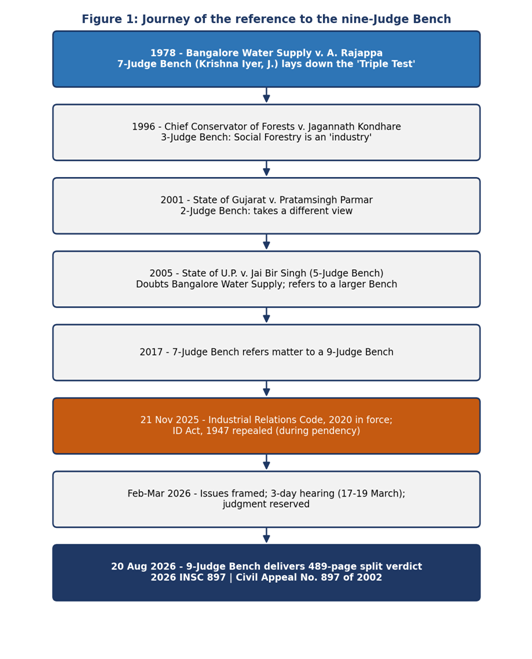
SUBJECT
1.Labour law: the meaning of ‘industry’ in Section 2(j) of the Industrial Disputes Act, 1947 (the ID Act), and whether the ‘Triple Test’ of Bangalore Water Supply needs to be reconsidered. The Bench also dealt with the sovereign-functions exception, the position of government welfare schemes, and the effect of the repeal of the ID Act by the Industrial Relations Code, 2020 (the IR Code).
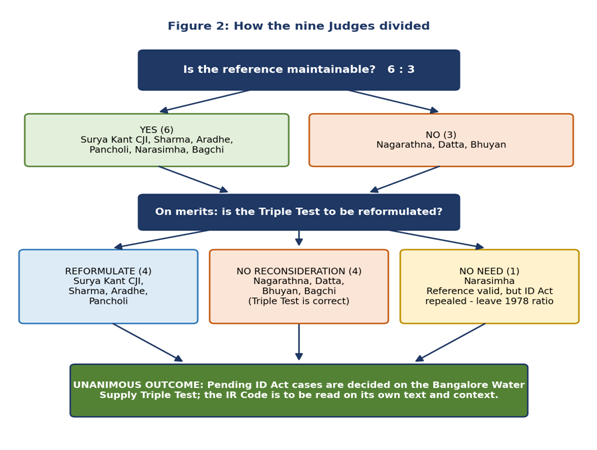
2.The definition is the gateway to the ID Act. In 1978 the seven-Judge Bench gave it a wide, functional reading that brought hospitals, educational institutions, clubs and government welfare departments within the Act (R7, R8). This reference decided whether that reading would survive.
3.The ruling appears in the LiveLaw Quarterly Digest for July-September 2026 (Administrative, Labour & Service Laws) as a cluster of headnotes on the definition of industry, the reformulated test, the sovereign-functions exception, the reference procedure and the effect of the IR Code.
IMPORTANT PROVISIONS
4.Section 2(j), Industrial Disputes Act, 1947: the definition of ‘industry’. The reference turned on its scope. The Act was repealed with effect from 21.11.2025.
5.Section 2(p), Industrial Relations Code, 2020: the replacement definition. The Bench held that it must be read on its own text and context and not through the repealed Section 2(j) case law.
6.Industrial Disputes (Amendment) Act, 1982 (Act 46 of 1982): a legislative attempt to restate the definition that was never notified. It was cited by the appellants as evidence of legislative intent and by the respondents as evidence of legislative acquiescence.
7.Articles 14, 38, 39 and 43 of the Constitution: relied on by Bagchi, J. to hold that a blanket exclusion of government welfare departments from Section 2(j) offends equality and the Directive Principles on social justice and workers’ welfare.
8.Articles 310 and 311: the constitutional framework for civil servants. The Chief Justice’s opinion treats functions governed by these articles as lying outside Section 2(j), as they lack an analogy to trade or commerce.
9.Article 145(5): concurrence of a majority of Judges, invoked by Datta, J. on when a smaller Bench may question a larger Bench.
OVERVIEW
10.The dispute began over whether the Social Forestry Department of the State of Uttar Pradesh is an ‘industry’. In 1996 a three-Judge Bench held that it is, relying on Bangalore Water Supply. In 2001 a two-Judge Bench took a different view. A five-Judge Bench in 2005 noticed the conflict and referred Bangalore Water Supply itself for reconsideration. In 2017 a seven-Judge Bench passed the matter on to nine Judges.
11.The nine-Judge Bench heard the matter over three days in March 2026 and reserved judgment on 19 March 2026. In the meantime the ID Act was repealed and replaced by the IR Code on 21.11.2025. Judgment was delivered on 20 August 2026 in five separate opinions.
12.The result is a fractured decision. On maintainability, six Judges upheld the reference and three rejected it. On merits, four Judges proposed refining the Triple Test, four held that Bangalore Water Supply needed no reconsideration, and Narasimha, J. found it unnecessary to disturb the 1978 ratio because the Act stands repealed.
13.All nine Judges converged on the practical outcome. Pending disputes under the repealed ID Act continue to be decided on the Triple Test as laid down in 1978, and the IR Code definition is to be interpreted afresh.
ISSUES RAISED
14.Four questions were framed in the Chief Justice’s opinion (R7):
- Whether the Triple Test laid down in Bangalore Water Supply is correct in law.
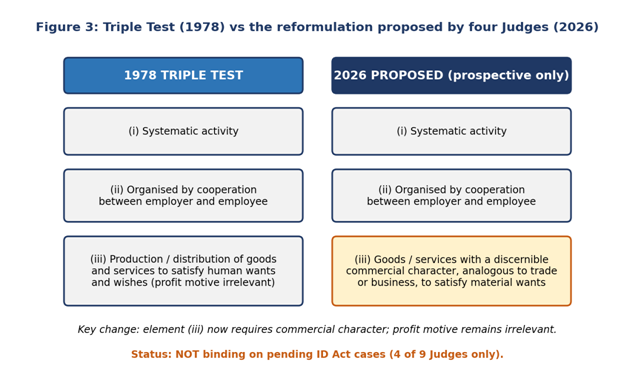
- Whether the 1982 Amendment Act and the IR Code have any legal impact on the interpretation of ‘industry’ in the 1947 Act.
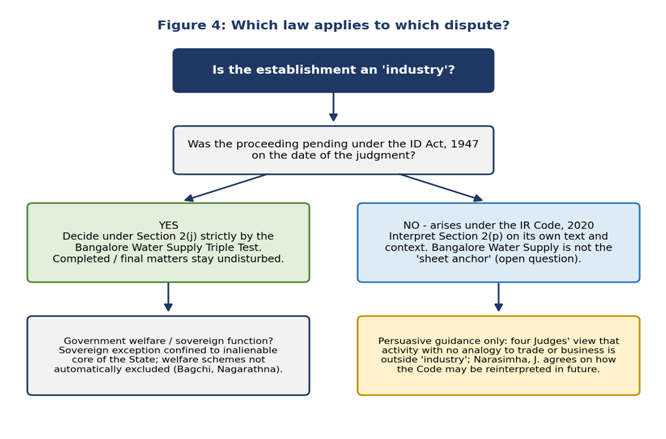
- Whether social welfare activities and schemes of government departments or their instrumentalities can be industrial activities under Section 2(j).
- What the sovereign functions of the State are that fall outside Section 2(j).
15.Preliminary issues were also argued: whether the reference was maintainable at all, given the objections based on res judicata, stare decisis and judicial discipline; whether a five-Judge Bench could validly doubt a seven-Judge Bench; and whether the conflict between Kondhare and Parmar was a real conflict of law or merely a factual distinction.
16.A consequential issue arose from the repeal: whether the Court should still answer the reference, and what rule should govern the many disputes pending under the repealed Act.
ARGUMENTS ADVANCED BY THE APPELLANT
17.The State and the Union, led by the Attorney General, along with employer-side parties, argued that the Triple Test had become over-inclusive. Their core submission was that the test brought within the ID Act welfare, charitable and governmental activities that were never meant to be ‘industries’.
18.They urged that ‘commercial character’ be treated as a dominant factor, so that an activity qualifies only if it is analogous to trade or business. On this view the 1978 decision had shifted attention almost wholly to the presence of an employer-employee relationship, and the nature of the activity had receded.
19.They relied on the unnotified 1982 Amendment and on the definition in the IR Code as signs of legislative intent to narrow the scope of the term.
20.They pointed to the history of conflicting decisions, which showed that the definition was causing practical difficulty, and argued that a nine-Judge Bench was needed to bring certainty to the law. On maintainability they maintained that the reference was validly made.
ARGUMENTS ADVANCED BY THE RESPONDENT
21.The workmen, represented among others by Ms. Indira Jaising and Mr. C.U. Singh, Senior Advocates, argued that Bangalore Water Supply was correct law and should not be reopened. It had held the field for almost fifty years, and legislatures and executives had ample opportunity to amend the definition but did not do so.
22.They argued that the Triple Test protects millions of workers in hospitals, schools and government departments, and that narrowing the definition, particularly after the repeal of the Act, would cause hardship and unsettle accrued rights.
23.On maintainability they objected that there was no real conflict to justify a reference. Parmar had distinguished Kondhare on the evidence in the affidavits, so the reference rested on a factual difference and not on a difference of law. They also relied on res judicata and stare decisis.
24.The Bench also noted, in the course of the hearing, that the Preamble to the ID Act is directed at the settlement of disputes and industrial peace, which suggests that a narrow definition could leave out human activities the Act was meant to cover.
JUDGEMENT ANALYSIS
A. Maintainability of the reference (6 : 3)
25.Six Judges (Surya Kant CJI, Sharma, Aradhe, Pancholi, Narasimha and Bagchi) held that the reference was validly made and rightly entertained. Narasimha, J. found the effort of the post-1978 decisions to bring certainty to be justified, and Bagchi, J. held that the manner of reference conformed to Dawoodi Bohra, though he left the ‘substance test’ as a matter of judicial opinion.
26.Narasimha, J. rejected the preliminary objection on res judicata and stare decisis. Res judicata applies to determinations between parties arising from a specific cause of action, not to pure questions of law or to the reference of precedents. A five-Judge Bench, being stronger than a three-Judge Bench, could properly refer its doubts to the Chief Justice for placing before a larger Bench (Paras 90-96, 110-138, as cited in the digest).
27.Nagarathna, J. and Datta, J. (with Bhuyan, J.) held the reference unjustified. Datta, J. accepted the objection that Parmar had only distinguished Kondhare on affidavit evidence, leaving no conflict. Applying the tests of Kesoram Industries and the ‘substance’ test, he found that the reference served no practical or doctrinal purpose. He also held that a Bench of lesser strength cannot question the soundness of a decision of a larger Bench merely because later opinions diverge.
B. Opinion of Surya Kant, CJI (for himself, Sharma, Aradhe and Pancholi, JJ.)
28.The Chief Justice held that the core framework of the Triple Test has stood the test of time but needs calibration. The 1978 decision had erred by discarding the rule of noscitur a sociis altogether, producing an over-expansive reading that detached ‘industry’ from its commercial and economic roots (Paras 216-220, 230-236, 246-250, 274-278).
29.The reformulated test requires (a) a systematic activity, (b) organised through cooperation between employer and employee, and (c) the production, distribution or provision of goods or services with a discernible commercial character analogous to trade or business, to satisfy material human wants. Absence of profit motive stays irrelevant.
30.On government activity, the opinion holds that welfare schemes undertaken to further Parts III and IV of the Constitution are not automatically industries merely because they involve organised employment. Departments are to be judged by substance and function. Functions governed by Articles 310 and 311, or lacking any analogy to trade, fall outside Section 2(j), while public utility services and severable commercial-type units within departments remain covered (Paras 261-287).
31.The reformulation is expressly limited. It is stated to be the Court’s considered opinion for future guidance and operates only prospectively. All matters pending under the ID Act, and in particular those before Labour Courts, Tribunals, High Courts and the Supreme Court, are to be decided on the Triple Test as laid down in 1978, and final determinations are not to be reopened. The opinion also declines to examine the IR Code definition or the 1982 Amendment.
C. Opinion of Nagarathna, J.
32.Nagarathna, J. held that reconsideration was wholly unnecessary and gave ten reasons for upholding Bangalore Water Supply. She held that the five-Judge Bench had treated a factual distinction between Kondhare and Parmar as a legal conflict, and could have reconciled them or overruled one of them, instead of choosing a third path of questioning the seven-Judge Bench (Paras 1.1-1.4, 3, 4, 12.1-19.8, as cited in the digest).
33.On merits she held that the Krishna Iyer test is correct law, that the 1982 Amendment and the IR Code have no legal impact on reading Section 2(j), and that government welfare activities may be industrial depending on their nature, since the government character of an activity does not by itself exclude it. She stressed that, after the post-1991 shift to liberalisation, privatisation and globalisation, a broad definition remains vital to protect workers with weak bargaining power.
D. Opinion of Datta, J. (for himself and Bhuyan, J.)
34.Datta, J. held that Bangalore Water Supply had become settled law through decades of reliance and does not require reconsideration, even assuming the reference was proper. He added that, with the ID Act repealed, the rights of workmen in pending legacy proceedings cannot be unsettled by rewriting or reading down the 1978 decision under the label of calibration. Pending matters under the repealed Act are to be concluded under the law that applied before the IR Code came into force, without prejudice to any challenge to the new Code.
E. Opinion of Bagchi, J.
35.Bagchi, J. agreed with the majority that the reference was valid, but could not accept the Chief Justice’s reformulation on merits. He agreed instead with Nagarathna and Datta, JJ. that the original Triple Test correctly marks the scope of ‘industry’.
36.He wrote separately on sovereign functions. A blanket exclusion of government welfare departments and schemes is unconstitutional under Article 14, because a gardener, driver, clerk or maintenance employee does not do a different kind of work merely because the State pays the wages. The sovereign-functions exception must stay confined to the core of Statehood, such as defence, foreign affairs, coinage, administration of justice and legislation, and extending it to socio-economic welfare schemes would strike hardest at daily-rated and precarious workers.
F. Opinion of Narasimha, J.
37.Narasimha, J. agreed that the reference was valid and could be answered on merits, but held that an authoritative determination, compelling at the time of reference, had become unnecessary after the repeal of Section 2(j) on 21.11.2025. He held that the ratio of Bangalore Water Supply is now confined to cases arising under the repealed Act (R7).
38.His reasoning is practical. Modifying or restricting the 1978 ratio would exclude certain entities from the Act and push long-pending disputes into civil courts. It is prudent to dispose of pending cases on the 1978 ratio without creating a third set of principles for them. He also agreed with the Chief Justice’s hypothetical view on how the Code may need to be reinterpreted in future, and stressed that Section 2(p) of the Code should be read on its own text and context.
G. Operative directions
39.The Bench stated that the principles in Bangalore Water Supply shall not be treated as a sheet anchor for interpreting the IR Code or any of its provisions should that question arise later, and that such questions must be decided on the text and context of the Code. The references were disposed of accordingly (R7).
H. Opinion-wise snapshot
|
Judge(s) |
Reference |
On merits |
Distinct contribution |
|
Surya Kant CJI (with Sharma, Aradhe, Pancholi) |
Valid |
Refine the test; add discernible commercial character |
Prospective only; 1978 test applies to pending cases; IR Code left open |
|
Narasimha |
Valid |
No need to disturb 1978 ratio after repeal |
Dispose of pending cases on 1978 ratio; read IR Code afresh |
|
Nagarathna |
Not valid |
Triple Test is correct; broad definition essential |
Reference unnecessary; government activity not excluded merely as such |
|
Datta (with Bhuyan) |
Not valid |
Triple Test is correct, if reached |
Certainty and finality; legacy rights must not be unsettled |
|
Bagchi |
Valid |
Triple Test is correct; no reformulation |
Welfare schemes cannot be blanket-excluded; sovereign exception is narrow |
I. Critical commentary (analyst’s own view)
40.Precedential value is thin. Only four Judges supported the new test, and four rejected any change. The Chief Justice’s opinion itself says that the reformulation is only an opinion and does not displace the governing position. Commentators therefore caution against the shorthand that a nine-Judge Bench has recast the definition. Courts and tribunals deciding legacy cases should continue to apply the 1978 Triple Test, with its dominant-nature test for composite organisations.
41.The outcome is shaped by timing. The repeal of the ID Act while the reference was pending turned a question about the correctness of the law into a question about the transitional rule. The unanimous direction to decide pending matters on the 1978 test avoids two sets of rules for the same class of workmen, which is the concern Narasimha, J. voiced about artificial discrimination.
42.The real contest has moved to the IR Code. By saying that the 1978 decision is not the sheet anchor for Section 2(p), the Court has kept the question open. The Chief Justice’s hypothetical reformulation and Nagarathna, J.’s defence of breadth are both likely to be cited when the Code definition is first tested. Narasimha, J.’s agreement with the Chief Justice on the Code is a signal that the commercial-character approach may have more support on that question than the head-count on the legacy Act suggests.
43.Weaknesses and risks. The reformulation leaves open how ‘analogous to trade or business’ will be applied to hospitals, universities and charitable bodies, which will probably produce fresh litigation. Bagchi, J.’s point that blanket exclusion of welfare departments harms the lowest-paid workers is not answered directly by the four-Judge opinion, which relies on a function-based test instead.
CONCLUSION
44.The nine-Judge Bench did not overrule Bangalore Water Supply. It upheld the reference by a 6:3 margin, split four ways on the merits, and agreed on one thing: pending disputes under the repealed ID Act are decided on the 1978 Triple Test, and the IR Code definition of industry is to be interpreted on its own terms.
45.For practitioners, the working rules are: (i) for legacy ID Act matters, apply the Triple Test and the dominant-nature test as in 1978; (ii) treat the four-Judge commercial-character formulation as persuasive opinion only; (iii) do not assume that the sovereign-functions exception extends to welfare schemes, since two opinions treat the exception as narrow; and (iv) for matters under the IR Code, argue Section 2(p) on its own text.
46.Limits of this analysis. The full text of the judgment and the LiveLaw digest entries were behind a paywall or truncated when this note was prepared. The summary rests on the digest headnotes and on press and commentary reports, and quoted paragraph numbers come from the digest. The text of the 489-page judgment should be read before the note is cited in court or in advice.