


The Genesis of the Directorate (1956 to Now)
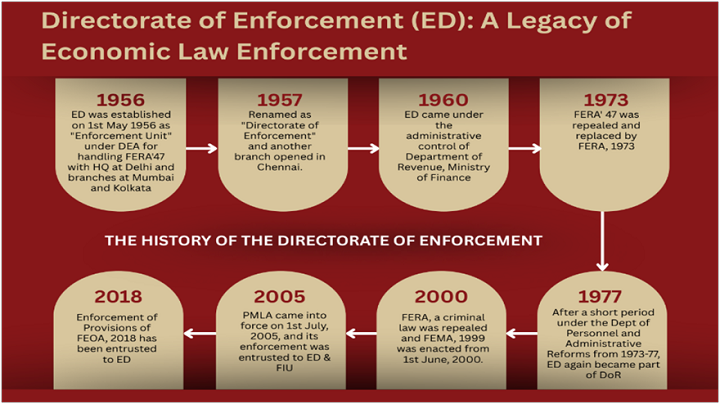
The Enforcement Directorate was formed on the 1st of May, in the year 1956. The organization was originally named as "Enforcement Unit" in the Department of Economic Affairs. The Enforcement Unit was given the singular task of handling the violations of the Foreign Exchange Regulation Act of 1947. The FERA of 1947 was an extremely significant piece of legislation in the economic development of India. The severe foreign exchange crunch faced by India in the post-independence era posed a significant threat. The Enforcement Unit , in its nascent stage, had its headquarters in Delhi and branches in Mumbai and Kolkata. The leadership was provided by the Legal Service Officer who acted as the Director. The team was supplemented by officers deputed from the Reserve Bank of India and the Special Police Establishment.
The evolution of the Directorate’s name and its administrative alignment has mirrored its growing salience in the Government’s fiscal landscape. In 1957, just a year after its inception, the "Enforcement Unit" was renamed the "Directorate of Enforcement," and its spatial outreach began with the opening of its third branch in Chennai. In 1960, the Directorate was transferred from the Department of Economic Affairs to the Department of Revenue in the Ministry of Finance, where it still is today, without forgetting its brief stint in the Department of Personnel and Administrative Reforms from 1973 to 1977. This administrative move from the Department of Economic Affair to the Department of Revenue was a conceptual leap, for foreign exchange violations were no longer seen as regulatory hurdles in trade but as revenue-related threats that could undermine the country’s financial integrity.
This trend of expanding the mandate continued with the Fugitive Economic Offenders Act (FEOA) of 2018, which was specifically aimed at dealing with high-value economic offenders who flee the country to escape the Indian legal system. In order to effectively manage these massive responsibilities, the ED has reorganized their cadre strength, which has increased from a sanctioned strength of 745 in 2006 to 2,063 in 2011. At present, the organization is functioning through five regional offices located at Northern (Chandigarh), Southern (Chennai), Central (Delhi), Eastern (Kolkata), and Western (Mumbai), headed by a Special Director each. This is supplemented by 27 Zones and 18 Sub-Zones, thereby ensuring that the organization is able to effectively tackle economic risks at the ground level while at the same time ensuring a centralized structure.
The Watchdog’s Mandate: FEMA and the Quest for Transparency
In terms of hierarchy in the functions of the Directorate, the Foreign Exchange Management Act (FEMA), 1999, is the main legislation for the Watchdog role of the agency. Unlike the PMLA, which is a penal code, FEMA is largely a civil law aimed at simplifying the legalities of foreign trade and remittance. The main aim of FEMA is to facilitate foreign trade and develop an orderly market for foreign exchange in India. This paradigm change from FERA's 'regulation and control' to FEMA's 'management' reflects India's aspirations for becoming a global economic power while at the same time desirous of transparency in financial flows between countries.
The key power in the FEMA framework is offered by Section 37A, which was included in order to combat the problem of "Equivalent Value This section grants the Directorate the authority to confiscate properties located in India, which are of equivalent value to any foreign exchange, security, or immovable property located outside India in contravention of the laws. This ensures that the offender does not succeed in evading the long arm of the law by keeping his ill-gotten gains in some safe haven outside India where the Indian authorities might not have jurisdiction.
The Adjudication and Investigation Lifecycle under FEMA
The lifecycle of the investigations carried out by FEMA has been divided into distinct stages, which are sometimes indicated by a file number.
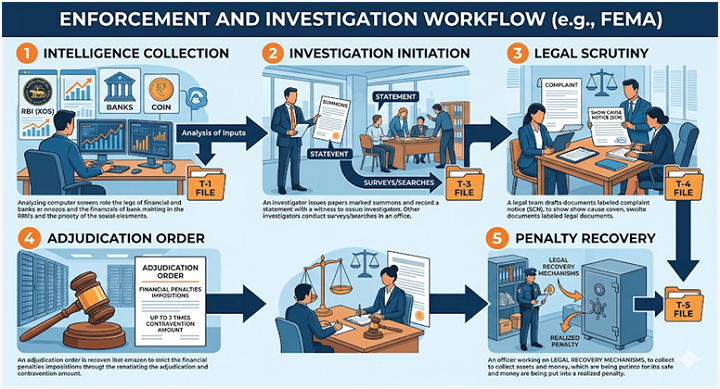
In the financial year 2024-25, the activities of the watchdog recorded an intensification. The investigations initiated under FEMA recorded an increase of 5%, whereas the amount of penalty recorded an astonishing rise of 94%, which touched ₹5,238 crore. The increase in the investigations is the agency's focus on large-scale contraventions, such as trade-based money laundering (TBML) and suspicious outward remittances.
For example, in the case of a Surat-based gem. The entity had carried out fake import and export deals worth ₹3,700 crore over two years. The entity had accepted payments but had not utilized the money in selling the goods in the local market. The payments for overvaluation of exports worth US $ 430.8 million were not realized in the foreign country. The properties were seized directly in India from the domestic value of the assets of the foreign entity.
The Sharpness of the Blade: Draconian Provisions under the PMLA
FEMA is the protective shield, whereas the Prevention of Money Laundering Act (PMLA), 2002, is recognized as the "blade" of the Enforcement Directorate. The PMLA was not only framed to trace the money trail; it was framed with the objective of preventing the "menance" of money laundering from undermining the national financial system. It is a comprehensive code in itself that vests the ED with the power to conduct searches, seizures, investigations, arrests, and attachment of assets under the law.
The purpose of the Act is to deprive criminals of the "Proceeds of Crime" (PoC), thus making the business of financial crime an unprofitable business.The definition of "Proceeds of Crime" under Section 2(1)(u) is the key to the effectiveness of the PMLA. It encompasses,
“any property derived or obtained, directly or indirectly, by any person as a result of criminal activity relating to a scheduled offence or the value of any such property.”
The law further expands the meaning of the term to include "the value of any such property" and, more significantly, "property of equivalent value" located within the country in the event that the original proceeds were kept abroad. This ensures that the criminal is held liable in the event that the exact property is laundered away.
Detailed Analysis of Stringent Statutory Provisions
The rigors of the PMLA are codified in specific sections of the act, which differentiate the criminal procedure in the case of money laundering from other criminal procedures followed in the rest of India.
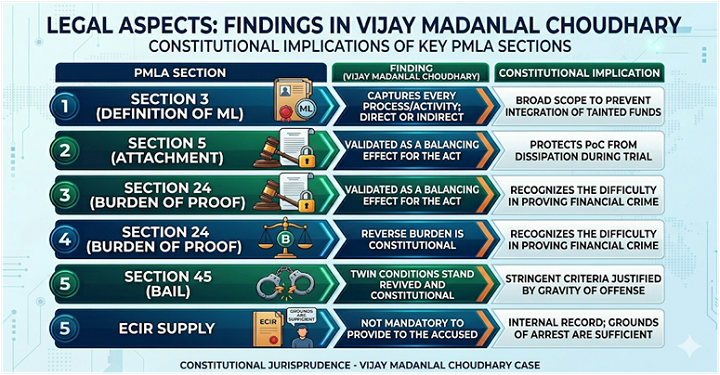
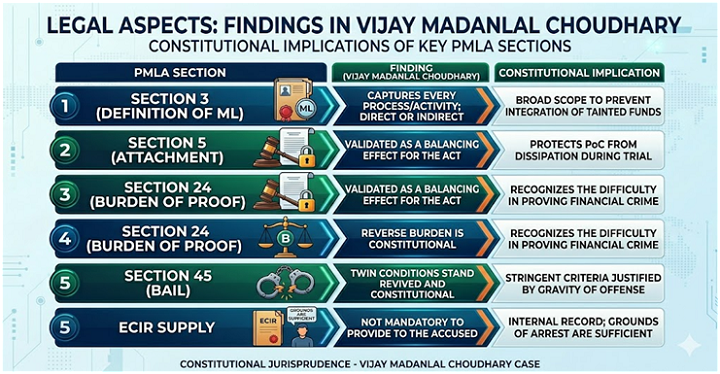
- Section 5: Provisional Attachment: This section gives a power to a Deputy Director or a higher authority to provisionally attach the property up to a period of 180 days if the authority has a reason to believe, based on the material in possession, that the property in question is proceeds of crime and its movement might hamper the proceedings. The Supreme Court of India has also upheld the constitutional validity of Section 5 in the case Vijay Madanlal Choudhary vs Union Of India [2022 SCC ONLINE SC 929]
- Section 17 and 18: These are special and self-contained provisions which enable the ED to conduct searches on premises and individuals on the suspicion that these may be in possession of money or records relating to crime. These are considered to be more effective than general provisions contained in the Code of Criminal Procedure. The SC has upheld the constitutional validity of section 17 and 18 in the case of Vijay Madanlal Choudhary (Supra).
- Section 19: This section empowers the specified authorities to arrest a person if there is material which gives rise to a recorded reason to believe that the person is guilty of money laundering. These safeguards involve the mandatory production of the arrestee before a magistrate within 24 hours and the submission of a copy of the arrest order and the reasons in a sealed envelope to the court.
- Section 45: This is the most contentious clause. It requires that prior to the release of an individual accused under the PMLA on bail, an opportunity must be given to the Public Prosecutor to oppose the bail, and the court must be satisfied that there exist reasonable grounds for believing the individual is "not guilty" of the offense for which he is accused and is unlikely to commit any offense while on bail. Given the fact that trials under the PMLA can take decades, the dual conditions function like a death knell on individual liberty. It puts immense power in the hands of the Enforcement Directorate because an arrest is effectively like sentencing the individual to a long stay in jail irrespective of the outcome of the trial. It takes away power from the judge in bail decisions because they have to follow a set formula.
The Legal Siege: Analyzing Vijay Madanlal Choudhary and the "Reverse Burden"
The biggest hurdle to the "Weapon" image was witnessed in the landmark decision of the Supreme Court in the case of Vijay Madanlal Choudhary v. Union of India (2022), which may be regarded as a "Legal Siege," whereby the validity of the provisions of the PMLA was questioned. The decision of the Supreme Court upheld the Act as constitutional and declared that the provisions of the Act were nothing but the "necessary response" to the heinous crimes of money laundering that affected economic sovereignty.
The crucial issue concerning the "Reverse Burden of Proof" in Section 24 of the PMLA, as interpreted by the Court, was that while in normal cases, the burden of proving the guilt of the accused lies on the prosecution, in this case, once the prosecution establishes the existence of the proceeds of crime and the participation of the accused in it, the burden is then shifted to the accused of proving that such property was "untainted." In this regard, it is worth mentioning here that the Court has held that Section 24 has a reasonable nexus with the objects of the Act and hence is not unconstitutional since the crime of money laundering is inherently secretive and hard to detect.
The Revival of the Twin Conditions and ECIR Status
The judgment also addressed the problem of the "Twin Conditions" under Section 45. The Twin Conditions had been ruled unconstitutional in the year 2018 in the case of Nikesh Tarachand Shah because of their discriminatory nature. However, in the Finance Act of 2018, Parliament amended the law and revived these twin conditions. The Supreme Court in its judgment ruled that the revival of these conditions was justified because of the judicial character of the discretion given to the court. Additionally, these twin conditions also applied to anticipatory bail so that any difference in the various stages of bail could be avoided.
Finally, the issue addressed in this judgment about the ECIR. As per the Supreme Court, it can be concluded that the ECIR is just an internal report, and thus not covered by any statutory mandate. It can be said that the non-provision of ECIR is not a violation of Article 21 of the Constitution, as long as the accused has been notified about the "grounds of arrest." Therefore, if this condition is met, the requirements of Article 22(1) are fulfilled.
Although this decision was quite favorable for the Directorate, yet it highlighted the importance of a jurisdictional requirement. To this end, the Supreme Court ruled that the PMLA authority cannot act against any person without a registration of the "scheduled offense" in the police, or where a complaint is filed in an ongoing inquiry..
Checks and Balances: The Necessity of Judicial Oversight
Such high concentration of power in one organization calls for effective checks and balances to ensure that such power is not abused. These are effected through judicial and internal measures. Some recent case laws have played an important role in defining the scope of ED's activities, especially when it comes to staying within bounds regarding non-scheduled offenses.
One of the cases where judicial oversight played an important role in defining the scope of ED was Pavana Dibbur v. The Directorate of Enforcement (2024). In this case, the Supreme Court was very explicit in defining the scope of the definition of the offense of "Criminal Conspiracy" under IPC Section 120B, as a scheduled offense under PMLA. In this case, the Supreme Court ruled very explicitly that the offense of criminal conspiracy could be classified as a scheduled offense only if the criminal conspiracy involved commission of an offense covered in the PMLA schedule. This is an important judicial observation since it limits the scope of ED from using Section 120B as a 'broad brush' to investigate transactions without including the underlying crimes in the schedule.
In the Pavana Dibbur case ruling, another important point has been made regarding how money laundering should be prosecuted. It has been observed that whether the individual in question was accused or not in the predicate offense case, the possibility of prosecuting a case involving money laundering depends on the presence of proceeds of crime. This implies that if in a predicate offense case, there has been acquittal or discharge of charges, no one can prosecute the money laundering charge as the very premise of existence of the "tainted property" would cease to exist.
FATF Mutual Evaluation Report 2024: A Global Audit
The most rigorous external check on the ED’s efficacy comes from the Financial Action Task Force (FATF). In its 2024 Mutual Evaluation Report, India was rated in the "Regular Follow-up" category, a status shared by only four G20 nations. This rating reflects the credibility and robustness of the ED and its alignment with international standards.The "Moderate Effectiveness" rating for Immediate Outcome 7 highlights the systemic delays in the Indian judicial system, where constitutional challenges to the PMLA have historically slowed down trials and convictions. This acts as a reminder that the "Weapon" is only as effective as the judicial system’s ability to deliver timely verdicts.
Restitution: The Human Face of Accountability
A significant evolution in the Directorate’s accountability is the focus on "Restitution" to victims of financial crime. Under Section 8(8) of the PMLA and subsequent 2019 amendments, the ED is now empowered to restore attached properties to legitimate claimants even during the pendency of the trial. This shift recognizes that the objective of the law is not just to punish the offender but to compensate the victim.
By restitution of over ₹30,462 crore as of March 2025, the Directorate demonstrates that the "blade" can also be used to carve out justice for the common man. This process of restoring ill-gotten wealth to the public sector and defrauded citizens serves as a powerful testament to the agency’s commitment to the rule of law.
Expert opinion: The Erosion of Due Process
Adv. Tanvi Bansal , a leading advocate at Delhi High Court, asserts that the Prevention of Money Laundering Act (PMLA), 2002, as implemented by the Directorate of Enforcement (ED), is a deviation from the normal Indian criminal jurisprudence. Its effectiveness is based on a set of strict provisions that emphasize the security of the financial integrity of the country and not the freedom of the person.
Section 3 of the act provides definition of money laundering , which is made to be comprehensive and includes all the steps in the process of integrating the tainted funds. Section 2(1) (u) is the functional heart, and extends the definition of Proceeds of Crime to cover not only the original property, but its fair market value or a property of equivalent value in India in the event that the main proceeds are in a foreign country. This provides the law to be effective even in cases whereby the assets are laundered by means of complex offshore layers, thus holding the criminal liable despite the form or the location of the asset.
The Act will enable the ED to exercise extraordinary powers prior to the conviction being obtained, which the state has argued will help to curb the dissipation of illicit wealth. It enables 180-day freezing of property on a basis of a reason to believe that the property is related to crime. This was maintained in Vijay Madanlal Choudhary as a counter-checking factor to make the trial effective. It also allows the officers to detain suspects on grounds that have been recorded as long as they satisfy the safeguards such as production in front of a magistrate within 24 hours. Although these powers are meant to be proactive they exert a lot of pressure on the accused even before they are found guilty in a court of law.
These areas are the most controversial ones of the PMLA, frequently termed as the death knell on personal freedom because of the duration of the Indian trials. In contrast to the normal law where a prosecution has the burden of proving that a person is guilty, Section 24 places the burden on the accused to prove that his or her property is untainted after having been proven by the prosecution to be associated with a crime. The Supreme Court defended this by the fact that financial crimes are secretive. The section requires that in order to grant bail, the court must be convinced that the accused is not guilty, and that he/she is unlikely to repeat his offenses. Such circumstances virtually reverse the principle of innocence until proven guilty. The renewal of such conditions by Parliament in 2018 following their initial judicial declaration as unconstitutional reflects a desire on the part of legislators to see money laundering as a singularly vicious menace to economic sovereignty.
Conclusion: Harmonizing Power with Accountability
The dual role of the Enforcement Directorate as both a 'Weapon' and a 'Watchdog' is neither contradictory nor problematic; rather, it is the necessary balance in the governance of the economy. While the Enforcement Directorate plays the role of the watchdog by facilitating the necessary surveillance for India to trade globally under FEMA, it plays the role of the 'Weapon' by equipping the state with the necessary tools to dismantle the financial structure of organized crime and corruption through the PMLA.
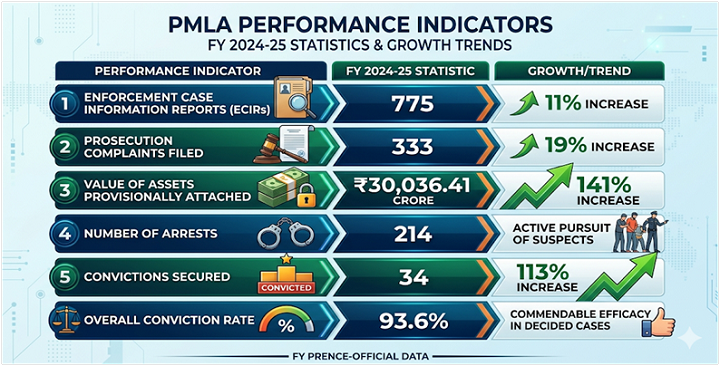
The transformation of the Enforcement Directorate from a small enforcement body in 1956 to a high-powered body in 2025 is a measure of the complexity of financial crimes in the digital age. While the success of the last year, marked by a 141% increase in the number of asset attachments, and the high conviction rate of 93.6% in the decided cases testify to the success of the risk-based approach adopted by the Enforcement Directorate, the 'Moderate' rating by FATF on the speed of trials, as well as the legal hurdles faced by the Enforcement Directorate, as discussed in the case of Vijay Madanlal Choudhary, indicate that the 'Legal Siege' is an ongoing process.
The future of the Enforcement Directorate would be in the further harmonization of its immense powers with procedural accountability. The adoption of advanced forensic technologies in collaboration with institutions such as the NFSU, the computerization of its internal systems, and the focus on the restitution of victims of crime would be the key steps in this regard. Ensuring that every step taken by the Directorate is informed by reasons recorded in writing and subject to the oversight of the Special Courts would be the key to the Directorate continuing to protect the integrity of the Indian financial system and the constitutional rights of the citizens of the country. The goal remains clear: crime must not pay, and the fruits of crime must be returned to the nation and the victims to whom they rightfully belong.
Join LAWyersClubIndia's network for daily News Updates, Judgment Summaries, Articles, Forum Threads, Online Law Courses, and MUCH MORE!!"


Tags :others


