
INTRODUCTION
A trademark is a word, symbol or logo that is more than just a word, a symbol or a logo it is the identity of the business and how consumers recognize one trader's goods or services from another's. The aim of trademark law is to avoid consumer confusion and to safeguard companies' goodwill and reputation. With the growing competitiveness of commerce and the growing importance of branding what is protectable by trademark has become a question of increasing importance.
The Trade Marks Act, 1999 provides for the substantive rights of trademark owners and the conditions surrounding the registration of a trademark. Protection is encouraged by the Act, but words or expressions that should continue to be available for public use are not monopolised. It is therefore important to note that Section 9 of the Act provides absolute grounds for refusing to grant registration in respect of a mark that lacks distinctive character, is merely descriptive, generic or cannot distinguish one person's goods from another.
Although the language in the statute is not overly complex, problems often arise regarding what is meant by "distinctiveness" and what is the level of distinctiveness needed to register a claim. One of the common issues in trademark examination is that a trademark ought to be novel or unique to be registered. This effectively creates an extra precondition which Parliament did not anticipate.
The Delhi High Court recently discussed the issue in ADS Spirits Pvt. Ltd. v. Registrar of Trade Marks, where it gave a significant judgment which clarified the ambit of Section 9(1)(a). Justice Jyoti Singh, in the case unambiguously stated that the Trade Marks Act does not mandate uniqueness. The Court noted that the Registrar had denied the trademark application by using a test that is not set out in the Act, an error of law. The judgment not only sets out the law but also emphasises the requirement on the part of the Trade Marks Registry to give reasoned and legally sound orders after considering the applicant's submissions.
FACTS OF THE CASE
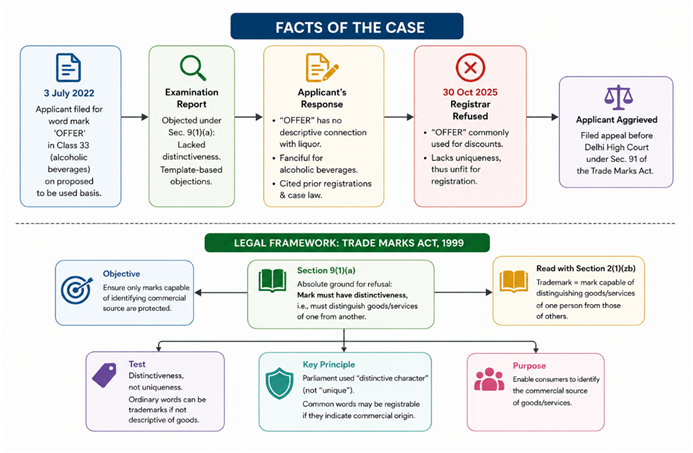
The issue was between the company involved in the manufacturing and sale of alcoholic beverages (ADS Spirits Pvt. Ltd.) and the company that filed the application. The issue was between the company that filed the application and a company engaged in the manufacturing and sale of alcoholic beverages (ADS Spirits Pvt. Ltd.). The company lodged an application for the registration of the word mark ‘OFFER' in Class 33 for alcoholic beverages other than beer on 3 July 2022. It was applied for on a “proposed to be used” basis pursuant to the Trade Marks Act.
The Trade Marks Registry objected to the examination under section 9(1)(a) during the examination process. The report stated that the mark was not distinctive and could not be used to indicate the commercial source. Interestingly, the examination report also seemed to be based on a template, using a combination of surnames, geographical names, ornamental expressions, and even geometrical figures without specifically explaining how each of these objections would apply to the word “OFFER.” This mechanical method was one of the reasons why the High Court faulted the Registry later.
The applicant responded with detailed written submissions. It said that “OFFER” is a common English word, but has no direct or descriptive connection to alcoholic beverages. The word neither pertains to the character, quality, ingredients of liquor products or intended use of liquor products. Therefore, if used in connection with alcoholic beverages, it is a fanciful designation which it is possible to differentiate from those of the competitors.
The applicant also pointed to several previously-registered trademarks incorporating the term "OFFER", as well as judicial precedent confirming that common English words could still be protected by trademark rights when used outside of the context of their original trade. It asked the Registrar to consider the application in line with the statutory provisions in section 9(1)(a).
This application was still rejected by the Registrar in an order dated 30 October 2025. Among the main reasons reported was that the term "OFFER" is frequently used when looking for discounts, and thus did not have "uniqueness. The Registrar found that the mark was not unique, and that this made it unfit for registration.
The refusal infuriated the Applicant and it filed an appeal before the Delhi High Court under Section 91 of the Trade Marks Act.
THE LEGAL FRAMEWORK UNDER THE TRADE MARKS ACT, 1999
The issue which was the subject of the controversy before the Court was the interpretation of Section 9(1)(a) of the Trade Marks Act, 1999.
Section 9 deals with the absolute grounds for refusal of registration. While relative grounds under Section 11 focus on conflicts with prior trademarks, Section 9 looks at the nature of the proposed mark. The aim is to make sure that only marks which can perform the necessary function of a trademark are afforded statutory protection.
According to Section 9(1)(a), those trademarks that lack any distinctive character, that is, that do not distinguish the goods or services of one party from those of another party, shall not be registered.
The focus of the statutory criteria is therefore on distinctiveness. A mark does not have to be invented or original, but it must be capable of identifying the commercial source of goods or services.
This provision shall also be interpreted together with Section 2(1)(zb) which defines what is meant by a trademark being a mark capable of distinguishing the goods or services of one person from the goods or services of others. Both provisions employ the same underlying principle that trademark protection depends upon the mark's ability to distinguish commercial origin.
Of particular interest is the absence of a ‘uniqueness' test as a standalone measure in either Section 2 or Section 9. The word choice of "distinctive character" was deliberate on Parliament's part, acknowledging that ordinary language can be a trademark when used with goods for which it does not have any descriptive connection.
THE ISSUES BEFORE THE DELHI HIGH COURT.
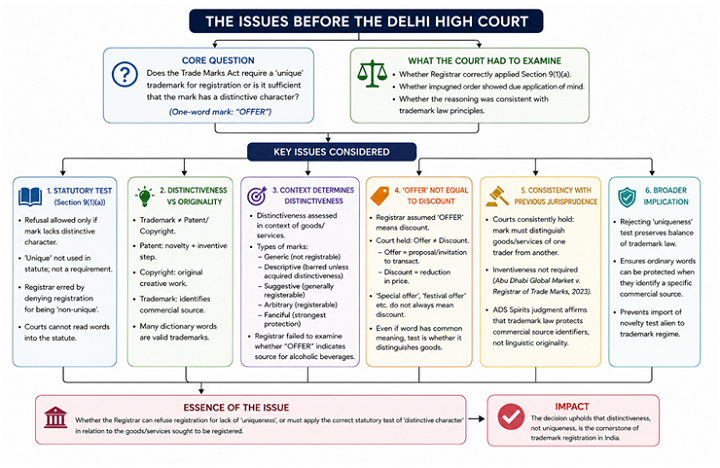
This appeal involved a very basic but important issue for the Delhi High Court to consider: Whether the Trademarks Act imposes a requirement of a ‘unique' trademark before it can be registered or it is enough if the trademark has a distinctive character? The issue was actually just one-word mark ‘OFFER’ but the implications of the decision encompassed much more than the facts of the case.
The main question before the Court was whether the Registrar had properly applied Section 9(1)(a) of the Trade Marks Act in his refusal. It also had to consider whether the impugned order was indicative of due application of mind and if the reasoning used by the Registrar was consistent with the principles which had been laid down in the trademark law. The truly important issues involved in the case were not only the registrability of a given mark, but rather the rules that govern the exam of trademarks in India.
The Statutory Test
Justice Jyoti Singh first looked into the words of Section 9(1)(a). The Court noted that the provision only allows the registration to be refused if the mark is lacking in distinctive character, which would be the case if it does not distinguish the goods or services of one trader from another. The word unique is never used in the statute and does not imply that uniqueness is a prerequisite to registration.
The Court thus found that the Registrar had failed to meet the correct criteria and granted registration based on the usage of the word "OFFER", which the Court found to be non-unique. This would have been a method of interpreting words that Parliament had deliberately omitted. The courts cannot expand on the text of the statute, replacing the word with their own preferences, especially when the statute grants rights.
The decision is important because it further endorses one of the fundamental rules of statutory interpretation: that courts may not impose conditions on eligibility that are not specified by statutes. It is clear that if Parliament meant by the word ‘uniqueness' that uniqueness was a necessary condition for the registration of a trademark, it would have stated this explicitly in the Trade Marks Act. The concept could not be introduced by the Registrar by executive decision-making since it did not.
Why Distinctiveness Matters More Than Originality
The Court further explained that the “trademark” is different from the patent or copyright. Patents are granted for inventions that are novel, have an inventive step and are industrially applicable. Original literary, artistic or musical works are protected by copyright. Trademarks, on the other hand, serve a completely different commercial purpose: to mark the source of goods and services.
This means that a trademark does not have to be original in the sense that is required under intellectual property laws for inventions or creative works. The crucial issue is whether the consumer makes the mark the connection of a specific commercial source.
The Court commented that many well-known trademarks are composed from everyday dictionary terms. They are not novel words but words that show where something has come from. Commercial identity is then protected under trademark law, not linguistic innovation.
Context Determines Distinctiveness
One of the most helpful things about the judgment is the recognition that distinctiveness always has to be considered within the context of the goods/services that are being sought to be registered.
The Court restated the principle that there are various types of trademarks:
- Generic marks;
- Descriptive marks;
- Suggestive marks;
- Arbitrary marks; and
- Invented or fanciful marks.
Generic expressions refer to the product itself and cannot be used as trademarks since they have to be available to the public. Description only identifies a characteristic, quality, purpose or ingredients of a product or service and, as a descriptive mark, is normally within the scope of prohibition of Section 9(1)(a) of the Trademark Act unless it has become distinctive through long and exclusive use.
Suggestive marks need some imagination to relate to the products and are therefore usually registerable. Arbitrary marks are words that are already used in everyday language in a different context, and fanciful marks are expressions that are new creations for trademark purposes. These are typically the most well protected, as they naturally provide a means to distinguish one trader's products from another's.
The Court concluded that the Registrar had failed to make this contextual enquiry. The Registrar did not determine or decide if the word "OFFER" served as a source identifier for alcoholic beverages, but only that it was a word that was commonly used in English. That was a faulty judgement of the statutory question.
So the judgment restates that a word can't be considered descriptive or non-distinctive because it's a familiar term to the public. In all instances, a connection between the language and the corresponding products or services must always be considered in deciding if a word is "registrable".
Offer is not the same as discount
A key finding in the judgment is that the Registrar assumed that the term ‘OFFER' was used to denote discounts.
In clear terms, Justice Jyoti Singh disagreed with this argument. The Court noted that the words "offer" and "discount" are not synonymous, nor do they mean the same. While an offer is just a proposal or invitation to enter into a transaction, a discount technically is a reduction in price.
In commercial practice, 'special offer', 'festival offer', 'limited offer' or 'exclusive offer' are often used to market products. This doesn't always mean that a price is being discounted. Similarly, a seller can offer a discount without making it an offer.
The Court thus found that the reasoning of the Registrar was both legally and factually incorrect. Most important, even if the word had a well-known sense in the dictionary, this would not satisfy the statutory requirement under Section 9(1)(a). The question, which was still valid, was whether the word distinguished the alcoholic beverages of the applicant from those of competing manufacturers.
The Judgment in the light of the previous trademark jurisprudence
The rationale followed by the Delhi High Court is not a unique one but is in continuity with the judicial interpretations of Section 9 of the Trade Marks Act. The central question of trademark law is whether a mark is capable of distinguishing the goods/services of one trader from that of another, Indian courts have held repeatedly. The focus has always been on the mark and its unique qualities and features, not on its novelty.
Abu Dhabi Global Market v Registrar of Trade Marks (2023) is one of the more important cases in this respect. If so, the Delhi High Court specifically stated that inventiveness is not a mandatory condition for trademark registration whereas distinctiveness is. Under patent and design law, inventiveness is a condition for granting a patent, whereas trademark law is focused on the commercial role played by a trademark. The fact that a mark is not distinctive should therefore be preceded by the issue of whether the mark can distinguish between the goods or services of different traders. The decision did not allow the concepts of other areas of intellectual property law to be introduced into the trademark area.
The principle is that which is being built in the judgment of ADS Spirits. The Court's decision to reject the Registrar's desire to enforce the “uniqueness” requirement reaffirmed that trademark law does not protect linguistic originality, but commercial source identifiers. If the Court had followed the Registrar's reasoning, it would have effectively have turned trademark registration into a mechanism to find novelty, which is contrary to the purpose of the statute and case law.
The Court's reasoning is also in line with previous rulings that held that the ordinary dictionary words can, in some circumstances, serve as a valid trademark in contexts beyond the goods/services they are normally used to indicate. Numerous internationally known brands are formed of familiar terms that have become trademarks as they are linked to a specific source and not their literal definition. This shows that "distinctiveness" is relative and cannot be judged simply from the familiarity of a word in the common language.
CRITICAL ANALYSIS
It is laudable that the judgment both reinforced the substantive trademark law and the principles of administrative fairness. First, it emphasises the need to follow the words of the statute. Administrative authorities may not impose new requirements simply because they seem to be policy wise desirable. This would jeopardize the supremacy of the law and lack clarity to trademark applicants.
Secondly, the decision adds to transparency in the Trade Marks Registry. Orders of the speaker play an important role in any quasi-judicial proceedings, as it signifies fairness, makes it easier to demonstrate the appellate review and inspires confidence in the process of deciding the case. This is likely to prompt more careful and legally reasoned examination of trademark applications in the future, as the Court will critique examination reports based on a template.
The judgment also acknowledges realities of commerce. Because of the nature of modern brand, it is more and more relying on the short and memorable words from the normal language. Value of successful trademarks often comes not from originality of language, but through continued commercial use and recognition by consumers. A requirement for uniqueness in order to register would be an undue limitation on the concept of branding and stifle legitimate commercial innovation.
Meanwhile, the move doesn't leave the registration process too loose. The Court noted that distinctiveness is a factual issue to be decided based on the relationship between the mark and the relevant goods, and that the Court was not resolving it, but rather remanding it for further consideration. This "parity" ensures that private trademark interests are respected and balanced against the public interest in the preservation of expressions that are descriptive in the common parlance.
CONCLUSION
The Delhi High Court's judgment in the case of ADS Spirits Pvt. Ltd. v. Registrar of Trade Marks, is a significant addition to the Indian trademark jurisprudence. The Court's decision, by explicitly making 'distinctiveness' rather than ‘uniqueness' the requirement for Section 9(1)(a), has addressed a misunderstanding that could have led to a misguided approach to trademark examination and imposed an unjustified burden on the applicants that was not intended by the legislators of the Trade Marks Act, 1999.
Also notable is the Court's emphasis on the importance of giving reasoned and well-thought orders by the Trade Marks Registry, as a quasi-judicial body, having considered all applications made by the applicant, which are relevant to the application. Judicial scrutiny of mechanical refusal on the basis of template reasoning or extra-statutory grounds is not going to stand up.
This judgment is expected to be a significant guidance to trademark examiners and practitioners in the Indian context, with the digital economy and the consumer market growing. It restates the basic rule of the trademark law that it does not promote originality for originality's sake, but it does serve as a defense against marks which clearly and effectively distinguish the goods/services of one trader from another. The Delhi High Court has thus clarified the real intent behind trademark protection and enhanced the certainty and equity of the trademark registration framework in India by reintroducing the element of ‘distinctive character.’
Join LAWyersClubIndia's network for daily News Updates, Judgment Summaries, Articles, Forum Threads, Online Law Courses, and MUCH MORE!!"


Tags :Others