


INTRODUCTION
The first internship for law students used to mark a key step into the legal world, moving them from learning rules in class to seeing them in action in courts, law offices, and other legal settings. It also introduced students to professional responsibility, which can't be learned from textbooks alone. In recent years, however, this experience has changed a lot because of social media. Now, internships are often shared online, with posts, videos, and reels showing daily life in law firms or courtrooms. For many, documenting their internship has become almost as important as the internship itself.
This trend isn't always bad.
Social media has made legal careers more accessible, helping students find internships, build networks, and learn about the field. It has also made the legal profession seem more approachable for people not in big cities. However, there are concerns about turning internships into online content. Legal work is based on confidentiality—every conversation with a client, every document, and every strategy discussion is private. Interns are given access to this information, which means they have a responsibility to keep it secure.
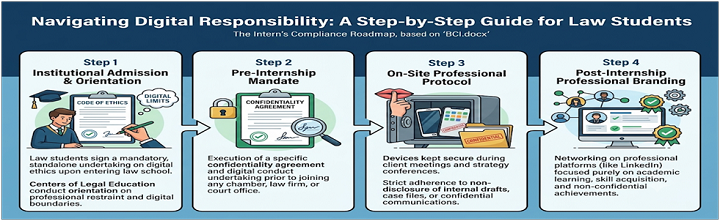
In response, the Bar Council of India introduced rules in July 2026 that restrict interns from posting pictures, videos, or other content related to their internships.
They also require interns to sign agreements promising to maintain confidentiality. The BCI isn’t just banning reels—it’s addressing the growing tension between digital culture and professional ethics. The core issue is not whether students can share their experiences online, but whether traditional legal values like discretion and confidentiality can still hold in a world where everything is public.
LEGAL INTERNSHIPS WERE ALWAYS ABOUT LEARNING, NOT PERFORMANCE.
Students were meant to observe and grow in a professional environment, absorbing the culture and customs of the law. But now, internships are also seen as a way to build personal brands and create online content. This shift has made internships more about visibility than education. While social media can help students find opportunities, it also encourages the public display of private experiences. This creates a conflict between the open, attention-seeking nature of online platforms and the need for discretion and confidentiality in legal practice.
The BCI's rules aren’t about stopping students from using social media—they’re about making sure the ethical standards of the legal profession aren’t lost in the digital age.
The rules recognize that online posts can reflect not just the individual but also the law firm, the clients, and the entire profession. They reinforce that confidentiality is a core part of the legal profession, not just a formality. Clients trust lawyers to keep their information private, and that trust is essential for effective legal representation. Without it, the justice system itself could be weakened.
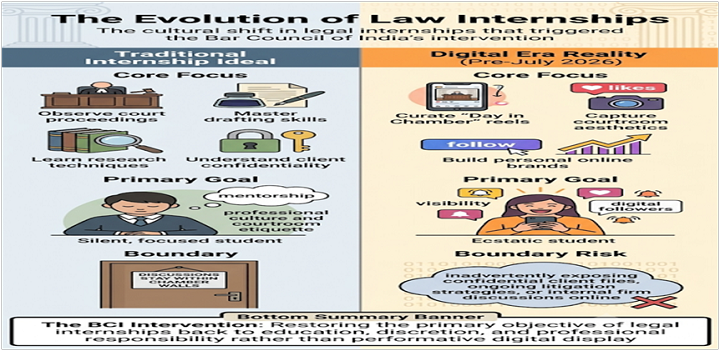
In summary, the BCI’s intervention aims to protect the confidentiality that is fundamental to the legal profession.
It seeks to integrate ethical behaviour into legal education and ensure that students develop a strong sense of responsibility before they become practicing lawyers. The rules reflect a shift towards recognizing that professionalism in the digital age still requires the same values that have guided the legal profession for generations.
DOES THE CIRCULAR LIMIT FREEDOM OF SPEECH?
One of the initial concerns levelled at the Bar Council of India's circular is that it goes beyond what is essential by interfering with the right to free speech and expression, which is guaranteed by Article 19(1)(a) of the Constitution.
Many students claim that sharing internship experiences, images with mentors, and observations on daily learning are all forms of personal expression that should not be limited merely because the internship takes place in a law office.
At first, this argument seems convincing. Law students are not yet professionals and don’t have the same responsibilities or privileges as practicing lawyers. Therefore, it's reasonable to question whether a professional body can control how students use their personal social media accounts.
However, the constitutional issue is more complex.
Free speech does not mean people can freely share any information, especially if it's confidential. Indian law has always recognized that individual rights come with duties. For instance, an employee can’t share trade secrets just because they have the right to free speech, and a government official can't reveal classified information on the same grounds. Similarly, an intern who gains access to privileged legal communications can't justify sharing them by citing free speech.
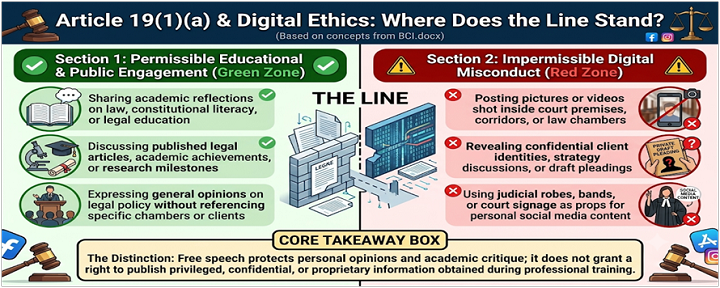
The key difference is between sharing one's opinion and revealing confidential information that someone has trusted with.
The circular doesn't seem to stop students from discussing their academic experiences, reflecting on legal topics, or expressing views on legal education.
The real problem arises when social media posts begin to showcase ongoing cases, reveal internal processes, identify clients, or expose relationships that rely on confidentiality.
In this sense, the circular focuses on regulating behavior, not just opinions.
It aims to protect professional information rather than limit the free exchange of ideas.
That said, some concerns remain.
Regulatory documents need to be clear to avoid causing confusion. If students fear that even taking a photo outside a court or thanking an advocate after an internship could be seen as breaking professional rules, the circular might create a fear of speaking up beyond what it intended. Ethical regulation works best when boundaries are clearly set. Too much ambiguity can lead to unnecessary self-censorship.
For this reason, it's important that the circular's implementation includes detailed guidelines explaining what’s acceptable and what’s not.
Clear rules are needed for professional discipline to coexist with real freedom of expression.
CAN THE BCI REGULATE STUDENTS WHO AREN’T YET ADVOCATES?
Another important question is about the BCI's authority. Law interns are not officially advocates under the Advocates Act. They don’t appear on the State Rolls and can’t practice independently. They are still students focusing on legal education. Does this mean the BCI has no say over them?
The answer isn’t as simple as that. Although the BCI mainly regulates advocates, it plays a key role in setting educational standards. Under the Advocates Act, the Council has powers related to recognizing law degrees, inspecting law schools, and setting educational requirements. Internships have become a major part of legal education since the implementation of the Rules of Legal Education.
The circular seems to view interns not only as future advocates but also as part of a regulated system of professional training.
In short, the BCI is not imposing the same rules on students as on practicing lawyers. Instead, it is setting ethical standards that educational institutions and supervising advocates are expected to support.
This distinction is significant since professional identity doesn't suddenly develop on the day someone becomes an advocate. It develops gradually via observation, guidance, and exposure to professional norms.
Internships teach more than just legal skills.
Students learn how advocates interact with judges, clients, and maintain confidentiality in professional settings. These ethical habits often last throughout a lawyer’s career.
Therefore, requiring interns to observe confidentiality standards doesn’t contradict the educational role the BCI is entrusted with.
THE CIRCULAR ADDRESSES A PROBLEM THAT MANY CHAMBERS HAVE QUIETLY FACED
Although students have been the primary focus of public conversations over the circular, many practicing solicitors have been discreetly worried about social media use for years.
Interns are frequently permitted to observe client meetings, strategy discussions, and case preparations involving private or sensitive material by senior attorneys.
This is predicated on the idea of reciprocal trust. Smartphones, however, have altered how secrecy is managed.
Unlike previous generations, today’s interns have devices that can record high-definition video, capture confidential documents, transmit information instantly, and store digital data permanently. A simple photo meant as a keepsake might inadvertently expose information that shouldn’t be shared.
Some law firms have already taken steps to limit phone use, restrict access to meeting rooms, or require interns to hand over devices during client meetings.
Others have asked interns to sign informal confidentiality agreements before the BCI circular was introduced.
A problem that has previously been a source of worry for the legal profession is formalised by the new standards.
Instead than establishing a new responsibility, it acknowledges that technology has increased the risks associated with maintaining confidentiality.
THE UNANSWERED QUESTIONS, THE NEGATIVE, AND THE POSITIVE
The circular deserves praise for acknowledging that professional ethics must change to keep up with technology changes.
Additionally, it conveys a crucial message that the legal profession shouldn't be used as a stage for performative social media behaviour.
Like every regulatory structure, it is not without its detractors, though.
Educational content is one area that need further clarification.
Should it be discouraged, for instance, if a student publishes a reflective piece about their internship experience without mentioning any customers, solicitors, or private matters?
In a similar vein, would it be unprofessional to take a picture outside a High Court after work?
Can students openly acknowledge internship certificates or thank mentors publicly?
The circular clearly targets content that promotes legal practice or potentially breaches confidentiality.
However, it would benefit from better examples that clearly show what’s allowed and what’s not.
Another issue is proportionality.
Digital communication has become a key part of professional networks. Employers often review LinkedIn profiles before offering internships or placements. Law students regularly share achievements, research, and academic milestones online.
Ethical rules shouldn’t discourage legitimate professional interactions that don’t threaten confidentiality.
The goal shouldn’t be digital silence; it should be digital responsibility.
A balanced framework would distinguish between educational communication and promotional content.
Speaking to LCI, Advocate Amritesh Singh stated that “Look, it was about time someone called out this entire "lawyer life" reel culture. Joining a chamber or interning under a senior used to be a privilege based on absolute trust. When a senior lets you sit in a client conference, they are handing you access to someone's private life, commercial secrets, or criminal defense strategy. Turning that into background music and aesthetic footage for Instagram engagement is just plain amateurish.”
He further said that “The argument that this attacks a student's freedom of speech is completely missing the point. Free speech lets you critique a judgment or discuss legal theory online all day long. It does not give you the right to post someone's draft pleading or film a chamber meeting. An employee in a corporate firm cannot post internal product designs under the guise of "free speech," so why should a law intern get a pass for posting confidential case prep?”
Lastly he said that “The BCI had to step in because chambers were quietly getting fed up with students pulling out smartphones every five minutes. The requirement for a mandatory undertaking before an internship is a solid reality check. It instills the idea from day one that the law is a profession built on client confidence, not a playground for personal branding.”
INTERNATIONAL PERSPECTIVES
Interestingly, the concerns raised in the BCI circular are not unique to India.
In common law countries, professional bodies have set out rules about how solicitors should use social media.
The Law Society of England and Wales mandates that lawyers behave appropriately online, particularly with regard to protecting client privacy, maintaining professional standards, and preserving public confidence.
The similar strategy has been adopted by Australian legal professional associations, reminding solicitors that ethical guidelines regarding the confidentiality of client information are applicable whether information is given online or through conventional channels.
What makes the BCI circular unique is that it includes interns and law students in these concerns. Instead of waiting until students become practicing lawyers, the BCI is enforcing professional standards right from the start of legal education.
This approach shows that the habits students develop online during law school can carry over into their legal careers.
Conclusion: Beyond Reels, Towards Responsible Lawyering
The debate surrounding the BCI's social media circular has, perhaps unsurprisingly, centred on what students can no longer do. Headlines proclaiming the end of "Lawyer Life" reels and "Day in Chamber" videos have dominated public discourse, reducing a significant professional development to a discussion about Instagram content. In doing so, the larger objective of the circular risks being overlooked.
At its core, the circular is not an attempt to discourage students from celebrating their achievements or participating in the digital world. Rather, it seeks to remind aspiring lawyers that entry into the legal profession demands a different understanding of responsibility. Unlike many other professions, legal practice is built upon confidence.
Clients disclose deeply personal, financial and commercial information because they believe their lawyer will protect it. Courts function effectively because participants adhere to standards of dignity and restraint. Every advocate, regardless of seniority, ultimately contributes to maintaining public trust in the administration of justice.
Law students become part of this ecosystem much earlier than they often realise. The moment an advocate allows an intern to observe a client conference, review a draft pleading or sit through discussions involving litigation strategy, the student is entrusted with responsibilities that extend beyond academic learning. Confidentiality is not postponed until enrolment with the State Bar Council. It begins the moment trust is placed in an individual entering a professional space.
At the same time, the circular should not be viewed as beyond criticism. Professional regulation is most effective when its boundaries are clear, proportionate and capable of practical implementation. Students should not be left uncertain about whether expressing gratitude to a mentor, announcing the completion of an internship or sharing general reflections on professional learning could invite disciplinary concerns. Greater clarity through explanatory guidelines or illustrative examples would reduce ambiguity and encourage voluntary compliance rather than fear-based restraint.
Join LAWyersClubIndia's network for daily News Updates, Judgment Summaries, Articles, Forum Threads, Online Law Courses, and MUCH MORE!!"


Tags :Others


