
1. INTRODUCTION
Corporate governance revolves around a fundamental tension: how to allow the majority to drive the business forward efficiently while ensuring that the minority is not unfairly trampled. In India, where family-owned enterprises, promoter-led conglomerates, and concentrated shareholding structures dominate the corporate landscape, this tension is particularly acute. Corporate democracy is built on the premise that decisions are made by the highest number of votes. However, if left completely unchecked, absolute majority rule can devolve into corporate tyranny, suppressing the voices of smaller investors and stalling the flow of public capital.
The evolution of Indian company law reflects a continuous effort to calibrate this balance. The Companies Act, 2013 marked a significant paradigm shift from its 1956 predecessor by introducing robust, progressive measures specifically designed to empower minority shareholders. This paper examines the legal architecture governing minority shareholder protection in India, analyzing how the legal system attempts to foster a healthy corporate democracy while maintaining the commercial agility required for economic growth.
2. MAJORITY RULE PRINCIPLE AND CORPORATE CONTROL
The bedrock of corporate decision-making is the principle of majority rule, which establishes that the will of the majority of shareholders binds the company. This concept was famously codified in the English common law case of Foss v. Harbottle (1843). The court held that when a wrong is committed against a company, the company itself is the proper plaintiff, and individual shareholders cannot generally bring legal action if the alleged wrong is a matter that can be ratified by a simple majority. The rationale behind this rule is deeply practical: it prevents endless, vexatious litigation by disgruntled minority factions and respects the commercial judgment of those holding the largest economic stake.
In India, this principle remains the default baseline for corporate administration. Boards of directors are elected by majority vote, and ordinary or special resolutions dictate major structural and operational decisions. However, the Indian corporate ecosystem features distinct structural vulnerabilities. Unlike Western economies, where shareholding in public companies is often highly dispersed among institutional and retail investors, Indian companies routinely exhibit high promoter concentration. Promoters frequently hold absolute majorities or massive, commanding pluralities. Consequently, the traditional safeguards of a dispersed market do not automatically apply. If the Foss v. Harbottle rule were applied absolute and without qualification, minority shareholders in India would essentially possess no voice, turning corporate democracy into an illusion.
3. MINORITY RIGHTS UNDER THE COMPANIES ACT, 2013
Recognizing these structural imbalances, the Companies Act, 2013 ("the Act") intentionally carved out statutory counterweights to absolute majority rule, creating a more inclusive framework for corporate democracy. Rather than treating minority shareholders as passive capital providers, the Act recognizes them as active stakeholders with enforceable rights. These rights can be broadly categorized into proprietary, democratic, and supervisory powers.
|
Provision |
Threshold / Mechanism |
Core Function |
|
Section 135 & 151 |
At least 1,000 small shareholders or 1/10th of total |
Election of a Small Shareholders' Director (SSD) to sit on the board. |
|
Section 100 |
Shareholders holding not less than 1/10th of paid-up capital |
Right to requisition an Extraordinary General Meeting (EGM). |
|
Section 177 & 188 |
Disallowed voting for interested parties |
"Majority of Minority" voting for Related Party Transactions (RPTs). |
The statutory creation of the Small Shareholders' Director (SSD) is a prime example of an attempt to inject minority representation directly into the boardroom. While the implementation of this provision remains optional or dependent on specific shareholder requisitions, it provides a direct channel for retail investors to influence governance. Furthermore, the Act grants minority shareholders holding at least 10% of the paid-up capital or representing 1/10th of the total number of members the right to requisition an Extraordinary General Meeting (EGM). This ensures that the majority cannot simply freeze out alternative perspectives or avoid discussing critical corporate matters.
Perhaps the most potent democratic safeguard introduced by the Act is the mandate for "Majority of Minority" voting regarding Related Party Transactions (RPTs) under Section 188. In promoter-dominated firms, a frequent avenue for minority expropriation is the tunneling of assets or funds out of the listed entity into private entities owned by the promoter family. Under the Act, any shareholder who is a related party to the transaction is barred from voting on the resolution. This strips the promoter of their majority advantage for that specific vote, leaving the decision entirely in the hands of the independent minority and institutional investors.
4. OPPRESSION AND MISMANAGEMENT JURISPRUDENCE
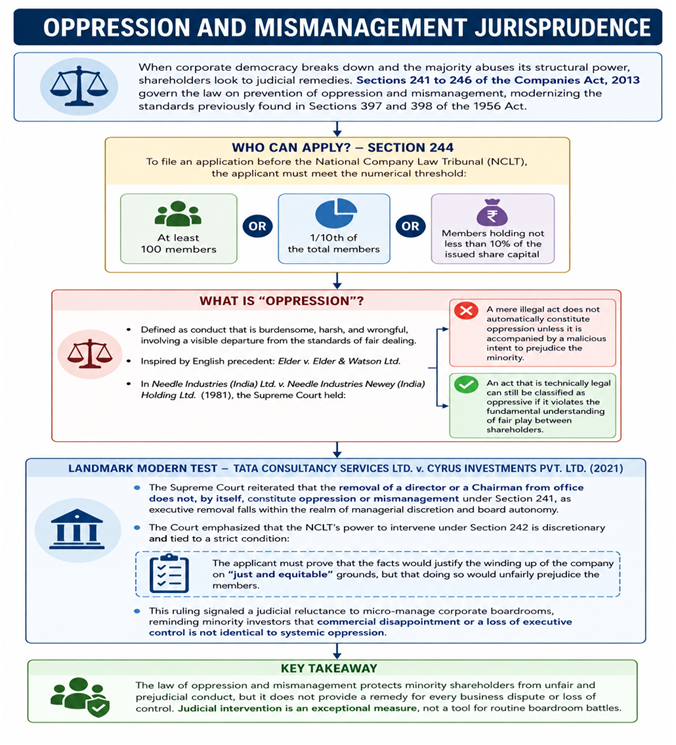
When corporate democracy breaks down and the majority abuses its structural power, shareholders look to judicial remedies. Sections 241 to 246 of the Companies Act, 2013 govern the law on prevention of oppression and mismanagement, modernizing the standards previously found in Sections 397 and 398 of the 1956 Act. To file an application before the National Company Law Tribunal (NCLT), the applicant must meet the numerical threshold set by Section 244: at least 100 members, or 1/10th of the total members, or members holding not less than 10% of the issued share capital.
The legal understanding of "oppression" has evolved substantially through Indian case law, drawing early inspiration from English precedents like Elder v. Elder & Watson Ltd. It is defined as conduct that is burdensome, harsh, and wrongful, involving a visible departure from the standards of fair dealing. In the landmark case of Needle Industries (India) Ltd. v. Needle Industries Newey (India) Holding Ltd. (1981), the Supreme Court of India clarified that a mere illegal act does not automatically constitute oppression unless it is accompanied by a malicious intent to prejudice the minority. Conversely, an act that is technically legal can still be classified as oppressive if it violates the fundamental understanding of fair play between shareholders.
The jurisprudence underwent its most rigorous modern test in the high-profile battle of Tata Consultancy Services Ltd. v. Cyrus Investments Pvt. Ltd. (2021). The Supreme Court reiterated that the removal of a director or a Chairman from office does not, by itself, constitute oppression or mismanagement under Section 241, as executive removal falls within the realm of managerial discretion and board autonomy. The Court emphasized that the NCLT’s power to intervene under Section 242 is discretionary and tied to a strict condition: the applicant must prove that the facts would justify the winding up of the company on "just and equitable" grounds, but that doing so would unfairly prejudice the members. This ruling signaled a judicial reluctance to micro-manage corporate boardrooms, reminding minority investors that commercial disappointment or a loss of executive control is not identical to systemic oppression.
5. CLASS ACTION LITIGATION AS A CORPORATE REMEDY
Prior to 2013, if a management team or a board committed fraud that harmed thousands of scattered retail investors, those investors had no viable, aggregated civil remedy within company law. They were forced to file individual lawsuits or rely on consumer forums and regulatory interventions by the Securities and Exchange Board of India (SEBI). Inspired by the United States style of class actions and triggered directly by the structural failures exposed during the Satyam computer scam of 2009, the legislature introduced Section 245 into the Companies Act, 2013.
Section 245 allows a specified number of members (100 members, or a percentage holding prescribed by the rules) or depositors to file a class action suit before the NCLT if they believe that the affairs of the company are being conducted in a manner prejudicial to the interests of the company or its members. The true innovation of Section 245 lies in its expansive scope regarding potential defendants. Unlike traditional oppression applications, which are generally confined to internal disputes against the company and its controlling directors, a class action suit can be filed not only against the company and its management, but also against:
- Statutory Auditors: Including the auditing firm and any partner who made misleading or fraudulent statements in their audit report.
- External Consultants & Advisors: Any professional who assisted in a deceptive or fraudulent scheme that led to shareholder losses.
This remedy shifts the accountability dynamic by creating a serious financial risk for gatekeepers who validate fraudulent financial reporting. By allowing the pooling of claims, it lowers individual litigation costs and gives retail investors a collective tool to seek damages or compensation directly from the individuals responsible for corporate malpractice.
6. ROLE OF NCLT IN PROTECTING MINORITY INTERESTS
The establishment of the National Company Law Tribunal (NCLT) and its appellate body, the NCLAT, under the 2013 Act was designed to replace the slow, fragmented system of the Company Law Board (CLB) and the High Courts. The NCLT functions as a specialized, quasi-judicial forum tasked with providing swift, expert adjudication on complex corporate disputes, particularly those involving allegations of oppression, mismanagement, and structural reorganization.
Under Section 242 of the Act, the NCLT is granted remarkably wide, equitable powers to remedy corporate malfunctions. The Tribunal is not merely an arbiter that strikes down resolutions; it has the legislative authority to actively restructure the internal governance of a non-compliant company. For instance, the NCLT can regulate the future conduct of the company’s affairs, order the compulsory purchase of shares of any members by other members, terminate or modify unfair agreements, and even appoint independent directors or an entirely new management team if the existing administration is found to be deeply compromised.
However, the expansive nature of these powers has occasionally led to jurisdictional overlaps and friction with other regulators, most notably SEBI. While the NCLT focuses on internal company governance and shareholder equities under the Companies Act, SEBI regulates the public market, investor protection, and market integrity under the SEBI Act, 1992. In cases involving listed companies, actions that constitute oppression (such as fraudulent asset stripping) simultaneously violate SEBI’s Prohibition of Fraudulent and Unfair Trade Practices (PFUTP) regulations. Indian courts have generally held that the jurisdictions are concurrent rather than mutually exclusive: the NCLT remedies the internal corporate wrong, while SEBI penalizes the market infraction and protects the broader public interest.
7. COMPARATIVE ANALYSIS WITH FOREIGN JURISDICTIONS
To evaluate the strength of India's minority protection framework, it is valuable to compare it with the legal approaches of the United Kingdom and the United States. As a common-law jurisdiction, India shares deep historical roots with the United Kingdom. The UK Companies Act, 2006 addresses these disputes through "unfair prejudice" claims under Section 994 and derivative claims under Section 260. A key point of divergence is that UK law allows an individual shareholder to bring an unfair prejudice claim regardless of their shareholding percentage, whereas India imposes a strict 10% statutory floor under Section 244 (though the NCLT retains the power to waive this requirement). The UK approach prioritizes individual access to justice, relying on the courts to filter out frivolous claims through cost orders, whereas the Indian approach utilizes numerical thresholds to protect companies from being held hostage by single, obstructionist shareholders.
In contrast, the United States, particularly Delaware corporate law, relies heavily on fiduciary duties rather than rigid statutory thresholds. In the US, controlling shareholders owe a direct fiduciary duty of loyalty and fairness to the minority. When a transaction involving a controlling shareholder is challenged, Delaware courts apply the strict "entire fairness" standard of review, placing the burden of proof squarely on the majority to demonstrate that the transaction featured both fair dealing (process) and a fair price (substance). Furthermore, the US has a deeply entrenched derivative suit culture, supported by contingency fee structures for attorneys, which makes shareholder litigation a primary driver of corporate accountability. India's framework is much more structurally rigid and codification-heavy; it relies on regulatory intervention and statutory compliance mandates rather than open-ended common-law fiduciary litigation to curb majority overreach.
8. CHALLENGES IN ENFORCEMENT
Despite possessing an advanced, progressive statutory framework on paper, the practical enforcement of minority shareholder protection in India faces significant operational bottlenecks. The most critical obstacle is institutional delay. The NCLT benches are severely overburdened, grappling with a massive influx of complex insolvency cases under the Insolvency and Bankruptcy Code (IBC), 2016 alongside their traditional company law workloads. Consequently, oppression and mismanagement applications, which require swift intervention to prevent asset stripping, frequently languish for years, diluting the efficacy of the remedy.
Another persistent challenge is the strict enforcement of the numerical thresholds required to initiate legal action. While Section 244 allows the NCLT to waive the 10% shareholding requirement in exceptional circumstances, the exercise of this judicial waiver has been uneven, sometimes leaving small retail investors with genuine grievances without a direct path to file an oppression claim. Additionally, institutional investors in India such as mutual funds, insurance companies, and state-owned financial institutions have historically adopted a passive approach to corporate governance. Rather than using their significant voting blocks to challenge promoter misbehavior or vote down questionable resolutions, they have traditionally preferred to simply exit the stock. While SEBI’s recent stewardship codes have begun pushing institutional investors toward active engagement, the culture of passive compliance remains a hurdle to genuine corporate democracy.
9. CONCLUSION
The journey of Indian corporate law has been a continuous process of balancing the efficiency of majority rule with the ethical and economic necessity of minority protection. The Companies Act, 2013 successfully dismantled the absolute immunity historically offered by the Foss v. Harbottle doctrine, replacing it with a nuanced, multi-layered regulatory architecture. Innovations such as mandatory independent oversight on related-party transactions, the introduction of class action suits, and the creation of a dedicated, specialized tribunal have significantly elevated the baseline for corporate governance in India.
However, the ultimate success of India’s corporate democracy depends on moving beyond statutory compliance to real, consistent enforcement. Legislative intent must be matched by operational efficiency within the NCLT, active stewardship from institutional investors, and a cultural shift among corporate promoters toward recognizing minority shareholders as genuine partners in enterprise. Only when these enforcement gaps are closed will India achieve a corporate environment where majority capital can drive commercial growth without compromising investor trust and market equity.
Join LAWyersClubIndia's network for daily News Updates, Judgment Summaries, Articles, Forum Threads, Online Law Courses, and MUCH MORE!!"


Tags :Others