
Index of Headings
- Introduction
- Factual Background
- Journey Through the Courts
- Statutory Framework: Section 138 and Proviso (b)
- The Question Before the Supreme Court
- “Giving of Notice” Means Dispatch to the Correct Address
- The Rebuttable Presumption and the Shifting Burden
- M.D. Thomas v. P.S. Jaleel Held Per Incuriam
- Application of the Law to the Facts
- Practical Implications for Complainants
- Practical Implications for Drawers
- Critical Analysis
- Conclusion
- Frequently Asked Questions
1.Introduction
Prosecutions for cheque dishonour under Section 138 of the Negotiable Instruments Act, 1881 (NI Act) form one of the largest categories of criminal litigation in Indian courts. Because the offence is created by statute and hedged by strict procedural preconditions, cases are frequently won or lost not on the merits of the underlying debt but on technical compliance with those preconditions. The most litigated of these is the statutory demand notice.
On September 30, 2026, a bench of Justice Ahsanuddin Amanullah and Justice Manmohan of the Supreme Court addressed a recurring question: if a demand notice is sent by registered post to the drawer’s correct address but is received by a family member rather than the drawer, is the notice validly served? The Court answered in the affirmative, set aside a Kerala High Court judgment that had acquitted the drawer on this very ground, and restored the conviction.
2.Factual Background
The case arose from a complaint under Section 138 of the NI Act concerning a loan of Rs. 3 lakhs advanced by the appellant (the complainant) to the second respondent (the drawer). The drawer issued a cheque towards repayment, and that cheque was dishonoured.
The complainant then issued a statutory demand notice dated August 31, 2016, by registered post to the drawer’s correct address. The notice was received by the drawer’s mother, Amina. No payment was made, and the drawer did not send any reply to the notice. The complaint followed.
3.Journey Through the Courts
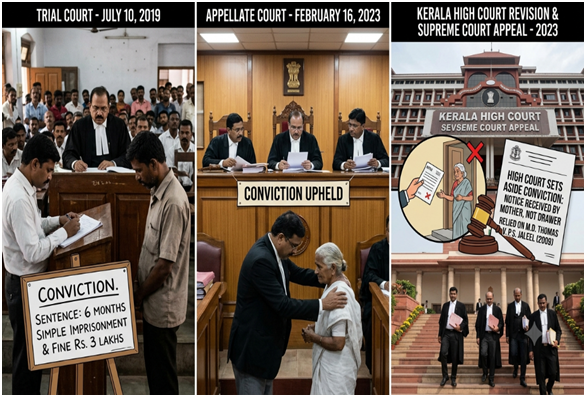
The Trial Court convicted the drawer on July 10, 2019, and sentenced him to six months’ simple imprisonment along with a fine of Rs. 3 lakhs. The appellate court upheld the conviction on February 16, 2023.
The drawer approached the Kerala High Court in revision under Section 397 of the Code of Criminal Procedure, 1973. The High Court set aside the conviction. Its reasoning was narrow: the requirement in proviso (b) to Section 138 had not been satisfied because the notice was received by the drawer’s mother and not by the drawer himself. In reaching this view, the High Court relied on the Supreme Court’s earlier decision in M.D. Thomas v. P.S. Jaleel (2009).
Aggrieved, the complainant moved the Supreme Court.
4.Statutory Framework: Section 138 and Proviso (b)
Section 138 makes dishonour of a cheque for insufficiency of funds, or because it exceeds the amount arranged to be paid, an offence punishable with imprisonment, fine, or both. The offence is not complete on dishonour alone. The proviso lays down cumulative conditions: the cheque must be presented within its validity period; the payee must make a demand for the amount by giving notice in writing to the drawer within thirty days of receiving information of dishonour from the bank; and the drawer must fail to pay within fifteen days of receipt of the notice.
Proviso (b) speaks of the payee “making a demand” by “giving a notice”. Proviso (c), in contrast, refers to the drawer’s failure to pay within fifteen days of the receipt of the notice. The interplay of the words “giving” and “receipt” has generated decades of litigation. Drawers have argued that the offence cannot arise unless the notice is actually received by them. Complainants have responded that a drawer cannot defeat prosecution by avoiding the postman, refusing delivery or leaving the notice unclaimed.
The Supreme Court’s three-judge bench decision in C.C. Alavi Haji v. Palapetty Muhammed (2007) addressed this tension and held that when a notice is sent by registered post to the correct address, the requirement of “giving of notice” is complied with, subject to the drawer’s right to rebut the presumption of service. That decision is the doctrinal anchor of the present judgment.
5.The Question Before the Supreme Court
The issue was straightforward but consequential. Where a statutory notice is dispatched by registered post to the drawer’s correct address, and is received by a family member who resides there, can the notice be treated as not served merely because the drawer personally did not receive it?
A related question was whether the High Court was right to follow M.D. Thomas, which on similar facts had reached the opposite result, given the earlier three-judge pronouncement in C.C. Alavi Haji.
6.“Giving of Notice” Means Dispatch to the Correct Address
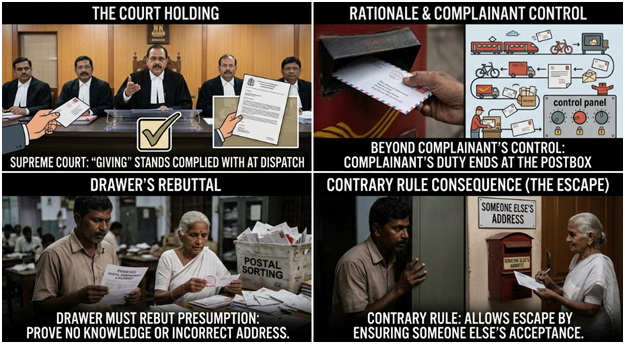
The Court held that the requirement of “giving of notice” stands complied with once the notice is dispatched to the correct address. The complainant’s statutory obligation is to send the notice to the drawer’s correct address. It does not extend to proving that the drawer personally received it or that he consciously evaded it.
The Court observed that, once the notice is dispatched to the correct address, it is for the drawer to rebut the presumption. In the Court’s words, the drawer must establish either that he had no knowledge of the notice having been brought to his address, or that the notice was not sent to the correct address, or that the postal endorsement is incorrect.
The rationale is consistent with the object of Section 138. Once a notice leaves the complainant’s hands, delivery depends on the postal system and on the circumstances of the drawer’s household, matters entirely beyond the complainant’s control. The Court accordingly held that the presumption of service cannot be defeated by circumstances beyond the complainant’s control. A contrary rule would allow a drawer to escape liability by ensuring that someone else at the address accepts the envelope, and then disclaiming personal receipt.
7.The Rebuttable Presumption and the Shifting Burden
Dispatch by registered post to the correct address raises a rebuttable presumption of service. This has two consequences.
First, the complainant’s burden is limited. The complainant must show that the notice was properly addressed and sent by registered post. Once that is done, the statutory presumption is attracted, and the complainant is not required to go further.
Second, the burden shifts to the drawer. The drawer can displace the presumption by showing, for example, that the address was incorrect, that he had no knowledge of the notice having reached his address, or that the postal endorsement is wrong. These illustrations indicate the kind of evidence that must be led. A bare denial of personal receipt is not enough.
Significantly, receipt by a family member is not treated as a defect. It is, if anything, a circumstance supporting the inference that the notice reached the drawer’s household and could reasonably have come to his knowledge. The inquiry is therefore not whether the drawer physically touched the notice, but whether he can credibly show that he did not know of it despite its delivery to his address.
8.M.D. Thomas v. P.S. Jaleel Held Per Incuriam
A notable feature of the judgment is its treatment of precedent. The Kerala High Court had relied on M.D. Thomas v. P.S. Jaleel (2009). In that case, a two-judge bench had set aside a conviction after finding that the statutory notice was served on the drawer’s wife rather than on the drawer.
The Supreme Court found that reliance bad in law. M.D. Thomas had been decided without considering the proposition laid down by the three-judge bench in C.C. Alavi Haji. Under the settled hierarchy of precedent, a bench of lesser strength cannot take a view contrary to a larger bench, and a decision rendered in ignorance of a binding earlier authority is per incuriam.
The Court accordingly held that M.D. Thomas was per incuriam. The practical effect is significant. For years, drawers in Kerala and elsewhere could cite M.D. Thomas to argue that service on a spouse or relative was no service at all. That line of argument is now closed. High Courts and trial courts must follow C.C. Alavi Haji, as reaffirmed in this judgment.
9.Application of the Law to the Facts
Applying these principles, the Court found substantial material establishing that the notice had been sent to the drawer’s correct address.
- The drawer later entered appearance pursuant to summons delivered at the very same address.
- His vakalatnama, appeal and revision petitions all carried the identical address.
- He never disputed the correctness of the address in his statement under Section 313 of the Code of Criminal Procedure.
- There was no case that the drawer and his mother lived separately, or that their relationship was such that receipt of the notice by the mother could not reasonably bring it to his knowledge.
On these facts, the Court held that the drawer had failed to rebut the presumption that attached once the notice was dispatched to his correct address. The High Court’s order was set aside and the conviction restored.
The analysis shows how courts will weigh the drawer’s own conduct. An address the drawer consistently uses in court filings is difficult to disown when it comes to receipt of a pre-litigation notice.
10.Practical Implications for Complainants
The decision offers reassurance, but diligent practice remains essential.
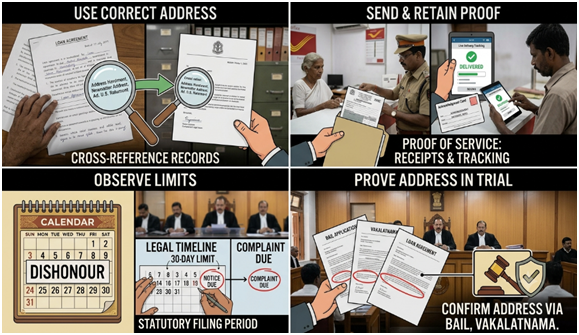
- Use the correct address. The entire presumption rests on dispatch to the correct address. Complainants should use the address in the loan or transaction records, cheque details and other documents, and preserve proof of the source.
- Send by registered post and retain proof. Postal receipts, tracking records and the acknowledgment or endorsement should be kept and proved in evidence.
- Observe the thirty-day limit. The notice must still be issued within thirty days of information of dishonour, and the complaint filed within the statutory period after the fifteen-day payment window expires.
- Prove the address in trial. Where the drawer later uses the same address in appearance, bail or vakalatnama documents, these can be brought on record to fortify the presumption, as the Court itself noted.
11.Practical Implications for Drawers
For drawers, the judgment signals that technical defences on service will face a higher threshold.
- A denial of personal receipt will not suffice. The drawer must lead evidence that the address was wrong, that he had no knowledge of the notice, or that the postal endorsement is incorrect.
- Consistency matters. Using the same address in court filings while denying it as the address for service is likely to be fatal.
- Family circumstances are relevant. If a drawer genuinely lived separately from the person who received the notice, or the relationship was estranged, that should be pleaded and proved, since the Court specifically noted the absence of any such case.
- Reply to notices. Even where service is disputed, a prompt reply gives the drawer an opportunity to raise objections on the record and to avoid an adverse inference from silence.
12.Critical Analysis
The ruling is a faithful application of the three-judge bench holding in C.C. Alavi Haji, and its principal virtue is clarity. By reaffirming that dispatch to the correct address completes the “giving” of notice, it removes an avenue by which technically minded drawers could defeat prosecutions that are otherwise made out.
At the same time, the judgment is balanced. It does not convert the presumption into an irrebuttable rule. A drawer who was genuinely not at the address, or who can show that the notice never reached his household, remains free to rebut the presumption. The Court’s list of illustrations preserves this protection. What the judgment forecloses is the shortcut defence that the notice was received by someone other than the drawer.
The decision also highlights a broader judicial concern with revisional interference. The Kerala High Court, exercising revisional jurisdiction, upset concurrent findings of conviction on a single technical ground that, on the correct law, was unavailable. The Supreme Court’s intervention reinforces that a conviction affirmed by two courts should not be set aside on the basis of a legal proposition that rests on a decision rendered per incuriam.
One may note that the outcome depended heavily on the factual matrix, particularly the drawer’s repeated use of the same address and the absence of any estrangement from his mother. A case with different facts, for instance where the drawer proves that the address was a former residence, could well be decided differently.
13.Conclusion
Sainaba v. State of Kerala settles an important procedural question in cheque dishonour law. A statutory demand notice dispatched by registered post to the drawer’s correct address is validly given, even if it is received by a family member. A rebuttable presumption of service arises, and the burden is on the drawer to displace it. M.D. Thomas v. P.S. Jaleel, to the extent it suggested otherwise, no longer carries precedential value.
For complainants, the lesson is meticulous attention to address and proof of dispatch. For drawers, it is that denial of personal receipt, without more, will not carry a defence.
14.FAQs
a.Is a Section 138 demand notice valid if it is received by the drawer’s family member?
Yes. If the notice is sent by registered post to the drawer’s correct address, it is validly given even if a family member receives it. A rebuttable presumption of service arises, and the drawer must prove that the address was wrong, that he had no knowledge of the notice, or that the postal endorsement is incorrect.
b.What is the effect of the ruling on M.D. Thomas v. P.S. Jaleel (2009)?
The Supreme Court held M.D. Thomas to be per incuriam because it ignored the three-judge bench decision in C.C. Alavi Haji (2007). It can no longer be relied on to argue that service on a spouse or relative is invalid.
Join LAWyersClubIndia's network for daily News Updates, Judgment Summaries, Articles, Forum Threads, Online Law Courses, and MUCH MORE!!"


Tags :Others