


INTRODUCTION
The principle of majority rule has long been regarded as the cornerstone of company law. Since a company functions through decisions taken by its shareholders, the will of the majority ordinarily prevails in matters concerning its management and affairs. This principle promotes efficiency in corporate decision-making and prevents unnecessary judicial interference in the internal functioning of companies. However, majority rule is not absolute. When controlling shareholders misuse their dominant position to prejudice minority shareholders or conduct the affairs of the company in a manner detrimental to its interests, judicial intervention becomes indispensable.
Corporate governance is founded not only on the concept of managerial autonomy but also on accountability and fairness. A company is a separate legal entity with diverse stakeholders, including minority shareholders whose interests deserve equal protection. Where majority shareholders abuse their powers by excluding minority shareholders from management, diverting company assets, manipulating shareholding, or acting in bad faith, the law provides remedies against such oppressive conduct. Similarly, when the affairs of a company are managed negligently or in a manner prejudicial to the company or public interest, the law recognises such conduct as mismanagement requiring corrective action.
Indian company law has gradually evolved from strictly following the principle of majority rule to recognising the need for protecting minority shareholders. While the Companies Act, 1956 introduced remedies against oppression and mismanagement under Sections 397 and 398, the Companies Act, 2013 consolidated and strengthened these protections through Sections 241 to 246. The establishment of the National Company Law Tribunal (NCLT) has further enhanced the effectiveness of these remedies by providing a specialised forum for resolving corporate disputes.
HISTORICAL DEVELOPMENT OF MINORITY REMEDIES
The law relating to oppression and mismanagement has its roots in English company law. The foundation of the majority rule principle was laid by the landmark decision in Foss v. Harbottle (1843). In this case, the Court held that where a wrong is committed against a company, the company itself is the proper plaintiff to institute legal proceedings. Since companies act through the will of the majority, courts ordinarily refrain from interfering in internal management where the majority has approved a particular decision.
The rule in Foss v. Harbottle serves two important objectives. First, it prevents multiplicity of proceedings by individual shareholders. Second, it respects the democratic nature of corporate decision-making by allowing the majority to determine the company's affairs.
However, rigid application of this rule often resulted in injustice. Minority shareholders found themselves without an effective remedy when the wrongdoers themselves controlled the majority and prevented the company from initiating legal proceedings. Recognising this limitation, courts gradually evolved several exceptions to the rule, particularly where actions were fraudulent, illegal, ultra vires, or oppressive towards minority shareholders.
Indian company law adopted these principles under the Companies Act, 1956 through Sections 397 and 398, which empowered courts to grant relief in cases of oppression and mismanagement. These provisions marked a significant shift from merely protecting majority rule to recognising equitable remedies for minority shareholders.
Subsequently, the Companies Act, 2013 replaced these provisions with Sections 241 to 246. The new legislation expanded the scope of judicial remedies, strengthened the powers of the Tribunal, and introduced greater flexibility in granting relief. Unlike ordinary civil remedies, these provisions focus on preventing future prejudice rather than merely compensating past losses.
The legislative evolution demonstrates that while majority rule remains the governing principle of company law, it cannot operate to legitimise unfair conduct or abuse of power. Minority protection has therefore become an integral component of modern corporate governance.
STATUTORY FRAMEWORK UNDER THE COMPANIES ACT, 2013
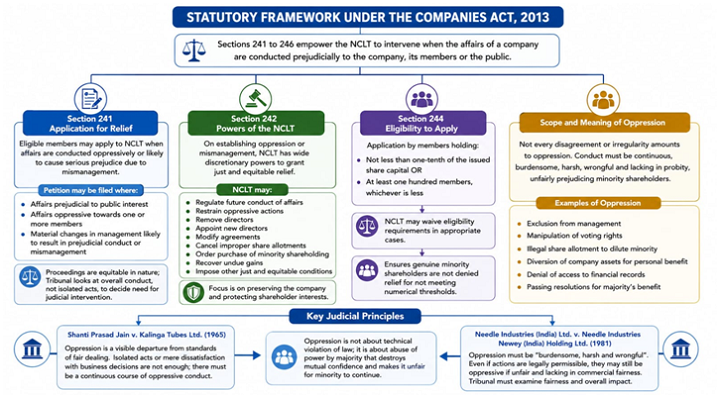
The Companies Act, 2013 provides a comprehensive statutory framework to address cases of oppression and mismanagement. Sections 241 to 246 empower the National Company Law Tribunal to intervene where the affairs of a company are conducted in a manner prejudicial to the interests of the company, its members, or the public.
Section 241 – Application for Relief
Section 241 enables eligible members to apply before the NCLT when they believe that the affairs of the company are being conducted oppressively or are likely to cause serious prejudice due to mismanagement. The provision is preventive in nature and seeks to prevent continuing harm rather than merely punish wrongful conduct.
A petition may be filed where:
- the affairs of the company are conducted in a manner prejudicial to public interest;
- the affairs are oppressive towards one or more members;
- material changes in management are likely to result in prejudicial conduct or mismanagement.
Unlike ordinary civil litigation, proceedings under Section 241 are equitable in nature. The Tribunal examines the overall conduct of the parties rather than isolated acts and determines whether judicial intervention is necessary to protect the interests of the company.
Section 242 – Powers of the NCLT
Section 242 grants wide discretionary powers to the Tribunal once oppression or mismanagement is established. The objective is not merely to declare rights but to provide practical solutions that restore fairness in corporate management.
The Tribunal may regulate the future conduct of the company's affairs, restrain oppressive actions, remove directors, appoint new directors, modify agreements, cancel improper share allotments, order the purchase of minority shareholding, recover undue gains, or impose such other conditions as it considers just and equitable.
These powers distinguish proceedings under Sections 241 and 242 from ordinary civil remedies because the emphasis is on preserving the company while protecting shareholder interests.
Eligibility to Apply
Section 244 prescribes eligibility requirements for filing petitions. Generally, applications may be made by members holding not less than one-tenth of the issued share capital or constituting at least one hundred members, whichever is less. However, recognising that genuine cases may arise where these thresholds cannot be satisfied, the Tribunal possesses the discretion to waive these eligibility requirements in appropriate cases.
The waiver provision reflects the equitable character of the legislation and ensures that deserving minority shareholders are not denied relief merely because they fail to satisfy numerical thresholds.
Scope and Meaning of Oppression
The term "oppression" has not been specifically defined under the Companies Act, 2013. Instead, its meaning has evolved through judicial interpretation over several decades. Courts have consistently held that not every disagreement between shareholders or every irregularity in the management of a company amounts to oppression. The conduct complained of must be continuous, burdensome, harsh, wrongful, and lacking in probity. It must demonstrate that the majority has exercised its powers in a manner that unfairly prejudices the legitimate interests of minority shareholders.
Oppression generally occurs when the majority uses its controlling position to deny minority shareholders their legal or equitable rights. Such conduct may include exclusion from the management of the company, manipulation of voting rights, illegal allotment of shares to dilute minority shareholding, diversion of company assets for personal benefit, denial of access to financial records, or passing resolutions solely to benefit the majority. The underlying principle is that majority shareholders must exercise their powers in good faith and in the interests of the company rather than for personal advantage.
The Supreme Court, in Shanti Prasad Jain v. Kalinga Tubes Ltd. (1965), observed that oppression involves a visible departure from the standards of fair dealing expected among shareholders. The Court clarified that isolated acts or mere dissatisfaction with business decisions are insufficient to establish oppression. Instead, there must be a continuous course of conduct that is oppressive to the minority.
Similarly, in Needle Industries (India) Ltd. v. Needle Industries Newey (India) Holding Ltd. (1981), the Supreme Court held that oppression must be "burdensome, harsh and wrongful." The Court further explained that even if certain actions are legally permissible, they may still constitute oppression if they are unfair and lack commercial fairness. This judgment established that the Tribunal must examine not merely the legality of an act but also its fairness and its overall impact on minority shareholders.
Therefore, the concept of oppression extends beyond technical violations of law. It focuses on whether the majority has abused its powers in a manner that destroys mutual confidence among shareholders and makes it unfair for the minority to continue under the existing management.
SCOPE AND MEANING OF MISMANAGEMENT
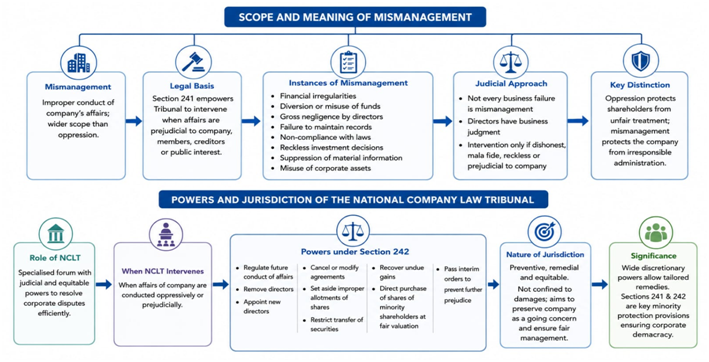
While oppression primarily concerns unfair treatment of shareholders, mismanagement relates to the improper conduct of the company's affairs. A company may be managed inefficiently or negligently without any deliberate intention to oppress minority shareholders. Consequently, the concept of mismanagement has a wider scope and focuses on protecting the interests of the company itself.
Section 241 of the Companies Act, 2013 empowers the Tribunal to intervene where the affairs of the company are being conducted in a manner prejudicial to the company, its members, creditors, or the public interest. The emphasis is on preventing future harm rather than waiting until actual loss has occurred.
Instances of mismanagement may include persistent financial irregularities, diversion or misuse of company funds, gross negligence by directors, failure to maintain statutory records, non-compliance with regulatory requirements, reckless investment decisions, suppression of material financial information, or misuse of corporate assets for personal purposes. Such conduct may seriously affect the financial stability and reputation of the company even though it does not directly target minority shareholders.
However, courts have consistently distinguished mismanagement from ordinary commercial failures. Every unsuccessful business decision cannot become a ground for judicial intervention. Corporate management necessarily involves commercial risks, and directors are entitled to exercise business judgment. Judicial interference becomes necessary only when management decisions are dishonest, mala fide, reckless, or clearly prejudicial to the interests of the company.
Thus, while oppression protects shareholders from unfair treatment, mismanagement protects the company itself from irresponsible or prejudicial administration. Although the two concepts frequently overlap, they remain legally distinct and require separate consideration by the Tribunal.
POWERS AND JURISDICTION OF THE NATIONAL COMPANY LAW TRIBUNAL
The National Company Law Tribunal occupies a central position in the enforcement of remedies relating to oppression and mismanagement. Established under the Companies Act, 2013, the Tribunal functions as a specialised forum possessing both judicial and equitable powers to resolve corporate disputes efficiently.
Once the Tribunal is satisfied that the affairs of a company are being conducted oppressively or prejudicially, Section 242 empowers it to pass such orders as it considers just and equitable. These powers are intentionally broad because rigid remedies may not adequately address the diverse forms of corporate misconduct.
The Tribunal may regulate the future conduct of the company's affairs, remove directors responsible for oppressive conduct, appoint new directors, cancel or modify agreements entered into by the company, set aside improper allotments of shares, restrict the transfer of securities, recover undue gains obtained by directors or managerial personnel, and direct the purchase of shares belonging to minority shareholders at a fair valuation. In appropriate cases, it may also pass interim orders to prevent further prejudice while the proceedings remain pending.
Unlike ordinary civil courts, the NCLT is not confined to awarding damages. Its jurisdiction is preventive, remedial, and equitable. The primary objective is to preserve the company as a going concern while ensuring that its affairs are conducted fairly and in accordance with law.
The wide discretionary powers of the Tribunal enable it to tailor remedies according to the facts of each case. This flexibility has made Sections 241 and 242 among the most effective minority protection provisions under Indian company law, allowing the Tribunal to intervene whenever corporate democracy is undermined by abuse of majority power or persistent mismanagement.
JUDICIAL TRENDS AND CASE LAW ANALYSIS
Judicial interpretation has played a crucial role in shaping the law relating to oppression and mismanagement in India. Since the Companies Act does not expressly define either term, courts and tribunals have developed principles to determine when judicial intervention is justified. Over the years, the judiciary has attempted to strike a balance between preserving the principle of majority rule and protecting minority shareholders from abuse of power.
The foundation of minority shareholder protection can be traced to the English decision in Foss v. Harbottle (1843). The Court held that a company is the proper plaintiff in actions concerning wrongs committed against it and that courts should ordinarily not interfere in matters approved by the majority of shareholders. This principle reinforced corporate democracy but often left minority shareholders without an effective remedy where those committing the wrong also controlled the company. Consequently, courts gradually recognised exceptions to the rule, particularly in cases involving fraud, illegality, oppression, or abuse of majority powers.
In India, the Supreme Court elaborated the meaning of oppression in Shanti Prasad Jain v. Kalinga Tubes Ltd. (1965). The Court observed that oppression involves a continuous course of conduct that is burdensome, harsh, and wrongful towards minority shareholders. It clarified that isolated illegal acts or mere dissatisfaction with management decisions do not constitute oppression. Instead, there must be evidence of a lack of fairness and probity in the conduct of the company's affairs.
A more detailed interpretation emerged in Needle Industries (India) Ltd. v. Needle Industries Newey (India) Holding Ltd. (1981), where the Supreme Court held that even actions which are legally valid may amount to oppression if they unfairly prejudice minority shareholders. The Court emphasised that corporate powers must be exercised in good faith and for the benefit of the company as a whole rather than for the personal advantage of the majority. This judgment remains one of the leading authorities on the principles governing oppression under Indian company law.
More recently, the dispute between the Tata Group and Cyrus Mistry brought renewed attention to the scope of judicial intervention. In Tata Consultancy Services Ltd. v. Cyrus Investments Pvt. Ltd. (2021), the Supreme Court examined whether the removal of Cyrus Mistry as Executive Chairman of Tata Sons constituted oppression and mismanagement. While the NCLAT had initially granted relief in favour of Cyrus Mistry, the Supreme Court reversed that decision, holding that every removal from management cannot automatically amount to oppression. The Court reiterated that commercial disagreements or differences in business strategy cannot justify judicial intervention unless there is clear evidence of unfair prejudice or abuse of majority power.
These decisions demonstrate that Indian courts exercise restraint while interfering in corporate affairs. Judicial intervention is intended to remedy genuine cases of oppression or mismanagement and not to substitute the commercial judgment of directors or shareholders.
REFORMING CORPORATE DISPUTE RESOLUTION
Although the Companies Act, 2013 has considerably strengthened minority shareholder protection, several reforms are necessary to improve the effectiveness of dispute resolution. Proceedings before the National Company Law Tribunal often involve significant delays due to increasing case pendency and limited judicial infrastructure. Since corporate disputes frequently involve ongoing management decisions, delayed adjudication may diminish the effectiveness of the remedies provided under the Act.
One important reform would be strengthening institutional capacity by increasing the number of NCLT benches and ensuring timely disposal of shareholder disputes. Greater use of mediation and negotiated settlements may also reduce prolonged litigation, particularly in closely held companies where preserving business relationships is often more beneficial than adversarial proceedings.
There is also a need for clearer judicial guidelines regarding what constitutes oppression and mismanagement. While judicial precedents provide considerable guidance, the absence of statutory definitions sometimes leads to inconsistent interpretations. More consistent standards would improve predictability and reduce unnecessary litigation.
Corporate governance mechanisms should likewise be strengthened to prevent disputes before they arise. Independent directors, transparent disclosure practices, effective audit committees, and stronger shareholder communication can minimise conflicts between majority and minority shareholders. Preventive governance is often more effective than post-dispute judicial intervention.
CONCLUSION
The law relating to oppression and mismanagement represents one of the most important safeguards available to minority shareholders under Indian company law. While the principle of majority rule remains fundamental to corporate democracy, it cannot be permitted to legitimise unfair, oppressive, or prejudicial conduct. Sections 241 to 246 of the Companies Act, 2013 provide a comprehensive framework enabling the National Company Law Tribunal to intervene where the affairs of a company are conducted in a manner detrimental to its members, creditors, or the public interest.
Judicial decisions such as Shanti Prasad Jain, Needle Industries, and Tata Consultancy Services Ltd. v. Cyrus Investments have clarified that courts will intervene only where there is a continuous pattern of unfair conduct, lack of probity, or serious mismanagement. At the same time, they have recognised that ordinary commercial disagreements and unsuccessful business decisions should not invite judicial interference.
As India's corporate landscape continues to evolve, effective corporate governance will depend upon maintaining an appropriate balance between managerial autonomy and judicial oversight. Strengthening the efficiency of the NCLT, promoting alternative dispute resolution, and encouraging transparent corporate governance practices will further reinforce investor confidence and minority shareholder protection.
Click here to download the original copy of the Files
Join LAWyersClubIndia's network for daily News Updates, Judgment Summaries, Articles, Forum Threads, Online Law Courses, and MUCH MORE!!"


Tags :Others


