
INTRODUCTION
A trademark is no longer simply a logo that is displayed on a product or service. In today's commercial world, a trademark is more than just a logo that is displayed on a product or service. It is the value of a business's identity, goodwill, reputation, and market value. Trademarks are often one of the most valuable assets of the modern economy, as consumers often identify the quality and trustworthiness of a product with a name, logo, slogan or packaging style. Companies spend significant money and creative effort building a brand identity, and trademark law's purpose is to provide legal protection against competitors' attempts to duplicate or deceive. Trademark law is designed to protect a company's commercial identity from duplication or deception by competitors, and companies invest large sums of money and creative resources in building their brand.
The protection of trademarks in India is governed by the Trade Marks Act, 1999 and the Trade Marks Rules, 2017. The legislation offers a comprehensive system of trademark registration, protection, enforcement, assignment, and licencing, as well as infringement. Indian law provides for common law rights of prior use, but registration is strategically essential to provide the proprietor with statutory protection, and to enhance the enforcement tools available to the proprietor.
Trademark registration has become a much more important aspect in the digital age. In today's world, businesses exist on a physical market, as well as on a website, an e-commerce platform, through the use of social media branding, and digital advertisements.
UNDERSTANDING THE CONCEPT OF TRADEMARK UNDER INDIAN LAW
The definition of trademark is given under section 2(1)(zb) of the Trade Marks Act 1999. The provision defines a trademark as a sign that can be represented graphically and can distinguish the goods/services of a person from those of other persons.
The definition as per the Indian legislations is intentionally wide and flexible. It acknowledges the fact that brand is not just about words or labels but is also in many forms of commercial identifiers. A trademark can be:
- Brand names
- Words
- Signatures
- Symbols
- Devices
- Labels
- Logos
- Combination of colours
- Shapes of goods
- Packaging styles
- Sound marks
The essential requirement is that the mark must be capable of distinguishing the goods or services of one trader from the goods or services of another trader. Trademark protection serves thus a double purpose. First, it safeguards the goodwill and reputation that businesses have developed over the years. Secondly, it shields consumers from confusion and deception in the marketplace.
For example, the Apple logo or the Nokia tune immediately brings a clear idea of the commercial source to the consumer's mind. That association is protected by the trademark law against being exploited without permission.
The notion of trademarks is based on the principle of fair competition. So if companies could be allowed to copy other companies' trademarks freely, consumers would be confused and good business practices would break down.
IMPORTANCE OF TRADEMARK REGISTRATION IN INDIA
Many companies and start-ups believe that just using a well-known brand name is enough to ensure full protection. Prior use rights exist under Indian law, but they are not very strong and would be virtually risky if they were relied upon solely.
There are many significant legal and commercial benefits to registering a trademark that can significantly improve a company's competitive edge.
Exclusive Statutory Rights
When the trademark is registered, the proprietor has exclusive rights to use the trademark in relation to the goods or services for which it is registered. This is especially significant if other companies try to use the same name.
Registered trademarks are given statutory recognition under the Trade Marks Act, 1999 as compared to unregistered trademarks. This statutory recognition makes enforcement easier and provides enhanced legal enforcement rights to the owner in court or in front of authorities.
Right to Sue for Infringement
A major advantage of registration is that Section 29 of the Trade Marks Act allows for proceedings for infringement of rights once the trade mark is registered.
The common law remedy of passing off involves proving goodwill, misrepresentation and damage, and is generally the remedy that an unregistered proprietor must rely upon. However, infringement actions are comparatively easier as there is a presumption of ownership and validity created in the process of registration.
Creation of Valuable Intellectual Property
A registered trademark is not just a legal right, it's also a business asset. Trademarks can be:
- Licensed
- Assigned
- Franchised
- Commercially monetized
Numerous trademarked companies around the world make use of their trademarks for a significant amount.
Consumer Trust and Market Recognition.
Consumers can often recognize products and services based on their trademark rather than the manufacturer's name. Registration thus enhances the credibility of the market and consumer confidence.
Protection against counterfeiting and misuse.
There are significant commercial concerns of counterfeit products and deceptive imitations in India. Registration is a huge help in the enforcement of unauthorized use and brand piracy.
Facilitating International Expansion
Trademark registration is significant to the businesses that plan to expand their operations abroad, as they can derive significant benefits from trademark registration in India, which may be useful for applications filed abroad under the Madrid Protocol system.
Therefore, trademark registration is not just about protecting the rights of the trademark owner, but also about investing in the business for the long term.
THE STEP-BY-STEP REGISTRATION PROCESS PRESCRIBED UNDER THE TRADE MARKS ACT, 1999 AND THE TRADE MARKS RULES, 2017.
The first step in the trademark registration process is to choose a mark that can be protected under the Trade Marks Act, 1999. This is an important stage as the power and distinctiveness of a trademark can significantly influence its registrability and enforceability.
According to Section 2(1)(zb) of the Trade Marks Act a trademark shall be capable of being represented graphically and distinguish the goods or services of one person from those of another. Thus, a mark which merely refers to the nature, quality, intended use or characteristics of the goods may be objectionable on examination.
In commercial use, trademarks can be classified based on their distinctiveness:
- Fanciful marks are invented words with no dictionary meaning, such as “Kodak.”
- Arbitrary marks are ordinary words used in an unrelated context, such as “Apple” for electronic goods.
- Suggestive marks indirectly indicate characteristics of goods or services without directly describing them.
- Descriptive marks directly describe qualities or characteristics of goods and may face objections unless they acquire distinctiveness through extensive use.
- Generic terms ordinarily cannot function as trademarks because they refer to the product category itself.
While these classifications are well known in trademark jurisprudence, they are not explicitly defined in the Trade Marks Act. In spite of this, Indian courts and trademark authorities continue to use the concept of distinctiveness in the evaluation of registrability.
Absolute Grounds for Refusal Under Section 9
The grounds of absolute refusal are set out in Section 9 of the Trade Marks Act, 1999. A trademark will not be registered if it:
- lacks distinctive character;
- is made up only of marks or indications which represent features of goods or services;
- has become a part of the natural use of the language or the trade practice;
- will probably mislead or confuse people;
- offers information that might offend religious feelings;
- is scandalous or obscene in nature; or
- Is forbidden by law.
These restrictions are intended to stop the monopoly on expressions of description or commonly used terms that are essential for the fair competition.
But it is not a foregone conclusion in all cases. If the applicant can demonstrate that the mark has acquired a distinctive character through its very use before the date of its application, then the mark may be registered.
Judicial Interpretation
The Court in Imperial Tobacco Co. v. Registrar of Trade Marks stated that geographical names are usually not inherently distinctive and that they cannot be protected as such without acquired distinctiveness, which is established by extensive commercial association.
The ruling was meant to reaffirm the basic tenet of trademark law that trademarks are meant to protect marks that serve as source identifiers, rather than mere descriptive expressions.
The practical considerations of choosing a trademark.
Prior to registration, trademark applicants typically perform a commercial and legal search to see if the trademarked mark:
- stands out and is memorable;
- does not describe the product or service that is sold;
- does not copy the already established reputed brands;
- can be commercially viable for expansion in the future; and
- can withstand scrutiny under Sections 9 and 11 of the Act.
By carefully choosing a trademark, you minimize the risk of objections, opposition and future enforcement action.
Step 2: Conducting a Trademark Search
Once a proposed trademark has been chosen, the next step is to perform a trademark search on the Trade Marks Registry records. While it is not required by the Trade Marks Act, it is a sensible and commercially useful process to carry out before lodging an application.
The main goal of the search is to determine if there are any existing trademarks that could cause conflicts with the proposed trademark, and possibly cause trademark opposition or trademark infringement issues.
Purpose of Trademark Search
A trademark search helps applicants to ascertain:
- there are already similar trademarks;
- there are registered or pending marks that are deceptively similar;
- there are similar phonetic expressions;
- similar logo or device marks are registered; or
- there is a likelihood of confusion among consumers with the proposed mark.
Search does not guarantee registration as the Registrar's decision is made on an individual basis. It does significantly lower the likelihood of foreseeable conflicts.
Types of Trademark Searches
Word Mark Search
A word mark search looks at the similarity of words in the proposed mark and existing marks.
For instance, if the marks are phonetically or visually similar, there can be legal objections to slight spelling changes.
Phonetic Search
Phonetic searches evaluate similarity in sound, not spelling. Indian trademark law acknowledges that consumers are sometimes misled due to their incomplete memory.
For this reason, even when the spelling is different, marks that are deceptively similar could still be deceptive.
Vienna Code Search
If the proposed trademark contains a logo, symbol or graphical device, a Vienna Code search can be done. The device marks are classified in accordance with internationally established visual classification systems.
This search helps to find graphically similar marks that are already registered.
Relative Grounds for Refusal to Grant Section 11
Section 11 of the Trade Marks Act, 1999 provides for the relative grounds for refusal of registration. A trademark can be denied if there is a risk of confusion that arises from the similarity or identity of the trademark and the prior trademark, and the similarity of goods or services.
In evaluating deceptive similarity, the authorities take into account the following:
- visual similarity;
- phonetic similarity;
- structural similarity;
- scope of the activities of the enterprise;
- class of purchasers;
- how the product was acquired; and
- surrounding commercial circumstances.
Whether an average consumer is likely to be misled about the source or association of goods or services is the key factor.
Judicial Interpretation
The Supreme Court, in Cadila Healthcare Ltd. v Cadila Pharmaceuticals Ltd, has made it clear that the test of similarity must be made from the average consumer's point of view with imperfect memory. The Court explained that even if there are differences with respect to spelling, phonetic similarity can lead to confusion.
A business can face the following risks if it doesn't properly search for trademarks:
- examination objections;
- opposition proceedings;
- infringement litigation;
- market confusion;
- reputational harm; and
- rebranding costs.
Often, companies spend a significant amount of money on advertising, packaging and branding their products online only to discover that the trademark they are seeking conflicts with existing rights.
For this reason, a trademark search serves as more of a risk management tool in the trademark registration process, rather than just a procedural safeguard.
Step 3: Determining the Appropriate Trademark Class
Trademark registration in India is a class based one. Protection is normally only provided for goods or services the trademark is registered for. Therefore, determining the correct class is an important step in the registration procedure that will have legal consequences.
India follows the internationally recognized Nice Classification system, which divides goods and services into forty-five separate classes:
- Classes 1 to 34 relate to goods;
- Classes 35 to 45 relate to services.
An applicant should indicate the appropriate class or classes in connection with the nature of commercial activities for which protection is desired.
Some examples of Trademark classes.
- Class 25 generally covers clothing, footwear, and headgear.
- Class 30 includes food products such as tea, coffee, and confectionery.
- Class 35 relates to advertising and business management services.
- Class 42 commonly covers technological and software-related services.
- Class 45 includes legal and security services.
If a business is engaged in several commercial fields, applications can be made in more than one class.
Importance of Proper Classification
Misclassification can lead to practical and legal difficulties. Simply being registered in one class does not give blanket protection in all other classes of goods/services.
But the extent of protection will ultimately rely on several factors such as:
- similarity of marks;
- form of the goods or services;
- likelihood of confusion;
- reputation of the mark; and
- Actual conditions of each case.
In some cases, well-known trademarks may, under the provisions of Section 11 of the Act, benefit from a more extensive protection than that provided by the classes of their registered trademarks.
So, not only the current business activity, but also the future expansion of the company and brand strategy should be taken into consideration when making a class selection.
Step 4: Filing the Trademark Application
After the proposed trademark and the appropriate class have been determined, the applicant can file the trademark application with the Trade Marks Registry.
Typically, applications are submitted online on the official IP India portal, but filing by hard copy is legally allowed as long as the procedure is followed.
Generally, the applications are filed in Form TM-A in accordance with the Trade Marks Rules, 2017.
Who May Apply
Anyone who feels that he/she is the proprietor of a trademark can apply for its registration under Section 18 of the Trade Marks Act. Applicants may include:
- individuals;
- companies;
- limited liability partnerships;
- partnership firms;
- startups;
- trusts; and
- societies.
If the application is submitted on a “proposed to be used” basis, the applicant does not need to have incorporated or engaged in commercial activities at the time of filing the application.
Information and Documents Generally Required
A trademark application ordinarily includes:
- name and address of the applicant;
- representation of the trademark;
- description of goods or services;
- relevant trademark class;
- date of first use, where applicable;
- user affidavit and supporting documents, where prior use is claimed; and
- authorization documents if filed through an agent or attorney.
Where prior commercial use is claimed, supporting evidence may include:
- invoices;
- advertisements;
- website extracts;
- packaging materials; or
- promotional documents.
“Proposed to Be Used” and Prior Use Claims
Indian trademark law recognizes both:
- applications from commercial uses; and
- Applications filed on a basis of intended use.
In general, India is a first come, first served jurisdiction in that when it comes to appropriation, earlier use takes precedence over subsequent registration. But the principle of "prior use" requires factual analysis including:
- continuity of use;
- territorial reputation;
- goodwill;
- honest adoption; and
- surrounding circumstances.
So, while no prior use is a defense to all later registrations, it is certainly a relevant factor in trademark litigation.
Application Number and Use of “TM” Symbol
An application number is assigned when the application is filed successfully. The applicant can then apply the “TM” trademark symbol to the mark to state that it is claiming ownership of a trademark.
The “TM” symbol, however, does not automatically grant statutory rights of registration, or conclusive proof of ownership. Finally, the protection of the legal kind depends on registration, previous use, distinctiveness and distinguishable goodwill.
In general, the “®” is only allowed to follow a registered trademark. Marks may be treated as registered by third parties without authority, and this could lead to legal repercussions under the Trade Marks Act.
Step 5: Examination by the Trade Marks Registry
Once the application has been filed the Trade Marks Registry examines the application to see that it meets the statutory requirements set out in the Trade Marks Act, 1999 and the relevant rules.
The examination process is based on the scrutiny of both:
- absolute grounds under section 9; and
- the relative grounds referred to in Section 11.
The Registry reviews to determine if the proposed trademark:
- possesses sufficient distinctiveness;
- conflicts with the prior trademarks;
- will likely mislead or mislead consumers; or
- otherwise violates statutory prohibitions.
Examination Report
Should any objections be made, an Examination Report is issued by the Registry giving the reasons for the objection.
Common objections might be about:
- descriptiveness;
- lack of distinctiveness;
- confusion in the mind of the public due to the similarity of the mark; and
- Incorrect specification of goods/services; or
- procedural deficiencies.
The period of time between the date of the examination and the date of the report of the results of the examination may differ depending on the administration and the registry procedure.
REPLY TO EXAMINATION REPORT.
It is to be expected that the applicant will present the Registry with a written response within the stipulated time that addresses the objections raised by the Registry.
The answer can consist of:
- legal submissions;
- indications of previous occupancy;
- proof of acquired distinctiveness;
- judicial precedents; and
- Factual clarification of the mark.
If the application is not responded within the stipulated time, it may be abandoned.
Hearing Before the Registrar
The Registrar may hold a hearing if, after reading the written response, he/she still is not satisfied with the response.
At the hearing, the applicant or authorized counsel may make oral submissions about:
- honest adoption;
- no consumer confusion;
- acquired reputation;
- distinctiveness; or
- Relevant legal considerations (other).
The Registrar may, after considering the submissions:
- accept the application;
- put restrictions or conditions on; or
- refuse registration.
Step 6: Publication in the Trade Marks Journal.
If the Registrar accepts the application, either without any conditions or with conditions, the trademark is published in the Trade Marks Journal.
The publication is a public notice of the proposed registration and enables third parties to oppose the application if they think that its registration may have a negative impact on their rights.
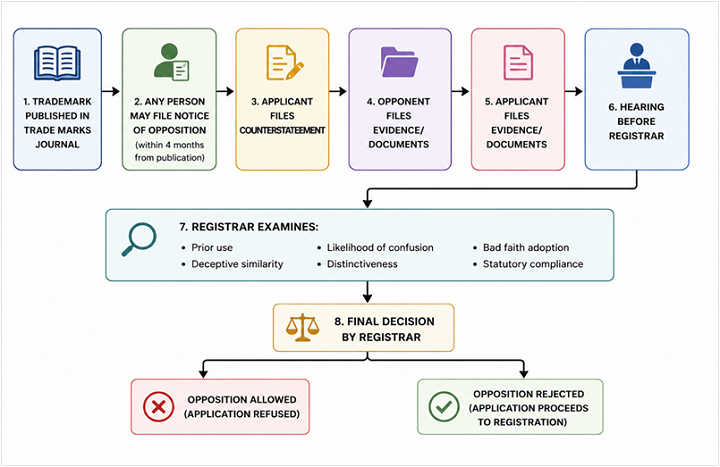
Step 7: Opposition Proceedings
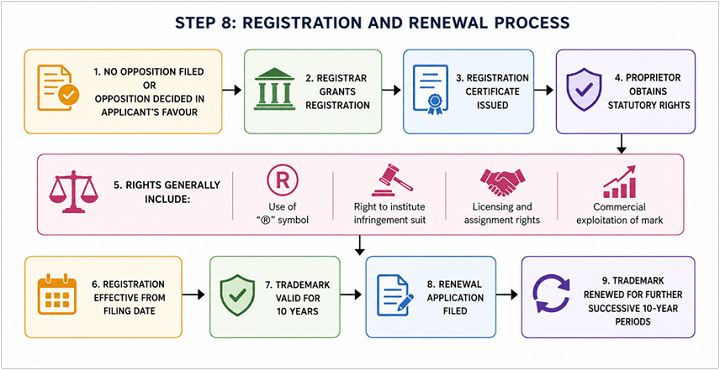
Step 8: Registration and Renewal
CONCLUSION
The registration of a trademark in India is an essential legal security to safeguard brand identification, business goodwill, and customer confidence. Under the Trade Marks Act, 1999, there are several crucial steps in the process, such as: choosing a distinctive mark, conducting a trademark search, classifying the mark, filing, examination, publication, opposition and registration. The stages guarantee that protection is only granted for valid and non-deceptive trademarks.
Registration is a necessary condition for trademark protection in India and it also enhances enforcement, but the protection of a trademark is also based on other considerations like prior use, distinctiveness and likelihood of confusion. The courts have been consistent on the need to strike a balance between proprietary business interest and fair competition and public interest.
Trademarks can be important intellectual property tools that can be used to create long-term commercial and reputational benefits in the competitive commercial landscape today. The registration is therefore not just a formality but also a crucial step towards ensuring and safeguarding the market identity of a business.
Join LAWyersClubIndia's network for daily News Updates, Judgment Summaries, Articles, Forum Threads, Online Law Courses, and MUCH MORE!!"


Tags :Others