
Abstract
On 15 October 2026, a Bench of the Supreme Court of India comprising Justices J.B. Pardiwala and K. Vinod Chandran held that the right to access and use the internet is a fundamental right of every individual under Article 21 read with Article 19(1)(a) of the Constitution, and that children, irrespective of their age, share it. The declaration came in Just Rights for Children Alliance v S Harish, a proceeding about the detection and removal of child sexual exploitation and abuse material (CSEAM). This paper traces the doctrinal path to the declaration, analyses the Court’s reasons for rejecting blanket restrictions on children’s internet use, maps the accompanying CSEAM framework, and sets the ruling against Australia’s under-16 account ban and India’s own Digital Personal Data Protection regime. It argues that the judgment’s deepest contribution is a change of regulatory target, from the child who uses the internet to the harm that travels through it, while identifying open questions on precedential weight, positive state duties, parental authority and age assurance. A practitioner-oriented section explains how the ruling may be deployed, and resisted, in litigation and compliance work.
Keywords: right to internet; Article 21; Article 19(1)(a); children’s rights; proportionality; CSEAM; intermediary liability; age assurance; DPDP Act
Contents
- Introduction: A Window Worth Keeping Open
- The Decision at a Glance
- How the Case Reached This Point
- The Road to Recognition: A Doctrinal Timeline
- The Holding Analysed
- The CSEAM Framework: Targeting the Harm
- Comparative and Statutory Context
- Critical Evaluation: Strengths, Gaps and Open Questions
- Lawyer’s Insight: Putting the Ruling to Work
- The Way Forward
- Conclusion
Note on Sources and Verification
References
1. Introduction: A Window Worth Keeping Open
Picture a twelve-year-old in a village with one school and no library. Her phone is the only window through which she can reach a chemistry lesson, a scholarship form, or a classmate who shares her disability. For a lawmaker unsettled by headlines about online predators, the instinct is to close that window for her own good. On 15 October 2026 the Supreme Court of India said, in substance, that the instinct is understandable and constitutionally misplaced.
The Court declared that the right to access and use the internet is a fundamental right of every individual under Article 21 read with Article 19(1)(a), and that children enjoy it irrespective of age. The Court added that denying the right to children altogether would be as absurd as saying that children below a certain age have no conscience worth protecting or freedom of speech worth expressing, and that safety and freedom are not at odds: children are entitled to both.
The setting is striking. The ruling was not delivered in a case about internet shutdowns, school phone bans or social media age limits. It came in applications asking the Court to make intermediaries comply with its 2024 directions on child sexual exploitation and abuse material. A constitutional declaration surfaced inside a child-protection enforcement matter, and that placement explains both its force and its fragility, as Part 8 explains.
This paper makes three claims. First, the declaration completes a doctrinal journey that began with online speech in Shreya Singhal and passed through privacy, shutdowns and digital accessibility. Second, the Court has treated children as rights-holders rather than as objects of protection, and has measured every child-safety measure against proportionality. Third, the practical centre of gravity of the judgment is a change of regulatory target: the Court asks the law to restrict the harm and the harmful, not the child. The paper then evaluates the ruling critically and closes with a practitioner-focused section on how to use it.
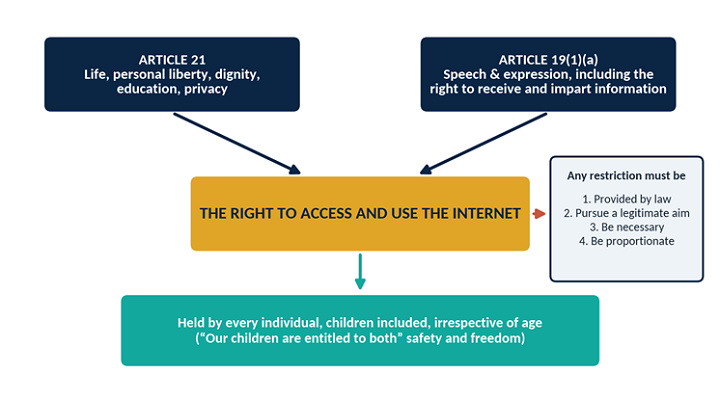
Figure 1: The constitutional architecture of the declared right. Original illustration prepared for this paper; the four-part test is the familiar Puttaswamy formulation, not a list quoted from the judgment.
2. The Decision at a Glance
Table 1: Case snapshot
|
Case |
Just Rights for Children Alliance and another v S Harish and others |
|
Citation |
2026 INSC 1149; 2026 LiveLaw (SC) 1063 |
|
Proceeding |
M.A. Nos. 2553–2554 of 2026 in Criminal Appeal Nos. 2161–2162 of 2024 |
|
Bench |
Justice J.B. Pardiwala and Justice K. Vinod Chandran |
|
Date of order |
15 October 2026 (widely reported on 17 October 2026) |
|
Appearing |
For the applicant: Bhuwan Ribhu, with others. For the Union: Solicitor General Tushar Mehta and ASG K.M. Nataraj, with others |
|
Core holding |
The right to access and use the internet is a fundamental right of every individual under Articles 21 and 19(1)(a); children, irrespective of age, enjoy the same right |
|
Child-safety stance |
Blanket restrictions on children’s internet access are “unproven measures of proven disproportionality”, but proportionate, age-based safeguards remain permissible |
|
Operative outcome |
A detailed framework for detecting, reporting and removing CSEAM; the Union to frame guidelines, SOPs and, where needed, amendments, and to file a compliance affidavit |
|
Next listing |
10 December 2026 |
3. How the Case Reached This Point
The route to the 2026 order begins in September 2024, when the Court decided Just Rights for Children Alliance v S Harish (2024 INSC 716). That judgment warned that links to child sexual abuse material were being circulated and sold on social media in ways that sidestepped penal provisions. It held that intermediaries must report such material to the police units specified under the POCSO Act and that failure would cost them the safe harbour in section 79 of the Information Technology Act, 2000.
The 2026 applications alleged continued lapses. The Court recorded serious lapses in compliance in an earlier order this year, and it noted news reports describing paid promotion of CSEAM through redirect links and websites; in one report, of 55 reported advertisements, 43 were held not to violate the platform’s advertising standards. The bench observed that more than two years after its 2024 judgment there had been no progress worth the name, and that it could not afford to wait any longer. With assistance from the Ministry of Electronics and Information Technology and the Ministry of Law and Justice, it settled a workable framework, examining the existing mechanism, the position in other jurisdictions and the Union’s response.
It was in this posture, a Court impatient with enforcement failure, that the larger question surfaced. If platforms keep failing to remove abuse material, should children be kept off those platforms? The Court’s answer to that question is the part of the judgment that will travel furthest.
4. The Road to Recognition: A Doctrinal Timeline
Constitutional rights rarely appear from nowhere. The 2026 declaration sits at the end of a chain of decisions, each of which moved the internet a little closer to the core of Part III.
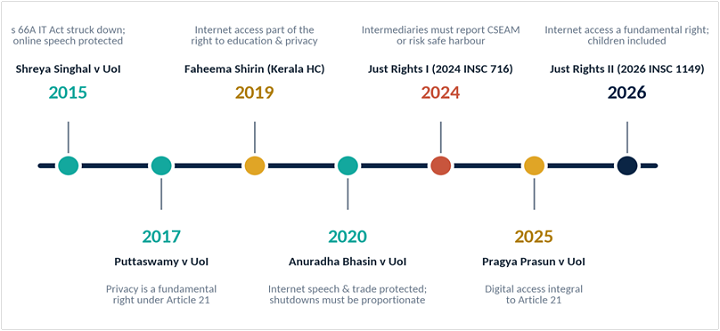
Figure 2: Milestones on the road to the 2026 declaration. Original illustration prepared for this paper.
4.1 Speech online: Shreya Singhal (2015)
In Shreya Singhal v Union of India, the Court struck down section 66A of the Information Technology Act as an unconstitutional restriction on speech not saved by Article 19(2), and read down the intermediary takedown provision in section 79(3)(b) so that platforms must act on actual knowledge conveyed through a court order or government notification. The decision established that speech does not lose constitutional protection because it travels online. It also matters today for a second reason: it shaped the safe-harbour architecture that the 2024 and 2026 Just Rights orders now press against.
4.2 Privacy and its surveillance shadow: Puttaswamy (2017)
Puttaswamy recognised privacy as a fundamental right under Article 21 and supplied the proportionality template of legality, legitimate aim, necessity and proportionality that courts now apply to rights-limiting state action. The link to children’s internet use is direct. When the 2026 Bench worried that age-based restrictions would require continuous collection and monitoring of sensitive data about every user, it was applying the privacy logic of Puttaswamy.
4.3 Access in the classroom: Faheema Shirin (2019)
The Kerala High Court, deciding a challenge to a hostel rule restricting mobile phone use, held that the right to access the internet forms part of the right to education and the right to privacy under Article 21. The case is the earliest judicial statement that internet access is itself, and not merely the speech carried over it, a constitutional interest. It is also a useful reminder that the first fights over this right were fought on campuses and in hostels, which is where many students will meet the new ruling.
4.4 Shutdowns and proportionality: Anuradha Bhasin (2020)
In Anuradha Bhasin v Union of India the Supreme Court held that freedom of speech and expression, and the freedom to carry on trade or business, through the medium of the internet enjoy constitutional protection under Articles 19(1)(a) and 19(1)(g), and subjected shutdown orders to proportionality review. The 2026 Bench was careful on one point: it recorded that Anuradha Bhasin had refrained from deciding whether access to the internet is, by itself, a fundamental right. That reserved question is precisely what Just Rights II answers.
4.5 Digital access as part of life and dignity: Pragya Prasun (2025)
In Pragya Prasun v Union of India, decided on 30 April 2025 on petitions by acid-attack survivors and a visually impaired lawyer, the Court held that digital access is an intrinsic part of the right to life and liberty under Article 21, and that a digital KYC process excluding persons with disabilities violates fundamental rights. The 2026 Bench described its own declaration as taking a leap from Anuradha Bhasin and Pragya Prasun. The metaphor is apt. Pragya Prasun spoke of digital access to public and financial services; Just Rights II speaks of the internet itself.
5. The Holding Analysed
5.1 Two anchors, one right
The Court did not rest the right on a single article. It read Article 21 with Article 19(1)(a). The Article 19(1)(a) strand rests on a long-settled proposition: freedom of speech has never been confined to the right to speak and includes the right to know, to receive and to impart information and ideas. Describing the internet as a marketplace of ideas, creative expression and information, the Court located its value not only in what it contains but in the access it affords to adults and children alike.
The Article 21 strand does different work. It carries the right beyond expression into education, dignity, companionship and the practical conditions of a life lived with others. The Court gave two vivid examples: for many children in remote areas the internet is often the only source of learning and information, and for children with special needs it is often the only place where they find companionship with others like them. Neither example is about speech in the strict sense, which is why Article 21 is doing the heavy lifting.
5.2 Children as rights-holders
The most quoted line of the judgment compares the denial of internet access to children with a denial that they have a conscience worth protecting or a voice worth hearing. The comparison is deliberate. It places the internet beside conscience and speech, rights nobody proposes to switch on at a given birthday, and it implies that any age-based limit must be justified as a limit on a right and not as the mere withholding of a privilege.
The approach matches the international framework to which India is a party. The Convention on the Rights of the Child recognises the child’s freedom of expression, including the freedom to seek, receive and impart information, and the child’s access to information from diverse sources. The Committee on the Rights of the Child has said in its General Comment on the digital environment that states must protect children online without cutting them off from the benefits of digital participation. The Supreme Court’s reasoning, as reported, rests on the Constitution, but the convergence is worth noting in any moot or written submission.
5.3 Why blanket restrictions fail
The Court’s rejection of blanket restrictions is carefully reasoned, and it is worth setting out the reasons separately because each can be borrowed in argument.
- Displacement. Children do not stop using the internet merely because the law forbids them. They migrate to unregulated platforms and sites that are potentially more unsafe.
- Silence. If using the internet is forbidden, a child who is being enticed or threatened online has reason to hide it from parents, guardians and trusted adults for fear of being reprimanded.
- Surveillance. Age-based bars require every user’s age to be identified and verified, which means continuous collection and monitoring of sensitive data and a disproportionate risk of misuse and surveillance.
- No demonstrated benefit. In the Court’s words, no jurisdiction has so far been able to demonstrate that children are safer because of such measures; their efficacy is at best contested.
From these premises the Court concluded that blanket restrictions are “unproven measures of proven disproportionality”, a phrase that is likely to be quoted in every future challenge to a categorical age bar. The accompanying image of the victim being mistaken for the problem makes the same point in plainer language: the failure to detect and remove harmful material is a failure of intermediaries and regulators, and children should not pay for it with their access.
5.4 What the Court still permits
The Court was explicit that its reasoning does not mean there should be no age-based safeguards. It acknowledged that some safeguards are necessary for children’s online safety and for moderating the content within their reach. It suggested a system that places greater emphasis on parental consent, guidance and oversight over children’s access to social media platforms, coupled with a dedicated “child mode” for their accounts: accounts private by default, restrictions on contact and messages from unknown adults, and moderation of advertisements and content. These could be applied to pre-teens with reasonable and proportionate means of verifying parental consent, and the modalities were left to the Union. The Court also clarified that nothing in its observations prevents the Union from restricting children’s access to specific categories of content or services that are inherently harmful to them, such as adult-content websites.
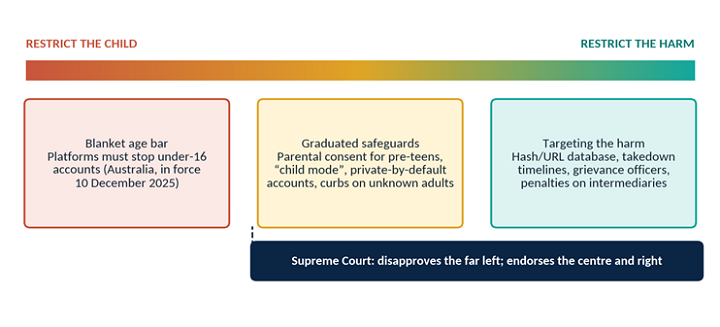
Figure 3: Three regulatory strategies and the Court’s position among them. Original illustration prepared for this paper, summarising the reported reasoning and the Australian law discussed in Part 7.
6. The CSEAM Framework: Targeting the Harm
If the first half of the judgment tells the State what it may not do to children, the second half tells intermediaries what they must do for them. The reported framework is detailed, and its architecture is easiest to grasp as a pipeline from detection to removal to accountability.
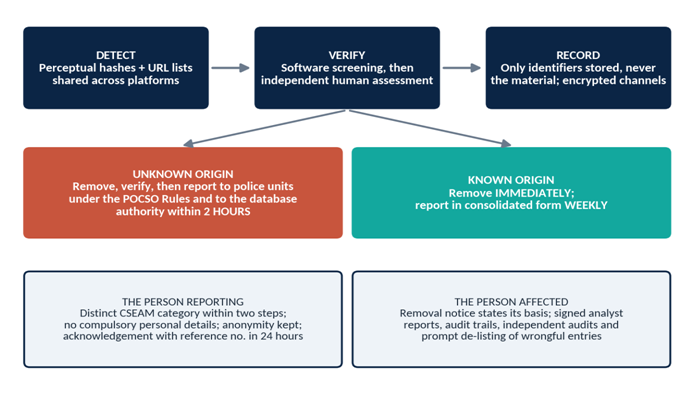
Table 2: The CSEAM framework at a glance
|
Subject |
What the Court said, as reported |
|
Detection |
Platforms act in isolation, so content removed by one is not automatically flagged by others. Perceptual hashing and URL listing are the globally used tools. Rule 4(4) of the IT Rules, which refers to content removed from “the computer resource of such intermediary”, is too narrow because it omits material removed elsewhere and content circulated through external links. |
|
National database |
Sharing hashes and URLs across platforms is essential; the Sahyog Portal was suggested as a possible foundation. Entries follow software screening and independent human assessment, travel through encrypted channels, and store only identifiers, never the material itself. |
|
Reporting timelines |
Unknown-origin CSEAM: verify and report to the police authorities under the POCSO Rules and to the database authority within two hours of removal or of resolving a complaint. Known-origin CSEAM: remove immediately and report weekly in consolidated form. |
|
Reporting and grievances |
A distinct, plainly named CSEAM category reachable within two steps, with no compulsory personal details and anonymity preserved; acknowledgement within twenty-four hours with a reference number; dedicated, trained grievance officers; no CSEAM complaint disposed of without such an officer’s review; a uniform machine-readable report format. |
|
Scope of CSEAM |
The POCSO emphasis on visual depiction applies to its penal provisions. For the IT Act and Rules, which are largely regulatory, CSEAM covers any electronic material with the propensity to facilitate or enable child exploitation. Advertisements for tools that manipulate images into abusive material, or that redirect to such content, fall within section 67B(d) and Rule 3(1)(b) and cannot hide behind advertising standards. |
|
Penalties |
Loss of safe harbour under section 79 is too drastic and too remote to deter routine default. The Union was asked to consider exemplary fines scaled to gravity, duration, recurrence and size, after the Court surveyed regimes in the United States, United Kingdom, European Union, Australia and South Korea. Revenue earned through paywalled CSEAM should be forfeited and disgorged. |
|
Safeguards for the accused and affected |
Removal must carry a notice stating its basis, so that aggrieved persons know whether to approach the intermediary or the database authority; signed analyst reports, audit trails, independent audits and prompt de-listing of wrongful entries. |
|
Implementation |
The Union, through MeitY and the Ministry of Law and Justice, must formulate guidelines, SOPs and, where necessary, amendments to the IT Act and Rules, and file an affidavit on progress before the next hearing. |
Two features deserve emphasis. First, the Court’s insistence on anonymity, a two-step reporting route and acknowledgement within a day translates the child-protection objective into user-experience obligations, which is unusual and welcome. Second, the safeguards against wrongful listing show an awareness that a national hash database is itself a rights-sensitive instrument: a database that can remove content across platforms can also remove it wrongly. The Court’s insistence on notices, audits and de-listing is the proportionality principle applied to the machinery of enforcement.
The Court did not end with takedowns. It closed by observing that children come onto the internet long before they understand it, that a child can use a phone before she can tell a friend from a stranger posing as one, and that safety therefore also requires awareness, the confidence to speak up and safe practices on and off the internet. That passage links the two halves of the judgment. If children are to be allowed on the internet, they must be equipped for it.
7. Comparative and Statutory Context
7.1 Australia: the under-16 account bar
Australia chose the path the Indian Court declined to endorse. Its Online Safety Amendment (Social Media Minimum Age) Act 2024 requires age-restricted social media platforms to take reasonable steps to prevent users under 16 from holding accounts; the requirement entered into force on 10 December 2025. The law places the obligation on platforms and not on children or parents, who face no penalty, and under-16s may still view publicly available content that needs no account. Its model is therefore less severe than a total ban on internet use, but it is still an account-level age bar of the kind the Indian Court regarded with scepticism, particularly because it depends on age assurance across all users.
The comparison should be handled with care. The Indian Court’s statement that no jurisdiction has demonstrated that such measures make children safer was made less than a year after the Australian law began operating, when the evidence base was inevitably thin. The statement is better read as a burden-of-proof allocation than as a settled empirical conclusion: a State that restricts a fundamental right must show that the restriction works.
7.2 India: the DPDP regime and the age of eighteen
India already has a statutory regime that touches children online, and it points in a different direction from both Australia and the Supreme Court’s suggested model. Section 9 of the Digital Personal Data Protection Act, 2023 requires verifiable parental consent before processing the personal data of a child, defined in section 2(f) as a person under 18, and bars tracking, behavioural monitoring and targeted advertising directed at children. Rule 10 of the 2025 Rules specifies how that consent is to be verified, and Rule 12 creates limited, purpose-based exemptions.
The timing matters. The Rules were notified on 13 and 14 November 2025, and the operational provisions, including those on children’s data, come into force eighteen months later, in or around May 2027. As of this paper’s date, then, the statutory machinery for parental consent is not yet operative, and the Court’s suggestions on parental consent and child mode will shape how it is designed.
Table 3: Three approaches compared
|
Dimension |
Australia (2025) |
India: DPDP Act and Rules |
Supreme Court, 2026 |
|
Age line |
Under 16 |
Under 18 (data processing) |
Suggests safeguards for pre-teens; modalities left to the Union |
|
Core mechanism |
Platforms take reasonable steps to prevent under-16 accounts |
Verifiable parental consent before processing a child’s data |
Parental consent and oversight, “child mode”, private-by-default accounts |
|
Who bears the duty |
Platforms |
Data fiduciaries |
Intermediaries and the Union (guidelines, SOPs, amendments) |
|
Child’s access |
Account-level bar |
Not barred; data processing conditioned |
Protected as a fundamental right |
|
Status |
In force since 10 December 2025 |
Core provisions due around May 2027 |
Order of 15 October 2026; compliance affidavit due; listed 10 December 2026 |
A drafting tension is visible. The DPDP framework treats everyone under 18 as a child for data-processing purposes, while the Court floated parental-consent measures for pre-teens and spoke of children’s autonomy and freedom. Reconciling a uniform statutory age of eighteen with an evolving-capacity model for older adolescents is one of the first design problems the Union will face.
8. Critical Evaluation: Strengths, Gaps and Open Questions
8.1 Strengths
- Doctrinal coherence. The declaration follows a recognisable line from Shreya Singhal to Pragya Prasun and fills the gap the Court itself had acknowledged in Anuradha Bhasin.
- Rights-based, evidence-sensitive reasoning. The Court asks whether restrictions work, whether they displace risk, and what they cost in privacy, rather than accepting protection as a self-justifying label.
- Operational specificity. Timelines, a grievance route, notices, audits and de-listing give the child-protection framework a shape that can be audited.
8.2 Is the declaration binding, or obiter?
The principal doctrinal vulnerability is procedural. The declaration arrived in miscellaneous applications in a criminal appeal that was concerned with CSEAM enforcement, not in a petition squarely framing a right-to-internet question. A State seeking to resist the ruling in a later shutdown or device-ban case may argue that the declaration was not necessary to decide the matter and is therefore obiter, even if weighty. The better reply is that the Court reached the declaration in order to answer a live argument, that children should be kept off the internet for their safety, and that the answer was integral to the reasoning that led it to prefer targeted over blanket measures. Whichever view prevails, the declaration will carry great persuasive weight and will be cited as such.
8.3 A negative liberty or a positive entitlement?
The ruling can be read narrowly, as a shield against State interference with internet access, or broadly, as the root of a duty on the State to make access available. The Court’s remark that the internet is often the only source of learning for children in remote areas, and the accessibility logic of Pragya Prasun, lend some support to the broader reading. But the judgment as reported contains no direction to provide connectivity, and courts are typically cautious about converting a liberty into a resource entitlement. Litigants should expect the shield reading to be easier to win and the entitlement reading to need further doctrinal work.
8.4 How the limits operate
Article 19(1)(a) is subject to the heads of restriction in Article 19(2), while Article 21 yields to a procedure established by law that must be fair, just and reasonable. Reading the two together invites a layered analysis: for the expressive dimension of internet use, the question is whether the restriction falls within Article 19(2) and is proportionate; for the broader life-and-dignity dimension, the question is whether the procedure is fair, just and reasonable. The reported judgment does not set out a fresh test, and counsel will need to build one from Puttaswamy, Anuradha Bhasin and the proportionality language of the 2026 order.
8.5 Parents, schools and platforms
The Court’s own safeguards lean on parental consent, which creates a tension with its rhetoric of children’s independent rights. A child’s right to information may sit uneasily with a parent’s right to say no, and the Court has left the balance, and the age at which it shifts, to the Union. The declaration also reaches private actors only indirectly: schools, hostels and families are not the State, yet they impose many of the restrictions children actually face. Where the institution is State-run or State-aided, the fundamental-rights analysis applies with full force; elsewhere, the right will operate through statutory duties, regulatory guidelines and the courts’ supervisory jurisdiction.
8.6 The enforcement problem
Perhaps the most sobering passage in the narrative is the Court’s observation that two years after its 2024 judgment there had been no progress worth the name. Declarations and frameworks do not enforce themselves. Whether the new national database, timelines and penalties transform behaviour will depend on the Union’s guidelines, on the Court’s monitoring through the next hearing on 10 December 2026, and on whether the proposed penalties are enacted in a form that is dissuasive but proportionate.
9. Lawyer’s Insight
Academic analysis tells us what a judgment means. A lawyer asks what it can do. The boxes below translate Just Rights II into working tools for different kinds of practice, along with the cautions a careful advocate should keep in mind.
LAWYER’S INSIGHT
For the litigator: challenging internet restrictions
- Plead the two articles together. Frame the restriction as an interference with the right to access and use the internet under Article 21 read with Article 19(1)(a), and force the State to justify it.
- Stack the authorities. Cite Just Rights II for the declaration, Anuradha Bhasin and Foundation for Media Professionals for proportionality review of shutdowns, and Pragya Prasun for the point that digital access is integral to dignity.
- Pre-empt the obiter argument. Argue that the declaration was necessary to the Court’s rejection of blanket restrictions and that, in any case, it follows the logic of earlier binding decisions.
- Use the Court’s own proportionality vocabulary. The phrase “unproven measures of proven disproportionality” converts a general principle into a ready-made submission on burden of proof.
LAWYER’S INSIGHT
For institutions, parents and advisers: device and access policies
- A blanket ban on phones or internet use in a school, college or hostel is now harder to defend where the institution is State-run or State-aided; the Faheema Shirin line gains a Supreme Court footing.
- Draft policies around purpose and least restriction: time-based limits, content filtering and supervised access are easier to justify than outright prohibition.
- Keep a written record of the safety problem the policy solves and of the alternatives considered. Proportionality is argued with evidence, not adjectives.
LAWYER’S INSIGHT
For platform and intermediary counsel: a compliance checklist
- Reporting route: a distinct CSEAM category within two steps, no mandatory personal details, anonymity preserved, acknowledgement and reference number within 24 hours
- Grievance officers: dedicated, trained staff, with human review before any CSEAM complaint is disposed of.
- Timelines: verify and report unknown-origin material to the POCSO police units and the database authority within two hours; remove known-origin material immediately and report weekly.
- Advertising and paywalls: audit ad-review processes for redirect links and image-manipulation tools, and treat paywalled content as high-risk, since disgorgement of revenue was flagged.
- Watch the safe harbour: section 79 protection remains the fallback sanction, and the Union’s guidelines and the 10 December 2026 hearing will fix the detail. Do not wait for the final text to begin gap-mapping.
LAWYER’S INSIGHT
For data-protection advisers: age assurance without surveillance
- The Court’s concern that age verification can become continuous monitoring of every user means data minimisation will be the test of any age-gating design
- Plan for two layers: the DPDP verifiable-consent regime (core provisions around May 2027) and whatever child-mode requirements the Union frames after this order.
- Prefer privacy-preserving verification and avoid retaining identity documents beyond the check.
LAWYER’S INSIGHT
Three questions a judge may put to you
- Is this the ratio or an observation? Have a two-limbed answer ready: necessity to the reasoning, and consistency with earlier holdings.
- Who owes the duty, and under what law? Identify the State actor, the statutory hook and the relevant rule before you arrive.
- What is the less restrictive alternative? The judgment makes this the central question. Bring the alternative with you, whether you argue for or against the restriction.
10. The Way Forward
The judgment hands the Union a considerable agenda. The following steps would translate it into workable law while staying faithful to its logic.
- Publish the guidelines in draft and consult. The database, timelines and grievance obligations affect rights of users, intermediaries and children; consultation will improve both legitimacy and design.
- Calibrate age and consent to evolving capacity. Align the DPDP age of eighteen with graduated safeguards that give older adolescents more autonomy than pre-teens, as the Court’s pre-teen focus implies.
- Legislate penalties that are proportionate and graduated. Exemplary fines scaled to gravity, duration, recurrence and size, with revenue disgorgement for paywalled abuse material, would give section 79’s all-or-nothing sanction a workable companion.
- Build safeguards into the database. Independent audits, signed analyst reports, transparent notices and fast de-listing should be statutory, not discretionary.
- Invest in digital literacy. The Court’s closing passage treats awareness and confidence to speak up as part of child safety. Curriculum, parent outreach and school-level reporting channels should be funded accordingly.
- Measure what works. Because the Court rested its rejection of blanket bars partly on the absence of proof that they protect children, India should evaluate its own measures and publish the results.
11. Conclusion
Just Rights II does two things at once. It lifts the internet into the constitutional core by declaring access and use a fundamental right under Articles 21 and 19(1)(a), and it insists that the right does not wait for adulthood. The same judgment demands far more of intermediaries and of the State in detecting and removing the material that makes the internet dangerous for children. The unifying idea is that safety is built by regulating the harm and the harmful, not by excluding the child.
The ruling leaves real questions open: its precedential weight, the scope of any positive duty, the line between parental authority and a child’s own rights, and the design of age assurance that does not become surveillance. Those questions will be argued in courts, drafted in ministries and tested in households over the coming years. What the Court has done is move the burden. Anyone who would restrict a child’s access to the internet must now show, with evidence and with proportion, why the window should be narrowed, and not merely why it might be closed.
Join LAWyersClubIndia's network for daily News Updates, Judgment Summaries, Articles, Forum Threads, Online Law Courses, and MUCH MORE!!"