
1. Introduction
1.1 Meaning and Definition of International Law
Public International Law is a term that refers to the set of rules and principles that regulate interactions among sovereign States and other entities on the international stage. These rules cover various aspects, such as diplomacy, treaties, war, human rights, international trade, and the environment. International Law is at the global level, unlike municipal law, which is within a State. Therefore, it is mainly based on the consent and mutual recognition of the States.
The first person to use the expression "International Law" was Jeremy Bentham in 1789. Before that, it was called the "Law of Nations." According to Lassa Oppenheim, International Law is "the body of customary and conventional rules which are considered legally binding by civilized States in their intercourse with each other." In opposition to this, John Austin said that International Law is not genuine law but "positive morality, " since it has no sovereign authority and sanctions. Nevertheless, present-day scholars consider it as binding on the basis of State consent, established practice, and institutional mechanisms.
1.2 Historical Development of International Law
International Law has its roots in different historical eras during which it changed through various phases. In ancient times, for example, the early treaties of the Treaty of Kadesh showed rudimentary diplomatic relations. The influence of natural law and the writings of Hugo Grotius during the Middle Ages contributed to modern International Law's foundation. The beginning of the modern period is traditionally linked to the Peace of Westphalia, which brought about the principle of the sovereignty of the State.
The idea of International Law took a huge leap with the formation of the United Nations in 1945 as the primary organ to promote peace, human rights, and international cooperation. Thus, it started a new era of codification and institutional development.
2. Nature and Scope of International Law
2.1 Whether International Law is True Law
The issue of whether International Law can be considered as "true law" has been a matter of discussion for a long time in jurisprudence. The most notable opponent was John Austin, who considered law as the command of a sovereign backed by sanctions. Since there is no global sovereign power to compel States to comply with rules, Austin thus regarded International Law only as "positive morality, " i.e., a matter of mutual convenience rather than legal obligation.
This standpoint has, however, been the target of severe criticism. To begin with, even in municipal legal regimes, a number of laws are not enforced by means of sanctions. Moreover, States typically adhere to international rules as a matter of legal obligation (opinio juris), besides diplomatic reciprocity and the fear of international consequences such as sanctions, retaliation, or loss of reputation. What is more, bodies such as the International Court of Justice offer formal avenues for dispute resolution.
Nowadays, it is widely accepted that International Law is binding law since States by their conduct consent to be bound by treaties and customs.
2.2 Scope of International Law
The sphere of International Law has undergone a major transformation. Being once confined to the relationship between States at the political level, such as recognition, diplomacy and warfare, it has now reached economic matters, including international trade and investment law. It is instrumental in the defence of human rights through worldwide conventions and institutions. Environmental law deals with issues of climate change, biodiversity, and development that is sustainable. Furthermore, niche areas such as the law of the sea and space law dictate the rules for human exploration and utilization of sea and space, thus mirroring the changes and development of the global community.
3. Public International Law vs Private International Law
3.1 Meaning of Public International Law
Public International Law is the set of rules and laws that regulate the interactions of sovereign states and other players in the international arena such as international organizations. Among other things, it covers issues like diplomacy, treaties, trade, human rights, war, environment, and law of the sea. The main purpose of Public International Law is to ensure international peace, security, cooperation, and justice. It is mostly based on agreements, customs, and general principles of law acknowledged by the nations.
3.2 Meaning of Private International Law (Conflict of Laws)
Private International Law, or Conflict of Laws, is concerned with situations where there is a foreign element in a private-law dispute. It answers the three main questions: (i) which court has the jurisdiction, (ii) which law is to be applied and (iii) whether the recognition and enforcement of a foreign judgment is possible. As an example, in case the parties to a contract belong to different countries, Private International Law determines the country law that shall govern the dispute between the parties. This branch of law, unlike Public International Law, does not deal with cross-border relations between States but rather with the resolution of conflicts between different municipal legal systems.
3.3 Differences between Public and Private International Law
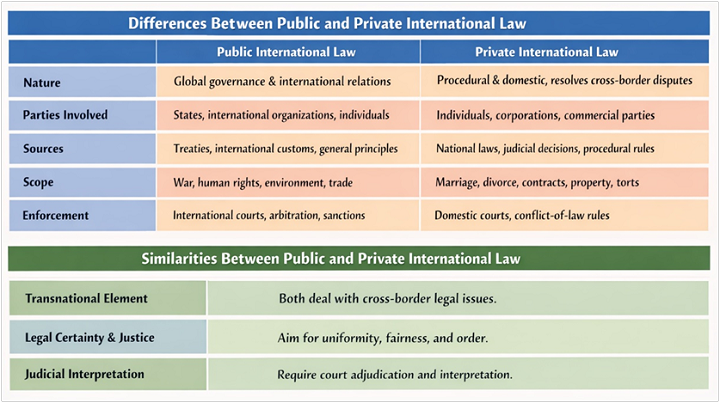
Nature: As Public International Law deals with international relations and global governance, Private International Law is more procedural and domestic in nature, i.e. it resolves cross-border private disputes.
Parties Involved: The principal subjects of Public International Law are States, international organizations, and occasionally individuals. Private International Law involves private individuals, corporations, or parties engaged in international commercial transactions.
Sources: Public International Law bases its validity on treaties, international customs, and general principles of law. Private International Law largely rests on national legislations, judicial decisions, and procedural rules of a specific country.
Scope: Public International Law embraces issues such as war, human rights, environmental protection, and international trade. Private International Law is concerned with topics such as marriage, divorce, contracts, property and torts where a foreign element is involved.
Enforcement: There are various ways in which Public International Law is being enforced, for example, through international courts, arbitration, diplomatic pressure, or sanctions. Private International Law, on the other hand, is in force through domestic courts that apply conflict-of-law rules.
3.4 Similarities between Public and Private International Law
To begin with, each law branch is concerned with transnational or cross-border elements. Public International Law is essentially about States and international entities cooperating on a global scale; on the other hand, Private International Law is about the courts resolving disputes between individuals or business entities that have cross-border connections. In fact, without a foreign element, neither foreign nor private international law makes sense.
Secondly, the two laws that are concerned with international interactions ultimately have as their object legal certainty, uniformity, and justice. Public International Law is there to prevent war, establish order, and make it easier for nations to co-operate, while Private International Law is, in a way, humanizing, since it is geared towards granting equitable relief to private litigants whose cases cross jurisdictional boundaries.
Thirdly, both fields need judicial interpretation and adjudication for their survival and growth. Public International Law gets interpreted by international courts and judges, while in Private International Law conflict-of-law rules are used by domestic courts to come to a decision on these kinds of issues. The role of judges in both spheres is crucial as their decisions help clarify and develop the legal doctrines.
4. Relationship between International Law and Municipal Law
The interaction between International Law and Municipal Law has attracted a lot of attention and is often described as one of the most complex issues in jurisprudence. The main point of contention is which scenario is correct: international rules automatically have internal validity in a State, or they need to be somehow incorporated into domestic law first before they can be enforced.
4.1Concept of Municipal Law
Municipal Law, sometimes called domestic or internal law, is the law that a State applies within its territory. It regulates the behavior of persons, institutions, and government authorities inside the territorial boundaries of the State. It consists of various branches such as constitutional law, criminal law, civil law, administrative law, and laws passed by the legislature. Whereas International Law is concerned with the regulation of relations between States and other international actors, Municipal Law is the law that directly binds and is enforced against citizens by national courts and authorities.
When a State signs up for international treaties or takes on international obligations that might be at odds with its internal laws, it becomes crucial to understand how these two legal systems interact.
4.2 Monist Theory
Meaning
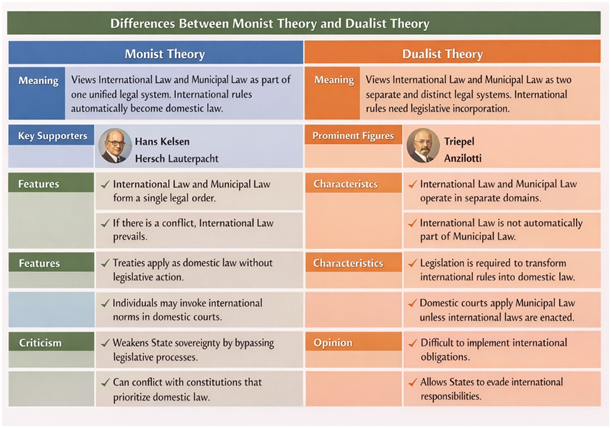
The Monist Theory perceives International Law and Municipal Law as components of the one legal system. From this perspective, international rules become domestic law automatically, without the need for separate legislative enactment.
Key Supporters
Among the distinguished figures advocating for this are Hans Kelsen and Hersch Lauterpacht. The focus of Kelsen's "Pure Theory of Law" was the primacy of International Law over municipal law.
Features
- International Law and Municipal Law together constitute one legal order.
- If there is a conflict, International Law is the one that prevails.
- Treaties can be domestically applied without any transformation.
- In domestic courts, individuals may invoke international norms directly.
Criticism
The theory is challenged on the grounds that it weakens State sovereignty. Most countries actually adopt the practice of requiring a legislative measure to domesticate a treaty. Besides, it can clash with constitutional stipulations that give primacy to domestic law.
4.3 Dualist Theory
Meaning
The Dualist Theory sees International Law and Municipal Law as two different and completely separate legal systems. While International Law regulates the inter-State relations, Municipal Law controls persons inside a State.
Prominent Figures
The theory was championed by the legal scholars Triepel and Anzilotti.
Characteristics
- The two systems coexist in separate domains.
- International Law is not an automatic part of Municipal Law.
- Transformation or Incorporation through Legislation is necessary.
- In case of conflict, domestic courts would apply Municipal Law unless international rules are formally adopted.
Opinion
Dualism is blamed for making it difficult to implement international obligations. It may serve as a loophole for States to escape their international responsibilities by not incorporating treaties into domestic law.
4.4 Practice in India
India mostly implements the Dualist approach but with a slight inclination of judicial harmonization.
Constitutional Provisions
- Article 51 of the Constitution of India obligates the State to promote respect for international law and treaty obligations. Although this is part of the Directive Principles of State Policy, it shows India's law obligation towards international norms.
- Article 253 gives power to Parliament to legislate for execution of international treaties and agreements, even if it involves subjects in the State List. This means that the enforcement of treaties at the domestic level requires legislative action.
Judicial Approach
The Indian Judiciary has crafted a moderate and forward-looking approach.
In Vishaka v. State of Rajasthan (1997), the Supreme Court utilized international treaties, most notably CEDAW, to identify the normative framework for sexual harassment at the workplace in the absence of domestic legislation. The Court declared that international agreements that are compatible with fundamental rights can be considered as part of domestic law.
In Gramophone Company of India v. Birendra Bahadur Pandey (1984), the Court laid stress on the doctrine of comity of nations and pointed out that Indian law should normally be construed so as to be in harmony with international law unless there is a definite conflict.
In Jolly George Varghese v. Bank of Cochin (1980), the Supreme Court ruled that although international treaties may serve to clarify the meaning of the text, they are not capable of changing the law that is expressed in clear terms, unless they have been enacted through legislation.
5. Codification of International Law
5.1 Meaning of Codification
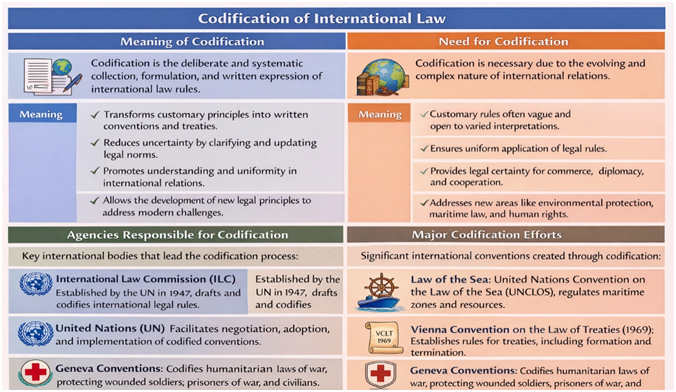
Codification of International Law means a deliberate and systematic collection, formulation, and written expression of the rules of international law in a clear and orderly fashion. It is a fact that a large number of rules of the International Law came into existence due to State practice and customs, which frequently produced an element of uncertainty and obscurity. Codification is intended to lessen the degree of uncertainty by transmuting customary principles into written conventions or treaties. It not only identifies and confirms existing rules but also allows for progressive development of law to meet the needs of the times. In this way, codification assists in deepening understanding, harmonization, and the stability of international relations.
5.2 Need for Codification
The requirements for codification have come up as a result of the changing and complex character of international relations. For one thing, customary rules are generally imprecise and might be understood differently by different States. A written codification serves to clarify the law and prevents misunderstandings about the content of the law. Secondly, codification helps in the uniform application of legal principles worldwide thereby promoting stability and consistency. Thirdly, it improves legal certainty, which is a prerequisite for international commerce, diplomacy and cooperation. Fourth, codification fosters dispute settlement by ensuring that the rules are clear and therefore misunderstandings are minimal. Finally, in the era of globalization, new areas such as environmental protection, maritime law, and human rights call for legal frameworks, which codification provides.
5.3 Agencies Responsible for Codification
International Law Commission (ILC)
The main agency responsible for codification and the progressive development of International Law is the International Law Commission. The ILC was set up in 1947 by the United Nations General Assembly and is composed of international law specialists who prepare draft articles on different subjects. Such drafts usually constitute the core of international conventions. The Commission is at the same time a codifier of existing customary law rules as well as a developer of new legal principles.
United Nations
The United Nations is a key factor in world affairs that assists and encourages the adoption of legislation through codified conventions. The UN helps countries to negotiate, adopt, and implement international treaties through different platforms, such as the General Assembly and diplomatic conferences. It is also a global stage for States' consensus.
5.4 Major Codification Efforts
Among the codification efforts, the most notable is the United Nations Convention on the Law of the Sea (UNCLOS). This convention covers all the rules related to the sea such as maritime zones, territorial waters, exclusive economic zones (EEZ), and deep seabed resources. In this way, the law of the sea is brought under one legal superstructure.
Another major instrument is the Vienna Convention on the Law of Treaties which sets out the law relating to treaties including their conclusion, interpretation, modification, and termination. Besides codifying such fundamental principles as pacta sunt servanda (agreements must be kept), the Convention also specifies the extent to which this principle is subject to the reservations allowed to treaties.
The Geneva Conventions are perhaps the most notable codification of humanitarian law in war times. They offer detailed rules that safeguard the lives and dignity of the injured soldiers as well as the prisoners of war and civilians even during hostilities. These Conventions have become the cornerstone of almost all humanitarian law and practice.
6. Sources of International Law
In International Law, sources are that by which a particular legal rule or principle is recognized as fact. The most authoritative and most recognized enumeration of sources is found in Article 38(1) of the Statute of the International Court of Justice (ICJ).
6.1 Article 38 of the Statute of the International Court of Justice (ICJ)
Article 38(1) of the Statute of the International Court of Justice identifies the main sources of law that the Court should apply when it is called upon to settle a dispute. These sources
- International conventions (treaties)
- International custom
- General principles of law recognized by civilized nations,
- Judicial decisions and teachings of highly qualified publicists as subsidiary means.
However, Article 38 has been thus far a very successful instrument not only for the ICJ but for the general public of international law, because it has been comprehensively accepted as an accurate description of the sources of Public International Law.
6.2 Treaties
Meaning
Treaties refer to formal documents containing agreements between States or international organizations that are subject to International Law. They can be either bilateral (between two parties) or multilateral (among several parties).
Types of Treaties
Law-making treaties, which set out general rules that are applicable to a large number of States (for example, human rights conventions).
Contractual treaties, which create specific obligations of the parties to each other.
Treaties can also be classified according to the geographical area that they cover, whether regional or worldwide.
Binding Nature
The binding force of a treaty originates from the basic rule of pacta sunt servanda that agreements must be kept. After a State has declared its consent to be legally bound, usually through the act of ratifying, it undertakes the legal obligation to implement the treaty in accordance with good faith. The Vienna Convention on the Law of Treaties is a codification of the rules that regulate the creation, interpretative and termination aspects of treaties.
6.3 International Customs
Custom is undeniably one of the oldest and most important sources of International Law. It is born out of patterns of consistent and general State practice coupled with a belief that there is a legal necessity to follow such practices.
There are two main components:
State Practice: A consistent and uniform conduct of States over time, for instance, the diplomatic immunity practices.
Opinio Juris: The notion that the practice is performed because it is legally required and not just as a result of goodwill or habit.
Only when both the components exist, a customary norm becomes binding for all States, except those States which consistently Object.
6.4 General Principles of Law Recognized by Civilized Nations
General principles are fundamental legal concepts that are common to the major legal systems throughout the world. These are law principles that fill the gap where neither a treaty nor a custom exists. Examples of such fundamental concepts are good faith, equity, estoppel, res judicata and responsibility for wrongful acts. They play a major role in ensuring justice even in those cases where the international rules are not expressed explicitly and, hence, they facilitate the logical consistency of legal reasoning.
6.5 Judicial Decisions
Judicial decisions are referred to as subsidiary means for determining rules of law. The judgments International Court of Justice decisions force the parties to the particular dispute only, but the rulings of the ICJ form the substantial source of persuasive authority and have a great impactful contribution to the formation of legal principles. On the other hand, the advisory opinions of the ICJ which are non-binding, provide legal guidance-authority on still more challenging questions of law from UN organs and specialized agencies.
6.6 Juristic Writings
International Law has been deeply influenced by various jurists' works. Profound thinkers like Hugo Grotius, often hailed as the father of International Law, provided the theoretical basis for this Law. Lassa Oppenheim modernized the doctrines in a systematic way, whereas Hersch Lauterpacht highlighted human rights and emphasized the judicial development. Though non-binding, juristic writings help judges and lawyers in better interpreting and understanding international norms. Therefore, the sources of International Law denote on the one hand State consent and on the other hand changing world practice which together assure the international legal order's stability and progressive development.
Opinion of a Practising Advocate on Public International Law
From the standpoint of a practicing advocate, public international law is now a significant and useful component of contemporary legal systems rather than just a theoretical field. Domestic litigation, constitutional interpretation, trade disputes, environmental regulation, extradition cases, and the execution of foreign arbitral decisions are all currently impacted by it, demonstrating its relevance beyond diplomatic relations. As evidence of its rising practical significance, courts are increasingly interpreting domestic laws in accordance with international commitments.
Its influence at the domestic level has been further enhanced by the recognition of individuals under international criminal law and human rights law. International conventions are frequently cited in court rulings in nations like India in order to elucidate and extend fundamental rights.
However, there are still issues, especially with enforcement, since political will and state approval are crucial for compliance. In spite of this, public international law is still crucial for upholding international law, encouraging collaboration, and guaranteeing amicable dispute settlement in a world growing more interconnected by the day.
7. Conclusion
At its inception, Public International Law mainly covered the regulations derived from customs controlling the relationships among the sovereign States. Currently, it is a global dynamic legal system, neatly arranged, handling various societal and natural environment aspects at the worldwide level. This article has explored the concept and historical background of Public International Law, its nature as a law which is still a matter of debate, its changing scope, and its recognized subjects. Besides this, the article discusses the difference between Public and Private International Law and the theoretical debate between monism and dualism. It also outlines India's constitutional approach to International Law, the importance of codification, and the authoritative sources of International Law mentioned in Article 38 of the ICJ Statute. All these things combined present International Law as a legal system with rules, institutions, and processes rather than merely a framework for moral behaviour.
Today, Public International Law is indispensable in a globalized world. Major areas where it has significant functions include: maintenance of international peace and security, protection of human rights, regulation of trade and environmental obligations, and facilitation of international cooperation. Its institutional base is made more solid by the presence of such bodies as the United Nations and the International Court of Justice.
Join LAWyersClubIndia's network for daily News Updates, Judgment Summaries, Articles, Forum Threads, Online Law Courses, and MUCH MORE!!"


Tags :Others