
Abstract
In Gopal Pathak v. Nitin alias Pappu & Anr., a Bench of Justice Ahsanuddin Amanullah and Justice Manmohan held that a court cannot avoid comparing a disputed signature or writing merely by saying that it is not an expert. The Court set aside a Madhya Pradesh High Court order that had treated a handwriting expert’s opinion as “essential” to decide whether a Will was genuine, and restored the trial court’s order refusing expert examination. This article sets out the facts and procedural history, the statutory framework (Sections 39 and 72 of the Bharatiya Sakshya Adhiniyam, 2023, “BSA”), the reasoning of the Court, its treatment of the precedent in Thiruvengada Pillai, and the likely practical consequences for civil and criminal trials. Flowcharts show the procedural path of the case and the decision logic a trial court may now follow.
1. Introduction
Disputed signatures are a routine feature of Indian litigation, particularly in property, succession and tenancy matters. A common reflex in trial courts has been to refer the document to a handwriting expert whenever genuineness is contested. The Supreme Court’s order checks that reflex. It states that comparison is the court’s own duty under Section 72 BSA, and that expert evidence, being only an opinion that does not bind the court, is an aid to be used when the court has a real need for it.
The order was passed on 18 September 2026 and is reported as 2026 INSC 1085. It was widely reported after its upload in early October 2026, including by LiveLaw, which cites it as 2026 LiveLaw (SC) 1018.
2. Factual and Procedural Background
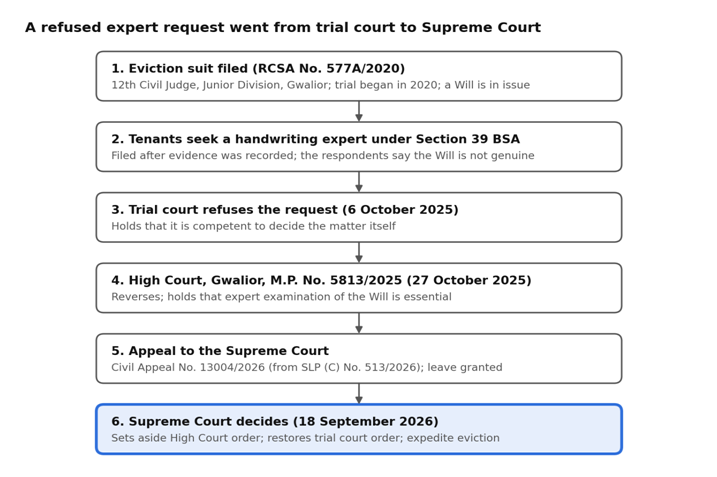
The underlying dispute is an eviction suit before the 12th Civil Judge, Junior Division, Gwalior (RCSA No. 577A/2020). The respondents are the tenants. A “Will” was in issue, and the respondents contended it was not genuine. According to the Order, the appellant argued that the Second Sale Deed dated 20 October 1981 expressly records that the respondents’ father was a tenant, and that the respondents had admitted that deed in their own application under Section 39 BSA.
The appellant also pointed out that the application for expert opinion was filed four years after trial proceedings began in 2020 and after both sides’ evidence had been recorded, so that allowing it would reopen the whole evidentiary process.
The trial court rejected the request to send the Will to a handwriting expert on 6 October 2025, reasoning that it was competent to take a call on the matter itself. The High Court of Madhya Pradesh at Gwalior, in M.P. No. 5813/2025 decided on 27 October 2025, reversed that decision and held that sending the Will to an expert was “essential” to determine its genuineness. The appellant, Gopal Pathak, then moved the Supreme Court. Figure 1 traces this path.
3. The Statutory Framework
3.1 Section 72 BSA: comparison by the court
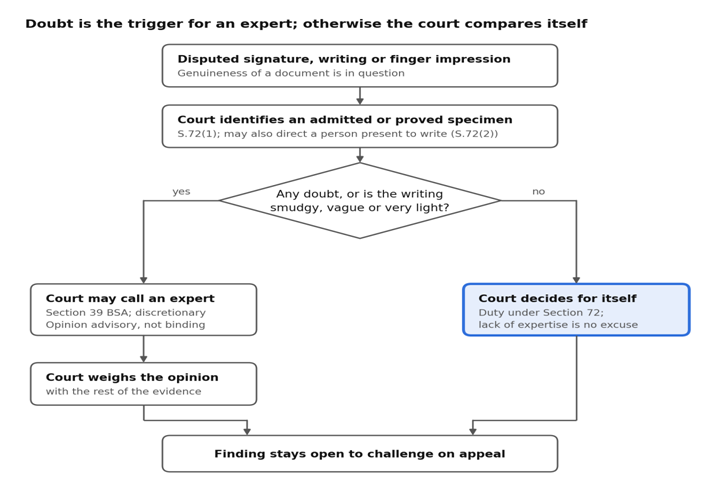
Section 72 permits the court to compare a disputed signature, writing or seal with one “admitted or proved to the satisfaction of the Court” to be that of the person concerned, even if the specimen was not produced or proved for any other purpose. Sub-section (2) allows the court to direct any person present in court to write words or figures so they can be compared with the disputed writing. Sub-section (3) extends the section, with necessary modifications, to finger impressions.
Section 72 substantially carries forward the structure of Section 73 of the Indian Evidence Act, 1872. Because the provision has long been part of Indian evidence law, the Supreme Court’s emphasis is on how the power is to be understood, not on a new power.
3.2 Section 39 BSA: expert opinion
Section 39 BSA makes relevant the opinions of experts on, among other things, the identity of handwriting or finger impressions. The respondents’ application for a handwriting expert was made under this provision. The legal question was therefore how the two sections relate: must a court send a disputed document to an expert under Section 39, or may it decide by its own comparison under Section 72?
4. Issue Before the Court
The Court framed the “short point” as whether it would be essential, as the High Court had held, to send the document for expert opinion under Section 39 BSA to determine the genuineness of the Will, or whether genuineness could be ascertained by comparison under Section 72 BSA.
5. Arguments of the Parties
The appellant argued that the High Court failed to appreciate that the respondents could not rely on the Second Sale Deed and simultaneously repudiate it; that the application was belated; and that whether to decide the matter itself or take the help of an expert is a matter of the court’s discretion.
The respondents argued that the Will was not genuine and that the only remedy was to ask the court to send it to a handwriting expert. They relied on paragraph 16 of Thiruvengada Pillai v. Navaneethammal & Anr., (2008) 4 SCC 530, to contend that where handwriting, signature or finger impression is disputed, a finding by the court itself could be hazardous and risky, so the matter should go to an expert.
6. The Court’s Reasoning and Holding
The Court held that the impugned order could not be sustained. Its reasoning can be summarised in five propositions:
- Discretion lies with the court. The law gives the court discretion to decide whether it will compare the signatures itself or seek expert opinion.
- Comparison is a duty. It is the duty of the court to compare the signature or writing and reach its own conclusion, and this cannot be avoided by saying that the court is not an expert.
- Expert evidence is only an opinion. It does not bind the court. The High Court’s view that obtaining expert opinion under Section 39 was essential to determine the Will’s genuineness was therefore untenable in law.
- Experts may still be called in suitable cases. The Court retains full discretion to seek expert opinion, for example where it has any doubt or the writing or impression is smudgy, vague or very light.
- Thiruvengada Pillai is distinguished. What was disputed and compared there was a finger impression, not handwriting or a signature. Paragraph 16 of that decision cannot be read to mean that an expert must be examined in every case involving disputed handwriting, signature or finger impression.
The Court found no infirmity in the trial court’s view, noted that what the trial court ultimately holds remains open to challenge by the aggrieved party, allowed the appeal, set aside the High Court order and restored the trial court’s order of 6 October 2025. Since the matter concerns eviction, it directed that the case be expedited. Figure 2 sets out the resulting decision logic.
7. Analysis
7.1 From a safe default to a reasoned choice
A referral to an expert can feel like the cautious route for a trial judge, since it appears to insulate the decision from later criticism. The Court’s holding removes that comfort. Declining to compare because “the court is not an expert” is no longer an acceptable reason, while a referral grounded in an actual difficulty, such as faint, smudged or unclear writing, remains fully available. The shift is from a default referral to a reasoned exercise of discretion, and trial courts will be expected to record why they have chosen one path or the other.
7.2 Reading Thiruvengada Pillai narrowly
The respondents’ reliance on Thiruvengada Pillai failed because the Court read paragraph 16 in light of its facts, a finger impression dispute. The practical lesson for counsel is to read observations on the “hazard” of judicial comparison against what was actually compared. Note, however, that Section 72(3) applies the comparison power to finger impressions as well. The Court’s distinction therefore limits the earlier case’s reach on the point of mandatory expert evidence; it does not suggest that finger impressions can never be sent to experts.
7.3 Delay and abuse of process
The appellant highlighted that the expert application came four years into the trial and after evidence closed. The Court decided the case on the short point of law and did not separately rule on delay or on the contention that the respondents could not both rely on and repudiate the Second Sale Deed. Even so, the restoration of a trial court order refusing a late request, together with the direction to expedite, signals judicial discomfort with expert applications that stall eviction and similar proceedings.
7.4 Limits of the ruling
Three cautions apply. First, the Court did not hold that expert evidence is unreliable or unnecessary; it expressly preserved the power to call it. Second, earlier decisions have counselled care when a court compares handwriting without any assistance, for example Murari Lal v. State of M.P., (1980) 1 SCC 704, which accepted judicial comparison but advised that it is prudent to obtain expert help. The present order does not discuss that line of cases, and its reference to “doubt” gives courts room to apply that caution. Third, the outcome of the comparison remains open to challenge on appeal.
8. Practical Guidance
For trial judges: compare the disputed and admitted or proved specimens yourself under Section 72; record your assessment; and refer to an expert only where a stated doubt or a defect in the writing or impression justifies it.
For litigants seeking an expert: ground the application on a specific difficulty, such as legibility, scarcity of admitted specimens or a materially degraded document, instead of the general proposition that courts lack expertise. File it promptly.
For litigants opposing an expert: point to Section 72, the non-binding nature of expert opinion, the lack of any identified doubt, and any delay in the application.
9. Conclusion
Gopal Pathak reaffirms that judging the genuineness of a signature is a core judicial function. Section 72 BSA gives courts the means, and the Supreme Court has now made clear that they must use it instead of deferring reflexively to experts. At the same time, the door to expert assistance stays open where the document itself leaves the court in doubt. The decision is brief, and its effect will depend on how trial courts articulate “doubt” in practice.
Join LAWyersClubIndia's network for daily News Updates, Judgment Summaries, Articles, Forum Threads, Online Law Courses, and MUCH MORE!!"


Tags :Others