
SYNOPSIS
- Introduction
- Concept and Meaning of Trademarks
- Historical Evolution of Trademark Law in India
- Legal Framework Governing Trademarks in India
- Types of Trademarks Recognized in India
- Importance of Trademarks in the Modern Economy
- Challenges in Trademark Law in India
- Contemporary Relevance of Trademark Protection
- Critical Analysis
- Conclusion
1. INTRODUCTION
In a worldwide market that is open, competitive, and complex, trademarks have changed a lot from their original use as simple labels for goods and services. Nowadays, they stand as strong icons of trust, reputation and consumer loyalty. A mere word, logo, emblem, or a sound can bring to the consumer's mind strong memories and change their way of shopping and market behavior. People sometimes see trademarks as signs of good quality and have confidence in the trademark, thereby making the transaction a less risky one.
The rise of branding has led to trademarks being considered as important intangible assets. For a number of companies, their trademark portfolio might be even more valuable than their physical assets. Such a change highlights the fact that intellectual property is becoming a key element of economic growth and a source of innovation.
As a result, trademark law is expected to fulfill two functions. On one hand, it secures the interests of businesses by permitting them exclusive usage of their marks; on the other, it protects consumers by avoiding market confusion and falsehood. Here in India, the laws related to trademarks have changed a lot. What used to be the common law doctrine of passing off, now incorporates the statutory Trade Marks Act, 1999 which provides a complete framework for the protection of trademarks.
2. CONCEPT AND MEANING OF TRADEMARKS
A trademark is a sign that primarily indicates the origin of the goods and helps consumers make a distinction between the products or services of one entity and those of others. According to Section 2(1)(zb) of the Trade Marks Act, 1999, a trademark means any mark capable of being presented graphically and capable of distinguishing goods or services from those of other persons. In other words, it can be a word, a name, a logo, a label, a shape, packaging, or a combination of colors.
Two fundamental aspects make up a valid trademark.
Firstly, distinctiveness, which is the ability of a mark to differentiate the goods or services of one trader from that of another. This quality of being different can be natural as in the case of invented or random marks or can be acquired through the widespread use and fama in the market. More generally, marks can be divided into the following categories:
- Fanciful or coined marks (strongest protection)
- Arbitrary marks
- Suggestive marks
- Descriptive marks (only protectable if they have acquired distinctiveness)
- Generic marks (not protectable)
Secondly, graphical representation, to make sure that the mark can be visually represented and registered in the register, thus making enforcement easier.
Functions of Trademarks
First of all, they work as source identifiers, by helping consumers differentiate the goods and services of different producers. They also function as indicators of good and consistent quality, thereby motivating companies to keep their standards up. Besides these, they have an advertising role in that they help in promoting the brand and its recall. However, they also bring about goodwill which after some time, can be a commercial asset that the owner may license or assign. Also, trademarks play a significant role in consumer protection by not allowing unfair practices and making sure that products in the market are genuine.
3. HISTORICAL EVOLUTION OF TRADEMARK LAW IN INDIA
3.1 Common Law Era
Over the years, the legal regime for trademark protection in India has been subject to changes and developments. Initially, trademark protection was derived from common law rights and based on the principle of passing off. This meant that the courts used to protect the goodwill of the business from being misrepresented even without the trademark registration. The main reason was to ensure that the reputation of an established trader is not exploited by another.
Passing off principles were firmly settled in the case law of Reckitt & Colman Products Ltd. v. Borden Inc. which recognized the need for identifying goodwill, misrepresentation and damage. Ever since, Indian courts have been following these main points. In the case of Laxmikant V. Patel v. Chetanbhai Shah, the apex court has pointed out that the basis of goodwill protection is to keep trade honest and fair.
3.2 Trade Marks Act, 1940
The Trade Marks Act, 1940 was the initial move to try officially if trademark was a thing. The system was organized and can be a registered trademark meant that this one is exclusive for the owner thus also a big step was made in moving away from common law remedies. Still, the Act was limited and did not address the issues that a rapidly growing business environment posed.
3.3 Trade and Merchandise Marks Act, 1958
The Trade and Merchandise Marks Act, 1958 filled many gaps left by the previous laws and helped to establish a trusted framework of trademark protection. In the case of Amritdhara Pharmacy v. Satya Deo Gupta, the Supreme Court ruled that the sighting of similarity should be determined by the mind of an average buyer objecting to form that only keeps the memory to a limited degree. This idea was further developed in Cadila Health Care Ltd. v. Cadila Pharmaceuticals Ltd., where high standards were imposed, especially concerning pharmaceutical products, the public interest aspect of trademark law being the highlighted.
3.4 Trade Marks Act, 1999
The Trade Marks Act, 1999 brought into force a law that met modern requirements and was also in line with international one by including service marks, enlarging the range of trademarks, and increasing the power of ones who enforce the laws. In the case of N.R. Dongre v. Whirlpool Corporation, the Court brought up the idea of the cross-border reputation. That said, in the Toyota Jidosha Kabushiki Kaisha v. Prius Auto Industries Ltd., it pointed out that such a reputation has to be first made in India.
4. LEGAL FRAMEWORK GOVERNING TRADEMARKS IN INDIA
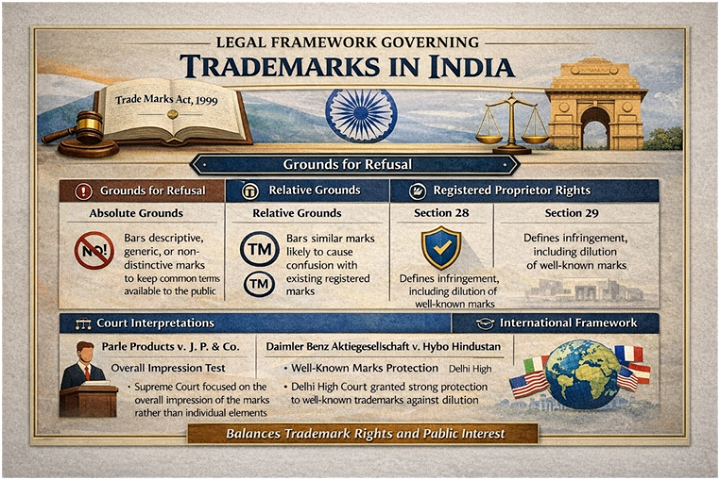
The Trade Marks Act, 1999 serves as the primary legislation governing trademarks in India. It lays down the detailed rules for registering, protecting, and enforcing trademarks. At the same time, the Act attempts to balance the rights of trademark owners to protect their brands with the interests of the public not to be confused or misled.
One of the main attraction points of the Act is the detailed exposition of the grounds for the registration or refusal of a trademark. For instance, Section 9 of the Act specifies the absolute grounds for refusal which means that it bars trademarks that are simply descriptive, generic, or lacking any distinctiveness from being registered. In other words, it is designed to make sure that common words or phrases are still available for everyone hence cannot be monopolized by a single company. Supporting this, Section 11 lists the relative grounds for refusal which prevent registration of marks that are the same as or very similar to earlier marks and are likely to cause confusion among the public.
Section 28 grants exclusive rights to the holder of a registered trademark, allowing them to use the trademark and take legal action against infringement. On the other hand, Section 29 contains the definition of infringement and the list of acts that amount to infringement, which goes beyond direct copying and includes situations where a well-known trademark is weakened or tarnished without really being copied.
Court rulings have had a quite big impact on the interpretation of these clauses. The parley Products (P) Ltd. v. J.P. & Co. case decided by the Supreme Court, for instance, pointed out that the way to decide similarity is by the overall impression of the marks on the consumers rather than by a side-by-side comparison of the elements of the marks. Likewise, in the case of Daimler Benz Aktiegesellschaft v. Hybo Hindustan, the Delhi High Court held that the protection of well-known marks from dilution should not be denied even when the marks belong to totally different kinds of goods.
Making the law effective in practice, the Trademark Registry is the authority responsible for trademark registration, opposition, renewal, and maintenance. However, like many other government bureaus, the Registry is facing issues like procedural delays and backlog which hinders its efficiency.
At the international level, India’s trademark regime is aligned with global standards through its obligations under agreements such as the TRIPS Agreement and the Paris Convention. These frameworks ensure harmonization of trademark protection and facilitate cross-border recognition, thereby strengthening India’s position in the global economic landscape.
India's trademark system is, on a global scale, broadly consistent with international standards through fulfilling its commitments via treaties like the TRIPS Agreement and the Paris Convention. These international agreements are the basis of co-ordination in the field of trademark protection and they ease the recognition of trademarks across borders, in this way giving India more leverage in the global economy.
5. TYPES OF TRADEMARKS RECOGNIZED IN INDIA
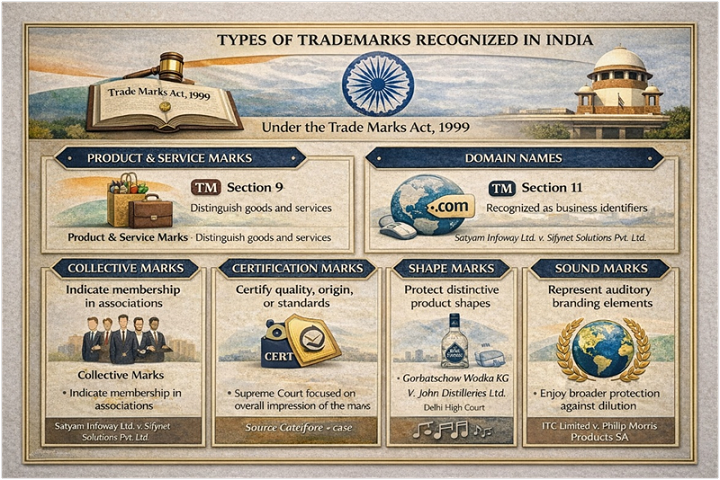
The Trade Marks Act, 1999 includes in the definition of "mark" a large variety of signs, therefore recognizing the fact that different types of trademarks may represent the changed character of branding and commercial practices. This change is very important because nowadays businesses use the most different ways of identification to be recognized by the market and to make their customers remember them, so that they are not limited to using only their names and logos.
On a very basic level, trademarks are divided into product marks and service marks, the first ones being used for goods and the second ones for services. The introduction of service marks by the 1999 Act was a landmark step, especially taking into consideration the exponential increase of the service industry. The Supreme Court in Satyam Infoway Ltd. v. Sifynet Solutions Pvt. Ltd. held that domain names are business identifiers and therefore they are protected in the same way as trademarks, thus recognizing trademark rights in the online world.
Collective marks are yet another kind of marks that are used by all members of an association to show that they belong to the same group and that they are following the same standards. They encourage harmony and give small producers the possibility of being helped by a good reputation. And in the same way, certification marks show that the goods or services meet the requirements in relation to quality, place, or manner of production. Contrary to normal trademarks, the public character of certification marks makes them a means for the consumer to be confident and for the producer to be clear and open.
Besides that, the legislation allows for non-traditional trademarks like shape and sound marks. Shape marks are the protection of the characteristic form of the articles or their packaging, only if they are not just functional. In Gorbatschow Wodka KG v. John Distilleries Ltd., the Court of Delhi gave the lock to a bottle of vodka that has a unique shape and stated that distinctiveness might be derived from the visual appeal. Sound marks have entered the inventory of the goods to be protected quite recently, as they reflect the new direction of marketing that relies on sound rather than visual images only.
Finally, well-known trademarks are afforded an enhanced level of protection as a result of their global recognition. Such marks are safeguarded even in respect of goods or services which are entirely different in order to eliminate the risk of dilution of the renown. In ITC Limited v. Philip Morris Products SA, the Court supported the protection from dilution, which basically means that the Court confirmed the idea that the law should protect the reputation of a mark as such.
Therefore, the acknowledgement of various trademark categories indicates Indian trademark law's responsiveness to the ever-changing business environment.
6. IMPORTANCE OF TRADEMARKS IN THE MODERN ECONOMY
Currently, in economic terms, trademarks have become very important elements that, through legal identification at first, have developed into the main business instruments thanks to which companies generate their growth, competition and consumer acceptance. Besides businesses, their significance is seen in the whole marketplace's efficiency and integrity.
What makes them very important is their economic value. A company's intellectual property portfolio would be incomplete without them, and, in fact, they may be the major source of the company's valuation. A powerful trademark is the basis on which a business builds brand awareness, loyalty among customers, and ability to set higher prices. In fact, the brand value in consumer perception-driven industries often outstrips the value of the physical assets.
Trademarks are also indispensable elements of consumer protection. They help a lot in ensuring that the right goods or services are being marked, and thereby deception and confusion are avoided. The Supreme Court brought up this aspect in Cadila Health Care Ltd. v. Cadila Pharmaceuticals Ltd., by pointing out that due to potential effects on public health, there must be more stringent rules when it comes to trademarks of pharmaceutical products. It is clear that trademark laws are not only meant to serve private interests but also to appeal to the welfare of the community itself.
Besides, trademarks give companies a competitive advantage because they highlight the differences of the products/services in a very complex market. A good and memorable mark is the first step in creating the brand image because it helps the consumers to remember and identify the qualities and the experiences that they associate with the brand. Differentiation is a must for the sake of competition's fairness and market's efficiency.
Besides, trademarks also serve commercial tools that enable different types of business transactions. For instance, they can be licensed, assigned, or franchised, thus creating income and facilitating brand growth. Besides this, in mergers and acquisitions, trademarks portfolios often determine the company's value.
Therefore, trademarks are a fundamental part of today's trade as they lead to economic development, increased consumer trust, and competitive markets.
7. CHALLENGES IN TRADEMARK LAW IN INDIA
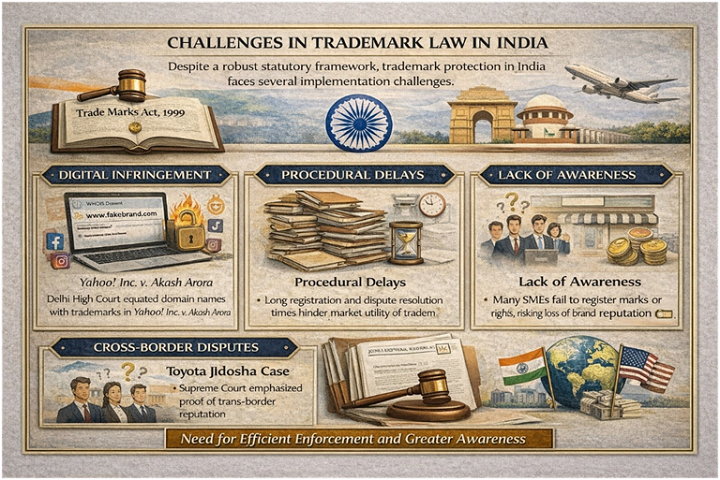
Though India has a detailed legislative framework through the Trade Marks Act, 1999, the actual implementation of trademark protection in India still remains a problem in some respects. These problems are due to the rapid technological changes, ineffective administrative systems and the global nature, which is increasingly, of trade.
The biggest challenge is the surge in digital infringement. As the internet and e-commerce platforms get bigger and bigger, there is also more and more unauthorized use of trademarks through domain names, online marketplaces and social media. In fact, the judiciary has already recognized this problem with an attempt at a solution, Yahoo! Inc. v. Akash Arora, being a good example, the Delhi High Court considered that domain names are doing the same job as trademarks and so they are entitled to similar level of protection. Unfortunately, the extent and the pace at which online infringements happen are beyond the reach of the enforcement systems.
Yet another major challenge has been procedural delay in the Trademark Registry. The procedure for registration, opposition, and adjudication can take a long time, which might affect the benefit of trademarks usage in commercial activities, especially for startups and small enterprises. If registrations are delayed, it can expose businesses to infringement situations and also weaken their position in the market.
Moreover, there is a lack of awareness among small and medium enterprises about the necessity of trademark protection. A lot of businesses do not either get their marks registered or fail to enforce their rights properly resulting in loss of goodwill and higher exposure to copying. Hence, there is a need to inform and educate more about intellectual property rights.
Furthermore, cross-border trademark disputes pose complex legal problems. Today, with the worldwide interconnectedness, trademarks are often used in a number of countries making issues like territoriality and enforcement arise. The Supreme Court in the case of Toyota Jidosha Kabushiki Kaisha v. Prius Auto Industries Ltd. ruled that protecting trans-border reputation requires establishing it in India, thereby highlighting the territorial aspect of trademark rights.
Therefore, even though the legislative framework is quite comprehensive, its real utility can be ensured by addressing these implementation issues through administrative changes, enhanced digital enforcement, and better awareness.
8. CONTEMPORARY RELEVANCE OF TRADEMARK PROTECTION
Trademark law is once again in the spotlight in the modern world due to exponential technology growth and changing business models. Digital dependence has dramatically changed not only the manner of usage but also the ways of protecting and enforcing trademarks.
The development of e-commerce has not only opportunities but also threats to the owners of trademarks. On one hand, businesses can quickly attract a bigger customer base through online marketplaces and on the other hand, such platforms have been the lair of counterfeit goods and unauthorized trademark use. In fact, consumers often depend on the trademark for recognizing authentic products online, therefore ensuring their protection is paramount.
Besides that, social media and influencer marketing have been the main methods of advertising for brands recently. More and more companies are partnering with their favorite online celebrities to promote their products. These promotions sometimes involve using trademarks which have caused legal problems regarding unauthorized use, misleading endorsements, and brand dilution. The very nature of social media, i.e., informal and fast-paced, makes it very difficult to control and enforce.
Besides that, rapid development of the Indian startup sector has also increased the importance of trademarks. Startups mainly use their brand to get a name, bring in investors, and gain the consumer's trust. Without a doubt, having a unique trademark is one of the strongest ways a startup can characterize itself in the market and set a path for success in the long run.
Furthermore, the fact that non-traditional trademarks such as sound and shape marks have become more popular shows that branding is changing these days. To keep up with changes, trademark law has always been adapting, and it will have to continue this process while at the same time finding a good balance between protection and competition.
Trademark laws are very important in those days when everything is changing so quickly. First of all, they make sure the market remains honest and innovative. Also, they protect not only businesses but consumers as well.
9. CRITICAL ANALYSIS
Indian trademark law, which is mainly based on the Trade Marks Act, 1999, is a quite advanced and comprehensive legal arrangement that is still changing and is by and large in sync with international standards. The fact that the law covers various concepts such as service marks, well-known trademarks, and protection against dilution shows the law is quite progressive. Also, the judiciary has played an important role in strengthening the law by coming up with tests for deceptive similarity, among others, and even going against the norm and expanding the law to cover trans-border reputation and digital infringement.
Nevertheless, the framework effectiveness is still subject to certain limitations. One of the major issues is enforcement, particularly in the digital space. The fast growth of online market places and social media platforms has made trademark violation both rampant and very challenging to control.
Besides that, inefficiencies in the procedures of the Trademark Registry also make it difficult to get the registration done quickly or resolve disputes in effective ways. Waiting periods for examination and opposition processes could even make trademark rights less valuable, especially for new and emerging businesses. What makes things worse is the unawareness level of many small and medium enterprises, who often do not even think of protecting their trademarks properly, let alone enforcing them.
Another significant problem is the challenge to align trademark protection with fair competition. Expanding trademark rights too much, especially in the area of terms that are descriptive or generic, can result in monopoly situations and may bar other traders from entering the market.
Therefore, although India's trademark system is fundamentally well-structured, the future success of the system will depend on filling enforcement loopholes, increasing administrative efficiency, and continuing to balance between protection and competition.
10. CONCLUSION
The trademark legislation in India has been revamped to quite an extent, shifting from a regime based on common law fundamentals to the present comprehensive statutory regime under the Trade Marks Act, 1999. Currently, it is a major support of the intellectual property law in the country and it is an indispensable tool for protecting business interests, securing consumer confidence, and encouraging fair competition at the marketplace.
Enlarging the range of trademark protection to include service marks, non-traditional trademarks, and well-known marks are testimonies that the legal framework is still capable of adapting to the needs of today's business environment. Courts through their role of interpreting statutes have also contributed to the development of trademark law by tackling new problems and refining the understanding of important legal concepts.
That said, the fast-changing global and digital economic landscape always poses questions for us which means that the law in this field needs to keep evolving. It is necessary to improve enforcement so that legally protected rights can be defended even in online environments. At the same time, it is also vital that administrative processes associated with trademarks are efficient and the community of businesses is well-informed of the potential of trademark protection.
On a further note, trademark law needs to maintain a careful balancing act between granting exclusive rights to proprietors and not interfering with fair competition. As branding is gradually taking the center stage of economic activity, a strong and adaptable trademark system will be the necessary tool for raising the level of innovation, ensuring the integrity of the market, and helping the economy grow in a sustainable manner.
Click here to download the original copy of the Files
Click here to download the original copy of the Files
Join LAWyersClubIndia's network for daily News Updates, Judgment Summaries, Articles, Forum Threads, Online Law Courses, and MUCH MORE!!"


Tags :Others