
TABLE OF CONTENTS
1. Concept of International Organizations
- 1.1 Meaning
- 1.2 Legal Personality
2.United Nations
- 2.1 Objectives and Principles
3.Organs of the United Nations
- 3.1 General Assembly
- 3.2 Security Council
- 3.3 Economic and Social Council (ECOSOC)
- 3.4 Secretariat
- 3.5 International Court of Justice (ICJ)
4.Specialized Agencies
- 4.1 World Health Organization (WHO)
- 4.2 International Labour Organization (ILO)
- 4.3 United Nations Educational, Scientific and Cultural Organization (UNESCO)
- 4.4 International Monetary Fund (IMF)
5.Role of the United Nations in World Peace
6.Conclusion
1.Concept of International Organizations
International relations, once dominated primarily by interactions between sovereign States, have progressively evolved to include institutional frameworks that facilitate cooperation at the global level. In contemporary international law, international organizations play an increasingly important role in coordinating state behaviour, encouraging collective decision-making, and addressing transnational challenges that individual States cannot effectively manage on their own. Issues such as international peace and security, economic development, public health, and environmental protection often require coordinated international responses, and international organizations provide the structured platforms through which such cooperation takes place.
From a legal perspective, most international organizations are created through multilateral treaties concluded between States. These treaties act as constitutive instruments defining the organization’s objectives, institutional structure, and scope of authority. By establishing such institutions, States
voluntarily agree to cooperate within a common framework to pursue shared interests and manage collective concerns. This process does not diminish state sovereignty; rather, it represents an exercise of sovereignty through which States collectively design institutions capable of facilitating cooperation while retaining control over the powers granted to them. The emergence of international organizations gained particular momentum during the twentieth century, when growing economic interdependence and the devastating consequences of global conflicts revealed the limitations of purely bilateral diplomacy. Early initiatives such as the League of Nations attempted to create a system of collective security after the First World War. Although the League ultimately failed to prevent another global conflict, it nevertheless contributed significantly to the conceptual development of modern international organizations.
A major development occurred with the establishment of the United Nations in 1945, which introduced a comprehensive institutional framework composed of principal organs and specialized agencies addressing political, economic, and social issues. Through these institutions, the international community sought to create a more stable system of cooperation grounded in respect for international law. International organizations therefore perform several important functions within the international system: they provide forums for diplomatic negotiation, facilitate the peaceful settlement of disputes, and contribute to the progressive development of international law through treaties, resolutions, and institutional practice. Although they do not possess inherent sovereignty like States, their authority derives from powers granted through founding treaties, enabling them to operate as distinct institutional actors within the evolving framework of international governance.
1.1 Meaning
The term international organization generally refers to an institutional arrangement created by agreement between States in order to pursue common objectives through organized cooperation. Unlike temporary alliances or diplomatic conferences, international organizations possess a permanent structure, defined functions, and established procedures that enable them to operate continuously within the international system. Such organizations are typically established through international treaties that outline their aims, institutional framework, and decision-making procedures. Examples include the United Nations, the International Labour Organization, and the World Health Organization. These institutions provide platforms through which States can coordinate policies, negotiate agreements, and address problems that require collective solutions.
A defining feature of international organizations is their institutional autonomy. Although they are created by States, they are capable of acting in their own name within the limits of authority granted by their constitutive instruments. This allows them to perform functions such as administering programs, coordinating international cooperation, and implementing policies agreed upon by their members. By providing structured mechanisms for dialogue and cooperation, international organizations contribute significantly to stability within the international legal order.
1.2 Legal Personality
A key legal question concerning international organizations is whether they possess international legal personality. Legal personality refers to the capacity of an entity to hold rights and obligations under international law and to perform acts on the international plane. Traditionally, only sovereign States were considered full subjects of international law. However, the growing importance of international institutions has expanded this understanding. International organizations derive their legal personality primarily from their constitutive treaties, which grant them specific functions and powers. Although they are created by States, they operate as distinct entities capable of carrying out activities independently within the scope of authority delegated to them.
Legal personality enables these organizations to conclude agreements, acquire property, and enjoy privileges and immunities necessary for the performance of their functions. The legal status of international organizations was clarified by the International Court of Justice in the Reparation for Injuries Case (1949). In this advisory opinion, the Court considered whether the United Nations had the capacity to bring an international claim against a State for injuries suffered by one of its officials. The Court held that the UN possessed international legal personality because it had been entrusted with functions requiring the exercise of international rights and duties. The decision also established the doctrine of implied powers, according to which international organizations possess those powers necessary for the effective performance of their functions. Consequently, while their legal personality differs from that of States, international organizations are recognized as important actors within the international legal system.
2.United Nations
The United Nations (UN) is the most prominent international organization in the contemporary global order. It was established after the Second World War with the aim of preventing future conflicts and promoting cooperation among States. The organization was formally created through the United Nations Charter, signed in San Francisco on 26 June 1945 and entering into force on 24 October 1945. The formation of the United Nations was influenced by the shortcomings of the League of Nations, which had failed to prevent the outbreak of the Second World War. The drafters of the UN Charter therefore sought to establish a stronger institutional framework capable of maintaining international peace and promoting global cooperation.
The Charter functions as the constitutional document of the organization. It outlines the purposes of the United Nations, defines the structure of its institutions, and regulates the distribution of authority among its principal organs. According to Article 1 of the Charter, the United Nations seeks to maintain international peace and security, promote friendly relations among nations, encourage international cooperation in solving global problems, and promote respect for human rights and fundamental freedoms. Membership in the organization is open to peace-loving States that accept the obligations contained in the Charter. Under Article 4, admission of new members is decided by the General Assembly upon the recommendation of the Security Council. Over time the organization has expanded to include nearly all sovereign States, making it the most representative international institution.
The United Nations operates through several principal organs, including the General Assembly, Security Council, Economic and Social Council, Secretariat, and the International Court of Justice. Together with its specialized agencies, the UN provides mechanisms for diplomatic dialogue, peacekeeping, economic cooperation, and the development of international law.
2.1 Objectives and Principles
The objectives and guiding principles of the United Nations are articulated in the UN Charter, particularly in Articles 1 and 2, which collectively establish the normative foundation of the organization and regulate the conduct of its member States. These provisions reflect the broader aspiration of the international community to create a stable and cooperative global order based on respect for international law and collective responsibility. The foremost objective of the United
Nations is the maintenance of international peace and security. In pursuit of this aim, the organization seeks to prevent threats to peace, suppress acts of aggression, and promote the peaceful settlement of disputes. States are therefore encouraged to resolve conflicts through diplomatic and legal mechanisms such as negotiation, mediation, arbitration, or judicial settlement, thereby reducing the likelihood of armed confrontation.
Another significant objective is the promotion of friendly relations among nations, founded on the principles of equal rights and the self-determination of peoples. This principle gained particular prominence during the twentieth century, especially in the context of decolonization, when numerous territories achieved independence and emerged as sovereign members of the international community. The Charter also emphasizes the importance of international cooperation in addressing economic, social, cultural, and humanitarian challenges. Through its various organs and specialized agencies, the United Nations provides an institutional framework for tackling global issues such as poverty, disease, environmental degradation, and social inequality. Closely linked to this objective is the commitment of the organization to promote respect for human rights and fundamental freedoms without discrimination based on race, language, religion, or gender.
Complementing these objectives are the fundamental principles outlined in Article 2 of the Charter, which guide the functioning of the organization and the behaviour of its member States. Among the most important is the principle of sovereign equality, which affirms that all States possess equal legal status within the international system regardless of differences in size, power, or economic capacity. Furthermore, the Charter requires States to settle their international disputes by peaceful means and to refrain from the threat or use of force against the territorial integrity or political independence of any State. It also recognizes the principle of non-intervention in matters essentially within the domestic jurisdiction of States, subject to enforcement measures authorized by the Security Council. Taken together, these objectives and principles form the legal and ethical framework that guides the activities of the United Nations and shapes its role in promoting international stability, cooperation, and the rule of law.
3.Organs of the United Nations
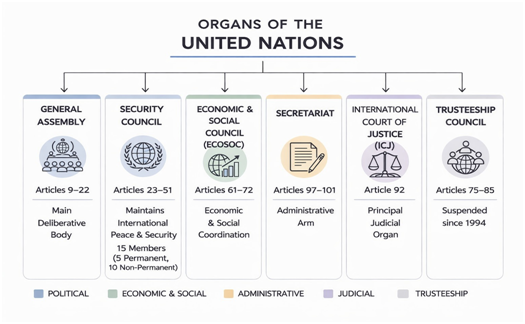
The United Nations performs its functions through a system of principal organs established under Article 7 of the UN Charter. These include the General Assembly, Security Council, Economic and Social Council, Secretariat, International Court of Justice, and the Trusteeship Council. Each organ performs specific roles that collectively enable the organization to pursue its objectives. The General Assembly serves as the main deliberative body where all member States are represented. The Security Council bears primary responsibility for maintaining international peace and security. The Economic and Social Council (ECOSOC) coordinates international cooperation in economic and social matters.
The Secretariat, headed by the Secretary-General, functions as the administrative body responsible for implementing the decisions of other UN organs. Meanwhile, the International Court of Justice serves as the principal judicial organ of the organization. The Trusteeship Council, originally established to supervise trust territories during the process of decolonization, suspended its operations after the independence of the last trust territory in 1994. This institutional structure reflects an attempt to balance political decision-making, administrative coordination, and judicial oversight within the international system.
3.1 General Assembly
The General Assembly is the principal deliberative body of the United Nations. Its composition and functions are provided under Articles 9–22 of the UN Charter. All member States are represented in the Assembly, and each State has one vote, reflecting the principle of sovereign equality. The Assembly serves as a forum for discussing international issues such as peace and security, economic development, and human rights. Under Article 10, it may make recommendations to member States or the Security Council on matters within the scope of the Charter.
The Assembly also performs important administrative functions, including approving the UN budget and electing members to various UN organs. Its authority in financial matters was examined in the Certain Expenses Case (1962), where the International Court of Justice confirmed that peacekeeping expenditures authorized by the Assembly could constitute legitimate expenses of the organization.
3.2 Security Council
The Security Council is responsible for maintaining international peace and security under Article 24 of the UN Charter. Unlike the General Assembly, the Council has the authority to adopt binding decisions that member States must comply with under Article 25. The Council consists of fifteen members, including five permanent members China, France, Russia, the United Kingdom, and the United States and ten non-permanent members elected for two-year terms. The permanent members possess veto power, allowing them to block substantive resolutions.
Under Chapter VI, the Council may recommend peaceful methods of dispute settlement. When a situation threatens peace under Article 39, it may take enforcement measures under Chapter VII, including sanctions or authorization of force.
3.3 ECOSOC
The Economic and Social Council (ECOSOC) promotes international cooperation in economic, social, and humanitarian matters. Established under Articles 61–72 of the UN Charter, it coordinates the activities of specialized agencies and international programs. Composed of fifty-four members
elected by the General Assembly, ECOSOC conducts studies, makes recommendations, and supports international initiatives relating to development, education, health, and human rights.
3.4 Secretariat
The Secretariat is the administrative arm of the United Nations. It is headed by the Secretary-General, appointed by the General Assembly on the recommendation of the Security Council under Article 97 of the Charter. The Secretariat assists other UN organs by conducting research, preparing reports, and implementing decisions. Under Article 99, the Secretary-General may bring matters threatening international peace to the attention of the Security Council.
3.5 ICJ
The International Court of Justice (ICJ) is the principal judicial organ of the United Nations under Article 92 of the Charter. It settles legal disputes between States and provides advisory opinions on legal questions referred by UN organs. The Court consists of fifteen judges elected for nine-year terms by the General Assembly and Security Council.
4.Specialized Agencies
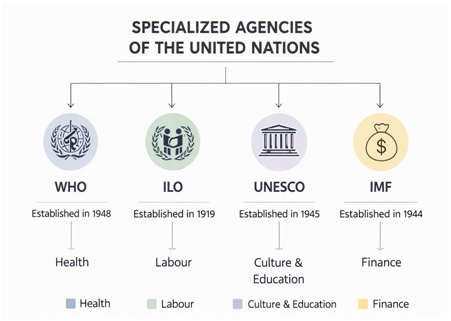
In addition to its principal organs, the United Nations operates through a network of specialized agencies that focus on specific areas of international cooperation. These agencies are autonomous international organizations formally linked to the UN through agreements with the Economic and Social Council (ECOSOC) in accordance with Articles 57 and 63 of the UN Charter. Although they maintain their own governing structures and operational independence, their activities are coordinated with the broader objectives of the United Nations system.
Specialized agencies perform an important role in addressing complex global challenges that require technical expertise and sustained international collaboration. By developing international standards, conducting research, and providing policy guidance, these institutions support member States in dealing with issues such as labour rights, education, financial stability, and public health. Through this system of institutional cooperation, the United Nations is able to extend its influence into specialized
policy areas while ensuring that global initiatives remain coordinated and consistent with the purposes of the Charter.
4.1 World Health Organization
The World Health Organization (WHO) is the specialized agency responsible for promoting international cooperation in the field of public health. Established in 1948, the organization aims to achieve the highest possible standard of health for all people. WHO plays a central role in coordinating global responses to health emergencies, monitoring disease outbreaks, and assisting States in strengthening national health systems. In addition to providing technical assistance and research, the organization develops international health regulations and guidelines intended to improve global health governance. Through vaccination campaigns, disease surveillance programs, and public health initiatives, WHO contributes significantly to the prevention and control of infectious diseases as well as the promotion of overall public health worldwide.
4.2 International Labour Organization
The International Labour Organization (ILO) is one of the oldest international institutions associated with the United Nations system. Originally established in 1919 following the First World War and later integrated into the UN system in 1946, the organization seeks to promote social justice and internationally recognized labour standards. A distinctive feature of the ILO is its tripartite structure, which includes representatives of governments, employers, and workers in its decision-making processes. Through conventions and recommendations adopted by the International Labour Conference, the organization establishes international labour standards aimed at improving working conditions, protecting workers’ rights, and promoting fair employment practices across the world.
4.3 UNESCO
The United Nations Educational, Scientific and Cultural Organization (UNESCO) was created in 1945 with the objective of promoting peace through cooperation in education, science, and culture. The organization operates on the principle that intellectual and cultural exchange can foster mutual understanding among nations and thereby contribute to long-term international stability. UNESCO undertakes various initiatives to promote educational development, scientific collaboration, and the protection of cultural heritage. One of its most notable contributions is the World Heritage Convention, which identifies and protects cultural and natural sites of outstanding universal value. Through such initiatives, UNESCO encourages cultural dialogue and helps preserve humanity’s shared heritage.
4.4 International Monetary Fund
The International Monetary Fund (IMF) plays a crucial role in maintaining stability within the international financial system. Established during the Bretton Woods Conference in 1944, the IMF seeks to promote international monetary cooperation, facilitate the expansion of global trade, and support economic stability among member States. The Fund provides financial assistance to countries experiencing balance-of-payments difficulties and offers economic policy advice aimed at strengthening national economies. In addition, the IMF conducts economic surveillance and technical assistance programs designed to help governments improve fiscal management, monetary policy, and financial regulation. Through these functions, the IMF contributes to global financial stability and supports sustainable economic development.
5.Role of the United Nations in World Peace
The United Nations plays a central role in maintaining international peace and security, as stated in Article 1(1) of the Charter. Through the Security Council and other organs, it seeks to prevent conflicts, mediate disputes, and restore stability in regions affected by violence. The organization employs various mechanisms including peacekeeping operations, diplomatic mediation, and economic sanctions authorized under Chapter VII. Peacekeeping missions help monitor ceasefires and support post-conflict reconstruction. By addressing economic inequality, human rights violations, and humanitarian crises, the UN also tackles underlying causes of conflict and promotes long-term stability.
6.Conclusion
International organizations, particularly the United Nations, have become indispensable components of the contemporary international legal order. By providing structured forums for cooperation, they enable States to address complex global challenges that transcend national boundaries. Through its institutional framework, the United Nations promotes dialogue, supports the peaceful settlement of disputes, and contributes to the progressive development of international law. Despite the continuing importance of State sovereignty, the growing reliance on international organizations reflects a broader shift toward institutionalized global governance, where collective action and legal cooperation play an increasingly vital role in maintaining international stability and promoting common interests.
Join LAWyersClubIndia's network for daily News Updates, Judgment Summaries, Articles, Forum Threads, Online Law Courses, and MUCH MORE!!"


Tags :Others