
Index
- Introduction: Section 298 BNS and the "Lord Krishna" Case
- Case Details and Coram
- Factual Background: FIR No. 67 and the WhatsApp Status
- Statutory Text and Ingredients of Section 298 BNS
- Contentions on Behalf of the Petitioner
- Contentions on Behalf of the State
- Judicial Interpretation of "Object": The Ejusdem Generis Rule
- Mens Rea Under Section 298 BNS: From the Hicklin Test to the Community Standards Test
- Constitutional Protections: Articles 19(1)(a) and 25
- Precedents Relied Upon by the Court
- Ratio Decidendi and Obiter Dicta
- Key Takeaways
- Conclusion
- FAQs
1.Introduction: Section 298 BNS and the "Lord Krishna" Case
By judgment dated 01.07.2026, a Single Bench of the High Court of Punjab and Haryana at Chandigarh, presided over by Justice Subhas Mehla, allowed a petition invoking the High Court’s inherent jurisdiction to quash an FIR registered under Section 298 of the Bharatiya Nyaya Sanhita, 2023 (BNS), the offence of injuring or defiling a place of worship or a sacred object with intent to insult a religion. The case, Ranjanni Gaur v. State of Punjab and Another (CRM-M-11112-2025 (O&M)), arose from the petitioner dressing her pet dog as Lord Krishna and posting the photograph as her WhatsApp status on Janmashtami.
The ruling is a significant precedent on the statutory ingredients of Section 298 BNS, the correct legal standard for assessing offence to religious sentiment, and the constitutional limits within which criminal law may police matters of personal religious expression. It is of particular interest to criminal law practitioners handling quashing petitions founded on similarly worded provisions.
Master The Indian Penal Code: A to Z - In-Depth by Adv. Raghav Arora. Enroll Now!
2.Case Details and Coram
- Case Title: Ranjanni Gaur v. State of Punjab and Another
- Case Number: CRM-M-11112-2025 (O&M)
- Court: High Court of Punjab and Haryana at Chandigarh
- Coram: Hon'ble Mr. Justice Subhas Mehla (Single Bench)
- Reserved on: 24.03.2026 | Pronounced on: 01.07.2026
- Counsel: Mr. Mitul Singh Rana for the petitioner; Mr. Subhash Godara, Addl. A.G., Punjab, for the State
- Statute: Section 298, Bharatiya Nyaya Sanhita, 2023
3.Factual Background: FIR No. 67 and the WhatsApp Status
FIR No. 67 dated 03.09.2024 was registered at Police Station Talwara, District Hoshiarpur, under Section 298 BNS, on a complaint filed by a private complainant identifying himself as a youth leader of a political party. The complainant alleged that the petitioner had hurt the sentiments of the Hindu community by dressing her pet dog to resemble Lord Krishna and disseminating the photograph.
During investigation, the petitioner's statement disclosed that she had remained issueless after six years of marriage and treated her pet dog as her own child. Two to three days prior to Janmashtami, she dressed the dog in a yellow cloth, a crown, a morpankh (peacock feather), and other ornaments associated with Lord Krishna, and photographed it. On Janmashtami, she uploaded the photograph as her personal WhatsApp status, without, as she stated, any knowledge that the act would hurt religious sentiments. On completion of investigation, a final report/challan dated 19.01.2025 (Annexure P-2) was presented before the trial court under Section 193 of the BNSS, the provision corresponding to the erstwhile Section 173 CrPC governing police reports.
4.Statutory Text and Ingredients of Section 298 BNS
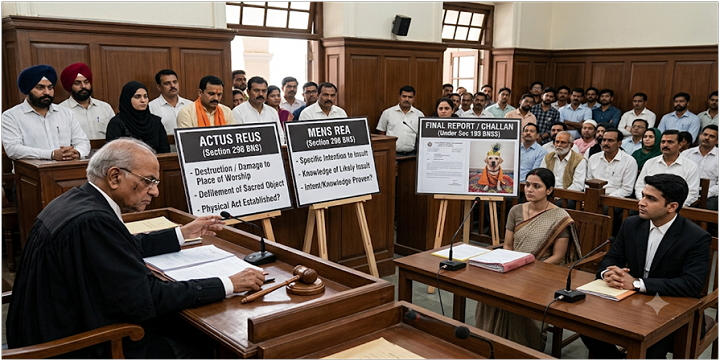
Section 298 BNS, the successor to Section 295 of the Indian Penal Code, penalises the destruction, damage, or defilement of a place of worship, or of any object held sacred by any class of persons, done either with the intention of insulting the religion of that class, or with knowledge that such an act is likely to be regarded as an insult, and prescribes imprisonment of either description extending to two years, or fine, or both.
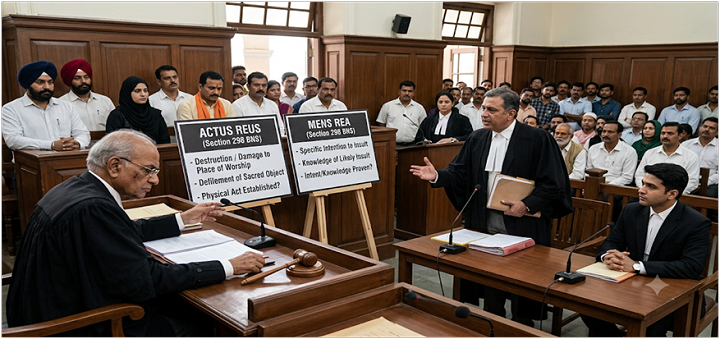
The offence thus has two constituent ingredients that the prosecution must independently establish: the actus reus, being destruction, damage, or defilement of a qualifying place of worship or sacred object, and the mens rea, being either specific intention to insult, or constructive knowledge that the act was likely to be regarded as an insult. Both must be independently satisfied; the absence of either is fatal to the prosecution's case, and it was on this dual failure that the petitioner's quashing petition proceeded.
5.Contentions on Behalf of the Petitioner
Counsel for the petitioner advanced a three-fold submission: first, that the act was a bona fide expression of personal faith and devotion devoid of any intention to insult; second, that the prosecution rested on misplaced religious hypersensitivity and subjective perception of offence rather than the objective legal standard contemplated by Section 298 BNS; and third, that registration of the FIR amounted to an unwarranted overreach of criminal law and an abuse of process.
It was contended that the items used, a yellow cloth, a crown, a morpankh, and other ornaments, were not objects held sacred by the Hindu community within the meaning of the provision, and that the petitioner, herself a Hindu, could not be attributed malicious intent against her own community. Reliance was placed on State of Haryana v. Bhajan Lal, 1992 Supp (1) SCC 335, category (5), covering allegations that are inherently improbable and absurd such that no prudent person could ever reach a just conclusion of sufficient ground to proceed, as well as on Mr. Kailash v. State of Maharashtra, 2025 (2) AIR BomR (Cri) 154, and Mahendra Singh Dhoni v. Yerraguntla Shyamsundar, 2017 INSC 1282. It was further submitted that the photograph, posted only as a private WhatsApp status rather than on an openly accessible platform, negated any inference of deliberate intent to wound religious feelings.
6.Contentions on Behalf of the State
The State opposed the petition, submitting that the FIR prima facie disclosed commission of the offence, that the petitioner's own admission of dressing the dog and posting the photograph was sufficient to sustain prosecution, and that her membership of the same religious community as the complainant did not negate the offence. The State accordingly prayed for dismissal of the petition.
7.Judicial Interpretation of "Object": The Ejusdem Generis Rule
On the actus reus, the Court applied the rule of ejusdem generis to hold that the word "object" in Section 298 BNS takes its colour from the preceding phrase "place of worship," and therefore an object is protected under the section only if it is situated within a place of worship, or carried in a religious procession on a festive occasion. This construction was drawn from a consistent line of authority: Queen Empress v. Imam Ali, (1887) 10 All 150 (FB); Ramesh Chunder Sannyal v. Hiru Mondal, (1890) 17 Cal 852; and S. Veerabhadran Chettiar v. Ramaswami Naicker, AIR 1958 SC 1032. Applying this settled test, the Court held that the props used by the petitioner in a private, domestic setting did not qualify as sacred objects under Section 298 BNS, which was by itself sufficient to negate the actus reus.
8.Mens Rea Under Section 298 BNS: From the Hicklin Test to the Community Standards Test
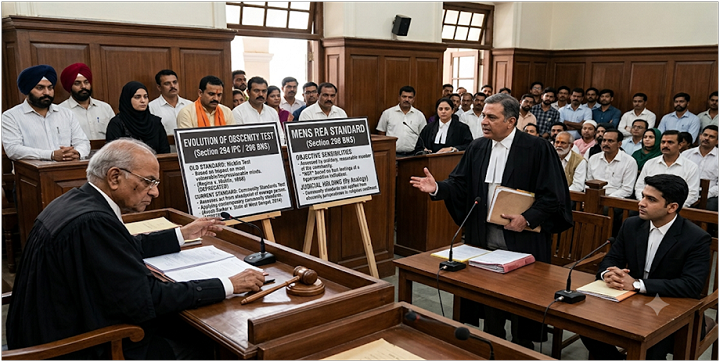
On mens rea, the Court held that liability cannot rest on the hurt feelings of a hypersensitive individual, but must be assessed by whether the act would wound the religious feelings of an ordinary, reasonable member of the community. To support this objective standard, the Court drew an analogy to the doctrinal evolution of the obscenity test under Section 294 IPC (now Section 296 BNS): the older Hicklin test, derived from Regina v. Hicklin, (1868) LR 2 QB 360, which measured impact on the most impressionable and vulnerable mind, was replaced by the community standards test laid down by the Supreme Court in Aveek Sarkar v. State of West Bengal, 2014 INSC 75, which assesses the impugned act from the standpoint of an average person applying contemporary community standards. Extending this reasoning by analogy, the Court held that offence to religious sentiment under Section 298 BNS must likewise be judged by the objective sensibilities of the ordinary reasonable person, not the subjective hypersensitivity of an individual complainant.
9.Constitutional Protections: Articles 19(1)(a) and 25
The Court situated its statutory findings within the constitutional guarantees of freedom of speech and expression under Article 19(1)(a) and freedom of conscience and religion under Article 25 of the Constitution of India, holding that the petitioner's symbolic act of devotion fell within their protective ambit, subject only to reasonable restrictions on grounds of public order and morality, restrictions the Court found were not attracted on the facts. In an extended discussion, the Court also traversed comparative religious symbolism involving animals across Hindu textual sources (the Bhagavad Gita, the Mahabharata, the iconography of Kal Bhairava and Dattatreya, the Chandogya Upanishad, Advaita Vedanta, and the Bhakti tradition), as well as Egyptian, Japanese Shinto, and other traditions, to reason that the perception of divinity is shaped by the devotee's own inner disposition (bhava) rather than the outward form of the object of devotion.
10.Precedents Relied Upon by the Court
In Mr. Kailash v. State of Maharashtra, 2025 (2) AIR BomR (Cri) 154, it was held that Section 295A IPC (the predecessor mens rea provision) requires deliberate and malicious intent to outrage religious feelings, and that the operative test is whether the act had the potential to disturb public order or morality.
In Mahendra Singh Dhoni v. Yerraguntla Shyamsundar, 2017 INSC 1282, concerning a magazine cover depicting the cricketer in the attire of Lord Krishna captioned "God of Big Deals," the Supreme Court held that insults offered unwittingly, carelessly, or without deliberate or malicious intention fall outside the section. In Priya Prakash Varrier v. State of Telangana, 2019 (12) SCC 432, concerning a song alleged to offend religious sentiment, the Supreme Court cautioned against entertaining criminal proceedings where the accused's intent was not to provoke disorder, and against the frivolous invocation of criminal law over matters of personal expression.
11.Ratio Decidendi and Obiter Dicta
For practitioners citing this ruling, it is useful to separate its binding ratio from its persuasive commentary. The ratio decidendi, the ejusdem generis construction of "object," the objective community standards test for mens rea, and the constitutional anchoring under Articles 19(1)(a) and 25, is confined to the Court's statutory and constitutional analysis. The Court's extended discussion of comparative religious philosophy and the theological status of animals across traditions, while illuminating context for the finding on intent, is properly characterised as obiter dicta: persuasive and contextually rich, but not part of the binding holding that a future court applying Section 298 BNS is obliged to follow.
12.Key Takeaways
- Section 298 BNS requires proof of both actus reus (destruction, damage, or defilement) and mens rea (intention or knowledge of insult); the absence of either is fatal to prosecution.
- "Object" under Section 298 BNS is read ejusdem generis with "place of worship": it must be situated in a place of worship or carried in a religious procession to attract the provision.
- Mens rea for offences against religious sentiment is assessed by the community standards test (an objective, ordinary reasonable person standard), not the subjective hypersensitivity of the complainant.
- Articles 19(1)(a) and 25 of the Constitution protect personal, symbolic expressions of religious devotion that carry no deliberate intent to insult.
- State of Haryana v. Bhajan Lal remains a live safeguard against FIRs that are inherently improbable, absurd, or filed with an oblique or political motive.
13.Conclusion
Ranjanni Gaur v. State of Punjab reinforces two settled but frequently overlooked limits on the invocation of Section 298 BNS: the actus reus must be tethered to a place of worship or a religious procession, and the mens rea must meet an objective, community-wide threshold rather than the subjective sensitivity of a single complainant. Both limits function as structural safeguards against the misuse of religious-offence provisions for personal, political, or opportunistic ends, a concern the Court found squarely applicable given the complainant's stated political affiliation.
The judgment demonstrates how a two-ingredient statutory test, combined with the Bhajan Lal safeguards against abuse of process, can be deployed to secure relief at the threshold stage, without the matter proceeding to trial. Its treatment of constitutional protections under Articles 19(1)(a) and 25 further signals that Indian courts remain willing to draw a firm line between genuine communal harm and prosecutions founded on little more than personal or political umbrage.
14.FAQs
Q1. What are the essential ingredients of an offence under Section 298 BNS?
Section 298 BNS requires two elements: an actus reus, being the destruction, damage, or defilement of a place of worship or an object held sacred by a class of persons, and a mens rea, being either the intention to insult that class's religion or knowledge that the act is likely to be regarded as such an insult. Both must be established; if either is missing, as the Punjab and Haryana High Court found here, the offence is not made out.
Q2. Can a person be prosecuted under Section 298 BNS merely because a complainant subjectively felt offended?
No. The Court held that criminal liability cannot be founded on an individual complainant's subjective hypersensitivity. It must instead be assessed against the objective standard of an ordinary, reasonable member of the community, applying the same community standards test the Supreme Court adopted for obscenity in Aveek Sarkar v. State of West Bengal, 2014 INSC 75.
Join LAWyersClubIndia's network for daily News Updates, Judgment Summaries, Articles, Forum Threads, Online Law Courses, and MUCH MORE!!"


Tags :others