
A complaint about communications exchanged over a three-month period emerges at work. To make sure nothing is lost, the company must first protect the employee's laptop, phone information, email account, cloud files, access logs, and workplace CCTV video.
As the situation progresses, more difficult decisions emerge.
Should the company copy the entire phone, including family photos, health records, and private conversations unrelated to the complaint? Should all emails sent by the employee over the past five years be saved, just in case one message is relevant? Should investigators look into private messages with a lawyer? And when should the copied data be deleted?
This is a real conflict between preserving evidence and respecting privacy. While privacy protects liberty, dignity, and the right to keep one's personal life secret until absolutely essential, evidence preservation is about guaranteeing a fair trial or investigation.
The issue has become urgent because modern evidence is scattered across various platforms like phones, cloud accounts, location history, payment records, deleted files, call logs, CCTV, and automated logs.
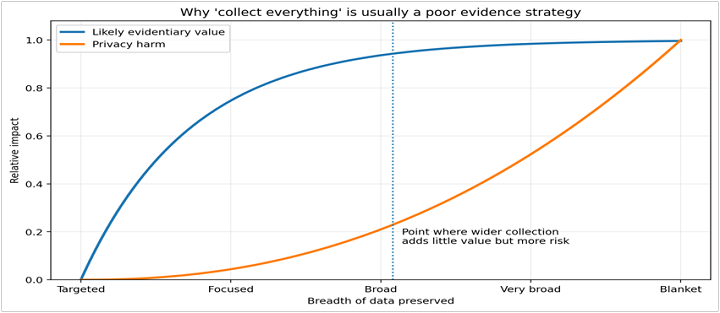
A single dispute could tempt investigators to copy a person's entire digital footprint. Copying has become easy, but unnecessary exposure has not. Indian law offers a way to balance these needs.
Privacy requires legality, a valid purpose, and proportionality. Evidence law requires authenticity, while criminal procedure allows searches with legal permission. Data must be deleted or kept in compliance with legal obligations, according to data protection legislation.
The proper balance is maintained when someone retains just what could be relevant, uses the least intrusive method, protects the data from abuse, and then eliminates or returns it when the legal need is met.
This conflict is no longer limited to criminal cases. It now affects many areas of law, including family disputes, commercial lawsuits, employment matters, medical negligence, and intellectual property cases. Digital evidence can disappear quickly, CCTV footage may be overwritten, cloud accounts may close, devices may be reset, and logs may be stored only for a limited time. A party waiting for trial may find that the best evidence is gone.
However, the urgency can lead to risks. The phrase “preserve first, think later” can become a justification for copying everything without proper limits. Data may spread among investigators, attorneys, suppliers, and experts after it has been duplicated, which raises the possibility of leakage and abuse.
The legal concern is how to prevent loss without transforming a targeted investigation into widespread monitoring, not whether preservation should take place.
Preservation should not be the same as unrestricted access. Preservation, collection, evaluation, and disclosure are four distinct processes that are sometimes combined into one.
Preventing the alteration or destruction of pertinent material is known as preservation. Taking charge of or duplicating the data is part of collection. Examining the content is review, and disclosing it to others is disclosure.
These steps involve different levels of intrusion. An administrator may freeze an email account without reading all emails. A forensic expert may create an encrypted copy of a device, while a court decides later what can be searched.
A company may keep a folder but allow review only through specific keywords and date ranges. One party may receive an unredacted version of a document from the court, while others may receive a redacted version.
This difference is important since maintaining data does not include sharing or evaluating all of it.
While permitting issues of relevance, privilege, and privacy to be addressed later through a controlled procedure, a preservation order with a specific emphasis can assist in protecting evidence.
Preserving data widely enough to prevent loss while examining it narrowly to minimise pointless searches is the best privacy-protective strategy.
Even preservation should not be unlimited. Freezing ten years of data for a dispute about a single transaction in one month is hard to justify, even if storage is cheap.
Table 1: Four stages that should not be confused
|
Stage |
What it means |
Privacy impact |
Good control |
|
Preservation |
Stop alteration or deletion |
Low to medium if access is blocked |
Freeze only relevant sources |
|
Collection |
Take possession or create a copy |
Medium to high |
Record scope and chain of custody |
|
Review |
Read, search or analyse contents |
High |
Use dates, keywords and named reviewers |
|
Disclosure |
Share with court, regulator or another party |
Potentially very high |
Redact, seal and restrict copying |
PRIVACY DOES NOT PREVENT EVIDENCE FROM BEING OBTAINED, BUT IT AFFECTS THE METHOD
In the case of K.S. Puttaswamy v. Union of India, the Supreme Court confirmed that privacy is a fundamental right guaranteed by the constitution, connected to life, freedom, and dignity. The court outlined that any interference with someone's privacy must meet three key conditions: it must be based on law, it must serve a proper purpose, and the methods used must be suitable for that purpose.
This approach is highly relevant when considering how evidence should be kept and managed.
First, there needs to be proper legal authority. Any action taken by the police must follow criminal procedures or another applicable law. A court order must clearly state the power being used.
Private employers or platforms must base their actions on contracts, legal responsibilities, legitimate uses, or valid consent, depending on the situation. It is not enough to simply believe that information might be useful in the future; this is not a sufficient reason for keeping information permanently.
Second, there must be a genuine reason for retaining evidence. Keeping data to investigate a specific complaint is different from creating a long-term record of all employees' behavior. Holding onto logs to support an existing claim is different from keeping them indefinitely in case of future disputes.
Third, the steps taken should be suitable and not excessive. Could the time period be limited? Could names of third parties be hidden? Could a neutral person examine the device? Could only basic information be kept at first? Could access be tracked and restricted? Could unnecessary data be deleted after a review?
In conclusion, privacy does not grant a general right to destroy evidence. Instead, it requires that evidence be preserved and handled with care.
RELIABLE EVIDENCE REQUIRES PRESERVATION, NOT MERELY POSSESSION
The Bharatiya Sakshya Adhiniyam provides legal recognition to electronic records and outlines the conditions needed to establish the validity of computer-generated outputs. Section 63 continues the certificate-based approach that was previously outlined in Section 65B of the Indian Evidence Act. The Supreme Court has consistently highlighted that electronic information can be easily altered, copied, or moved, which means its authenticity cannot be taken for granted just because a screenshot or printout exists.
Therefore, the process of preserving digital evidence must go beyond what is visibly seen.
It should also include the surrounding context that allows the information to be properly examined. This can involve the original device or source, timestamps, file properties, account information, system logs, records of the chain of custody, and the method used to create a copy.
In the case of Arjun Panditrao Khotkar v. Kailash Kushanrao Gorantyal, the Supreme Court reaffirmed that a statutory certificate for secondary electronic evidence is essential for the evidence to be admitted. This shows that the practical approach to handling evidence should begin at the time data is preserved, not just when a trial is about to start. Even if a copy is technically perfect, it can still cause problems if there is no record of where it came from, who had control over the system, or how the output was created.
On the other hand, failing to preserve evidence is also a serious issue. In Tomaso Bruno v. State of Uttar Pradesh, the Supreme Court used the prosecution's failure to provide accessible CCTV evidence as justification for drawing a negative conclusion. This concept was once more utilised in a 2026 Supreme Court ruling to censure the failure to obtain and produce a tape-recorded discussion that may have shed light on what transpired.
These decisions emphasise the significance of appropriate preservation as well as the risks associated with improper management of evidence.
Careless destruction or withholding of evidence is prohibited. However, only materials that can really aid the court in making a decision should be used in the preservation process.
The data protection framework allows for both the erasure and legal retention of data.
The Digital Personal Data Protection Act was developed with the idea that, unless there is a legal obligation to keep it, personal data should not be used after its initial purpose has been completed. Unless retention is required for legal compliance, Section 8(7) requires that data be deleted when permission is withdrawn or when its purpose is no longer relevant. A right to erasure is also granted under Section 12 if legal retention is required.
When processing is necessary for judicial reasons, to enforce a legal claim, or to prevent, detect, investigate, or prosecute criminal crimes, the Act provides an exemption.
However, these provisions do not support unlimited storage.
“Necessary for a legal claim” is not the same as “possibly useful to a lawyer.” Necessity means that the material must be directly related to the dispute and relevant to the period of time it is being retained.
The final Digital Personal Data Protection Rules, introduce specific requirements for data retention and security, including logs, backups, and access controls.
There is also an important timing aspect. From July 2026, the main duties under Sections 3 to 17 of the Act, along with most operational rules, are expected to take effect in May 2027, as stated in the phased commencement notification. Organisations should be clear about which provisions are already in effect and which are still scheduled for implementation.
Even before the full implementation of the Act, the framework provides courts and organisations with guidance: data should be kept for a specific reason, secured while it is stored, and deleted once that reason no longer applies.
|
Rule or judgment |
Paragraph or section |
Working principle |
|
K.S. Puttaswamy v. Union of India |
Part S, para 180 and conclusions |
Privacy intrusions require law, a legitimate aim and proportional means. |
|
Bharatiya Sakshya Adhiniyam, 2023 |
Section 63 |
Electronic output must satisfy the statutory proof and certificate framework. |
|
Arjun Panditrao Khotkar |
Para 61, as reaffirmed by the Supreme Court |
The electronic evidence certificate is a condition for admissibility of secondary computer output. |
|
Tomaso Bruno v. State of Uttar Pradesh |
Para 28 |
Withholding material CCTV evidence can justify an adverse inference. |
|
DPDP Act, 2023 |
Sections 8(7), 12 and 17 |
Erase when purpose ends, but permit necessary retention for law, claims and investigations. |
|
PUCL v. Union of India |
Paras 18 to 19 |
Private communication cannot be intercepted outside lawful procedure and safeguards. |
A PHONE IS NOT A SINGLE DOCUMENT
In addition to storing a thorough picture of its owner's personal life, a smartphone might include proof of criminal activity.
Messages, images, financial information, health applications, browser history, contacts, and location information are all included. While taking a phone may be legally allowed, searching every part of it could be more intrusive than necessary.
In India, the criminal justice system allows investigators to search, seize, and request material.
However, these powers must be used with clear reasons and records. Searches should be as focused as possible, limiting scope to specific dates, accounts, file types, people, or subjects. The method used to extract data should preserve its accuracy without exposing unrelated information to everyone involved.
The People’s Union for Civil Liberties v. Union of India telephone-tapping case still offers important guidance. The Supreme Court recognised that private communication is part of an individual’s private life and emphasised that technological interception must follow legal procedures and safeguards. Modern phone searches can be more invasive than old telephone tapping because they can gather years of information at once.
The significance of safeguards is shown by the earlier Pooran Mal ruling, which said that pertinent evidence is not necessarily deleted simply because it was discovered through an unlawful search.
Privacy must be safeguarded at every stage—authorization, collecting, filtering, storage, and disclosure—if legal infractions do not automatically remove evidence.
By forcing investigators to explicitly define what they are searching for, maintain access logs, utilise hash values to check data integrity, segregate private or personal material, and either return or destroy unnecessary information when the case is settled, courts may enhance the process.
When a full copy of a device is necessary, it should be reviewed by an impartial forensic examiner using a written protocol.
CIVIL AND COMMERCIAL DISPUTES: THE ISSUE OF EXCESSIVE LITIGATION HOLDS
Companies sometimes place a litigation hold on records when they receive a legal notice.
This is reasonable when there is a real chance of litigation and routine deletion might destroy important data. However, the problem arises when the hold extends beyond the scope of the dispute and continues long after the risk has passed.
A disagreement about a single-ended contract typically doesn’t require freezing every mailbox in a company. A focused hold can identify the people involved, the relevant project, a reasonable time frame, and the systems likely to contain relevant records. It should also clarify what employees should not delete and whom to contact if they have questions.
Commercial litigation also involves another layer of privacy. Business records often include personal information about employees, customers, and vendors who are not part of the case. Therefore, the production of such records should be based on relevance, with necessary redactions, restricted inspections, or sealed filings.
Preservation should also be handled consistently. A claimant cannot let its own auto-delete mechanisms to continue while demanding extensive disclosure from the opposing party. Selective preservation, in which one party retains advantageous portions while allowing the surrounding context to vanish, is something that courts should be aware of.
Documenting when the need to preserve originated, what was saved, why those sources were selected, who had access, what searches were done, and when the hold was released is the best course of action.
Both the evidence and the process's legitimacy are protected by this record.
Workplace questions: safeguarding the complaint without keeping an eye on everyone
Internal complaints create a challenging situation for all involved.
Messages may be erased if there is a delay, but excessive gathering may terrify witnesses and divulge personal information. The organization has obligations to the respondent, the complainant, and any other workers whose data may be included in the records.
A documented accusation or a well-defined concern is the first step in a fair procedure.
Preservation should follow the allegation, not the other way around. If the complaint is about messages between two employees over six weeks, the first response should not be a complete archive of all employees’ communications.
PERSONAL DEVICES REQUIRE SPECIAL CARE.
If a company allows work on personal phones, it should avoid taking a full image unless there is no better alternative. Relevant chats can be exported with the employee present or collected by a neutral expert. Personal and confidential material should be separated. The employee should receive a record of what was taken.
Confidentiality should be realistic. Evidence should only be available to those who need it for the investigation and as principle, it shouldn't be discussed as office gossip or stored on an open shared drive, this carries an innate risk of evidence tampering and would prevent legitimate preservation. The final report may include sensitive material without repeating every particular detail.
This is not a lack of seriousness about misconduct. It is a disciplined approach to investigation. An inquiry gains credibility when it proves what it needs without humiliating individuals who may ultimately be found not guilty.
Platforms and cloud providers: preservation requests need an end date. Data kept by telecom firms, cloud service providers, and social media platforms is used in many legal issues.
Sometimes urgent preservation petitions are required because their regular retention practices may delete evidence before a court may take action. A proper request should clearly identify the account, time period, and type of data being sought. A demand to preserve “all information connected to” a person can capture years of irrelevant activity. The request should also include an expiry date. If no legal process follows, the provider should not keep an indefinite backup of the data.
Preservation should be separate from disclosure. Freezing data does not automatically grant the requesting party the right to access it. Disclosure might still require consent, legal authority, or a court order. This distinction ensures that evidence is protected without exposing private information just because someone sent a notice.
FIVE MISTAKES THAT INCREASE BOTH EVIDENTIARY AND PRIVACY RISKS
The first mistake is collecting data before clearly defining the issue.
Without a clear understanding of what is being investigated, relevance is undefined.
The second is relying only on screenshots.
While useful, screenshots may miss important account details, surrounding conversation, and technical context. Keeping the source and documenting the extraction method makes verification easier.
The third mistake is giving too many people access.
Evidence repositories should use role-based access, encryption, and activity logs.A privacy breach can harm the case the archive is meant to protect.
The fourth mistake is forgetting third parties.
A relevant chat might contain medical records, photos, or contact details of people not involved in the dispute. Redaction and filtering matter when that information isn’t needed.
The fifth mistake is never ending the hold.
Preservation should have a start and an end. After considering appeals, time limits, and other proceedings, irrelevant copies should be securely deleted or returned.
A SIX-STEP MODEL FOR BALANCING PROOF AND PRIVACY
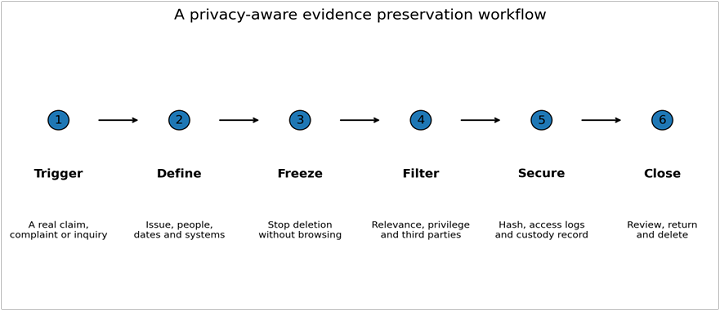
A PRACTICAL SYSTEM SHOULD FOLLOW SIX STEPS.
- Identify the trigger. There should be a clear reason to expect a legal claim, investigation, inquiry, or regulatory request. General concerns are not enough.
- Define the issue. Clearly state the allegation, transaction, event, or legal question. This sets a clear boundary for relevance.
- Map the likely sources. Identify the people, devices, systems, and dates most likely to contain useful information. Begin with direct sources.
- Preserve without unnecessary exposure. Freeze accounts, create reliable copies, calculate hash values, and keep detailed records of the chain of custody. Segregate privileged, personal, and unrelated data.
- Control review and disclosure. Use named reviewers, access logs, search terms, date limits, and confidentiality rules. When the data is especially sensitive, a neutral expert can assist.
- Close the process. Regularly review the hold. When the purpose is fulfilled, return devices, remove restrictions, and securely erase unnecessary copies.
This model treats privacy as a necessary part of good evidence management, rather than an obstacle to investigation.
WHAT COURTS SHOULD CONSIDER BEFORE ISSUING A PRESERVATION ORDER
Even when an urgent preservation order is necessary, it should address fundamental questions.
What materials are involved? Who is responsible for preserving them? What time frame applies? Does the order limit preservation to just safeguarding, or does it also permit collection and review? How will privileged or data from third parties be treated? How long will the order remain valid?
Courts should be careful when requiring full phone copies, entire email accounts, or endless cloud histories. The person requesting the preservation should explain why narrower sources would not suffice. A neutral examiner can identify and isolate the relevant data before it is disclosed.
Intimate information doesn’t always have to be excluded. It can be managed through redaction, sealed records, private hearings, and restrictions on copying. Proportionality also includes the cost and practical difficulty, especially for individuals and small organizations.
MY VIEW: THE REAL DANGER IS PRESERVING DATA WITHOUT CONTROL
The discussion is often framed in extremes. There is one side that argues that privacy must give way whenever evidence is needed. The other side, which exists, believes that personal data should not be accessed without permission. Neither position works in a legal system that must uncover facts while also respecting people.
A message is not less important simply because it is private. A phone is not automatically open for inspection just because one message might be relevant.
The best solution is a clear process which means asking a specific question, preserving only the likely source, using a reliable method, keeping access limited, documenting every step, removing what is no longer needed.
Indian courts should also consider overly broad digital collection as a procedural flaw on its own.
Often, the focus is only on whether the material will be admissible at trial. That is too late. By then, private photos may have been viewed, health information copied, and unrelated conversations shared. A later decision that the data was not relevant cannot undo that damage.
Privacy protections should be embedded in search warrants, production orders, workplace procedures, and discovery instructions from the beginning.
This would not weaken the evidence. Instead, it would make evidence more trustworthy because its collection would be transparent, limited, and responsible.
Speaking to LCI, Advocate Amritesh Singh stated that “The second a workplace harassment complaint or a whistleblower notice lands on their desk, everyone panics. They call in the IT guy, duplicate an employee's entire personal phone, dump a five-year email archive, and honestly think they are doing a thorough job. In reality, they just handed the other side a massive win.
Grabbing everything does not make you a smart or aggressive lawyer. It just creates a huge liability. The minute you download private family photos, medical records, or personal messages between a worker and their spouse, you ruin the integrity of the whole process. You cannot just snoop through someone's entire private life and pretend you are just saving proof.”
He further said that “The old way of vacuuming up all the data now and letting the courts sort it out later is completely dead. Under the new laws, if you cannot clearly justify the exact dates, the specific keywords, and the exact people you need to check before you press copy, you are not doing forensics anymore. You are running illegal workplace surveillance. Smart strategy means putting a lock on the data container so nothing gets deleted, and then using a scalpel instead of a chainsaw to look inside. If you do not build privacy into your evidence gathering from day one, expect the court to throw your best proof straight into the trash”
A PRACTICAL REFORM AGENDA
India doesn’t need to choose between preserving evidence and protecting privacy. What is needed are common standards. Preservation notices must identify the legal basis, categories, custodians, dates, and expiration.
Device searches should follow written procedures with full extraction justified and unrelated data separated. Evidence databases should maintain access logs. Hash verification, chain-of-custody forms, and Section 63 certificates should be planned from the start.
Confidentiality orders should be standard when disclosure involves health, sexual, financial, biometric, or children’s data. Preservation should be reviewed regularly, and secure deletion should be properly recorded.
The balance is a method, not a slogan. The phrase “evidence preservation versus privacy” sounds like a conflict where one side must win.
In practice, these two interests often align. A focused preservation process leads to more accurate and reliable evidence. Strict access controls prevent tampering. Clear records of who handled the evidence protect its authenticity. Defined retention periods prevent data archives from becoming unmanageable. Neutral filtering ensures fairer disclosure.
The law should be firm against destroying, hiding, or selectively withholding evidence.
It should also be equally firm against using a legal dispute as an excuse to search someone’s entire digital life.
The right question is not, “Can this data be copied?” It is, “What exactly must be preserved, for what legal purpose, by whom, under what safeguards, and for how long?”
When these questions are honestly answered, evidence can be preserved without allowing preservation to turn into surveillance.
Practical preservation checklist
|
Question |
Why it matters |
Minimum record to create |
|
What triggered preservation? |
Prevents speculative or permanent holds |
Date, allegation, notice or order |
|
What is the issue? |
Creates a relevance boundary |
Short written scope statement |
|
Whose data is included? |
Identifies affected people and third parties |
Custodian and account list |
|
Which dates and systems apply? |
Avoids copying years of unrelated data |
Date range and source map |
|
Who may review? |
Limits misuse and gossip |
Named access list and access log |
|
How is authenticity protected? |
Supports admissibility and trust |
Hash, extraction note and custody record |
|
When will the hold be reviewed? |
Prevents indefinite retention |
Review date and closure trigger |
|
What will be deleted or returned? |
Closes the privacy risk |
Secure deletion or return certificate |
Frequently Asked Questions
Can a person demand deletion of data after a legal dispute begins?
Not necessarily. Data that is genuinely required for a live claim, investigation or legal duty may be retained despite a deletion request. The retention should still be limited to what is necessary and should end when the legal need ends.
Does privacy make secretly obtained evidence automatically inadmissible?
Indian law has not adopted a general rule that all illegally obtained relevant evidence must be excluded. Specific constitutional or statutory violations can still affect admissibility, presumptions, fairness and the legality of the investigation.
Should an entire phone be copied when only a few messages are relevant?
A complete forensic image may sometimes be required to prevent alteration or verify authenticity. Review and disclosure should still be narrowed through dates, accounts, search terms, neutral filtering and segregation of unrelated material.
What happens if CCTV or electronic records are not preserved?
A court may draw an adverse inference where a party or investigating agency had control of important evidence but withheld or failed to preserve it without a satisfactory reason.
How long should evidence be preserved?
There is no single period for every case. The answer depends on the proceeding, limitation period, appeals, regulatory duties and sector-specific law. Every preservation decision should include a review date and a rule for lifting the hold.
Join LAWyersClubIndia's network for daily News Updates, Judgment Summaries, Articles, Forum Threads, Online Law Courses, and MUCH MORE!!"


Tags :Others