
Introduction
Creativity being something only people do - that idea sits at the heart of copyright law. Laws written years ago, court rulings made since, even how we define who counts as an author - they all rely on a thinking person making choices. Yet lately, things have started to shift. Machines powered by artificial intelligence now produce songs not just copied from patterns, instead works that stand up on their own, sounding real, feeling complete, reaching listeners like human-made tracks.
Nowhere does this clash become clearer than in the courtroom arguments unfolding at the Delhi High Court over Tarun Chaudhary's case. Far from weighing distant legal theories, judges here face a real accusation of copied material - yet one built on a creation that might lack basic eligibility for ownership rights. Because of this odd twist, what looks like routine litigation shifts ground, turning instead toward deeper questions about where copyright truly begins - and ends.
The challenge goes beyond tech. What matters here is how we think. Expression gets shielded by copyright - on condition someone stands as its maker. Once code drives creation, the legal system faces a puzzle it did not expect: must protection vanish when humans step away from making? This choice shapes more than one trial - it steers where Indian IP law might go next.
Factual Background
It started like many others - a complaint about someone using music without permission. Tarun Chaudhary said he owned a particular track, pointing fingers at several people who used it anyway. At first glance, things looked routine enough. Ownership claimed here, usage spotted there, then off to court for resolution. What came next unfolded much like such matters often do.
Suddenly, things changed when people started questioning what kind of work it actually was. Midway through the hearing, someone pointed out the track might have come from an AI system. That detail altered everything at a deeper level. Led by Justice Tushar Rao Gedela, the Court saw how the matter now stretched beyond copying. What popped up first was something quieter but heavier - whether copyright could exist at all here.
What matters here isn’t about steps - it runs deeper, into structure. Because claims of copying only make sense if there’s something legally protected to begin with. Without that foundation - a rightful copyright - the whole case falls apart. So the court must first decide if the work is actually shielded by law. Only then can any talk of breaking those rules come up.
Nowhere is the puzzle clearer than here - India’s copyright rules say nothing straight out about creations made by artificial intelligence. With no clear law to point toward, judges have to piece things together using past ideas and comparisons. That gap opens room to build something new. Yet building it means moving carefully, so older legal foundations do not crack under fresh weight.
The Core Legal Issue Copyright Without a Human Author
A single question drives the heart of this legal fight - one that seems basic at first glance, yet tangled deep down. Is it possible for music made by artificial intelligence to get protection under India’s Copyright Act from 1957? Everything turns on whether the law sees such creation as having real authorship and genuine originality.
Who makes music owns it, says the law. For songs without words, credit goes to whoever wrote the tune. Words on a page? The one who penned them holds rights. This framework thinks in people, not machines. Creation here means choice, effort, thought - things bots do not have.
Without clear rules on AI-made creations, there's an open question. Assumptions won’t settle it. Interpretation has to step in instead. Whether old copyright terms can stretch around AI help or AI-only work is up to the Court now. Outcomes depend on if those outputs are seen inside - or beyond - current legal bounds.
What makes this tricky ties back to how original something must be. In India, copyright isn’t about being new like a patent needs to be. Instead, the work has to come from the creator and show just a little spark of imagination. Courts shaped this idea over time. But confusion sets in once the source shifts - say, when a machine plays the role of creator instead.
Should the judges decide only people can create protected work, pieces made entirely by machines might get no legal shield. Yet should they lean toward openness, credit could go to those who set the system in motion, their role seen as shaping the result.
Testing Authorship and Originality Beyond Current Rules
Originality and who creates something aren’t just rules written in law books. Built into how copyright works, they form its base. Judicial rulings have strongly influenced what counts as original in India. A key shift came through the Eastern Book Company versus D.B. Modak decision. That ruling by the top court left behind the old idea that effort alone makes something original. Instead, it introduced a small but necessary level of creative input.
This change matters most when thinking about artificial intelligence. Because creativity needs some kind of personal touch, it raises doubts - can that touch really come from a person if an algorithm makes the work? When someone just types a request and gets back a full piece of music, their role might feel distant, maybe even too far removed to count.
What makes this tricky is how AI builds on itself, step after step. One piece follows another - training data shapes algorithms, those guide responses, users add their own cues along the way. Who actually made the final thing? Hard to say when so many pieces come together like that. Each person who touched it might argue they had a hand in shaping it.
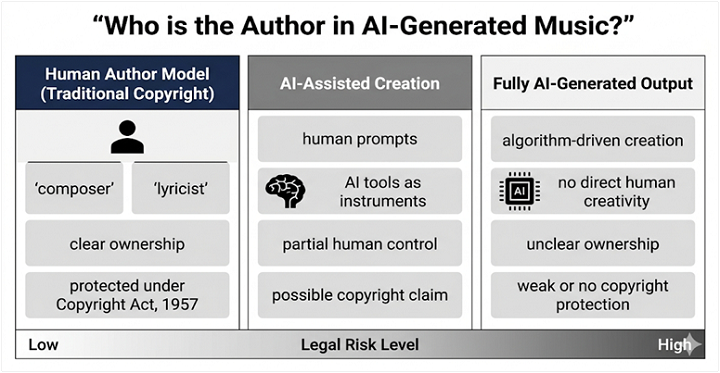
Who made what doesn’t fit neatly when machines are involved. Rights around creation stack together - ownership, passing them on, defending them in court. Machines sit outside all that. They do not carry duties nor own anything. One path points toward those who built the system. Another leads to the person pressing go and shaping the result.
A single role here can’t cover everything. Building the system comes down to the coder, yet what it produces isn’t theirs to decide. What shows up on screen depends on the person typing - though that doesn’t always count as making something new. Right now, legal rules just aren’t built to untangle this mix smoothly.
Ai As A Tool Or A Creator Shapes Legal Results
What stands out most? The Court might zero in on how AI functions - not just as something used, but as something seen as originating work. Not spelled out in law, sure, yet somehow the framework of copyright hints at it anyway.
Sometimes a person guides the machine, shaping each choice while the tech follows along. Creative power stays with the individual, since only they decide what goes where. Recognition of legal rights flows easily here, because one mind leads the work. Ownership remains clear, resting fully on the person who directs the process. Tools change, yet responsibility does not shift from the user.
Now picture this: once AI runs on its own, making key choices alone, things shift. When the machine picks how a piece is built, arranged, even worded - without real human input - it's hard to point at a person and say they made it. As independence grows in the software, any argument that a human created it fades fast.
A twist in the Delhi High Court’s review points toward this second kind of situation. Should things lean that way, refusal of copyright could follow - not due to poor merit, yet failing legal standards set by doctrine.
Infringement Without Copyright How Claims Fall Early
Copyright court cases follow a strict order. Before anything else, the person suing has to prove their copyright is legitimate. Once that happens, only then can anyone look at whether copying occurred. This isn’t just about steps in a process. It mirrors how the legal system thinks.
A decision hangs on whether the piece can be copyrighted at all. Right now, that is what the judges are weighing. Should protection not apply, the case collapses. Resting solely on copyright status, the plaintiff’s argument stands or falls with it.
Right off, there's a gatekeeping problem here. Should the judge decide the piece doesn’t show real creative effort, everything stops before it even starts. Without clear signs of original input by an author, the whole claim might collapse immediately. Outcomes hinge on whether creation itself meets basic legal standards.
A shift like this could ripple out in many directions. When tech is new, judges might start looking harder at whether a copyright claim makes sense. Instead of assuming rights exist, people making accusations would need to prove there is something real worth protecting.
Parallel Legal Moves Personality Rights Replace Rather Than Fix
Relying more on personality rights in AI conflicts shows how laws can stretch yet still fall short. Over ten years, Indian judges slowly built rulings about these rights, especially when someone uses another's voice, image, or name without permission for profit. Still, one must see clearly - such rights cannot replace copyright. Entirely separate ground governs them.
Truth often shows up in small choices - like staying real when copying feels easier. Using someone else’s face without asking shifts trust into violation. Songs built by machines to mimic known artists? That triggers debate before the first note finishes playing. It does not matter if the melody is new - what counts is whose identity got used. Harm happens when likeness turns into profit without consent. A name carries weight, even in digital form.
This difference counts since it narrows how much is shielded. When a tune made by artificial intelligence fails to mimic a living person's vocal features or clear markers, personal image laws cannot step in. Without ownership claims under copyright, oversight simply vanishes there. Free movement of the piece becomes possible, no matter its worth in culture or cash.
A shape begins to warp when stretched too far. When personality rights grow to include wider creative traits, their original role starts to blur. Judges have moved slowly here, aware that these rights must not slip into disguised ownership of styles or forms. That shift would eat away at shared culture, limiting work others might freely create.
A patchwork of rules shows up when you look closely. Without clear authorship, copyright often falls short, whereas personal image rights kick in just once in a while. The gaps between these approaches expose how outdated current laws are for content made by artificial intelligence. What sticks out most is the push toward building a unified system - one that actually fits how creation works alongside machines.
The Problem With Training Data Unknown Origins and Unclear Permissions
Training remains central to how artificial intelligence produces material, though it draws less attention than expected. These models build responses based on massive collections of existing information rather than generating ideas independently. Copyrighted materials frequently appear within those data pools without explicit permission. Such inclusion prompts debate - whether using protected content during learning violates legal rights, particularly before output is even generated.
Though crafted long before modern computing, India's Copyright Act of 1957 remains silent on whether using protected works to train artificial intelligence is lawful. Instead of replicating visible content, machine learning absorbs underlying structures from data. Because the law anticipated straightforward duplication - not abstract pattern recognition - it lacks clear guidance here. Its original intent focused on human-perceivable copies, not computational analysis. Thus, when algorithms learn from creative material without reproducing it directly, legal boundaries blur.
Still, making too much of this difference misses the point. Feeding copyrighted material into models happens in a structured way. Though no one piece matches exactly, patterns from those sources can linger in results. That brings up questions about borrowed structure. Just because nothing is copied outright does not mean legal lines stay unbroken.
Closest in idea might be fair dealing, found in Section 52 of the Act. Still, fitting that rule to AI learning isn’t clear-cut. Its reach stays narrow, linked only to set goals - like study, personal use, commentary, or evaluation. Big-profit AI model training matching those aims seems unlikely at best.
In recent years, legal disputes around this matter have spread across global courtrooms - especially within the U.S. and EU. Although India's judiciary remains untouched by such cases so far, anticipation builds for future involvement. Once local rulings begin, judges may find themselves balancing progress in tech against fair recognition for artists who originate work.
Even here, this matter stays quietly aside. Still, its structure ties closely to the central concern. Should AI-created content fail to gain copyright due to missing human origin, then scrutiny of the training phase's compliance with current rights grows necessary. Without such review, imbalance looms - protection for inputs alone, while results go unguarded, or the reverse.
Music Industry Shifts Ownership Incentives Markets
Should courts grant or reject copyright for tunes made by artificial intelligence, consequences ripple well outside legal chambers. Ownership models shift when machines compose, altering who holds rights. Incentives to create evolve under such conditions, influencing human artists’ motivations. Competition within the sector transforms, depending on how laws treat machine-authored works.
With AI creations recognized under copyright law, organizations running these systems might mass-produce music affordably. Such a shift could reshape financial dynamics across the sector. Creators relying on effort, expertise, and investment face rivalry from automated output made quickly and repeatedly. Their work risks being overshadowed by material generated without comparable human input.

Questions emerge over how markets might be skewed and because copyright aims to reward people's creative efforts through special protections. If such protections apply to material made by artificial intelligence, the original purpose risks weakening. As a result, recognition might move from artists to the companies controlling the systems.
Still, removing copyright safeguards completely might backfire in ways not initially expected. Without legal protection, profits from creative output could shrink. That risk might cool enthusiasm among builders and companies putting money into artistic AI systems. When returns are uncertain, funding often slips away.
The problem does not split neatly into two sides. Finding middle ground between opposing needs becomes necessary here. Where human effort can clearly be shown, some form of safeguard might apply - yet creations made entirely by machines could fall outside that scope. Putting this line into real-world use, though, brings complications.
Ownership questions surface just as quickly. Protection might apply, yet deciding who actually holds the claim proves tricky. Could it belong to the person using the system, the team that built it, or perhaps a shared setup across them both? Every path changes how authority and earnings would be managed.
How the Delhi High Court ultimately responds could reshape the way companies organize their work. Whether artificial intelligence supports creative effort or replaces it may depend on that outcome.
Judicial Restraint and Judicial Innovation Balancing Interpretation
Nowhere is the challenge clearer than here - faced with fresh circumstances, judges find themselves rethinking old rules. How much can doctrine bend before breaking? Such moments expose tensions between stability and change. Who decides when tools outpace laws meant for simpler times? In stepping forward, courts inevitably shape more than outcomes; they influence expectations. Not merely interpreting statutes, yet not quite making them either. The task sits uneasily between precedent and possibility.
Usually, courts work by following laws as written. While applying rules is their main role, crafting fresh legal systems lies beyond their task. When it comes to creations made by artificial intelligence, unclear legislation pushes judges toward shaping answers.
Only so much ground can be covered here. If courts began treating machines or animals as authors, it would break sharply from what the Copyright Act, 1957 set up. That kind of shift might look like judges stepping too far into lawmakers’ territory - especially when big societal choices hang in the balance.
Meanwhile, failure to adjust risks making legal rules irrelevant when facing modern issues. To stay useful, judges need to find middle ground. By reading current laws flexibly, they allow slow evolution - yet stepping beyond interpretation into creation undermines their role. Staying within bounds matters just as much as responding to new realities.
Perhaps here, the Court moves carefully. Reaffirming human authorship might happen, yet space could remain for future laws. Consistency in legal principles stays intact under such a path. Still, room exists to admit change is necessary.
This method matters because it sharpens how institutions fit together. Because real answers - especially on economic choices or tech rules - often come clearer from laws, not court-made fixes.
Industry Perspective
Speaking to LCI, Adv Abhishek Jan stated that 'Honestly, this is one of those cases where the law is being pushed into territory it was never really built for. If this had come up earlier, most courts would have brushed it aside pretty quickly, but now as we see with AI tools actually producing full-fledged music, you can’t avoid the question anymore.
He further said that 'From where it stands today, the Copyright Act, still assumes that there is a human author behind every work. That’s the starting point. So the moment you’re dealing with something that’s largely generated by AI, the entire claim becomes shaky. Before even getting into infringement, you have to ask, is there a valid copyright at all?'
Expanding further upon the same he said that 'That’s where things get messy in practice, as because clients don’t see it that way and for them, the song exists, it has value, and they want protection. But legally, we’re still tied to a framework that doesn’t clearly recognise that kind of creation. So there’s this gap between how the industry is moving and how the law is structured. I also think courts will be careful here. They’re not going to completely stretch the definition of authorship just to accommodate AI, because that could create bigger problems later. At the same time, if they take a strict view, you’re basically saying a whole category of content doesn’t get protection."
The Push for Laws Instead of Ruling by Ruling
Clearly, today's laws fall short in key areas. When it comes to problems sparked by AI-made material, court rulings alone fail to offer real solutions. A broad overhaul through legislation - covering every major issue - is what fits the moment.
A work produced using artificial intelligence raises immediate questions about who - exactly - counts as the creator. Starting this conversation requires setting out what we mean by authorship when machines are involved. Determining how much a person must contribute becomes central to deciding if legal rights apply at all. Questions emerge around control: who holds claim when both programmers and operators shape the outcome. Clarity here prevents confusion later, especially when interests overlap or conflict.
Training data poses a challenge legal systems need to address. What counts as acceptable use of protected content during AI creation requires clear rules, while measures should prevent abuse. Uncertainty on these points will probably lead to more court cases over time.
One option worth examining involves different kinds of safeguards. Rather than relying on conventional copyright, another path might fit better for material made by artificial intelligence. Instead of defaulting to existing rules, lawmakers could test new models - rights shaped specifically around how these outputs are created.
Flexibility meets precision when shaping a system ready for fast tech shifts, yet clear enough to guide users. Because innovation moves quickly, rules need room to adapt - without leaving anyone guessing about their role. Creators want protection; builders seek freedom; people expect access - all pulling in different directions. Somehow, the structure holds them together without favoring one too much.
A shift won’t come just because of what happened in Delhi’s high court. Still, the ruling could expose where rules fall short, possibly nudging lawmakers toward change. Without those changes, judges must keep handling each situation alone - carrying the weight of uneven outcomes along the way.
Conclusion
Above all else, the challenge before the Delhi High Court reaches beyond mere complexity - into uncharted territory shaped by outdated legal assumptions. This moment reveals a fault line long overlooked, one that pressures old definitions past their breaking point. Built firmly on authorship tied to people, the Copyright Act of 1957 stumbles when faced with outputs where human touch fades into background noise - or vanishes entirely. With each passing development, the mismatch grows harder to overlook.
A decision one way or another may shape how future creations are treated under law. Should justices insist on human involvement, consistency stays intact though machine-made works gain no shield. Moving toward looser standards might accommodate new technology yet blur long-held legal lines. Outcome hinges not just on precedent but on how creativity itself gets defined. Boundaries once clear could shift without notice.
Even now, the example shows something obvious. Not every fix belongs inside a trial setting. When laws do not foresee a matter, judges reach their limit. Policy choices around creation, rights, datasets, and people's involvement stretch beyond what tribunals handle alone. A court can interpret rules - yet gaps remain where law falls short.
Right now, interpreting the law cautiously makes the most sense. In India, copyright hinges on clear human creation alongside measurable creativity. Presently, courts see artificial intelligence as an instrument, not an originator. How long this view lasts stays unclear. Still, change - if it happens - will probably arrive through new laws instead of court decisions.
This instance then marks a beginning, not an end. A shift appears when technology challenges legal foundations once taken for granted. Future shape hinges on how these core ideas adapt, influencing more than just copyright - it reshapes law’s stance toward creations made by machines.
Join LAWyersClubIndia's network for daily News Updates, Judgment Summaries, Articles, Forum Threads, Online Law Courses, and MUCH MORE!!"


Tags :Others