


I. Introduction: The Problem with Treating Cheque Bounce as a Pure Criminal Matter
Cheque bouncing troubles India on a massive scale. Across the nation, magistrate courts are weighed down by millions of pending cases tied to Section 138 of the Negotiable Instruments Act. Making bounced cheques a crime had one clear goal - help payments go through smoothly in business dealings. Trust matters when receiving a cheque; people expect it will be honoured. Should it fail, legal action needs to follow without delay so fairness is brought back.
Money drives that aim, not ethics. Hardship strikes even when intent was honest, yet courts still
lock up entrepreneurs over bounced cheques. Lawmakers did not picture Indian cells packedwith traders caught by short-term cash crunches.
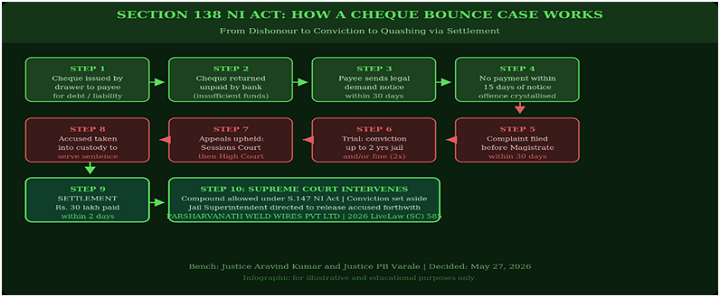
Step-by-Step Journey of a Section 138 NI Act Case, from Dishonour to Post-Conviction Settlement
What Parliament really intended was money going back to the person who got stuck with the bounced cheque. To lock someone up? That came only if nothing else worked, meant more to scare than to solve.
Still, judges faced an odd situation. As time passed, plenty of people charged in bounced check cases started misusing court processes - pretending to settle disputes just to stretch out hearings, dragging things longer than needed, turning agreement requests into stalling moves. The bench took notice. A few magistrates turned down settlement bids altogether, even when real deals existed, arguing closed rulings can’t get redone.
Out of nowhere, the 2026 Supreme Court decision in Parsharvanath Weld Wires Pvt Ltd and Anr. v. State of Chhattisgarh and Anr. hits this issue head on. Because a real resolution happened - money paid, dues cleared - the court says holding on to a conviction makes no sense. When fairness finds its mark, punishment loses its place. Justice? That part already landed. Holdbacks crumble once peace settles in. Freedom follows where debt ends.
II. Background: What Happened in This Case
What happened here does not stand out. More often than not, it mirrors what unfolds daily in business conflicts around India.
Back in 2014, a ruling found the director of Parsharvanath Weld Wires Pvt Ltd guilty under Section 138 of the NI Act. One year behind bars followed, served without hard labour. Payment of twenty eight lakh rupees went ordered too - covering every bit of the bounced cheque’s worth. This sum reached the complainant directly because the court insisted on it, citing Section 357(3) of the CrPC. Justice moved through numbers and time, landing where laws draw lines.
The verdict was challenged by the director which was dismissed by the Sessions Court, which maintained its decision. Even then, the High Court of Chhattisgarh upheld it once more. After every possible appeal ended, jail took him in, and the time started counting.
After arriving in police hands, everything settled fast and there were no long delays. Two days passed before money changed sides, quietly, without court noise. Thirty lakh rupees moved from appellant to complainant, a sum that tipped two lakhs beyond the bounced cheque value. That extra amount did not argue - it simply fit. Payment done, the receiver nodded yes, ready to close the case like turning a page. Willingness showed clearly: move on, leave it be.
A request to compound the case reached the First Class Judicial Magistrate. Turned down there. Later, the Chhattisgarh High Court backed that decision. Seeing things through its own lens, it held firm - once a final verdict stands, revisiting isn’t allowed. So, seeking compounding after such a stage? Not acceptable.
Later, the case reached the highest court. Not agreeing with earlier thoughts, Justices Aravind Kumar and PB Varale saw it another way altogether.
III. What the Supreme Court Decided and Why
The Court Approved the Settlement
Without pause, the top court moved forward. Building on what it had decided before - in Gian Chand Garg versus Harpal Singh (2025 SCC OnLine SC 2317) - it permitted settling the charge under Section 147 of the NI Act. Then came reversal: the punishment and guilty finding under Section 138 got erased. Out quickly went orders to free the person who appealed - held at Central Jail in Raipur - with instruction that jail staff send confirmation back to the Supreme Court office. Compliance mattered; proof of release needed to reach the registry without delay.
"Having heard the learned Advocates appearing for the parties and in view of the law laid down by this Court in the case of Gian Chand Garg vs. Harpal Singh and Another reported in 2025 SCC OnLine SC 2317, we have no hesitation to accept the compromise entered into and compound the offence, particularly in the light of settlement arrived at between the parties."
Surprisingly firm, the wording stands out. Not once did the judges pause - they stated outright they felt zero doubt. Far from being hesitant, their stance feels almost eager. Clearly then, the rule here holds solid ground. Courts below that block these requests? They miss the mark entirely.
Magistrate and High Court Decisions Questioned
What seemed logical to the Magistrate and later the High Court still failed to match legal reality. Because a final ruling usually blocks review, they claimed the compounding request could not proceed in a lower forum - fair point on paper. Yet that view skips what truly matters here.
One way to see Section 147 of the Negotiable Instruments Act is as a clear signal - offences here can be settled privately. There's nothing there limiting such settlements to times before a verdict comes down. Nowhere does it claim guilt recorded stops reconciliation. Its wording stays wide open, actually. Over years, the Supreme Court has leaned into that openness, reading the rule generously because money disputes need workable fixes. What drives this? A sense that the law serves real business life, not just legal form.
One thing stands out: the Supreme Court said it before, loud and clear, especially in Gian Chand Garg (2025). A deal between sides in an NI Act matter shakes things up so much that holding onto guilt becomes impossible. Not because some judge reopens old arguments or flips past rulings. What happens instead? The situation shifts completely once money moves hands. Suddenly, the whole point of punishing someone - the unpaid debt - just vanishes. That base for calling them guilty? Gone. Fixed.
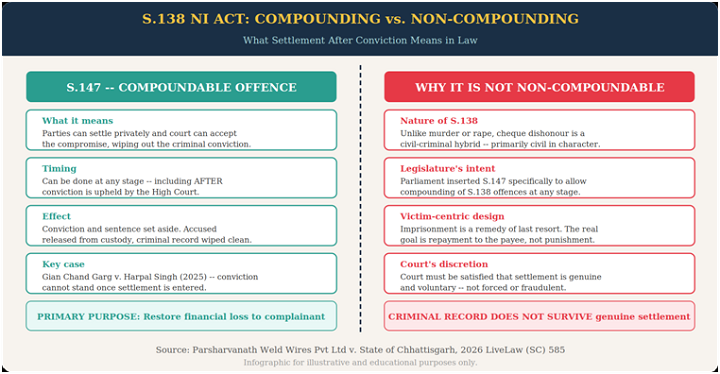
Infographic 2: Compoundable vs. Non-Compoundable Offences Under the NI Act: What Settlement After Conviction Means in Law
IV. UNDERSTANDING SECTION 138 AND SECTION 147: THE LEGISLATIVE DESIGN
Understanding how the NI act built its criminal rules makes this decision clearer. Why those rules took shape matters too. A look back shows their purpose began long ago. This context turns a simple verdict into something deeper. Seeing it differently changes nothing about what happened.
SECTION 138 DEFINING THE CRIME
Unpaid cheques became a crime under section 138 of the NI act. That change came in 1988, during India's economic rise. Cheques were gaining ground then as tools for future payments. At that point lawmakers aimed to discourage people from issuing cheques they knew would bounce. Weak balances or limits set by banks triggered penalties once this rule took effect.
Two years behind bars could follow the crime, along with a penalty reaching double the cheque's value, or one of them. Thirty days after getting news from the bank about the bounced payment, the receiver needs to send a written request to the person who wrote it. Only once that note is sent does the clock start ticking - fifteen full days given for settlement. Silence or delay past those fifteen days turns the act into an established violation. Then comes the chance to bring charges, but only if done within thirty days at a magistrate’s office.
SECTION 147 A WAY OUT WHEN RULES GET TOO TIGHT
Right there in section 147, tucked into the NI act, sits a quiet but powerful release. This part makes clear that any crime under the law can be settled out of court. Notice how it says any - that covers everything, without leaving room for special cases. When someone chooses not to push forward with charges, and the judge agrees, that decision wipes away guilt. If punishment already happened? Then what was decided gets undone. That shift happens only when both sides align on closing the matter.
It’s obvious when looking at both rules side by side: lawmakers meant for section 138 to be effective. Yet they also saw value in stopping cases once money owed had been repaid. Prosecution loses reason if the harm is already fixed. After someone pays what they owe on their own, pushing forward with court feels too heavy handed. The threat of charges did its job - getting the debt settled. Going further than that tilts the balance too far. Justice shifts when facts change.
V. THE GIAN CHAND GARG PRECEDENT: A YEAR BEFORE THIS CASE
Looking at the 2025 decision in Gian Chand Garg v. Harpal Singh matters more than it first appears - it's what firmly holds up the 2026 judgment. Though quiet in tone, its role is central, acting like unseen support beneath something heavier.
When the case reached the supreme court in Gian Chand Garg, multiple courts had already confirmed a conviction under section 138. Yet after those rulings, an agreement emerged between the two sides. Once that happened, the court made clear: such a conviction falls apart if the accuser and defendant settle their dispute. With that reasoning, permission to compound came through under section 147. As a result, what stood before as a guilty finding no longer did.
What mattered most about the decision? It shut down once and for all the argument over whether a finalized guilty verdict blocks settlement. Settlement remains possible. Even then, during appeal proceedings, the highest court can still permit resolution through agreement. That point stands firm - no exceptions - in the 2026 judgment involving Parsharvanath weld wires.
Now comes the weight of two rulings - Gian Chand Garg in 2025, then Parsharvanath weld wires a year later - building something firm that lower benches must follow. Should a magistrate dismiss a plea to settle an ni act matter just because verdicts were already given, that choice runs against what the top court has made plain. Sessions courts doing the same? They step outside established lines. Even high courts are bound; ignoring this invites error.
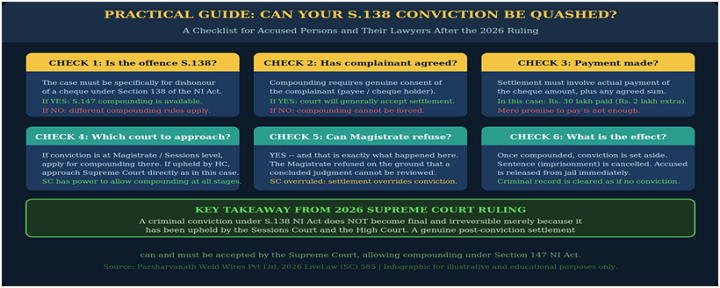
Infographic 3: Practical Checklist: Can Your Section 138 Conviction Be Quashed After Settlement?
VI. WHAT THIS RULING MEANS FOR BUSINESSES AND INDIVIDUALS
Some 35 to 40 lakh section 138 cases sat unresolved across india's magistrate courts by 2023, records from judicial panels show. Though money matters settled between sides in many instances, paperwork often stayed open. Because of that gap, what happened in court during 2026 began shifting how such situations played out afterward.
FOR ACCUSED PERSONS
A conviction under section 138 might already mean jail time - or it could be just around the corner. Relief often comes not from court rulings, but through an actual agreement with the person who filed the complaint. Winning the case outright isn’t required before such resolution brings results.
Paying real money matters more than just saying you will. Here, the judge agreed to close things after seeing that three hundred thousand rupees reached the person who filed the claim.
Should the magistrate or high court turn down your compounding plea, heading straight to the supreme court becomes a real option - thanks to what was shown in gian chand garg (2025) and later backed in parsharvanath weld wires (2026). Not every refusal blocks the path upward; sometimes it clears it. Past rulings like these open doors others might shut. When lower courts say no, higher ones may still listen - especially when earlier decisions point the way. Precedent here acts less like a suggestion and more like a signal. The route isn’t automatic, yet it exists. Those two cases together form something solid beneath your next step.
Just because several courts backed your conviction doesn’t mean it ends there. Even then, the supreme court can step in. It has moved fast before when real injustice shows up. Sometimes, they tell prison staff to let you go within hours. That kind of order arrives without delay.
FOR PEOPLE WHO OWN CHEQUES
You stay in charge when deciding to settle. A judge cannot make you accept a resolution. Agreement only works if it comes from you, freely given. Willingness matters - nothing happens without real approval.
Start with knowing this: the person accused wants the case closed more than anything. Because of that hunger, their lawyer pushes hard too. Yet it opens space - space to ask for more money than what the bounced check showed. Take the example floating around - a cheque worth twenty eight lakhs, yes, but thirty came through instead. All because timing tilted power toward the one holding the grievance. Pressure like that does not come every day.
After getting paid, if you’ve handed in your paperwork saying there’s no issue with the deal, chances are high the judge will sign off and wrap things up. Closing the case often follows once those steps are done right.
FOR BUSINESSES
This decision sends a signal about how business deals are handled. Though old-fashioned, cheques still dominate high-value exchanges across india, especially among suppliers and traders. When a real agreement to pay wipes out an already settled criminal case, it makes conflict resolution feel less rigid, more aligned with actual commerce. As long as companies show true intent and ability to make things right, they won’t stay trapped under threat of jail forever.
Even now, thinking you can freely write bad cheques because settling later fixes everything is wrong. Court trouble doesn’t vanish - expect repeated appearances, possible jail time, heavy fees, plus harm to how others see you. Stopping problems before they start still beats relying on this decision’s outcome.
VII. IMPLICATIONS FOR THE JUDICIAL SYSTEM AND CASE PENDENCY
Most unresolved criminal matters in India fall under section 138 of the NI act. Over time, the country's top court has flagged this delay many times. Panels were formed on its orders to suggest process improvements. Yet a steady roadblock remains - trial courts often refuse to accept settlements after conviction, despite agreement between involved sides.
One way the 2026 decision makes an impact? It confirms settlements - no matter when they happen, even after guilt is declared - must be honored if real. When such agreements exist, courts have to accept them, clearing the conviction along the way. Because of this, judges below can no longer shut down honest deals just because timing feels off. The message lands plainly: process shouldn’t bury fairness.
Now that lower courts may act on this decision, many unresolved ni act cases - settled yet denied compounding - might finally close. With settlements already in place, these resolutions can ease pressure on appeals courts, even free up jail space. The outcome lines up with what the law meant all along: fair outcomes rooted in practical finance, not delays.
VIII. CRITICAL ANALYSIS: IS THERE ANY RISK OF MISUSE?
Here’s something people wonder about: might the relaxed rules on late settlements open doors to abuse? Picture someone rich choosing to delay, counting on cash to fix things once found guilty. Is it possible such outcomes make section 138 feel less serious over time?
Truth is, these worries make sense on the surface - yet they give too much credit to the route this defendant actually followed. Picture it: found guilty, appeal after appeal shot down, hauled off by officers, only then cutting a check to close things out. Hardly a smooth plan. Legal fees pile up fast; a damaged name sticks around longer than anyone wants; jail time brings its own weight - shame included. Any sensible person running a company would steer far clear just to delay what was owed.
Should doubt arise about whether an agreement reflects true willingness, judges can step back and decline approval. When pressure tilts the balance, especially toward the person bringing complaint, acceptance may be denied outright. What keeps misuse in check isn’t banning settlements after verdicts - it’s the judge watching closely how freely consent was given.
Clear rules still apply after 2026. Meeting them leads straight to one result - out goes the conviction.
IX. CONCLUSION
One way to see the 2026 decision in Parsharvanath weld wires Pvt ltd and Anr. V. State of Chhattisgarh and Anr. Is as evolution, not upheaval. What stands out isn’t some bold new turn but a quiet nod to long-standing intent behind the negotiable instruments act. Instead of rewriting rules, the supreme court traced familiar ground. With restraint, it echoed past understanding. Not every judgment needs to break fresh soil - sometimes clarity matters more than change.
Once someone pays what they owe, holding onto a criminal charge makes little sense. Built into law not to punish endlessly but to keep faith in money promises. When debts clear through agreement between sides, the reason for punishment fades. No injury left means no need for penalty. Deterrence loses meaning if harm has already been undone. Justice shifts shape once balance is restored.
Right there in section 147 of the ni act sits the fix for moments like this. At any point - before, during, after - it opens a path to settle things quietly. Not even a conviction shuts it down, the supreme court made clear again, year after year, most recently in 2026 with extra weight behind the words.
Thousands caught in section 138 disputes across India finally see relief - settlements made, yet stuck in court loops. This verdict hands them leverage, maybe hope. When local benches hesitate, higher ground now waits. A path clears where none seemed possible before.
Click here to download the original copy of the Files
Join LAWyersClubIndia's network for daily News Updates, Judgment Summaries, Articles, Forum Threads, Online Law Courses, and MUCH MORE!!"


Tags :Others


