
Index of Headings
1. Introduction
- 1.1 Meaning and Importance of Statehood
- 1.2 Evolution of the Concept of State
2. Concept of State in International Law
- 2.1 Definition of State
- 2.2 Montevideo Convention and Statehood
- 2.3 Legal Personality of a State
- 2.4 Distinction between State and Government
3. Essential Elements of State
- 3.1 Permanent Population
- 3.2 Defined Territory
- 3.3 Government
- 3.4 Sovereignty and Capacity to Enter International Relations
4. Recognition of State
- 4.1 Meaning and Nature of Recognition
- 4.2 Theories of Recognition
- 4.2.1 Declaratory Theory
- 4.2.2 Constitutive Theory
- 4.3 Modes of Recognition
- 4.3.1 Express Recognition
- 4.3.2 Implied Recognition
- 4.4 De Facto and De Jure Recognition
5. Recognition of Government
- 5.1 Meaning and Governing Principles
- 5.2 Recognition upon Change of Government
- 5.3 Recognition of Insurgent and Belligerent Communities
6. Effects and Consequences of Recognition
- 6.1 Legal and Political Effects
- 6.2 Rights and Duties of Recognised States
- 6.3 Withdrawal of Recognition
7. Territory in International Law
- 7.1 Meaning and Territorial Sovereignty
- 7.2 Importance of Territory for Statehood
- 7.3 Boundaries and Frontier Disputes
8. Modes of Acquisition of Territory
- 8.1 Occupation
- 8.2 Accretion
- 8.3 Prescription
- 8.4 Cession
- 8.5 Conquest (Historical Perspective)
9. Special Areas under International Law
- 9.1 Air Space and Air Sovereignty
- 9.2 Polar Regions
- 9.3 Outer Space and Celestial Bodies
10. Contemporary Issues
11. Case Laws and Judicial Decisions
- 11.1 Montevideo Convention (1933)
- 11.2 Tinoco Arbitration Case
- 11.3 Western Sahara Case
- 11.4 Island of Palmas Case
- 11.5 Kosovo Advisory Opinion
12. Conclusion
- 12.1 Summary of Findings and Suggestions
- 12.2 FAQs
1. Introduction
1.1 Meaning and Importance of Statehood
Statehood is the foundational concept of public international law. It determines which entities may participate in the international legal order, exercise rights, assume obligations, and enjoy sovereign equality. Without a principled understanding of statehood, the regulation of relations between politically organised communities would be impossible. Recognition of statehood confers the ability to enter binding agreements, claim sovereign rights over territory and population, and participate in international organisations.
1.2 Evolution of the Concept of State
The origins of the modern state system can be traced back to the Treaty of Westphalia (1648). One of its major outcomes was the founding of sovereign equality among independent polities. The natural law theorist Emeric Vattel also established the idea that all states are the primary subjects of law of nations. In the twentieth century, the establishment of statehood criteria was further solidified by the Montevideo Convention (1933), and after World War II, the emergence of self-determination became a major guiding principle for decolonisation.
2. Concept of State in International Law
2.1 Definition of State
International law provides no universal statutory definition of the state. The most authoritative formulation appears in Article 1 of the Montevideo Convention (1933): a state must possess a permanent population, defined territory, effective government, and the capacity to enter international relations. This formulation reflects customary international law and has been consistently applied in judicial and arbitral practice.
2.2 Montevideo Convention and Statehood
The Montevideo Convention remains the primary codification of statehood criteria. Its positivist approach rests on observable factual conditions rather than political endorsement. The Convention affirms that political existence of the state is independent of recognition, thereby endorsing the declaratory theory. Courts and tribunals worldwide have applied its provisions well beyond the Americas.
2.3 Legal Personality of a State
States possess full international legal personality, enabling them to conclude treaties, bring international claims, join multilateral organisations, and enjoy sovereign immunity. This personality arises upon meeting the Montevideo criteria and does not depend on recognition by specific other states. Other actors, such as international organisations and individuals, hold only derived or partial personality.
2.4 Distinction between State and Government
The state is a continuing legal entity that persists despite changes in government. A government brought to power by revolution may satisfy effectiveness criteria even if its legitimacy is contested. The obligations of a state under treaties and customary law survive changes of government, and state property abroad retains sovereign immunity regardless of changes in the ruling administration.
3. Essential Elements of State
3.1 Permanent Population
No minimum numerical threshold is prescribed, as small states such as Nauru and Tuvalu satisfy this requirement. The population must be settled in character rather than nomadic or transient. The criterion connects statehood to a political community governed under a common legal framework and gives rise to obligations of protection and personal jurisdiction over nationals abroad.
3.2 Defined Territory
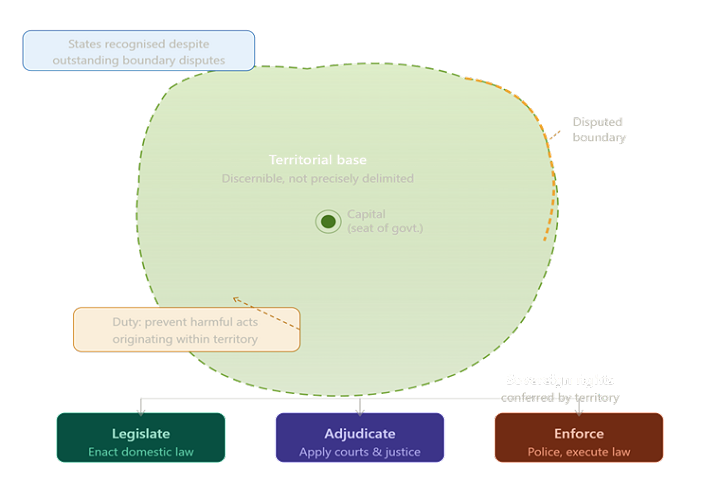
International law requires a discernible territorial base but not precisely delimited or undisputed boundaries. Many states emerged with outstanding boundary disputes and were nonetheless recognised as valid international persons. Territory confers sovereign rights to legislate, adjudicate, and enforce domestic law, and imposes the duty to prevent harmful activities against other states originating from within national boundaries.
3.3 Government
An effective government must maintain public order, conduct foreign relations, and fulfil international obligations. Effectiveness is assessed factually rather than by legality under domestic law. In decolonisation contexts, the international community has at times recognised entities as states before fully effective governmental authority was established, reflecting the primacy of self-determination.
3.4 Sovereignty and Capacity to Enter International Relations
This criterion signifies legal independence from any higher authority in international affairs, entailing the right to conclude treaties and participate in international organisations. Sovereignty is constrained by treaty law, customary norms, and jus cogens. The emergence of human rights obligations and the responsibility to protect doctrine have placed internal conduct within the purview of international scrutiny while sovereignty remains the organising principle of the international order.
4. Recognition of State
4.1 Meaning and Nature of Recognition
The act of acknowledging a new entity as having attained statehood and expressing a desire to consider it as a member of the international community is known as recognition, which is a legal as well as a political act. Regardless of the nature of the act, a new state finds it difficult to access international institutions and diplomatic ties in general without proper recognition.
4.2 Theories of Recognition
4.2.1 Declaratory Theory
The declaration theory states that recognition is just the formal acknowledgement of an independent legal position. A state is established when the conditions for statehood are satisfied. Both Article 3 of the Montevideo Convention and the bulk of judicial authorities support this viewpoint. Recognition is crucial from a political standpoint even though it does not imply legal personality.
4.2.2 Constitutive Theory
According to the constitutive theory, which is linked to Oppenheim and Lauterpacht, recognition is the legal act that establishes the state as a subject of international law. It has drawn criticism for being circular and allowing political factors to take precedence over legal requirements, creating the oddity that an entity may be a state for certain reasons but not for others. The declaratory approach has largely replaced it.
4.3 Modes of Recognition
4.3.1 Express Recognition
Express recognition is a formal declaration acknowledging statehood, through a diplomatic note, proclamation, or treaty.
4.3.2 Implied Recognition
Implied recognition arises from conduct necessarily presupposing acknowledgement of statehood, such as the establishment of formal diplomatic relations or conclusion of a bilateral treaty on sovereign matters. In general, involvement in humanitarian conventions or informal interactions are inadequate to imply recognition.
4.4 De Facto and De Jure Recognition
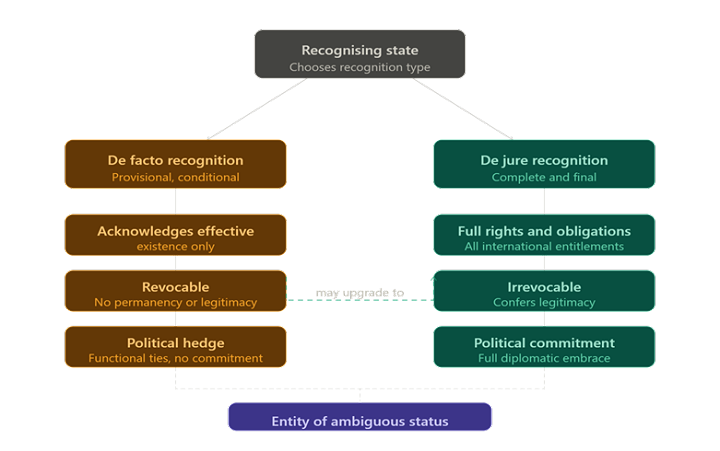
De facto recognition acknowledges effective existence but does not support permanency or legitimacy; it is conditional and provisional. De jure recognition is complete and final, encompassing all of the rights and obligations that come with being recognised as a state. States use this distinction to retain functional relationships with entities of ambiguous status while hedging political commitments.
5. Recognition of Government
5.1 Meaning and Governing Principles
Recognition of government arises when a change of power occurs by unconstitutional means and the legitimacy of the new authority is in doubt. The Tobar Doctrine conditions recognition on popular electoral endorsement. The Estrada Doctrine holds that states should base relations on the factual exercise of authority, avoiding pronouncements on foreign governmental legitimacy. Most states follow the Estrada approach in contemporary practice.
5.2 Recognition upon Change of Government
Lawful constitutional changes generate automatic recognition. Difficulties arise when power is seized by force or competing factions claim authority. Foreign states typically apply criteria of effective control, expressed popular will, and the government's willingness to fulfil international obligations in deciding which entity to treat as representative of the state.
5.3 Recognition of Insurgent and Belligerent Communities
Recognition of belligerency acknowledges that an armed group conducts hostilities in accordance with the laws of war, entitling them to the protections and obligations of international humanitarian law. Recognition of insurgency is a lesser acknowledgement of effective territorial control. Both carry significant legal consequences for the recognising state and the recognised group.
6. Effects and Consequences of Recognition
6.1 Legal and Political Effects
A recognised state gains complete international legal personality, allowing it to enter into treaties, file international claims, join organisations, and enjoy sovereign immunity. Its governmental activities have effect in foreign domestic law systems. Recognition also signifies political acceptability and preparedness for diplomatic, economic, and cultural engagement, whereas denial may serve as a form of political pressure.
6.2 Rights and Duties of Recognised States
Recognised states have sovereign equality, immunity from foreign jurisdiction for public acts, the right to self-defence, and freedom of navigation and overflight. They are responsible for refraining from threatening or using force, resolving disputes peacefully, safeguarding human rights, and carrying out treaty responsibilities in accordance with the principle of pacta sunt servanda.
6.3 Withdrawal of Recognition
Withdrawal of recognition of a state once extended is generally regarded as unlawful where the entity continues to meet statehood criteria. Withdrawal of governmental recognition is more clearly permissible where a government loses effective control or is succeeded by another authority.
7. Territory in International Law
7.1 Meaning and Territorial Sovereignty
Territory comprises land, internal waters, territorial sea, airspace, continental shelf, and exclusive economic zones as defined under UNCLOS 1982. Territorial sovereignty is the exclusive right to exercise governmental functions within a region to the exclusion of all other states, as affirmed in the Island of Palmas Case (1928). It confers legislative and enforcement authority while imposing the duty to prevent harmful uses of national territory against other states.
7.2 Importance of Territory for Statehood
Without a territorial base, exercising governmental authority and maintaining a legal system are nearly impossible. Territory offers the physical and jurisdictional basis for achieving the other statehood criteria. The loss of land due to occupation or annexation raises fundamental problems concerning state continuity and the rights of affected communities.
7.3 Boundaries and Frontier Disputes
Treaties, legal or arbitral decisions, or long-standing adherence to a de facto line all establish boundaries. International law promotes boundary stability and implements the principle of uti possidetis juris in postcolonial circumstances, retaining administrative lines inherited from colonial administration as newly independent state borders.
8. Modes of Acquisition of Territory
8.1 Occupation
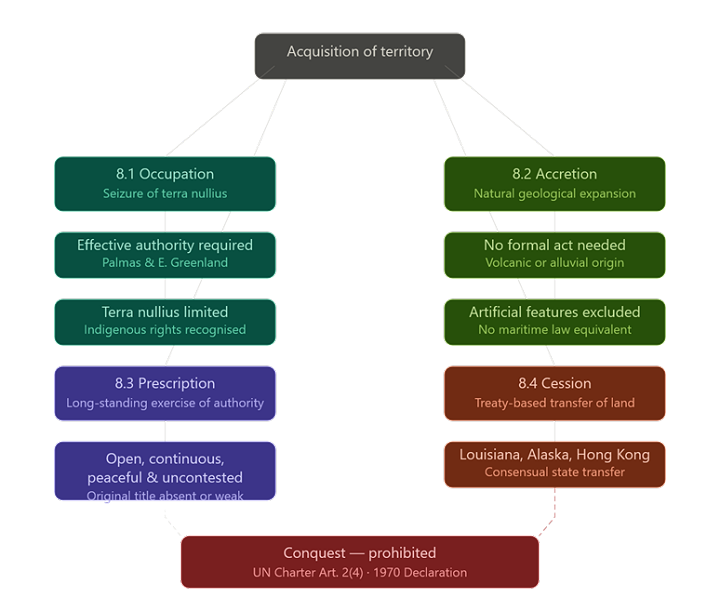
Occupation necessitates the effective seizure of terra nullius through the exercise of governmental authority. The Island of Palmas and Eastern Greenland instances confirmed the effectiveness criteria. The concept of terra nullius has been limited by the acceptance of indigenous peoples' rights to historically inhabited regions.
8.2 Accretion
Accretion refers to the natural expansion of area caused by geological processes such as volcanic activity or alluvial deposits. No formal legal act is required; fresh land is naturally subject to the sovereignty of the neighbouring state. Artificial features do not give rise to similar rights under maritime law.
8.3 Prescription
Prescription is the acquisition of sovereignty by the open, continuous, and peaceful exercise of authority over an extended period of time in which the original claim is absent or contested. The exercise of authority must be open, continuous, and uncontested by the state with the better originating title.
8.4 Cession and Conquest (Historical Perspective)
Cession is the transfer of land from one state to another through treaty, with the permission of the transferring state. Notable examples include the Louisiana Purchase, Russia's cession of Alaska to the United States, and China's takeover of Hong Kong in 1997.
Conquest was once a permissible mode of acquisition, but it is now outlawed under Article 2(4) of the United Nations Charter and the 1970 Declaration on Principles of International Law, which state that no territory acquisition originating from the threat or use of force should be acknowledged as legal.
9. Special Areas under International Law
9.1 Air Space and Air Sovereignty
Each state exercises complete and exclusive sovereignty over its airspace under the 1944 Chicago Convention. Rights of innocent passage applicable in the territorial sea do not extend to airspace. The International Civil Aviation Organisation establishes technical standards governing overflight and landing rights on a global basis.
9.2 Polar Regions
Arctic waters are subject to the jurisdictional claims of the five coastal states under the law of the sea. Antarctica is governed by the 1959 Antarctic Treaty, which froze territorial claims and established the continent as a zone of international scientific cooperation, prohibiting military activity and nuclear testing.
9.3 Outer Space and Celestial Bodies
The 1967 Outer Space Treaty declares outer space the province of all mankind, not subject to national appropriation by claim of sovereignty or otherwise. States bear international responsibility for national activities in outer space whether governmental or private. Commercial space activities are generating new pressure for the development and clarification of the outer space legal regime.
10. Contemporary Issues
Contemporary issues put traditional doctrines to the test. Partially acknowledged countries such as Kosovo, Taiwan, and Palestine demonstrate the limitations of existing institutions for settling politically challenged statehood claims. The contradiction between self-determination and territorial integrity has yet to be overcome. Climate change threatens small island nations with the loss of their whole land territory, a situation for which international law has yet to provide unambiguous continuity of statehood guidelines. The collapse of governmental power in failed states calls into doubt the international community's duties. Digital sovereignty and jurisdictional claims over cyberspace call into question traditional territorial assumptions based on physical location.
11. Case Laws and Judicial Decisions
11.1 Montevideo Convention (1933)
The Montevideo Convention codifies the four criteria for statehood and affirms the declaratory approach to recognition. Its provisions are regarded as reflective of customary international law and have been applied by international courts and tribunals across all regions.
11.2 Tinoco Arbitration Case
The Tinoco Arbitration (Great Britain v. Costa Rica, 1923) held that despite non-recognition by major powers, the Tinoco government had been the effective government of Costa Rica and that its acts bound the successor administration. The case affirmed that effectiveness of governmental control, not external recognition, is the decisive criterion for the validity of governmental acts in international law.
11.3 Western Sahara Case
The ICJ Advisory Opinion (1975) examined the status of Western Sahara at the time of Spanish colonisation and concluded that while legal ties with Morocco and Mauritania existed, they did not constitute territorial sovereignty displacing the right of the Sahrawi people to determine their own political status through self-determination.
11.4 Island of Palmas Case
The Permanent Court of Arbitration (1928) established that the continuous and peaceful display of state authority is the critical criterion for territorial sovereignty. A title of discovery must be consolidated by effective occupation. The case remains the foundational authority on the legal requirements for valid territorial title in international law.
11.5 Kosovo Advisory Opinion
The ICJ (2010) determined that Kosovo's declaration of independence did not breach international law, citing no applicable limitation on declarations of independence. The Court purposefully avoided discussing the right to independence under international law, leaving unresolved the conflict between self-determination and territorial integrity. The opinion has since been quoted by both sides of the Kosovo dispute.
12. Conclusion
This article has investigated the legal principles of statehood, recognition, and territory in public international law. The Montevideo criteria are the established foundation for considering claims to statehood, while their application in contentious cases continues to be controversial. Recognition, which is declarative in nature, has significant practical ramifications and remains a tool of political judgement. Territory is the material foundation of the state, and its acquisition and protection are governed by well-established traditional and customary regulations.
The lack of a mandatory procedure for objectively judging claims to statehood is a major flaw in the current structure. Clearer normative norms and an open adjudicatory mechanism for resolving disputed statehood claims will improve the international order.
12.1 Summary of Findings and Suggestions
This paper has examined the legal doctrines governing statehood, recognition, and territory in public international law. The Montevideo criteria provide the accepted framework for assessing claims to statehood, though application in contested cases continues to generate controversy. Recognition, declaratory in character, carries important practical consequences and remains an instrument of political judgement. Territory is the material foundation of the state, and its acquisition and protection are governed by well-developed conventional and customary rules.
The absence of a compulsory mechanism for objectively determining claims to statehood remains a principal deficiency in the current framework. Clearer normative standards and an accessible adjudicatory procedure for resolving disputed statehood claims would strengthen the international order. The law of territorial acquisition also requires updating to address climate-driven territorial loss and the potential submergence of island states.
12.3 Frequently Asked Questions
Q. What are the essential elements required for statehood?
A state must have a permanent population, a defined territory, an effective government, and the capacity to enter into relations with other states.
Q. Is recognition necessary for a state to exist?
Recognition is not strictly required if the conditions of statehood are met, but it is important in practice for participation in international relations.
Join LAWyersClubIndia's network for daily News Updates, Judgment Summaries, Articles, Forum Threads, Online Law Courses, and MUCH MORE!!"


Tags :Others