


Introduction
In today’s competitive market, a trademark is more than just a logo or brand name but an important asset which stands for trust and reputation. Legal enforceability is thus the strength of a trademark. The Trade Marks Act, 1999, states that registering a trademark provides a brand more than just an identity but strong legal rights, primarily under Section 28.
Section 28 plays a very significant role in relation to trademark protection in India. Section 28 is very important for protecting trademarks in India. This section also rearranged the burden of proof and provided law enforcement with a framework to operate within. The section also provides protection that is unavailable to unregistered marks under the complex common law remedy of “passing off ”.
This article examines Section 28 by its three main components: –
- The Power of Exclusivity: How registering gives you the "negative right" to keep others out.
- The Limits of Protection: Knowing the rules and restrictions that determine a mark's scope.
- Coexistence and Multiple Owners: How the law deals with different people who own the same or similar marks.
Relevant Statutory Provisions
Section 28 of the Trademark Act, 1999, specifies rights that accompany the registration of a trademark. It gives the registered owners exclusive rights over their trademarks and the right to sue any persons who use the same without consent. It also awards registered trademark exclusive rights and the right to sue infringers, thus changing the dynamics of proof in courts and offering protection that non-registered trademark lacks. Almost all infringement lawsuits and defences are made on Section 28. Trademark owners who do not register their marks rely on common law remedies such as passing-off, which requires more proofs. In this regard, the article analyses Section 28 of the Trademark Act in detail, including its clauses, meanings, and interpretations by courts.
What is Section 28 of the Trademark Act?
Section 28 of the Trademark Act, “Rights conferred by registration”, lists the rights that accompany registered trademark ownership. It shows that registering is not a mere formality but also gives one a plethora of legal rights. Each subsection covers a specific area of the rights that accompany trademark registration.
1.Subsection (1): A valid trademark registration confers the exclusive right to the proprietor of the mark for specific goods or services and to take legal action against unauthorized users, as stipulated in Section 29 and other relevant provisions of the Act.
2. Subsection (2): These exclusive rights are limited by the conditions on the registration, like certain colours or areas. This means that the owner can only use the mark within those limits.
3. Subsection(3): If more than one person registers the same or similar trademark, none of them has better rights than the others just because they registered it. Each can protect their mark from people who aren't in their group, but not from each other unless certain conditions are met.
To put it simply, Section 28 makes a registered trademark a valuable legal asset, but its protections depend on valid registration and following the rules of the Act. Lawyers use this part in court to protect their clients' rights, based on the idea in Section 31 that a registered mark is valid.
Exclusive Rights Under Section 28(1) of the Trademark Act
Registered proprietors of registered trademarks are granted rights by Section 28(1) of the Trade Marks Act to exclusively use the trademark for particular goods/services. These exclusive rights are "negative" in nature as they largely allow the trademark owner to stop another person from using an identical or similar trademark to that which they own, but they do not mean the trademark owner has control of the market. The trademark rights will only apply to the particular goods/services listed in the trademark registration in accordance with the Nice Agreement (International Classification of Goods and Services) Trademark Class 45 guidelines.
Registered trademarks in Class 25 may not include electrical items in Class 9 as an example. Specificity of claims and resultant application is what makes claims important to obtain relief from willing to issue Civil Remedies, within the parameters of Section 135, as defined by the Trade Marks Act, providing both civil remedies (injunctions/damages/profits), as well as Section 103 through Section 104, of the Trade Marks Act for false/illegal use and misrepresentation of registered trademarks, through criminal prosecutions.
The essential requirement for these rights is valid registration. Although Section 31 creates a presumptive validity of registered trademarks, challenges to the validity of registered trademarks can be made utilizing the provisions outlined in Section 57, of the Trade Marks Act. In most instances, the Courts will refer disputes to the IPAB (Intellectual Property Appellate Board); as a result of the amendments made to the Trade Marks Act on February 10, 2022, the Courts have divided jurisdiction with Divisions of the High Court.
As defined within Section 34, prior use of a trademark may outweigh its registration in instances of an original user's continuous good faith use without knowledge of the registration. Attorneys need not be concerned that all use of a trademark is prohibited under Section 28, as the fair use exceptions contained in Section 30 (such as descriptiveness or nominative use) would apply. This balance allows for the continued operation of trademarks without hindering legitimate trade..
Conditions and Limitations Under Section 28(2)
Section 28(2) clarifies that the exclusive rights created by registration are subject to conditions or restrictions. Those restrictions could include a geographic limit on where the mark can be used or limited colors according to Section 10 or disclaimers for non-distinctive features. For example, if someone registers a mark that is only allowed to use "red," then they would not have the ability to claim any rights to use the mark in other colors.
These conditions will be relevant to resolving disputes or otherwise comply with an absolute reason for refusal of registration under section 9 or with a relative reason for refusal of registration under section 11. Conditions attached to a registration can come about from rescinding an application or from opposition proceedings. Courts will strictly enforce these limits in situations where the registrant endeavored to go beyond their registered rights.
This section exists to stop unfair advantages from being taken advantage of in the trademark application process and also to promote fairness within the trademark system. As such, it is very important for lawyers reviewing registration certificates to pay careful attention when reviewing certificate or document to determine if there is any conditional registration since any oversight could create a weakness in an infringement action. This subsection ensures that registered trademark rights are granted to registrants in a specific manner and cannot create universal rights for a registrant.
Rights for Multiple Proprietors Under Section 28(3)
Registration does not give one registered proprietor priority over another registered proprietor who has registered the same or a similar trademark regardless of how many other registrations exist for identical or similar trademarks. By virtue of the registered trademark each registered proprietor has equal rights against third parties as if he were the sole proprietor of the trademark in question. Disputes between registered proprietors asserting conflicting registrations will be determined under the common law and/or by the provisions of other applicable statutes and not this section based on the issue of priority registration.
Honest concurrent use of a trademark as defined by section 12 will be governed by the terms and conditions of the registration and the relationship between the registered proprietor and the permitted users, such as licensees, will not be subject to the operation of section 28(3).
As a practical matter, no registered proprietor has the right to commence an action against another registered proprietor for infringement of the other party's trademark solely by reason of the other party's registration; however, it may be successful in a passing off action if it can establish that the other party's conduct deceives. For attorneys, this relates to section 30(2)(e) which limits the ability for one registered proprietor to claim infringement against another registered proprietor for a trademark that is also registered.
Comparison with Unregistered Trademarks
Section 28 of the Trademark Act offers statutory rights for registered marks, while unregistered marks rely on common law under Section 27. Here’s a comparison:
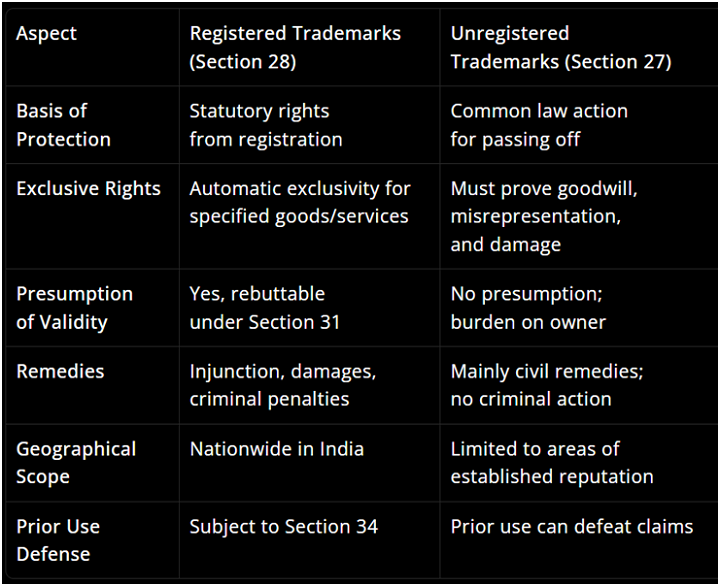
This illustrates why registration under Section 28 provides stronger protection.
Judicial Interpretations and Case Laws
Indian courts have clarified Section 28 of the Trademark Act through important rulings. These rulings guide lawyers in handling infringement cases, emphasizing evidence and statutory connections:
- In Revlon Inc v. Hosiden Laboratories (India) (2001), the Delhi High Court upheld Section 28(1), and thus said that an injunction against the use of “JONTUE” for talcum powder as it infringed the plaintiff’s cosmetic mark, on account of similarity.
- In Vishnudas Trading v. Vazir Sultan Tobacco Co. (1996), the Supreme Court emphasised that Section 28 applied only to goods listed, not classes. Therefore, it is recommended to narrow down descriptions to avoid any gaps.
- In SM Dyechem v. Cadbury (India) Ltd (2000), the Supreme Court ruled that validity challenges are within rectification proceedings, thus proffering supporting the presumption under Section 31 as tied to Section 28.
- The Bombay High Court in Lupin Limited v. Johnson & Johnson (2014) allowed courts to review registration validity at interim stages if fraud is evident, but set a high standard for defendants.
- Regarding Subsection (3), Eagle Flask Industries Pvt Ltd v. Bon Jour International (2011) by the Madras High Court confirmed that a registered owner cannot block another with a similar mark, aligning with Section 30(2)(e).
- In P.M. Diesels Private Limited v. Thukral Mechanical Works, the Supreme Court noted that identical marks for different goods prevent inter se lawsuits, but both can act against third parties.
- Recent cases like Wipro Enterprises (P) Ltd v. Himalaya Wellness Co. (2024) also confirm that prior use under Section 34 can override the rights provided under Section 28.
Summary
In today's fast-paced world of business, a trademark is much more than just a product or name. A trademark is an integral part of your business and is a representation of your reputation and the trust consumers have in you. A trademark’s true power is found in the ability to be legally enforced. In India’s Trade Marks Act, 1999, a registered trademark gives the owner a right that can be legally enforced against others who use the same or similar mark. Section 28 of the Act is the basis for how trademarks are protected in India. It provides registered trademark owners with the exclusive right to use their trademarks and provides them with a legal basis to take action against anyone who uses their trademark, including taking court action if necessary. In addition, Section 28 establishes a clear system for enforcing rights granted to registered owners of a trademark, and therefore provides greater certainty to registrants than would be available if they relied solely on the common law remedy of “passing off.”
The Mechanics of Section 28: A Three-Tiered Framework
The section is divided into three distinct subsections, each defining a specific layer of protection and limitation:
Section 28(1): The Right to Exclusivity and Relief :The primary benefit of registration, is the ‘exclusive right’ to use the mark in respect of the goods or services with which it is registered. This is a ‘negative right’ because its strength lies in the owner’s ability to restrain other persons from using identical or deceptively similar marks. It also includes the statutory right of the owner to seek for relief in respect of infringement, thus giving them access to the civil remedies such as injunctions and damages as well as criminal penalties in respect of falsification.
Section 28(2): The Boundaries of Protection: Absolute exclusivity is rarely unconditional. If a mark is registered with a limitation on a color or a certain geographical area of India, the proprietor cannot seek remedy of infringement outside those limits. Thus, the scope of the monopoly is restricted to what was actually approved in the registration process.
Section 28(3): Mutual Rights Among Multiple Proprietors: In certain circumstances such as honest concurrent use, two or more persons may be registered as proprietors of identical or nearly resembling trademarks. In this case, no one enjoys exclusivity over the other. Each proprietor has equal rights against the rest of the world, but they cannot institute an infringement suit against each other based on registration.
The Strategic Advantage of Registration
Understanding Section 28 of the Trade Marks Act requires a comparison to an unregistered mark. Under section 27 of the Trade Marks Act, owners of unregistered marks can bring an action for "passing off". However, they must satisfy many more requirements to succeed than if they had an unregistered mark. First, an owner must show that they possess goodwill existing within the relevant market, and that the defendant made a misrepresentation that caused the plaintiff to suffer damage or will cause them to suffer damage. Under section 28, registration of the mark provides prima facie evidence of validity (as per section 31), so it significantly reduces the evidential burden for litigating for an infringement of a registered trade mark.
Impact
The Indian judiciary has consistently demonstrated the importance of section 28 in the protection of registered trade marks in India. In Revlon Inc. v. Hosiden Laboratories (2001), the court held that registration provides an owner with protection of their commercial interests in the country. In Vishnudas Trading Co. v. Vazir Sultan Tobacco Co. (1996), the Supreme Court of India warned trade mark owners that rights afforded by section 28 do not give an owner a "blanket monopoly" on all goods within that class of goods; instead they only apply to the goods specifically set out in the trade mark registration.
In conclusion, section 28 provides the legal certainty businesses require in order to make sufficient investments in their brands, thereby ensuring that trade mark owners will enjoy the benefits created by their work product through strong statutory protections opposed to relying on the uncertainty of relying solely on existing common law principles.
Join LAWyersClubIndia's network for daily News Updates, Judgment Summaries, Articles, Forum Threads, Online Law Courses, and MUCH MORE!!"


Tags :Others


