
1. INTRODUCTION AND CONSTITUTIONAL OVERVIEW
The intersection of digital bureaucracy and socioeconomic vulnerability poses a recurring challenge to contemporary administrative law. In a definitive judgment championing the statutory guarantees of Persons with Benchmark Disabilities (PwBD), the Central Administrative Tribunal (CAT), Principal Bench, New Delhi, allowed the Original Application filed by Ms. Rinki, a 100% visually impaired candidate. The applicant had been denied the vital benefits of reservation and a scribe facility for the Delhi Subordinate Services Selection Board (DSSSB) Postgraduate Teacher (PGT) Political Science examination. This exclusion arose solely from an inadvertent error committed while filling out her online application through a third-party cyber cafe.
The applicant was represented before the Tribunal by a legal team led by Ms. Firdouse Qutb Wani, Advocate-on-Record (AOR), Supreme Court of India, alongside Mr. Md. Zaryab J. Rizvi, Dr. M. Afzal Wani, and Mr. Dilshad Ahmad.
The judgment, authored by Hon’ble Judicial Member Mr. Manish Garg and concurred with by Hon’ble Administrative Member Dr. Anand S. Khati, transcends mere procedural rectification. It anchors the concept of "reasonable accommodation" directly into the foundational guarantees of Articles 14, 16, and 21 of the Constitution of India. The ruling establishes that administrative efficiency and the technical rigidities of online recruitment portals cannot be weaponized by state instruments to dismantle the substantive rights enacted under the Rights of Persons with Disabilities (RPwD) Act, 2016.
2. EXHAUSTIVE FACTUAL MATRIX OF THE CASE
The applicant, Ms. Rinki, daughter of Mr. Satya Prakash Prajapati and resident of West Parmanand Colony, Delhi, is a 100% visually impaired (blind) individual. Far from being a stranger to the educational department, she was already serving competently as a Trained Graduate Teacher (TGT) in Social Science within the same department. Aspiring to advance her professional career, she sought recruitment for the post of PGT (Political Science) under Advertisement No. 07/2023 issued by the DSSSB on December 22, 2023.
Lacking direct personal digital access due to her complete visual impairment, Ms. Rinki visited a local cyber cafe to complete her application on the Online Application Registration System (OARS) portal. Relying on the assistance of the cyber cafe operator a common necessity across India’s digital divide an inadvertent clerical mistake occurred. The dropdown menu or specific field identifying her primary recruitment category failed to properly register her PwBD status, categorizing her instead under the Unreserved (UR) general pool.
Significantly, the underlying internal systems data captured by the OARS portal painted a contradictory and highly illuminating picture. The system's sub-category logs explicitly recorded:
"DC3Y: Visual (VH) (Blind), PH: Visual (VH) (Blind)".
Furthermore, because of these internal entries, her examination fee was fully exempted by the portal's automated protocols.
Ms. Rinki remained unaware of the systemic mismatch until her e-admit card was generated for the examination scheduled for July 15, 2025. The admit card displayed her category as Unreserved (UR) and completely denied her the facility of an exam scribe.
Recognizing that attempting a written competitive examination without a scribe was a physical impossibility for a 100% blind candidate, she immediately submitted detailed representations to the Secretary, Chairman, and Controller of Examinations of the DSSSB via email and by hand. The respondents refused to entertain her requests, orally informing her that the terms of the recruitment advertisement barred any post-submission modifications.
Faced with administrative exclusion, the applicant approached the Central Administrative Tribunal via O.A. No. 2612/2025. Recognizing the urgency, the Tribunal issued an essential interim order on July 14, 2025 one day prior to the scheduled test directing the DSSSB to provisionally permit the applicant to sit for the examination with the assistance of a qualified scribe under the PwD reserved category.
3. CORE LEGAL ISSUES FORMULATED FOR ADJUDICATION
To settle the dispute conclusively, the Tribunal evaluated two primary interwoven legal questions:
Issue A: Whether a candidate with a benchmark disability, who inadvertently fails to correctly declare her primary category in an online application form, can be stripped of the reservation benefits and reasonable accommodations guaranteed by Section 34 of the Rights of Persons with Disabilities Act, 2016.
Issue B: Whether a clerical omission made by a 100% visually impaired candidate due to third-party digital dependency constitutes a fatal structural defect justifying the rejection of her candidature, or whether it represents a trivial, remediable error protected by equity and the doctrine of de minimis non curat lex.
4. COMPREHENSIVE ARGUMENTS DEPLOYED BY BOTH PARTIES
4.1 On Behalf of the Applicant (Ms. Firdouse Qutb Wani, AOR)
Ms. Firdouse Qutb Wani and her co-counsels raised multi-layered statutory and constitutional arguments to establish that the applicant's exclusion violated fundamental rights:
Status of Eligibility and Institutional Fact: The applicant’s status as a 100% blind individual was an indisputable medical and institutional reality, as evidenced by her active employment as a TGT (Social Science) within the very same government ecosystem.
The Anatomy of a Bona Fide Error: The error on the portal was an accidental, non-strategic clerical omission. Far from trying to manipulate the system, the applicant was a victim of structural barriers caused by the "digital divide". Individuals with severe visual impairments must rely on third-party operators at cyber cafes, whose errors should not result in professional disqualification.
Systemic Estoppel and Internal Contradictions: The DSSSB portal itself held data confirming her disability. The backend entries clearly displayed her visual impairment sub-categories and recorded a complete fee exemption. The respondents could not claim ignorance of her disability when their own database had recognized and processed it.
Constitutional and Judicial Precedent:
1.The defense relied heavily on the landmark Supreme Court decision in Vikash Kumar v. UPSC, which declared that reasonable accommodation is a fundamental component of substantive equality under Articles 14 and 16, rather than a charitable concession.
2.Reference was made to Jeeja Ghosh v. Union of India, which grounded the rights of disabled individuals firmly within human dignity and Article 21.
3.To counter procedural rigidity, the applicant cited Vashist Narayan Kumar v. State of Bihar, where the Supreme Court applied the maxim de minimis non curat lex to preserve a candidate’s career from trivial online errors made at cyber cafes.
4.Finally, parallel high court rulings in Ms. Charu Kain v. High Court of Delhi and Mr. Shahid Akeel Shaikh v. Union of India were cited to demonstrate that courts consistently allow the rectification of bona fide application mistakes when no prejudice is caused to third parties.
4.2 On Behalf of the Respondents (DSSSB)
Mr. Amit Yadav and Dr. Monika Bhargava, representing the DSSSB, based their opposition on procedural compliance, administrative consistency, and contractual finality:
The Sanctity of the OARS Portal Undertaking: The respondents highlighted that during registration, the applicant validated a multi-point explicit undertaking. This disclaimer certified that all entries were true, complete, and final, stating that the candidate would not claim any change after final submission.
Strict Enforcement of Advertisement Clauses: Clause 9 of Advertisement No. 07/2023 was cited as an absolute bar. It stated that requests for changes or corrections in application details, including category modifications, would not be entertained under any circumstances, regardless of the method of communication.
The Principle of Uniformity: The Board argued that the terms of the recruitment advertisement bind both the agency and the applicants. Allowing one candidate to modify her form post-submission would create an unmanageable administrative precedent and disrupt uniform application processes.
Absence of a Correction Window: The respondents confirmed on instruction that the OARS portal did not provide a correction window for any candidate. Therefore, they argued that they lacked the administrative mechanism to execute the requested changes.
Judicial Reliance: To support their stand on strict adherence to recruitment timelines and rules, the respondents cited the Supreme Court judgment in UPSC v. S. Krishna Chaitanya (2011).
5. CRITICAL JUDICIAL ANALYSIS AND LEGAL PRECEDENTS CITED
The Central Administrative Tribunal examined the competing arguments by placing procedural rules alongside statutory mandates and constitutional principles.
The De Minimis Principle and Cyber Cafe Realities
The Tribunal rejected the respondents' strict interpretation of the portal's rules by referencing the Supreme Court's reasoning in Vashist Narayan Kumar. The apex court had observed that the "rarefied atmosphere of a cybercafe" frequently leads to inadvertent data entry mistakes by operators. The Tribunal noted that under the maxim de minimis non curat lex (the law does not concern itself with trifles), an accidental error that offers no unfair advantage to the candidate cannot be treated as a fatal flaw.
Re-characterizing "Reasonable Accommodation"
The judgment relies heavily on Vikash Kumar v. UPSC, using it to shift the understanding of disability rights from a model of sympathy to one of legal entitlement. The Tribunal reiterated that:
{Substantive Equality} = non-discrimination + {Reasonable Accommodation}
Reasonable accommodation requires the state to actively adapt its procedures to neutralize the structural barriers faced by disabled individuals, rather than reinforcing those barriers through rigid administrative protocols.
The Institutional Knowledge Factor
The Tribunal highlighted a key factual point: the internal records of the DSSSB database already contained the correct information. Because the backend system explicitly recorded her visual impairment and granted her a fee exemption, the data was already within the agency's ecosystem. The agency could not claim that allowing a correction would introduce entirely new or fraudulent variables into the selection process.
Additionally, the Tribunal supported its reasoning with the recent Delhi High Court ruling in Dr. Sachin Kumar v. NIEPA & Ors. (2025). That decision warned that rigid, unguided recruitment processes can inadvertently exclude eligible PwBD candidates, failing the test of constitutional morality.
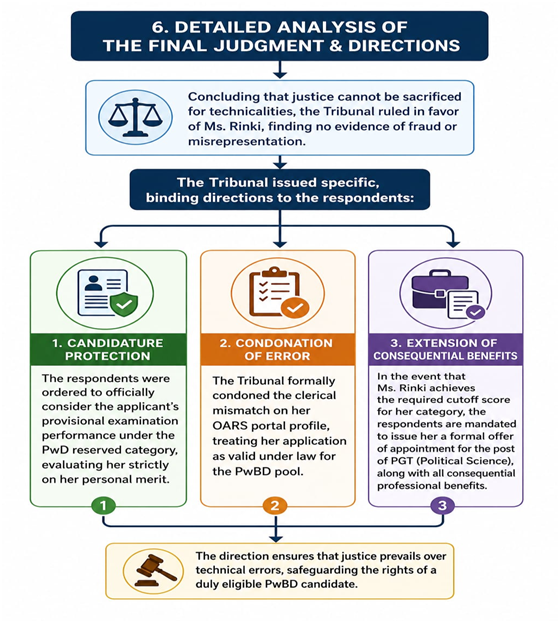
6. Detailed Analysis of the Final Judgment & Directions2
Concluding that justice cannot be sacrificed for technicalities, the Tribunal ruled in favor of Ms. Rinki, finding no evidence of fraud or misrepresentation. The Tribunal issued specific, binding directions to the respondents:
Candidature Protection: The respondents were ordered to officially consider the applicant’s provisional examination performance under the PwD reserved category, evaluating her strictly on her personal merit.
Condonation of Error: The Tribunal formally condoned the clerical mismatch on her OARS portal profile, treating her application as valid under law for the PwBD pool.
Extension of Consequential Benefits: In the event that Ms. Rinki achieves the required cutoff score for her category, the respondents are mandated to issue her a formal offer of appointment for the post of PGT (Political Science), along with all consequential professional benefits.
7. BROADER IMPACT ON DISABILITY JURISPRUDENCE
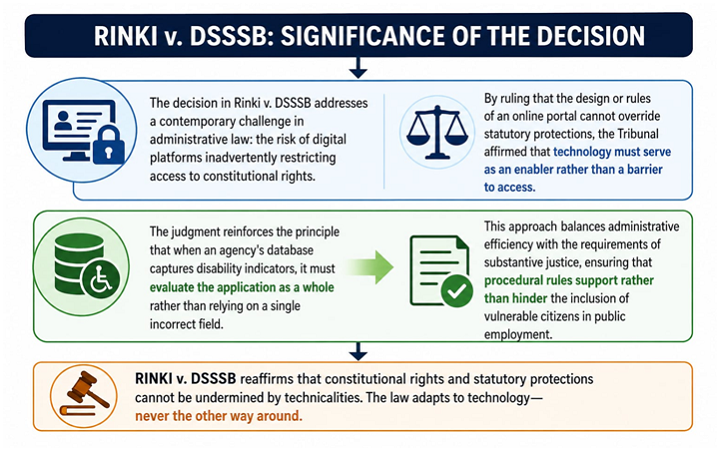
The decision in Rinki v. DSSSB addresses a contemporary challenge in administrative law: the risk of digital platforms inadvertently restricting access to constitutional rights. By ruling that the design or rules of an online portal cannot override statutory protections, the Tribunal affirmed that technology must serve as an enabler rather than a barrier to access.
The judgment reinforces the principle that when an agency's database captures disability indicators, it must evaluate the application as a whole rather than relying on a single incorrect field. This approach balances administrative efficiency with the requirements of substantive justice, ensuring that procedural rules support rather than hinder the inclusion of vulnerable citizens in public employment.
8 CASE ANALYSIS MATRIX
|
Constitutional Anchors |
Articles 14, 16, and 21 of the Constitution of India |
|
Key Judicial Maxims Applied |
De minimis non curat lex (The law does not care for trifles) |
|
Representing Counsel (Applicant) |
Ms. Firdouse Qutb Wani (AOR, SC), Mr. Md. Zaryab J. Rizvi, Dr. M. Afzal Wani, Mr. Dilshad Ahmad |
|
Representing Counsel (Respondents) |
Mr. Amit Yadav and Dr. Monika Bhargava |
|
Final Disposition |
Original Application Allowed in full with specific performance mandates |
9. PROFESSIONAL CONTRIBUTION AND SOURCE AUTHENTICATION
This study is based on the official records of the Central Administrative Tribunal, Principal Bench, New Delhi, under O.A. No. 2612/2025, decided on May 6, 2026.
The case documentation and legal inputs were verified by Ms. Firdouse Qutb Wani, Advocate-on-Record, Supreme Court of India, and Managing Partner at LCZF Law Firm.
Join LAWyersClubIndia's network for daily News Updates, Judgment Summaries, Articles, Forum Threads, Online Law Courses, and MUCH MORE!!"


Tags :Others