


This is the initial formal process of a criminal trial that begins with the submission of information related to the commission of the offence to the state. As is evident, under Section 173 of the “Bharatiya Nagarik Suraksha Sanhita,” equivalent to Section 154 of the CRPC, the act comprises a provision that “the information relating to the commission of a cognizable offence must be reduced to writing and must be recorded as a First Information Report.”
This legal provision contains a dual legislative intent. Firstly, it ensures that complaints about crimes are formally registered as soon as possible. Secondly, it is also intended to preclude arbitrary police denials of criminal complaints.
Interpretation by the courts has made it clear that the FIR is actually not a substantive piece of evidence. Being an evidence through confirmation or contradiction is what matters here, through the provision of the Bharatiya Sakshya Adhiniyam. Courts have never held the FIR to be a detailed account of the crime.
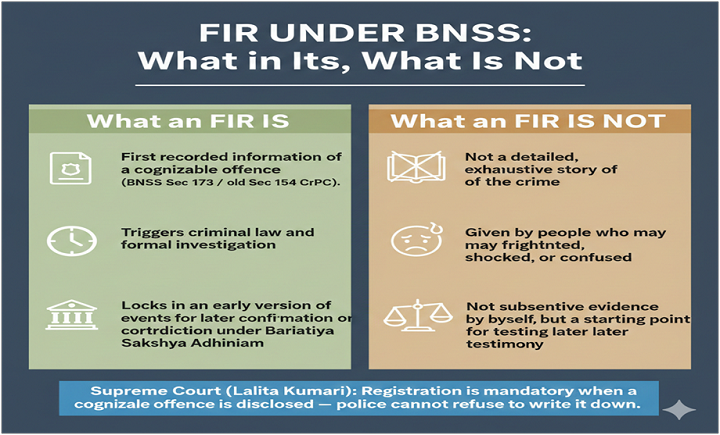
This is evident by the recognition of the Supreme Court that the person reporting the crime at the time of filing the FIR can be emotionally distressed, frightened, or physically shocked, such that omission or lack of detail would not automatically impugn the prosecutable evidence of the case.
It is, however, pertinent to note that the obligatory character of the FIR registration was finally judicially determined by the Constitution Bench of the Supreme Court of India in the case of Lalita Kumari v. State of Uttar Pradesh. While testing the extent of police discretion at the threshold stage, it was held in paragraph 120.6 that: “registration of FIR is mandatory under Section 154 of the Code, if the information disclose commission of a cognizable offence, and no preliminary inquiry is permissible in such a situation.”
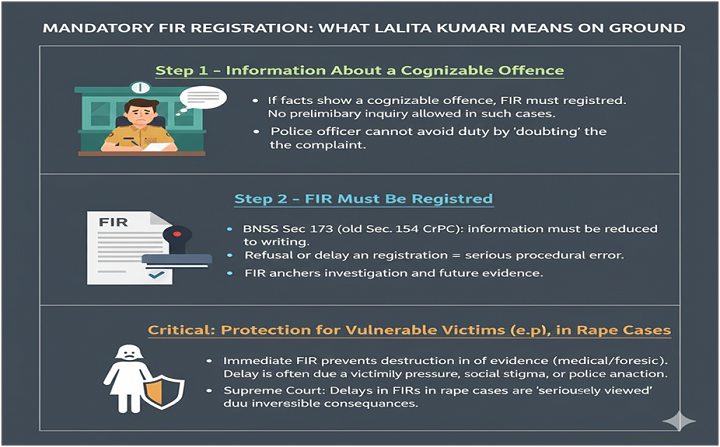
Additionally, in paragraph 120.1 of the judgment, it was held: “the police officer cannot avoid his duty of registering offence if cognizable offence is disclosed,” thereby clarifying that the police officer is obligated to act upon such information.
This judgment has left a significant impact on the manner of conducting criminal trials, as the non-registration of the FIR at the relevant time has been held to constitute a serious procedural error by the judicial authority. It is observed that the registration of the FIR is not only important for the investigation process but is also crucial for the authenticity of the evidence adduced during the trial.
The question of the filing of the FIR at a belated stage has also been thoroughly explored in rape cases. Indian courts have repelled the argument that filing the FIR is a prerequisite for placing reliance on such cases of rape. The Supreme Court ruled in paragraph 8 of the State of Punjab v Gurmit Singh case that the prosecution or the victim's case cannot be rejected only upon the ground of delay in filing the FIR and not doing the same within the given time. The court further emphasised upon it and said that it is normal for someone to be reluctant to disclose rape because of fear, humiliation, or public stigma.
Such judicial mindset marks a crucial shift from formalistic procedure to context-sensitive analysis. Moreover, the Court in the Gurmit Singh case observed, in paragraph 8, that it is crucial for the Courts “to be alive to the fact that in a tradition-bound society of the type that India is, hesitation to report such offences is understandable,” and as such, “delay, if satisfactorily explained, does not detract from the Prosecution Case.”
Such judicial thinking on the need for context-sensitive analysis of prosecutions in rape cases has, in subsequent judgments, withstood the test of time. However, the courts have also made a significant distinction between natural delay and unwarranted or apparently manipulative delays. When there is no plausible explanation for such delay on the part of the prosecution, such delay is taken into consideration by the courts as a ground that demands closer scrutiny of the evidence, but not necessarily a ground for acquittal.
After registering the FIR, the criminal law is brought formally into motion. This is the point at which the prosecution formally transitions from a private complaint to a public one. At this point, the State takes charge of the case, and the crime is transformed from one that is personal to one that is social. This explains the entire criminal trial procedure and the inability to reach a compromise or withdraw in serious crimes as mentioned in the Bharatiya Nyaya Sanhita.
Thus, the role of registration of the FIR is critical in the criminal trial. It establishes the point of departure for the proffered story by the prosecution, provides judicial oversight of the investigation, and places constraints on both the accused and the victim with regard to arbitrary application of power. While issues that amount to mistake or illegality at the point of registration of the FIR do not necessarily vitiate the trial, they tend to taint the alleged crime with suspicion that tends to perdure with the onset of judicial review.
Investigation and the Need for Fairness
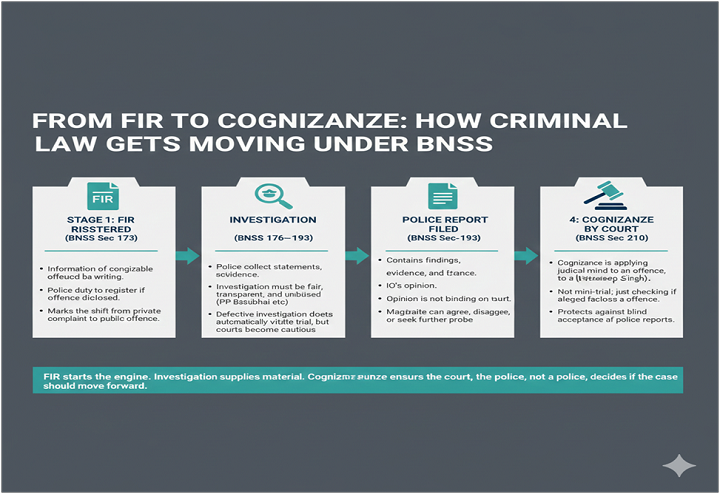
After the registration of the FIR, the criminal procedure enters into the investigative phase, regulated for the most part by Sections 176-193 of the BNSS. Investigation is the sole preserve of the executive, covering the entire procedure adopted by the police to gather evidence, trace suspects, or determine if there is an offense made under the Bharatiya Nyaya Sanhita, 2023. While the courts do not interfere with investigations, it should be noted that judicial review of fairness of investigations is a hallmark of criminal law in our country .
A fair trial necessarily means that one must start with a fair investigation. In the case of State of Bihar v. P.P. Sharma, it was held in paragraph 55 of the judgment that the “Investigation must be fair, transparent, and judicious and should not taint with any kind of bias.” This has been reaffirmed by the Court to make it clear that arbitrariness of investigation directly bears upon the creditworthiness of the prosecutorial case that is likely to emerge before the trial takes place.
Investigation involves recording statements, collecting physical or documentary evidence, arresting, if necessary, and, in the case of serious offences, scientific or forensic analysis. Courts are increasingly using forensic evidence to determine the authenticity of statements of guilt, especially in cases where the evidence of the eyes is inconclusive. However, courts are also cautioned that the value of forensic evidence depends on the manner in which it is gathered.
In the case of Manu Sharma v. State (NCT of Delhi), it was held in paragraph 197 that “Defective investigation by itself does not vitiates the trial, but the court has to be circumspect in evaluating the evidence.”
This judgment is of great importance in that it makes it clear that defective investigations by themselves do not result in acquittal, but they add weight to the responsibility of the prosecution to establish their authenticity through authentic evidence.
Similarly, the duty of the investigating authority to gather all relevant evidence, both favorable or detrimental to the prosecution, has also been stressed by the courts. In the case of Babubhai v. State of Gujarat, it was held by the Supreme Court: “A fair investigation is a part of constitutional rights guaranteed by Articles 20 and 21 of the Constitution of India.”
It was also held that the investigation should not be carried out with a predetermined conclusion in mind. “In other words, the investigating agency should investigate without any pre-conceived or predetermined notion or conclusion, but with an open mind and with a fair objective of ascertaining the truth.”
This is a very important aspect during criminal investigations and especially in court and this is because medical or forensic analysis is crucial. It is important for the court to establish that there are no flaws in the process of preserving the evidence through the sealing of the samples or that there is no break in custody.
The process of investigation ends with the filing of a police report as per Section 193 of the BNSS. This document contains the findings of the investigation, the evidence gathered, as well as the opinion of the investigating officer about the commission of an offence. It must be noted that the opinion of the investigating officer is not binding on the court. The Magistrate possesses entirely separate discretion to accept, disagree with, or disagree with the findings of the police report.
At this point in time, judicial oversight helps to ensure that the investigative process does not become an unchecked use of executive power. It is recognized that investigation is not a judicial power, but it is still governed by constitutional discipline. At this point in time, abuse or misconduct could potentially damage public confidence in the criminal justice system as a whole.
Noticing Act of Deficiency/Liability or Commencement of Proceedings
According to Section 210 of the BNSS, the court takes cognizance of the offence on receiving a police report, a complaint, or information from any person apart from the police officer. “Cognizance is the application of judicial mind to the facts disclosed, for the purpose of proceeding under the law.”
It is, however, clear that the taking of cognizance is not the same as the issuance of process. Indeed, it was held in the Indian case of R.R. Chari v. State of Uttar Pradesh that “Cognizance is taken as soon as a Magistrate applies his mind to the suspected commission of an offence.” This judicial standard is still applicable in determining the issue of valid judicial proceedings.
One major interpretation that came about with regard to the concept of cognizance was in the decision of Hardeep Singh v. State of Punjab. It was held by the Constitution Bench in paragraph 44 that “taking cognizance is of the offence and not of the offender.” This is important, for example, in situations where other accused are summoned for trial after evidence is adduced.
At the stage of cognizance, it is not anticipated that the court would assay the sufficiency of evidence for a verdict of guilt. It is only concerned with considering if the allegations indicate the commission of an offence that is cognizable before it. It is held that judicial precedents should never license a mini trial for purposes of cognizance.
The application of mind at the stage of cognizance is of immense importance. Blind acceptance of the report of the police or the complaint has been disapproved by the higher courts.
If the judicial mind is not applied at this stage, it may render the subsequent proceedings liable to being challenged by the accused on the ground of abuse of process. Cognizance, therefore, is an important procedural safeguard. It ensures that court proceedings are brought on only if the statutory threshold is satisfied, without undermining the independence of the judiciary from the investigative findings.
Providing Access to Documents, Disclosure Requirements, and the Structure of a Fair Trial
After taking cognizance and when the accused are summoned, the criminal justice system enters an era wherein procedural justice becomes more concrete and abstract. Sections 230 and 231 of BNSS provide that it shall be mandatory for the prosecution to provide copies of all police reports, statements, documents, or material objects upon which it seeks to rely when it appears before the accused.” It should be noted that this stage of the process of justice has nothing to do with formality. In fact, it has everything to do with the “guarantee of a fair trial set forth in Article 21.”
“The justification for compulsory disclosure is simple and fundamental.” A defendant cannot defend himself fully unless he is put on an equal footing with the prosecution. “Denial and selective disclosure of documents vitally affect criminal justice and strike at its roots” as clarified by the Supreme Court.
The ambit of disclosure obligations was clarified in the case of V.K. Sasikala vs. State, where the Court stated the following in paragraph 19:
"The accused is entitled to all documents relied upon by the prosecution and also such documents which may not be relied upon by the prosecution but are necessary for a proper and effective defence."
This is an important development in that it refutes the presumption that the prosecution has a monopolistic control over the determination that evidence is relevant. The defence will thus be entitled not only to relevant evidence that incriminates but to other evidence that could help to establish innocence or impeach the prosecution case.
This obligation of disclosure also includes exculpatory evidence. Destruction of evidence, of which an accused could have benefited, has been considered to amount to a grave violation of a fair trail right. In Manjeet Singh Khera v. State of Maharashtra, it has been held in paragraph 25 of the judgment: “Fair trail includes fair investigation, fair prosecution, and prosecution is obliged to make disclosure of all relevant evidence, whether it is in favour of prosecution or not.”
Importantly, courts have held that prejudice arising out of non-provision of documents would not necessarily be obviated by disclosure during the course of trials. The timing of disclosure also assumes importance in this regard. A possibility of irreparable harm to the accused’s ability to contest the prosecution case might arise if the documents are made available after charging the accused.
The statutory duty of document supply thus acts as a gate-keeping provision. It will ensure that the suspected person is not ambushed with facts and that the hearing is a battle between equals and not a matter of procedure asymmetry. Weakening the duty will reduce the criminal process to a formality and not a reasoned adjudication on guilt or innocence.
Framing of Charges and the Prima Facie Requirement of Satisfaction of the Offense
Framing of charges is the stage where the charges are formalized and crystallized. Sections 239-241 of the BNSS, state that the court is obligated to examine the police report and then the documents and the contentions of both the prosecution and the defense regarding whether there are sufficient reasons that the accused might have committed the offence.
The legal benchmark here has been nicely balanced by judicial pronouncements. It is not required to make a judgment on whether the prosecution will succeed in the end. It cannot also weigh the evidence as if it were conducting a trial. It only needs to determine whether there exists a prima facie case on the material on record.
In State of Bihar v. Ramesh Singh the Supreme Court has formulated the basic tenet applicable in framing of charge. The Court held in paragraph 4 as follows:
“At the stage of framing the charge, the court is required to apply its judicial mind to the facts of the case in order to determine whether a case for trial has been made out; it cannot blindly adhere to the prosecution case.”
This ruling achieves a balance between two opposing considerations. On the one hand, the court cannot suppress valid prosecutions in a case that requires proof beyond a reasonable doubt at the preliminary stage of a trial. On the other hand, a court cannot put a person through the nightmare of a criminal trial if the charges are inherently implausible or there is no concrete evidence.
The ambit of judicial review at this stage has also been clarified in the case of Union of India vs. Prafulla Kumar Samal. The court asserted in paragraph 10 that:
“If the material on record, taken at face value, reveals grave suspicion against the accused, which has not been properly placed, the court will be justified in founding an accusation.”
“grave suspicion” has since become a ‘touchstone’ in the doctrine. This is an indicator that a mere conjecture or a weak suspicion would not suffice, but a conclusive finding on the question of guilt is not necessary. There must also emerge a clear sequence on the commission of the crime. More recently, in the case of Amit Kapoor v. Ramesh Chander, the Supreme Court of India has reaffirmed these doctrines.
The Court has held in paragraph 27 of that “At the stage of framing of charge, the court is not required to scrutinize the evidence, except to determine whether a prima facie case has been made out against the accused.” This ruling becomes even more relevant in compex cases related to economic offences or special statutes involving a huge array of documents.
The courts have also been advised to not let the stage of framing of charges become a mini-trial in disguise in the name of judicial scrutiny. However, courts have simultaneously identified that the discretion to acquit is not an illusion. When the allegations, even if accepted in the most favourable manner, do not amount to any offense under the BNSS, the courts are obliged to acquit the respondent. This protects the criminal justice system from being utilized for harassment or intimidation.
Speaking to LawyersClubIndia, Advocate Dhruv Khera stated that “When it comes to practical situations i.e interpretation of what is written in statute. Charge framing marks the beginning of trial. After FIR, investigation and filing of chargesheet. Framing of charges are done by JMFC then subjected to the punishment of offence, trial is conducted by either JMFC or Asst. Session Judge.”
Stating an example he expanded by saying “For example in case of murder or such heinous offence, commital of the case to session Judge. Court frames charges based on " Prima facie" evidences related to the offence. If we go in further nitty gritty of charge alteration and dropping of some charges the "facts in issue" & Attendant circumstances becomes the point of axis where a case revolves. For example number of injuries, weapon used, Accused conduct prior or post commission of offence etc and the "aggravating or mitigating factors.”
He further said that “They determine whether there should be an alteration of charges or not. These alteration of charges can be suo moto if Judge is satisfied from the facts of the case to alter or by way of application by Accused or prosecution.”
With regards to submission of documents, Mr Khera said that “For further submission of documents there are primarily 3 ways :
- Court may summon material documents by way of Section 94 BNSS.
- Court may suo moto or the basis of application by prosecution or Accused if Court deems it fit my conduct further investigation U/S. 193(8) BNSS.
- On the basis of pleadings by the prosecution or the Accused. Court may order production of documents U/S 311 BNSS.”
The framing of charges, therefore, is a procedural turning point. It is where the courts make the decision to impose the fulcrum of the coercive power of a full-blown criminal trial on a person. The criteria evolved by courts strike a balance between the societal desire to prosecute crime and the person's rights to liberty and dignity.
Investigation of the Accused under Section 313 CrPC and its Contemporary Importance
Even after the prosecution completes its evidence and before it is time for the defence to appear and offer its evidence, it is statutorily obligatory on the part of the court to interrogate the accused under Section 313 of the BNSS.
This phase is unique during a criminal case as it is neither adversary nor wholly evidentiary in nature. The main idea behind it is to give each and every incriminatory circumstance that has arisen out of the prosecution evidence to the accused personally and offer him an opportunity to explain them personally.
The Supreme Court has reiterated the fact that this process is not an empty formality. Then in the case of Sharad Birdhichand Sarda v. The State of Maharashtra, the SC made it abundantly clear that no circumstance that is not brought to the notice of the accused under Section 313 of the CrPC shall be relied upon against the accused.
The implication of the ruling is that the element of fairness in the process cannot be separated from the guarantee of a fair trail. The process is to test the prosecution’s case in the face of the accused person’s defensive argument and not to prise out an admission through threats or implications.
The courts have also held that whereas the statement given by the accused under this section is not on oath and cannot form the foundation of conviction on its own, it can nevertheless be used to give weight to the prosecution case if it matches other facts on record. On the other hand, a likely defense offered by the accused can make quite a dent in the prosecution story, especially if the prosecution case is based on circumstantial evidence.
Speaking to LCI, Advocate Sarah Haque said that “Young lawyers think trials are about clever one liners in cross, but the real work happens much earlier. If your chief, your 313, and your discharge application aren’t all aimed at the same theory of the case, you’re just making noise.”
Talking about preparation for the cases, the advocate said that “ Good preparation means three things: in chief, you calmly build the facts you want the judge to write in the judgment; in cross, you only ask questions that actually damage the other side’s story; and in 313, you make sure the accused gives a clear, plausible version instead of a panicked denial.”
She further said that “Discharge is just the same discipline at an earlier stage and you’re essentially telling the court that ‘Even if you accept their papers as true, this doesn’t cross the line into a real case.’ The day you start seeing these as connected moves in one long game, your results in court change overnight”
Defence Evidence and the Right to Rebut the Prosecution Case
After the end of the examination of the accused, the next stage of the trial is the defence stage. It is at this stage that the accused has the opportunity to give evidence in his defence. One thing that has long been made clear by law is that the accused does not have to prove that he or she is innocent.
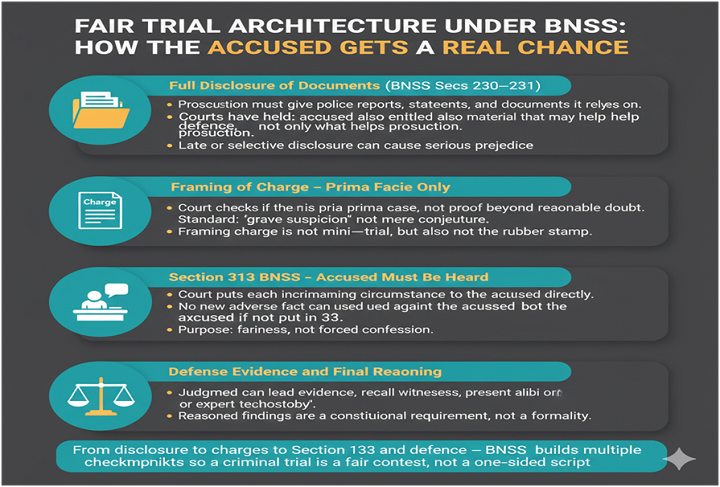
The onus of proof remains entirely on the prosecution throughout the trials. But it should be noted that this is an inherent right that applies in particular when scientific or technical issues or alibis are involved.
An absence of a fair opportunity to lead defence evidence has always been held by judicial precedent to render the trial invalid. In the case of State of Haryana v. Ram Singh, the accused must be given an opportunity to counter the prosecution's case, and rigidity of procedure cannot ever be allowed to overcome substantive justice. This is also an opportunity for the accused to summon the prosecution witnesses for further cross-examination, if permissible under law, thus maintaining the adversarial process.
The Place of Judicial Reasoning
The stage of final argumentation signals the end of evidentiary adjudication and the beginning of judicial adjudication. This is the point at which the prosecution and the defence offer their respective accounts of the evidence on record. The purpose of final argumentation is not the presentation of additional facts; rather, it is to help the court sustain inferences from the record on file.
It has been emphasized by the Supreme Court that it is necessary to show active judicial intervention at this stage. In State of Punjab v. Jagir Singh, it was held that a criminal court is not a silent listener to arguments but is bound to scrutinize the evidence very carefully and form an opinion on it. Even the level of reasoning presented at this stage impacts heavily on a judgment.
The announcement of the judgment is the final part of the criminal trial process. The courts are required to give a considered judgment that deals with the prosecution case, the defense arguments, the weight of the witnesses' evidence, and the relevance of the law that is applied. The burden of proof is beyond a reasonable doubt at this stage, and the courts have held that moral conviction should not substitute the requirements of legal proof.
In the case of Vijayee Singh vs. State of Uttar Pradesh, the Supreme Court held that a judgment in which there is no determination of how the charge is fulfilled by the prosecution is unsound and is liable to be quashed, since the requirement of stating the reasons is not a formality but a constitutional imperative in conformity with the principles of natural justice. It further stated that the requirement of stating the reasons is not a formality but a constitutional imperative in conformity with the principles of natural justice.
Speaking to LCI, Advocate Abhishek Jan said that “The only real question in quashing for a lawyer should be ‘Even if I believe every word of the FIR, does it still make out any criminal offence against this person?’ and if the answer to the same is in a negative, because some basic ingredient is missing, or the case is clearly a pressure tactic on admitted facts, then you’re in quashing territory. If the answer is ‘yes, but I have my own version’, that belongs in a trial, not in a quashing petition.
He further opined that “About the chargesheet coming while your quashing is pending, it is often thought that it’s the end of the road. It isn’t, but you can’t behave like nothing has changed. The moment a chargesheet is filed, the Court will not look at the FIR in isolation and it will open the entire file and ask, ‘After full investigation, is there now enough material to at least let this go to trial?’ Sometimes the chargesheet actually helps you, because it proves the police have nothing more than the bare allegations. Sometimes it completely plugs the gaps you were relying on. The smart thing to do is to immediately place the chargesheet on record as if you pretend the chargesheet doesn’t exist, the Court will feel you’re hiding something. Once that trust is gone, your quashing is gone with it.”
Sentence and The Principle of Proportionality
In cases where the guilty plea is confirmed, the trial is not completed with the conviction of the accused. The sentencing trial then ensues, during which the bench listens to the arguments of the accused regarding the sentencing of the case. This aspect of the courtroom procedure has increasingly gained attention from the judiciary, especially in the wake of recent changes in the jurisprudence of proportionality and reformation.
The court in the case of Bachan Singh v The State of Punjab, while determining the sentences in death penalty cases, the Supreme Court established the criteria for death sentences and highlighted the the fact that the sentence should fit the crime and the criminal. It further restricted the punishment of death penalty to the "rarest of the rare" crimes.
Remedies After a Trial
Appeals, Revision, and Suspension of a Sentence The judicial proceedings in a crime are not necessarily over once the trial is concluded.
There are measures provided under the law for appeal and revision based on the principle of procedural justice. An appeal against a conviction is a substantive right, and the appellate courts can reappraise the case, especially if the findings are perverse or inherently legally unsustainable.
In the case of Chandrappa v. State of Karnataka, the Supreme Court defined the limit of appellate intervention by stating that although respect for the judgment of the lower court is to be maintained, the appellate courts are not precluded from reconsidering the evidence if the cause of justice so requires. Heavily suspended sentences pending appeal again illustrate the legal maxim "conviction not final until appellate processes are exhausted."
Deepen Your Criminal Trial Expertise – LCI Learning Courses
Master FIR, Investigation, Evidence & Trial Procedure from India's Top Legal Minds
As you navigate criminal trials, forensic evidence, and procedure under BNSS, supplement your case law analysis with structured, expert-led training. LCI Learning offers certification courses taught by Senior Advocates and former judges with 40–50 years of experience. Pick courses that align with your litigation focus:
For FIR & Investigation Mastery:
- BNSS 2023 (Dr. Shikhar Goel & Adv. Raghav Arora) – Complete breakdown of FIR registration, police duties, investigation standards, and procedural safeguards under the new law. → Enrol
- CrPC Certification Course (Sr. Advocate Guru Gyan Shankar Shukla) – Foundations of criminal procedure, evidence treatment, and appellate strategy. → Enrol
For Forensic Evidence & Courtroom Skills:
- Complete Training on Forensics in Sexual Offence Cases: MLC, FSL, DNA, Courtroom Skills (Phil Cherian) – DNA analysis, medical examinations, injury interpretation, and expert witness cross-examination. → Enrol
- Deconstruction of Medical Reports in Court Using Forensics (Riva Pocha, Ashish S Chavan & Phil Cherian) – Learn to challenge or support FSL conclusions, toxicology reports, and autopsy findings. → Enrol
For Charge Framing & Trial Strategy:
- Criminal Law Drafting 2-Day Workshop (Dr. Shikhar Goel) – Practical skills on challenging charges, framing defences, and attacking procedural lapses. → Enrol
- The Art of Successful Cross-Examination (Jayant Bhatt) – Master witness examination and narrative construction in contested trials. → Enrol
Join LAWyersClubIndia's network for daily News Updates, Judgment Summaries, Articles, Forum Threads, Online Law Courses, and MUCH MORE!!"


Tags :others


