
I. The Quiet Revolution No One Is Talking About
Recently in the month of April, the Ministry of Corporate Affairs released a public notice asking for feedback on proposed updates to company registration rules. Instead of merging several forms into just two that detail grabbed attention everywhere. True, paperwork gets simpler.
Yet calling it mere cleanup sells it short. Since the original rules arrived in 2014, nothing has come close to matching this overhaul's scope. The adjustments reach much deeper than reducing documents. Behind the scenes, how companies take shape could shift entirely.
One moment you’re filing paperwork, next thing there’s another tweak to keep up with. These draft regulations bring more than fifteen adjustments, each poking at an old wound in India’s corporate laws - the space where promises of smooth operations crash into messy red tape.
Should they become official, founders launching ventures through SPICe+ will feel shifts just as much as accountants ticking boxes or secretaries tracking deadlines. Even someone handling a subscriber’s passing during setup won’t escape ripple effects. Feedback stays welcome up to 9 May 2026. Below lies a close look, part by part, at what’s truly on paper - and how it might play out when applied.
II. The Form Consolidation: E-CHNG and E-CON Are Not Just Renaming
One big shift in the Draft Rules is cutting down eleven old forms into just two fresh digital versions. Instead of filling out many different papers, people now pick one main form built in chunks. Merging INC-4, INC-22, INC-23, and INC-24 means those tasks go under E-CHNG - mainly for updates about where a company lives or what it's called.
At first glance, shrinking eleven forms down to two seems like little more than cleaning up clutter. Yet what matters sits beneath - how things connect. When a business shifts its name, it often moves its official address too, something the past setup ignored.

Instead of treating linked changes as one flow, officials processed each piece alone. That split meant double entries, double chances for errors, extra delays, and fees spent again. Now, merging updates into single actions pushes the system to see patterns, not silos. Related steps now move as one, guided by design, not coincidence.
A digital design issue hides inside this. If someone picks "Conversion of One Person Company" on E-CON, the interface shifts. Picking "Grant of License under Section 8" does the same - forms reshape themselves, showing only what fits. That matters. Right now, people often complain that MCA21 asks for details it should already know. With E-CON built in blocks like this, pieces might pull from old filings automatically. Retyping every time could become unnecessary. Will it run smoothly when live? Unclear. Still, the thinking behind how it's pieced together makes sense.
Right there in the Draft Rules lies what holds it all together - changes one rule at a time. Rule 4 kicks it off, then 6 follows, along with 7, jumping into 20, after that comes 21, 22 slips in, then 23 joins, later 27 steps up, 28 tags on, followed by 29, 30 slides through, 33 appears, then 37 links in, topped by 40 and finally 41 - all part of the Companies (Incorporation) Rules, 2014. Each swap swaps out an old form name for either E-CHNG or E-CON. Authority? It flows from sections 3 to 8, skips ahead to 11, 12, 13, 14, loops back to 17, includes 20 - and ties tight with Section 469 of the Companies Act, 2013. That wide net means nearly every moment tied to forming companies now runs through this shift.
III. The OPC Changes: Removing Paper That Was Never Really Protecting Anyone
Now things look simpler for single-owner firms. Getting rid of the director's sworn statement during conversion - that part might vanish completely. The draft suggests tossing out that step under Rule 7(4)(iii). On top of that, a whole rule about jail risks just for these companies could disappear too. Rule 7A, the one tying penalties directly to OPCs, may no longer stay. Changes like these clear away old hurdles without making noise about it.
Rule 7(4)(iii)'s demand for an affidavit always caused friction during OPC shifts. Sworn declarations only matter if lying brings real consequences - yet here, the facts they confirm show up again elsewhere in the paperwork. MCA files already let officials check whether someone qualifies as an OPC. Forcing a director to sign this extra document brought ceremony, not clarity. Dropping it recognizes something quiet but true: rules must match what they actually control.
Leaving out Rule 7A catches attention. Since One Person Companies run mostly through one individual, there was once a belief they could be misused more easily and so stricter penalties got added to discourage abuse. Still, laws like those in the Companies Act and the BNS already cover such cases fully.
Having a separate penalty just made it seem like extra oversight existed when really nothing changed beneath the surface. Taking that rule away now fits better with how companies are normally treated under law - where things probably belonged all along.
IV. The Name Availability Rules: Finally, Some Clarity (and a Lot of Examples)
What stands out most in the Draft Rules is how Rule 8 gets a full overhaul. Instead of small tweaks, it swaps entirely for a fresh take. This rule decides when a new company name clashes with one already taken. The updated version builds clarity through structure and examples. At its core lies a clear yes-or-no check. A name counts as too close only if it matches another after two moves. One comes first - ignore certain listed elements. Then follow with assessing specific factors laid out ahead of time.
Twelve things won’t count when checking names. Picture them laid out, row after row, each with a drawing to show what it means. Think company endings like Private or Ltd - those get ignored. So do changes between singular and plural forms. Upper or lower letters? Doesn’t matter. Spaces in odd places slip through too. Past, present, future - verb timing makes no difference here.
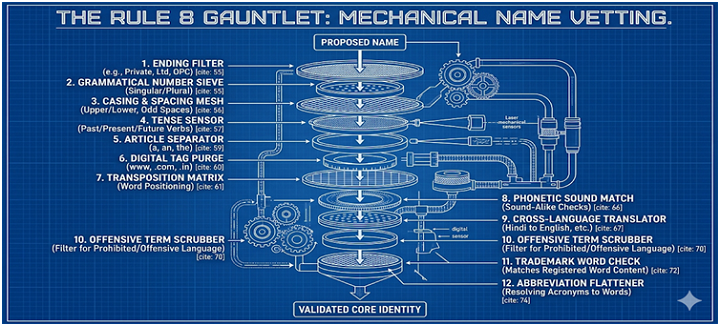
Even wrong spellings sometimes slide by. Slight tweaks like Fiber versus Fibre fall into the same bucket. Words such as a, an, or the simply vanish from view. Shortened versions of terms are treated as if they aren’t there. Web tags like www or .com? Tossed aside. Swapping where words sit in the name usually counts for nothing. Slap a city onto a name that lacked one before? Still overlooked. Numbers rewritten another way stay equal. Every point comes with real cases showing how it works. These samples actually help clarify confusion. Registrars used to rule differently on similar issues nationwide. Not anymore.
Starting off differently, how names might count as identical even when they look distinct covers several cases. Take sound-alike versions, like Xpress Delivery matching Express Delivery - it’s about how words are pronounced. Sometimes full rewording happens across languages, say Green Transport Corporation turning into Harit Parivahan Nigam in Hindi, yet still seen as one. Then there's when an IFSC subsidiary appends just the term IFSC to its parent’s name - this small addition keeps it legally separate, giving space for special financial setups at international hubs.
Rule 8A has been rewritten. It now spells things out clearly through twenty-two separate points. These touch on offensive choices, names too close to defunct businesses, even those echoing famous brands. What stands out is how it treats trademarks. Under the updated Rule 8A(1)(b), only word-based registrations matter when judging a name. Visual logos or design elements by themselves won’t block approval. That change fixes a long-standing issue. Plenty of firms were turned down before just because another company owned a logo with matching wording. Now that logic shifts. Clarity replaces guesswork. Protection focuses where it counts. Words rule. Images don’t carry the same weight here. This tweak may seem small. Still, its effect could stretch far.
Now there’s a way out after reserving a company name - under Rule 9A, users can pull back their request using the MCA21 system. Before, hitting pause wasn’t an option; lock-in lasted until expiry, no matter what happened later. Even when intentions shifted, the name stayed frozen in place. With this update, people regain say over their choices without waiting it out. Control returns where it belongs - right into the hands of those who made the pick.
V. KYC, Director Consent, and the Rule 17 Deletion
Fixing how ID checks work when someone joins is on the table under Rule 16 changes. Out goes clause (h) in subsection (1), completely removed. When proving who they are, Indians must show an Aadhaar Card or PAN, while foreigners need a Passport instead. Here’s where it gets easier - someone with a current DIN that has correct details won’t have to resubmit identity documents again. A fresh rule, numbered 16(1)(n), now lets people use a range of papers to prove where they live. Bank statements work, just like property tax receipts or an Aadhaar card might. Electricity bills count, so do mobile or landline phone invoices. Even different utility records are fine when showing residence. One thing stays fixed though - nothing older than three months will be accepted. If someone holds a DIN, that person still doesn’t need to follow this part.
Out of sight, the removal of Rule 17 slips under the radar yet brings real ease. Right now, appointing initial directors means sending in DIR-12 separately during company setup, listing their details and approvals. Because SPICe+ (INC-32) already gathers every bit of that data, the new proposal wipes out the old rule completely. A cleaner process emerges when outdated steps fade after being replaced - even if they lingered too long in print.
Now companies can list up to five directors right at incorporation, not just three. This shift adjusts what used to slow things down when bigger groups launched startups together. Having extra founders wait to get their Director ID after registration made little sense. Signing the company's founding document now counts as agreement to serve as a director. That approval happens automatically if they’re named in those initial papers. Others still needing to confirm must verify using an OTP system first. When phone-based codes fail, Form DIR-2 becomes the backup path. One less form floating around means smoother setup overall.
VI. The New Rule 23B: The Deceased Subscriber Problem
A twist pops up in the Draft Rules with something called Rule 23B. This change tackles a gap regular rules miss completely. Picture someone who signs the Memorandum but passes away before settling the share payment. That moment - between signature and cash - is where things get messy now. The current system fumbles here, offering little clarity. So this addition steps into the awkward silence left behind.
Right now, the setup lacks clear steps for this kind of situation within the founding guidelines. Once the person’s name shows up on the document agreeing to buy shares, money becomes due right away. Then, if that person passes away prior to the business being officially formed - or before handing over any cash - confusion follows. Who pays? That question floats without a solid answer. If payment still happens after death, who ends up owning those shares? The one left handling affairs inherits these doubts along with everything else.
Clean wording settles this under Rule 23B. Whoever steps into the shoes of the dead subscriber must cover what the person owed. After paying up, that same person gains all rights belonging to the original subscriber. The term 'legal representative' stretches wide, matching long-standing civil rulings. Anyone handling the estate counts, even without official court approval. This fix fits the problem size, nothing more, nothing less. Placing it within the updated rules shows someone looked closely at how things work on the ground. Not everything gets fixed from afar.
VII. Registered Office, Physical Verification, and the Shift to Risk-Based Checks
Rule 25, which handles how companies verify their registered office, is getting a major overhaul. Now, what’s acceptable as proof depends on the type of premises: if the company owns the place, it can show a title deed, property tax receipt, municipal khata, or a utility bill (as long as it’s not older than three months). If it’s renting or leasing, the same documents work, but if they’re in someone else’s name, the company needs to add an authorization letter. For the first time, co-working spaces and similar setups are covered—here, an allocation letter or payment receipt is enough. Companies in Special Economic Zones need to show SEZ authority documents.
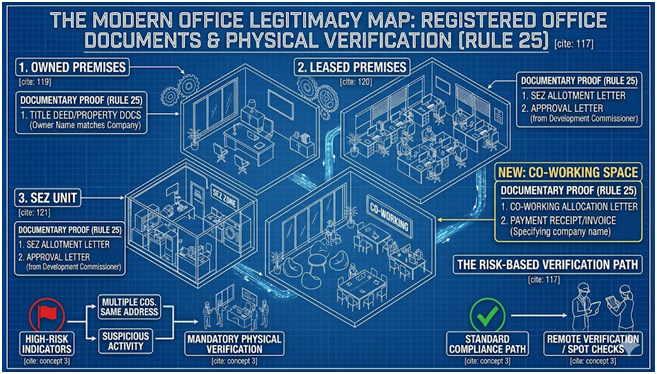
Physical verification under Rule 25B(1) is also changing. Instead of the Registrar doing routine, mandatory visits everywhere, checks will now happen only if there’s a good reason—some kind of red flag or risk. If needed, the Registrar can still send someone to visit the office, bringing along two local witnesses or even getting the police involved. This change matters, especially since the companies registry has never had enough people to visit every office on a regular basis.
There’s more flexibility now around moving a registered office from one state to another, thanks to changes in Rule 30. Under Rule 30(9), if a company is being investigated but hasn’t been taken to court yet, it can still move its office—as long as the Board promises to cooperate with the investigation. For companies that went through insolvency and got new management, office moves are now allowed if the problem dates back to before the new management took over (again, unless there’s a current prosecution for something that happened after the new team came in). This should give buyers of distressed companies more options and not tie their hands because of things the previous owners did.
VIII. Section 8 Companies and More Flexibility in AGILE-PRO-S
Section 8 companies—those non-profits licensed under Section 8 of the Act—are also seeing two big changes in the draft rules. First, Rule 39 will finally let a Section 8 company limited by guarantee convert into one limited by shares. This path has always been blocked before, likely because guarantee companies have a different kind of membership. Now, Section 8 organizations can rethink and restructure their capital setup as needed.
Next, when starting up a company through the AGILE-PRO-S form (INC-35) under Rule 38A, it’ll no longer be mandatory to sign up for EPFO, ESIC, and open a bank account all at once. Those options remain available, but companies can choose to start those registrations later, based on when they actually need them. For pre-revenue startups, this helps a ton—no more having to register for employee benefit schemes before they even hire their first person. Now, the timing of paperwork can finally line up with the real pace of business.
IX. The Bigger Picture: More Than Just Form Updates
It would be easy to brush these draft rules off as just more paperwork tweaks—some new forms, a few updated document lists, minor threshold changes. That misses the point. Under all these technical adjustments, there are actual policy shifts: a clear, rules-driven framework for company names (which limits Registrar discretion), risk-based checks for registered offices (moving from blanket requirements to targeted checks), the IBC carve-out for office moving (protecting new owners from issues caused by old management), and a new rule so subscribers who’ve passed away since 2014 aren’t left in legal limbo.
That said, what’s not changing stands out too. The draft doesn’t tackle the core problem of inconsistency between centralized MCA21 processing and the wild differences people experience from Registrar to Registrar. It doesn’t set any deadlines for name approvals, which are still hit-or-miss. And while the E-CHNG and E-CON forms look promising in theory, whether they actually work will depend on how well MCA21—a platform with a spotty record on these transitions—rolls them out.
Speaking to LCI Advocate Sanjeev Tiwari said that “ Surprisingly, MCA’s latest proposal addresses actual issues. Eliminating the OPC affidavit removes a step that only created paperwork without adding value. Combining forms may seem minor - yet it reduces unnecessary repetition. Events occurring at the same time, such as updating name and address, currently demand separate submissions. Filing twice means paying twice, increasing chances of mistakes. Death of a subscriber prior to incorporation falls under Rule 23B. This gap remained unaddressed after 2014. Office validation now follows risk-based assessment - practical, given limited capacity for universal review. The consultation ends on May 9. Rules shaped by real-world operation appear infrequently. What matters emerges only at the end.”
Join LAWyersClubIndia's network for daily News Updates, Judgment Summaries, Articles, Forum Threads, Online Law Courses, and MUCH MORE!!"


Tags :Others