


The ruling reaffirms that anti-corruption investigative agencies cannot escape transparency obligations by stretching the definition of national security organisations
The judgment reinforces the principle that anti-corruption investigation bodies are not excused by the nature of their work from transparency requirements, which are considered to apply to national security bodies. The Supreme Court has issued a much-wanted judgment regarding the definition of "intelligence and security organisation" for exemption from the transparency obligations under the Right to Information (RTI) Act, 2005v and the Special Police Establishment (SPE) of Madhya Pradesh Lokayukta Organisation is not such an organisation. In this regard, the Court also overturned a notification issued by the Madhya Pradesh government in 2011 to bar any access to information regarding the work of the SPE, and held that information regarding specific officers of the police department under corruption charges has to be made available to the police officer. In Special Police Establishment v Kamta Prasad Mishra & Ors, Justice J.K. Maheshwari and Atul S Chandurkar, a Bench of the Madras High Court, gave 32 pages of detailed reasoning on the statutory scheme that governs the Lokayukta in Madhya Pradesh and the scope of the executive discretion to exempt itself from transparency laws.
Background of the Dispute
The case started in 2017 when the Special Police Establishment Bhopal filed FIR against the Madhav Nagar police station (Katni) town Inspector Kamta Prasad Mishra. The charge was that he took a bribe and the case is pending under the Prevention of Corruption Act, 1988. A chargesheet was filed at the Special Court in Katni after the investigations. The Madhya Pradesh Home Department then gave its approval for the prosecution of Mishra on 20 May 2020. Mishra then filed an application for copies of documents and official correspondence that had led to the sanction order under the Right to Information (RTI) Act. But the State Information Commission refused to order disclosure, invoking Section 8(1)(h) of the Right to Information Act, which allows withholding of information when it is on-going investigation or prosecution. Aggrieved by this refusal, Mishra had filed a writ petition in the Madhya Pradesh High Court which ruled in his favour in December 2021 and ordered the authorities to provide the information sought. Then the SPE contested this order of the High Court before the Supreme Court. Significantly, the SPE did not call into question the merits of the disclosure alone but aimed to rely on the notification issued by the General Administration Department of the State Government under Section 24(4) of the RTI Act dated 25 August 2011. This notification had claimed to exempt the Madhya Pradesh Special Police Establishment and the State Bureau of Investigation from the ambit of full RTI Act, claiming that they had the characteristics of intelligence and security organisations.
The Question Before the Court
The Supreme Court pointed out that the appellant had not challenged the notification of 2011 before the High Court, but had attempted to rebut the RTI petition of Mishra in its entirety. The Court had to consider whether the notification was in keeping with the Scheme of the Section 24(4) of the RTI Act. The Bench noted that in cases of statutory interpretation, where there is a clear issue before the Court, and the State has had adequate opportunity to defend this measure, the Court cannot be precluded from deciding the question of legality for subordinate legislation, even if it was not the actual subject of the challenge in the lower court. Section 24 of the RTI Act allows the Central and State Governments to exempt intelligence and security organisations listed in the Second Schedule to the RTI Act or notified by the government under the law from being covered by its transparency provisions, but with a proviso that information regarding allegations of corruption and human rights violations will be issued. The specific powers given to the State Governments under Section 24(4) are to give notification to these organisations set up at the state level
Holding
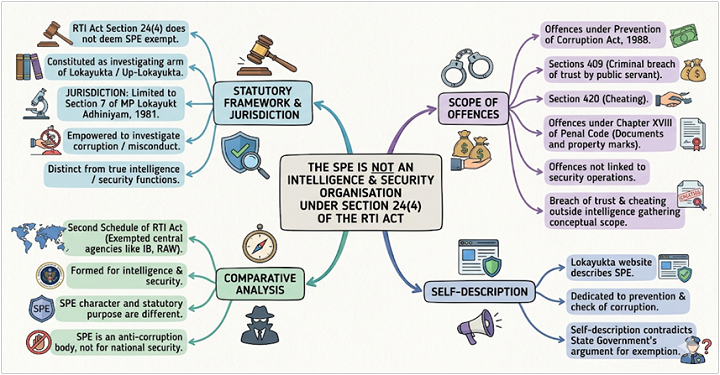
The Bench clearly said the SPE was not covered by this exemption. The Court noted that "Section 24(4) of the RTI Act, 2005 does not deem the SPE as an 'intelligence and security' organisation. The Bench further held that the statutory framework in which the SPE is constituted and the jurisdiction given to Lokayukta and Up-Lokayukta clearly establishes that the SPE is not an intelligence and security organisation when it helps the Lokayukta and Up-Lokayukta in the matters covered by Section 7 of the Madhya Pradesh Lokayukt Evam Up-Lokayukt Adhiniyam, 1981. The Lokayukta and Up-Lokayukta are specifically empowered by Section 7 of the Act, 1981 to investigate allegations of corruption/misconduct against public servants, and the SPE would be its investigating arm in matters of corruption/misconduct. The Court clearly distinguished between this anti-corruption investigative function and that of a true intelligence and security service. The case emphasized the narrow and specific scope of the jurisdiction of the SPE. The Bench also observed that the SPE is limited to investigating offences punishable under the Prevention of Corruption Act, 1988, Sections 409 and 420 of the Penal Code and offences under Chapter XVIII of the Code, and therefore, could not be considered as an intelligence and security organisation under Section 24(4) of the RTI Act. The Court found that neither criminal breach of trust by a public servant (as defined in section 409 of the Penal Code) nor cheating (as defined in section 420 of the Penal Code) was within the conceptual scope of intelligence gathering or security operation, and neither Chapter VIII nor Chapter XVIII concerning offences relating to documents and property marks was relevant.
The Court also looked at the Second Schedule of the RTI Act itself which details the organisations that the Central Government has recognised as falling under the intelligence and security exemption – the Intelligence Bureau, the Research and Analysis Wing, and other Central agencies. When looking at this list, the Bench noticed that the organisations are actually ones that are focused on intelligence and security and were formed by the Central Government for that very purpose. The character and the statutory purpose of the SPE, by contrast, was determined to be entirely different: an anti-corruption investigation body, rather than a body involved in intelligence-gathering or national security functions. Remarkably, the Lokayukta Organisation had its own official description of the SPE and the Court made reference to it when it had mentioned that its website describes the SPE as a body dedicated to prevention and check of corruption. The Court pointed out that this kind of self-description was not easily harmonised with the State Government's argument that the same entity should function as a security and intelligence agency while at the same time being one for RTI.
Rejecting the State's Defence
The Madhya Pradesh Government had contended before the Court that if the materials requested by the accused could be disclosed, it would hamper the investigation and prosecution proceedings, and had also relied on Section 207 of the Code of Criminal Procedure, 1973, which states that material collected by an investigating agency during the investigation stage cannot be sought by the accused. The Court, on the other hand, did not agree with this argument and said that the disclosure would not hamper the ongoing investigation as the chargesheet had already been filed in Mishra's case. The Bench also delved into the bigger picture of Lokayukta institution in Madhya Pradesh. The Court observed that the reasons and objects set out in the accompanying Statement of Objects to the 1981 Act were that there was no independent mechanism in place to investigate allegations of corruption against high-ranking officials such as the Chief Minister, other elected officials, and senior officers under the control of the State Government. The Court noted that the establishment of an independent and credible anti-corruption mechanism was long overdue to ensure good public administration, and this would be significantly undermined if the institution charged with the duty of combating corruption could get to the top of the political structure and hide behind the "security exemption" that it is not entitled to have. The Court observed that the notification of 2011 overreached the scope of Section 24(4) of the RTI Act as this was not meant to extend to such anti-corruption investigation agencies.
Implications of the Ruling
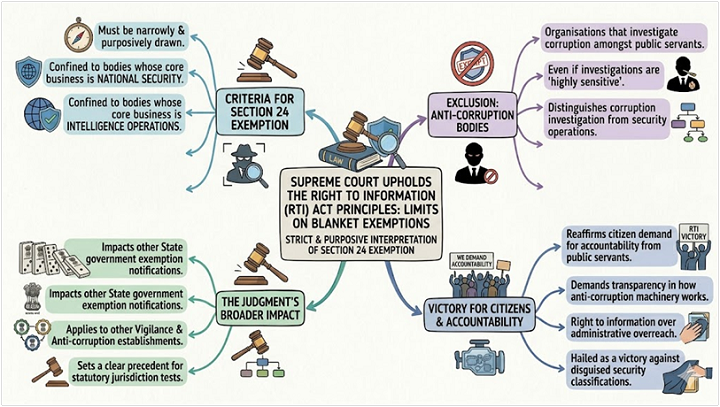
The Supreme Court has upheld a fundamental principle of the Right to Information Act: blanket exemptions are not possible by saying that an organisation falls under the 'intelligence and security' category, while its statutory functions are quite different. It makes clear that the exemption in Section 24 "must be narrowly and purposively drawn and confined to organisations whose core business is national security or intelligence operations, and not to organisations that investigate corruption amongst public servants, even if the investigations are highly sensitive". The judgment is also likely to impact on other exemption notifications issued by the state governments on their own anti-corruption/Vigilance establishments, because it provides a clear-test based on the statutory character and jurisdiction of the body concerned, not the terminology used in the notification by the executive. A victory for citizens who are demanding accountability from public servants, and transparency in how anti-corruption machinery works, the ruling has been hailed as a reaffirmation that the right to information cannot be won through administrative overreach, cloaked in the guise of a security classification.
Join LAWyersClubIndia's network for daily News Updates, Judgment Summaries, Articles, Forum Threads, Online Law Courses, and MUCH MORE!!"


Tags :Others


