


TABLE OF CONTENTS
- Introduction
- Legislative History and Background
- The Statutory Framework for Tariff Determination
- The Role of the Central Electricity Regulatory Commission (CERC)
- State Electricity Regulatory Commissions (SERCs) and Retail Tariffs
- Principles Governing Tariff Determination Under Section 61
- Competitive Bidding and Market-Based Tariff Discovery Under Section 63
- Open Access, Wheeling Charges, and Cross-Subsidy Surcharge
- Judicial Developments and Case Law
- Persistent Challenges in Tariff Regulation
- Conclusion
- Frequently Asked Questions (FAQs)
I. Introduction
Electricity regulation in India occupies a distinctive position at the intersection of constitutional law, administrative law, and economic policy. The power to legislate on electricity is a concurrent subject under Entry 38 of List III of the Seventh Schedule to the Constitution of India, 1950, which means both Parliament and state legislatures may enact laws on the subject, though central legislation prevails in case of inconsistency by virtue of Article 254.
Prior to 2003, the electricity sector in India was governed by a patchwork of statutes, principally the Indian Electricity Act, 1910, the Electricity (Supply) Act, 1948, and the Electricity Regulatory Commissions Act, 1998. These laws, while foundational in their time, were inadequate to address the demands of a liberalizing economy. Tariff-setting was largely discretionary, subsidy regimes were opaque, and regulatory accountability was minimal. The sector accumulated staggering losses, estimated at approximately Rs. 1 lakh crore annually by the late 1990s, largely because tariffs were set below the cost of supply for political reasons.
The enactment of the Electricity Act, 2003 (hereinafter 'the Act' or 'EA 2003') by Parliament marked a structural overhaul of the sector. The Act, which received Presidential assent on May 26, 2003 and came into force on June 10, 2003, repealed all three predecessor statutes. Its core objectives included the creation of independent regulatory institutions, the introduction of market competition, the rationalization of tariff structures, and the protection of consumer interests. This article undertakes a systematic legal analysis of the tariff provisions of the EA 2003, situating them within the broader statutory and constitutional framework.
II. Legislative History and Background
The reform of India's electricity sector began in earnest with the Electricity Regulatory Commissions Act, 1998, which established the Central Electricity Regulatory Commission (CERC) and authorized states to constitute their own commissions. However, this law suffered from significant limitations: it did not mandate the creation of state commissions, it did not provide for open access or competition, and it left tariff determination largely within the discretion of state governments.
The Expert Group on Restructuring of SEBs (the Godbole Committee) and subsequent consultations recommended a legislative overhaul. The result was the Electricity Act, 2003, which was designed to be a complete code for the electricity sector.
The Act has since been supplemented by subordinate legislation and policy instruments, including the National Electricity Policy, 2005 issued under Section 3(1) of the Act, the National Tariff Policy, 2006 (as amended in 2016) issued under Section 3(3) of the Act, and the Tariff Policy, 2016 issued by the Ministry of Power. These policy documents carry significant legal weight, as Section 61 of the Act expressly mandates that regulatory commissions shall be guided by them while determining tariffs.
III. The Statutory Framework for Tariff Determination
A. Part VII of the Electricity Act, 2003
The tariff provisions of the EA 2003 are consolidated within Part VII, spanning Sections 61 through 66. Each section addresses a distinct dimension of tariff regulation, and together they create a cohesive framework for pricing electricity across the supply chain.
Section 61 establishes the guiding principles for tariff determination. It directs that the appropriate commission, while determining tariffs under the Act, shall be guided by several stipulated factors, including the National Electricity Policy and the National Tariff Policy, the principles of fair and reasonable pricing, the promotion of efficiency, and the safeguarding of consumer interests.
Section 62 confers on the appropriate commission the power to determine tariffs for: (a) supply of electricity by a generating company to a distribution licensee; (b) transmission of electricity; (c) wheeling of electricity; and (d) retail supply of electricity. The section further provides that no tariff or part of any tariff may ordinarily be amended more frequently than once in any financial year, thereby assuring a degree of regulatory stability.
Section 63 introduces an alternative to commission-determined tariffs, permitting tariff adoption through a competitive bidding process conducted in accordance with guidelines issued by the Central Government. Under this process, the appropriate commission merely adopts the tariff discovered through competitive bidding, without independently determining it. This provision has been extensively used for the procurement of power from thermal, hydro, and renewable energy sources.
Section 64 prescribes the procedure for tariff applications, requiring licensees and generating companies to file applications with the commission and mandating that the commission dispose of such applications after conducting public hearings. This provision operationalizes the principles of natural justice and public participation in regulatory proceedings.
Section 65 deals with subsidies. It provides that if any state government requires a licensee to supply electricity below the determined tariff to any class of persons, the state government shall pay the amount of subsidy directly to the licensee in advance. This provision was aimed at ending the practice of cross-subsidization and making subsidy payments fiscally transparent.
Section 66 empowers the appropriate commission to promote the development of a market, including a trading market, in electricity, subject to safeguards against undue concentration of market power and cross-subsidization.
B. The National Tariff Policy, 2006 (Amended 2016)
The National Tariff Policy, 2016 is a crucial instrument in the tariff regulatory framework. Issued by the Ministry of Power under Section 3(3) of the EA 2003, it is legally binding on all regulatory commissions by virtue of Section 61(a) of the Act. Key provisions of the Tariff Policy include the requirement that cross-subsidies be progressively reduced, that tariffs for renewable energy procurement reflect the competitive discovered price, and that multi-year tariff (MYT) frameworks be adopted to provide certainty to investors and consumers alike.
IV. The Role of the Central Electricity Regulatory Commission (CERC)
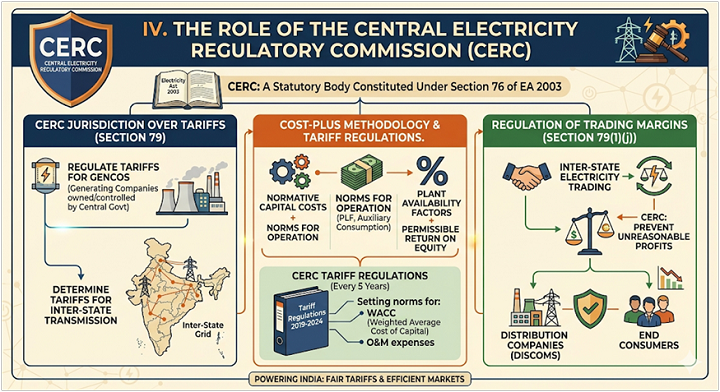
The CERC is a statutory body constituted under Section 76 of the EA 2003. Its jurisdiction over tariffs is defined by Section 79, which assigns to it the function of regulating the tariff of generating companies owned or controlled by the Central Government, and determining the tariff for the inter-state transmission of electricity.
CERC operates on a cost-plus methodology, determining tariffs on the basis of normative capital costs, norms for operation, plant availability factors, and a permissible return on equity. CERC issues comprehensive tariff regulations every five years, the most recent being the Central Electricity Regulatory Commission (Terms and Conditions of Tariff) Regulations, 2019, which govern the tariff determination for generating stations and transmission systems for the period 2019 to 2024. These regulations prescribe norms for plant load factor, auxiliary consumption, operation and maintenance expenses, and the weighted average cost of capital.
An important feature of CERC's jurisdiction is its role in setting trading margins. Under Section 79(1)(j) of the Act, CERC is empowered to fix the trading margin in the inter-state trading of electricity. This prevents electricity traders from earning unreasonable profits at the expense of distribution companies and end consumers.
V. State Electricity Regulatory Commissions (SERCs) and Retail Tariffs
Section 82 of the EA 2003 requires every state government to constitute a State Electricity Regulatory Commission (SERC). Where two or more states agree to constitute a joint commission, the Central Government may constitute a Joint Electricity Regulatory Commission (JERC) under Section 83. The functions of SERCs, as enumerated in Section 86, include determining retail supply tariffs, issuing licenses to distribution companies, and adjudicating disputes between licensees and consumers.
The retail tariff determination process begins with the filing of an Annual Revenue Requirement (ARR) petition by distribution licensees. The ARR petition sets out the licensee's projected expenses for the coming year, including power purchase costs, transmission charges, operation and maintenance expenses, depreciation, and a return on equity. The SERC examines these projections, conducts public hearings, and determines the revenue gap, if any, that needs to be recovered through tariff revision.
The National Tariff Policy, 2016 mandates that SERCs adopt a Multi-Year Tariff (MYT) framework, under which tariffs are determined for a control period of not less than three years. The MYT approach provides regulatory certainty, reduces the frequency of tariff revisions, and creates incentive-based regulation by rewarding utilities that outperform established efficiency norms.
SERCs are also responsible for specifying the surcharges that open access consumers must pay, including the cross-subsidy surcharge under Section 42(2) and the additional surcharge under Section 42(4) of the Act. These surcharges are a significant source of regulatory and commercial dispute.
VI. Principles Governing Tariff Determination Under Section 61
Section 61 of the EA 2003 is the foundational provision governing the philosophy of tariff regulation. It enumerates the factors that the appropriate commission must consider while framing regulations for tariff determination. A careful reading of Section 61 reveals several distinct principles that together constitute the normative basis of tariff regulation in India.
Cost Reflectivity: The tariff must progressively reflect the cost of supply of electricity. This principle, reinforced by the National Tariff Policy, requires that tariffs be set at a level that allows utilities to recover their prudently incurred costs. Persistent under-recovery of costs has historically been the primary cause of financial stress in the distribution sector.
Multi-Year Tariff Framework: Commissions are directed to adopt a multi-year tariff approach to reduce the uncertainty in revenue streams for utilities and provide stability for consumers. The MYT framework allows for mid-period corrections through a mechanism of true-up, where actual costs are reconciled against approved projections.
Incentives for Efficiency: Tariff regulations are expected to incorporate mechanisms that reward efficiency and penalize waste. CERC's 2019 regulations, for example, provide for a sharing mechanism under which efficiency gains accruing from better-than-target performance on parameters such as plant load factor are shared between the generator and the beneficiaries.
Promotion of Renewable Energy: Section 61(h) specifically provides that the commission shall be guided by the promotion of co-generation and generation of electricity from renewable sources of energy. This has led commissions to develop favorable tariff frameworks for solar, wind, biomass, and small hydro projects, including the specification of renewable purchase obligations (RPOs) under Section 86(1)(e) of the Act.
Consumer Protection: While commercial viability of utilities is a key concern, Section 61 equally mandates the safeguarding of consumers' interests. Commissions must ensure that tariff increases are justified, that the burden of increases is equitably distributed across consumer categories, and that grievance mechanisms are effective.
VII. Competitive Bidding and Market-Based Tariff Discovery Under Section 63
Section 63 of the EA 2003 introduced a market-oriented alternative to cost-plus tariff regulation by permitting the adoption of tariffs discovered through competitive bidding. The Central Government issued the Guidelines for Determination of Tariff by Bidding Process for Procurement of Power by Distribution Licensees, 2005 (as amended) to operationalize this provision.
The competitive bidding process has been widely used and has delivered significant benefits. The Discovery of historically low solar tariffs, as low as Rs. 1.99 per unit in recent tenders, has been cited as evidence of the effectiveness of competitive procurement. However, Section 63 raises important legal questions about the extent to which commissions can review or refuse to adopt a competitively discovered tariff, particularly where there are allegations of bid rigging or unreasonably low bids that may not be financially sustainable.
The Supreme Court addressed related issues in Energy Watchdog v. CERC, (2017) 14 SCC 80, where it considered the scope of regulatory power to intervene in contractual arrangements between generators and distribution companies. The Court affirmed the primacy of the Act and its regulatory framework over contractual arrangements that sought to bypass the statutory process.
VIII. Open Access, Wheeling Charges, and Cross-Subsidy Surcharge
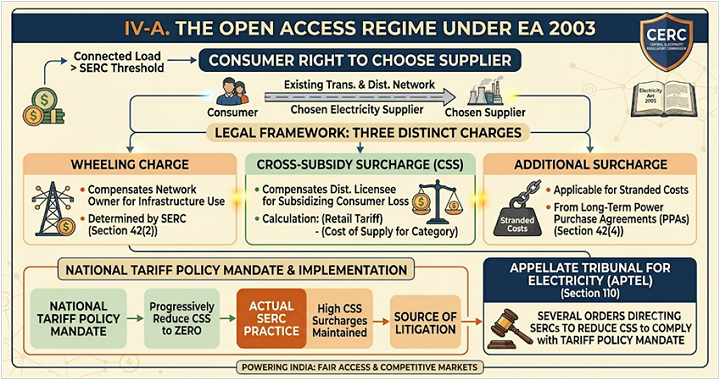
One of the most transformative innovations of the EA 2003 is the open access regime under Section 42. Open access refers to the right of any consumer, with a connected load exceeding the threshold specified by the SERC, to purchase electricity from a supplier of their choice by using the existing transmission and distribution network.
The legal framework for open access involves three distinct charges: (a) the wheeling charge, which compensates the network owner for the use of its infrastructure and is determined by the SERC under Section 42(2); (b) the cross-subsidy surcharge (CSS), which is intended to compensate the distribution licensee for the loss of a subsidizing consumer and is calculated as the difference between the retail tariff payable by the consumer and the cost of supply to that category; and (c) the additional surcharge under Section 42(4), applicable where the distribution licensee has stranded costs arising from long-term power purchase agreements.
The National Tariff Policy mandates that the CSS be progressively reduced to zero. However, in practice, SERCs have often maintained high surcharges, which has been a source of litigation. The Appellate Tribunal for Electricity (APTEL), constituted under Section 110 of the EA 2003, has in several orders directed SERCs to reduce CSS to comply with the mandate of the Tariff Policy.
IX. Judicial Developments and Case Laws
The tariff provisions of the EA 2003 have generated a substantial body of jurisprudence, principally from the Appellate Tribunal for Electricity (APTEL) and the Supreme Court of India.
PTC India Ltd. v. CERC, (2010) 4 SCC 603: The Supreme Court upheld the constitutional validity of the EA 2003 and confirmed that Parliament was competent to enact the legislation under Entry 38 of the Concurrent List. The Court also clarified that the principle of independent regulation was central to the scheme of the Act.
BSES Yamuna Power Ltd. v. DERC, (2006): APTEL held that regulatory commissions are obligated to ensure cost recovery for distribution licensees and cannot arbitrarily deny reasonable returns on equity. The Tribunal's jurisprudence has consistently held that tariff orders that result in financial unviability for licensees are contrary to the scheme of the Act.
Tata Power Co. Ltd. v. Reliance Energy Ltd., (2009) 16 SCC 659: The Supreme Court affirmed the regulatory powers of MERC (Maharashtra Electricity Regulatory Commission) and held that the commission's tariff orders are quasi-judicial in nature and subject to appeal before APTEL under Section 111 of the Act.
X. Persistent Challenges in Tariff Regulation
Despite the comprehensive framework established by the EA 2003, the electricity sector continues to face persistent challenges that undermine the effectiveness of tariff regulation.
SERCs, though designed to be independent, are often subject to indirect pressure from state governments that appoint their members. The result is regulatory capture, with tariff orders that prioritize political considerations over financial sustainability. Several state distribution companies continue to operate with significant annual revenue deficits.
When regulatory commissions defer the recovery of legitimate costs, the deferred amounts accumulate as regulatory assets on the distribution company's balance sheet. The existence of large regulatory assets is legally contentious, as it represents a deferred liability for consumers and a source of financial uncertainty for utilities. APTEL has repeatedly questioned the legality of creating regulatory assets beyond what is permitted under the Act.
Also, the large-scale induction of solar and wind energy, procured at very low tariffs through competitive bidding, has created a paradox: while generation costs have fallen, the overall cost of electricity supply has risen due to the need for grid balancing, storage, and backup capacity. Regulatory commissions are still developing frameworks to account for these systemic costs in tariff design.
Lastly, several state distribution companies are in severe financial distress. Government schemes such as UDAY (Ujwal DISCOM Assurance Yojana, 2015) and its successor schemes have sought to restructure distribution company debt, but these schemes do not substitute for fundamental tariff reform. Without cost-reflective tariffs, the financial health of distribution companies will remain precarious.
XI. Conclusion
The tariff regulatory framework under the Electricity Act, 2003 represents the most sophisticated attempt in India's legislative history to bring order, transparency, and commercial rationality to electricity pricing. By establishing independent regulatory commissions, codifying the principles of tariff determination, introducing market mechanisms such as competitive bidding and open access, and creating robust appellate institutions, the Act laid down an architecture that, if faithfully implemented, would serve the dual objectives of consumer welfare and sector viability.
However, the gap between the statutory design and regulatory practice remains significant. The full potential of the EA 2003's tariff framework will be realized only through genuine regulatory independence, consistent adherence to the cost-reflectivity principle, transparent subsidy mechanisms, and timely judicial enforcement. As India pursues an energy transition of historic scale, with targets of 500 GW of renewable energy capacity by 2030 and a net-zero commitment by 2070, the ability of the tariff framework to price electricity fairly and accurately will be central to whether these ambitions can be financed and sustained.
XII. Frequently Asked Questions (FAQs)
Q: Can a consumer challenge an electricity tariff order issued by a State Electricity Regulatory Commission (SERC)?
A: Yes. Under Section 111 of the Electricity Act, 2003, any person aggrieved by an order of a SERC may prefer an appeal to the Appellate Tribunal for Electricity (APTEL) within 45 days of the order. APTEL may admit appeals beyond this period if sufficient cause is shown. Further, an appeal against an order of APTEL lies before the Supreme Court of India under Section 125 of the Act. Consumers and their associations thus have a clearly defined statutory appellate pathway to contest tariff orders that are arbitrary, legally infirm, or contrary to the principles laid down in Section 61 of the Act and the National Tariff Policy.
Q: What is the legal basis for the cross-subsidy surcharge (CSS) paid by open access consumers, and can it be challenged?
A: The cross-subsidy surcharge (CSS) is levied under Section 42(2) of the Electricity Act, 2003 and is intended to compensate the distribution licensee for the loss of a higher-paying consumer who opts for open access. The National Tariff Policy, 2016 mandates that the CSS be progressively reduced and eventually eliminated to promote a competitive electricity market. SERCs are legally required to compute the CSS on the basis of a formula that reflects the actual cost of supply and the prevailing retail tariff for the relevant consumer category. Where a SERC specifies a CSS that is inconsistent with the National Tariff Policy or is computed on a legally unsound basis, it is open to challenge before APTEL under Section 111 of the Act. APTEL has in numerous cases directed SERCs to revise their CSS computations to bring them into conformity with the statutory framework.
Join LAWyersClubIndia's network for daily News Updates, Judgment Summaries, Articles, Forum Threads, Online Law Courses, and MUCH MORE!!"


Tags :Others


