
Case: Sheetal Vasant Thakur v. Chirag Arora | Citation: 2026 LiveLaw (SC) 618 | SLP(C) No. 18701-18702/2024
Bench: Justice Sanjay Karol and Justice N. Kotiswar Singh | Decided: June 11, 2026
Keywords: child custody, psychological evaluation, POCSO Act, parens patriae, child welfare, Supreme Court India 2026, minimum intrusion, trauma-informed adjudication, child psychology
ABSTRACT
When parents separate and take their dispute to court, the child caught in the middle faces a unique kind of harm that judges and lawyers do not always see: the harm caused by the legal process itself. Being questioned repeatedly by strangers, being assessed by mental health professionals appointed by each side, being asked to narrate traumatic experiences again and again, and being made to feel like evidence in someone else's battle are all deeply damaging experiences for a child. The Supreme Court of India, in a landmark ruling dated June 11, 2026, in Sheetal Vasant Thakur v. Chirag Arora, has taken a firm and comprehensive stand against this harm. Laying down 20 specific principles for courts dealing with requests for psychological or psychiatric evaluation of children in custody, visitation and parental access disputes, the Court has placed the child's welfare, emotional security and dignity at the very centre of the process. This article examines what these principles say, why they matter, and what they mean in practice for families, courts, and professionals working in this space.
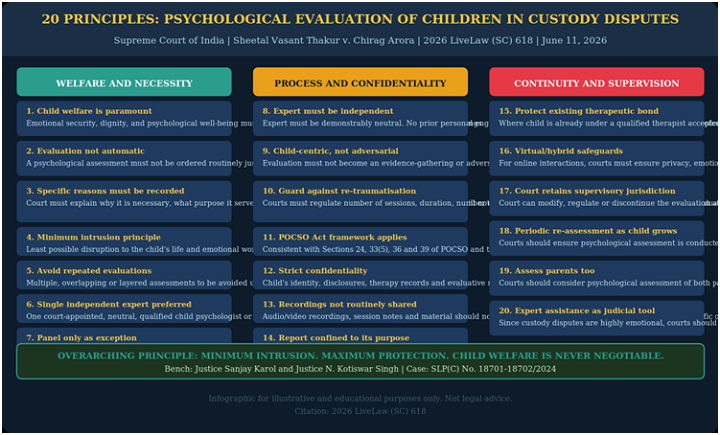
Infographic 1: All 20 Principles Laid Down by the Supreme Court for Psychological Evaluation of Children in Custody Disputes
I. INTRODUCTION
Most assume battles for custody play out only in tense courtrooms. Yet the methods meant to protect kids sometimes end up hurting them instead and most of such times, the courts ask for mental health checks when parents fight over kids. A trained person looks at how the child feels inside, who she leans on most, who feels like home. These answers aim to show which setup suits her life better than others. When claims come up about unwanted touching, laws like POCSO step in. Then the evaluation digs into whether the story holds weight emotionally, what echoes linger after trauma, where healing might begin.
Yet if such assessments come without thought, happen too often, or unfold amid fierce conflict, their purpose shifts - help turns into hurt. Picture a young person forced to retell painful events over and again, facing yet another adult sent by a parent, then maybe one chosen by judges. To her, these talks feel far from balanced or safe. Instead, they pull her back into moments she wishes never occurred. This repetition deepens wounds already present, an effect named re-traumatisation. Research on children clearly shows: damage follows, lasting much longer than any session ever should.
In June 2026, the Supreme court took on the issue directly through its decision in Sheetal Vasant Thakur v. Chirag Arora. Instead of setting rigid rules, two judges - Sanjay Karol and n. Kotiswar Singh - outlined twenty general guidelines. These are meant to help lower courts when they face demands for mental health assessments of kids caught up in custody battles or cases under POCSO. Still, the judgment makes clear that what’s listed isn’t everything, nor should it be treated as unchangeable. What matters here isn’t ticking boxes. It’s about guiding judges through work where law meets real lives - built on principles, protected by boundaries.
II. BACKGROUND
matter now at the supreme court centers on custody of a child said to be abused under the POCSO law. These overlapping circumstances add layers of difficulty. Normally, children caught in custody battles risk becoming tools between parents. But when claims of serious harm exist, tension grows even more. Real pain might already have shaped the child’s experience. Later on came the part where she had to tell everything again - this time to officers, then later still to a special courtroom. Each retelling pulled her back into what happened. On top of that, when psychologists got involved because of who would keep the child, it meant more questions, more hours going over details already worn thin.
What really happened in the case didn’t matter much to the supreme court’s decision. Instead, it wanted to build a loose structure others could follow later on. These thoughts, so they said, should never become rigid rules copied without thought. Still, judges facing child well-being issues might find them helpful. Though guidance was offered, nobody expects it to fit perfectly everywhere.
What stands out comes down to how it’s put. Not once does the court claim kids should skip psychological reviews during custody battles. Instead, its point lands differently - whenever those assessments happen, caution shapes every order. Execution needs precision. Oversight never pauses. What drives each step? Nothing beyond what helps the child.
Three. Twenty ideas unpacked here, through close look
CLUSTER ONE CONDITIONS FOR ORDERING AN EVALUATION
Child safety comes first when thinking about any kind of mental health check. Right from the start, number one sets the tone - what matters most is how the young person feels, their sense of worth, and being emotionally safe. Before anything else happens, these initial rules need to line up. Especially if a child might have suffered under POCSO laws. Only then does it make sense to move toward assessment steps. Each condition builds on protecting them above all.
Just because parents disagree on custody doesn’t by itself justify a mental health assessment of the child. Principle 2 draws a line - these evaluations shouldn’t happen just out of habit when visitation is in question. Often courts call for testing without thinking, using it like a routine step every time families clash. That practice misses the point, according to the highest court. What matters is real need, not ease or custom. Necessity should drive the decision, nothing less.
Third comes the step where courts need to state clear reasons first. Why does this assessment make sense? What will it actually help decide? How ties into the matters being heard right now? Is there a gentler way that could work instead? These points can’t just be glanced over. Each one pulls the judge toward deeper reflection before stepping into a young person’s world. The moment gets documented, weighed, considered - not rushed.
Start strong - principles 4 and 5 set clear boundaries. Because courts seek only what is essential, they follow the route causing least interference. Rather than piling on reviews, duplication stays out unless urgency justifies it, with explanations put down plainly. When parents pick separate experts, kids often face too many interviews. That scatter of opinions risks confusion, yet this rule pushes back.
Cluster Two Evaluators Guided by Principles Six Through Eight
When the court decides an assessment is needed, what follows is choosing the right person to do it. Not just anyone fits - Principle 6 points straight to one neutral specialist picked by the court, such as a child psychologist or psychiatrist trained in childhood trauma. Using only one expert isn’t accidental. More than one could lead to repeated interviews, retelling painful moments again and again, plus heighten chances of turning the whole thing into a battle between sides.
Seventh principle backs this idea, allowing expert panels just when case details truly demand it. When circumstances leave no alternative, that option opens. Independence lands front stage under the eighth rule - proof of neutrality matters most. Anyone chosen must show clear distance from both parents involved in court battles. No past personal ties fit within these lines. A lone exception slips through if work history connects them, say as doctor to one parent in a separate situation - but only with full transparency shown.
One thing leads to another when money changes what happens in family court fights. Rich parents might hire therapists who back up their side of things, handing judges papers made just for them. Judges get stuck reading two different stories from two separate doctors while kids sit through visits with each one. Now the top court steps in saying only one doctor should be chosen by the system itself, someone not on anyone's team. That single opinion becomes the guide everyone follows.
Cluster Three Principles 9 to 13 on how evaluation should be done
Once it’s clear who requests the assessment and who carries it out, the focus shifts to how things should proceed. Not every step fits neatly into rules, yet guidance exists. According to Principle 9, the attention should stay upon what serves the child best and not on building arguments for one side. Think of it less as a probe and more as support shaped around well-being. Maybe this rule matters more than others listed. If sessions begin resembling questioning meant to push certain replies, boundaries blur. Help fades. Exploitation slips in instead.
Getting stuck in too many court visits can pull old wounds wide open. Cutting down on how often a child shows up helps soften the blow. Fewer grown-ups asking questions means less pressure piling up. Short talks matter more than long ones stretching into exhaustion. What feels calm at first might weigh heavier once arguments heat up around it. Each moment adds up, not just the big moments standing alone. How things unfold together shapes what stays behind.
"A process that appears clinically benign in isolation may become psychologically stressful when conducted amid contentious litigation involving allegations of abuse. The Court must remain conscious of the risk of re-traumatisation from repeated narration of traumatic events."
Start anywhere but here: Principle 11 ties how evaluations happen to legal safeguards already in place through the POCSO Act. Because sections like 24, 33(5), 36 and 39 were built with children in mind, they shape the way statements get recorded and therapy access is arranged. When it comes to custody cases requiring mental health assessments, the top court insists methods stay aligned with those rules. Trauma-aware practices aren’t limited only to what happens under POCSO trials - this mindset stretches further.
Twelve and thirteen touch on privacy. A child’s name, what they say when assessed, their therapy files, and written summaries stay locked down tight. Recordings - sound or visual - or therapist jottings aren’t handed out freely; only if a judge orders it, spelling out why. This secrecy isn’t merely about rules. Without it, trust breaks. The child might hold back, afraid words spoken quietly could later echo in a trial, hurting them or those at home.
Cluster Four Insights From The Report Principle Fourteen
Here things stay narrow by design. That write up sticks only to what it was asked to check. Findings about guilt never make it in. Important line to hold. Court orders these reviews for one job, not others. Looking at someone's mind during custody fights does not mean hunting crimes. Should the evaluation drift into declaring someone guilty or innocent, it goes too far. Not having tools nor permission, the specialist cannot judge if a parent broke the law. That kind of call belongs elsewhere. Trespassing into criminal territory may tilt outcomes in court - both kinds. Boundaries matter when reports wander near blame.
Cluster Five Continuity Supervision and Parental Assessment Principles Fifteen to Twenty
Six last ideas touch on steady care, courtroom control, one overlooked piece: parents’ emotional well-being. Number fifteen guards a child’s current therapy bond. Suppose a skilled counselor - trusted by the legal system - is already helping. In that case, court battles must not break that link. Stability matters. Losing such support during disputes harms more than helps.
Start strong - today’s digital spaces bring kids face-to-face with legal processes through screens. When hearings shift online or split between physical rooms and video links, fairness doesn’t stop at connection quality. Protection kicks in where eyes can’t see: someone might be nearby, whispering answers out of frame. Courts have to watch for signs of pressure, subtle cues lost through cameras. A younger mind reacts differently under screen light than in a courtroom chair. Suitability hinges on how well the method fits the child - not the tech trend. Privacy gets endangered easily when platforms track clicks and the content surfed by the person. Emotional safety means more than silence as it requires control over who sees what, and when. Balance arrives only once comfort meets structure.
Once an expert gets named, the job of the judge isn’t done. Right from that point, oversight stays active. Should things tilt wrong for the child - emotionally or in daily life - the judge holds power to change course. Even mid-process shifts are possible: adjust, guide, or stop the review altogether. Control remains firm until closure.
Later on comes a key moment shaped by principles eighteen and nineteen. Growing up, the child deserves regular check-ins on mental health, something judges must confirm with guidance from a psychologist. Following that step, the very same kind of review touches the parents too. Moments like these shift how oversight unfolds.
"While it is important to make an assessment as to how the child will respond to either of the parents, it is equally important to ascertain the mental and psychological conditions of the parents themselves to deal with the need of the growing child. Thus, assessment of the psychological condition of both the parents assumes importance before subjecting the child to any further psychological assessment."
Something truly different just happened. Not long ago, Indian courts looked mostly at kids during custody battles, hardly ever checking how parents were doing inside their minds. Now the highest court says it plainly: what happens in a parent’s mind shapes how well they can raise their child. Ignoring that link makes little sense. Building on this idea, Principle 20 points out something clear - fights over children stir deep feelings, so judges ought to listen carefully to mental health experts when reviewing both mothers and fathers. These insights help shape fairer outcomes.
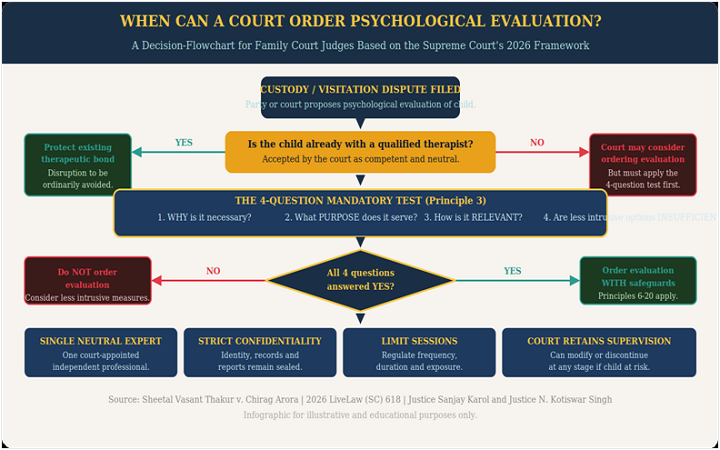
Infographic 2: Decision Flowchart for Family Courts Handling Requests for Psychological Evaluation Under the 2026 Framework
IV. THE COURT'S PARENS PATRIAE ROLE
Through every single one of the 20 principles runs a core belief: courts carry their own duty. Judges must act on protecting kids’ well-being, no matter what each parent wants. Should a mother or father request mental health assessments, the judge still needs to decide - on their own - if such steps make sense. Necessity, balance, and real benefit to the child guide that call.
This idea works just like a safety net. Courts step in where families struggle, becoming the fallback guardian for kids. Instead of picking one adult over another, judges focus on shielding the young one caught between grown-up disagreements. Someone needs to stand up for the silent voice stuck in the middle. These twenty points spell out how high courts expect that protection to function. Mental and emotional well-being shapes every part of that duty.
One detail stood out clearly when custody fights mix with serious legal claims. Not just how tests are done, but why they feel so heavy depends on setting. Picture a talk meant to help - suddenly it cuts deep because lawyers wait nearby. What might soothe in one room torments in another, especially if a young voice shapes outcomes about home or jail. Emotions shift weight depending on who's listening, and why.
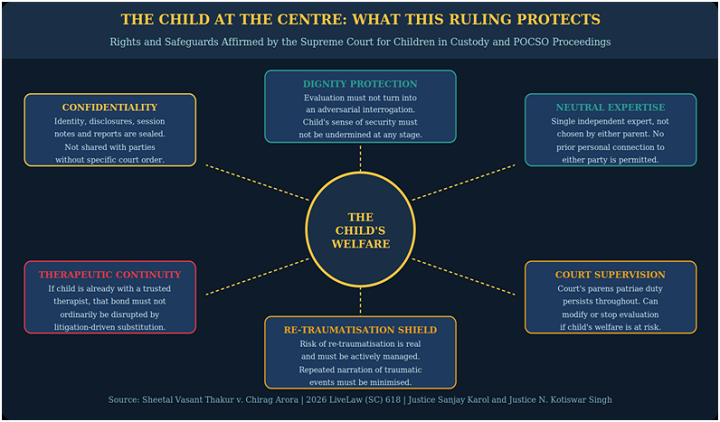
Infographic 3: Six Core Protections Affirmed by the Supreme Court for Children in Custody and POCSO Proceedings
V. WHAT THIS RULING MEANS IN PRACTICE
FAMILY COURTS AND TRIAL COURTS
Start by jotting down clear motives before requesting a mental health assessment during child custody cases. Each reason must line up with the four points laid out in principle 3. Courts expect explanations - just assigning an evaluation without them clashes with what the supreme court has set. When nothing justifies the move, it falls outside accepted standards.
A lone specialist, chosen by the judge, steps in when evaluations are needed. Instead of both sides naming separate therapists, one impartial person handles the assessment. Multiple interviews with conflicting goals fade out - only one conversation stays. The process skips back-and-forth analysis from opposing figures. A single voice replaces dueling opinions about the child's state.
Start by making clear to the specialist that blame for crimes shouldn’t appear anywhere in their write-up. Their job stops at looking into what helps or harms the child. Leave out any mention of guilt, wrongdoing, or legal fault - stick only to safety and care concerns. Whatever they conclude needs to stay focused on the young person’s environment, not courtroom ideas. Questions about arrests or punishment belong elsewhere, never inside this document.
Starting fresh might not help if a kid's already seeing a therapist who’s approved. Sometimes, what the court wants could come straight from those ongoing sessions instead. Jumping into another assessment may just add steps that aren’t necessary. The current counselor might already see enough to report back clearly. Going deeper isn’t always better when consistency matters more.
Thus, even after naming an expert, stay involved every step of the way. Appointing someone does not mean stepping back completely. Watch how things unfold, especially when signs show the child is struggling. If tension builds or harm appears likely, act without delay. Oversight matters most when silence could do damage.
PARENTS AND FAMILIES NAVIGATING CUSTODY DISPUTES
A request for your child's psychological assessment might get turned down. These days, judges need to pass a strict check before saying yes. Facing one of these requests? You could point out the criteria under principle 3 aren’t actually satisfied.
Start by thinking about exactly why an assessment feels unavoidable. Because guessing won’t help - be clear on what outcome matters most. Instead of saying things like "it helps," spell out how regular visits failed or discussions collapsed. When reasons stay fuzzy, judges hesitate. What changed? Name it. Skip broad claims about safety; point to moments where communication broke down completely. Since general worries rarely win support, specifics build trust. Even if emotions run high, facts carry further. After all, courts weigh intrusion against necessity every time.
Now here's something - courts might check how each parent is doing mentally, not only the kid. What matters is how fit a mother or father feels inside when deciding what suits the child most.
MENTAL HEALTH PROFESSIONALS IN CUSTODY CASES
The whole principle of independence and an uninfluenced opinion matters the most when taking on a court role. Should ties exist with one of the parents, speak up without delay. Only proceed further once it is ensured that no unnecessary influence exists.
One should start by ensuring that the space feels safe and calm for kids, as healing matters more than courtroom needs; keep focus on what helps the child most. When lawyers try to guide your method, gently hold back - your path stays independent. Let answers unfold naturally, never forced by legal agendas.
Stick to what the judge asked you to assess - focus only on welfare concerns. Stay clear of any opinions tied to criminal behavior. What matters here is the child's well-being, nothing beyond that scope.
VI. WHAT THE RULING GETS RIGHT AND WHAT IT LEAVES OPEN
This decision marks a real shift in how India handles family cases. Not until now had the highest court focused on how kids actually feel during custody battles. Seeing that going through court might hurt them deeply shows something new - a deeper awareness of emotional needs. What stands out is the demand that judges take steps to protect children from added stress. Rarely do legal decisions carry such clear insight into young minds.
What makes it useful is how judges must write down clear explanations when they order someone to be evaluated. This adds some responsibility to something that used to happen without much thought. Judges who often sent people for mental health tests during child custody fights can’t just do it automatically anymore - each situation needs its own reasoning.
What makes this approach fresh - and right - is pulling parents into the evaluation too. Not just events around a kid shape her well-being. Just as much hinges on how parenting lands - with care, with stress, with presence. That level of support ties directly to how stable each parent feels inside. When courts zero in on the child alone, skipping any look at parental mindset, they miss real context. Gaps like that weaken their view.
Questions still hang in the air. Though the decision mentions a "child psychologist, psychiatrist or similarly qualified expert with expertise in child psychology and child trauma," it leaves unclear exactly what counts as qualification. Across a vast, uneven landscape like india, access to these professionals swings wildly - from city to village, state to state. Implementation of the one-expert rule may look very different depending on where you are. What happens in places without enough trained people is something we’ll only learn over time.
Still, the decision skips over how private those assessment records should stay when one side must see what’s being claimed. Real friction points like this will fall to later rulings to sort out.
Speaking to LCI, Advocate Avinash Yadav stated that “This new Supreme Court ruling in Sheetal Vasant Thakur v. Chirag Arora is a massive lifesaver for our maintenance case. You know how the opposite side always tries to pull that routine stunt of demanding psychological evaluations or dragging the kid into multiple counseling sessions just to stretch out the matter and create pressure? The SC has completely trashed that practice.”
He further said that “They have laid down 20 strict principles making it clear that courts cannot just blindly order these mental health checks as a matter of habit or litigation strategy. Under Principle 3, the judge now has to pass a strict four-question necessity check and write down solid, explicit reasons before letting anyone touch the child’s psychological space. Even if they try to push for it, the court will only appoint one neutral, independent expert, so no more subjecting the child to multiple dueling psychologists hired by aggressive parents”
VII. CONCLUSION: PUTTING THE CHILD FIRST, FINALLY
The Supreme Court's June 2026 ruling in Sheetal Vasant Thakur v. Chirag Arora is a ruling about what it means to put the child first, not as a slogan but as a structured, enforceable set of obligations. The 20 principles it lays down are not complicated. They ask courts to think before they act, to use the least disruptive means available, to protect the child's confidences, to limit the number of people who intrude into the child's inner world, and to keep watching over the process even after the expert is appointed.
These are not radical demands. They are the minimum that a child in the middle of someone else's legal dispute deserves. What is significant is that the Supreme Court has now said so explicitly, clearly, and in a form that can guide every family court in the country.
The ruling also carries a broader message about how Indian courts are beginning to understand the psychology of the legal process itself. Law is not neutral. Litigation causes harm. And when the person most affected by the litigation is a child who never chose to be part of it, the legal system has a special duty to protect her from being made worse off by the very process that is supposed to serve her best interests.
That is what this ruling does. It protects the child from the process. That is a long overdue protection, and it is welcome.
Join LAWyersClubIndia's network for daily News Updates, Judgment Summaries, Articles, Forum Threads, Online Law Courses, and MUCH MORE!!"


Tags :Others