
INTRODUCTION
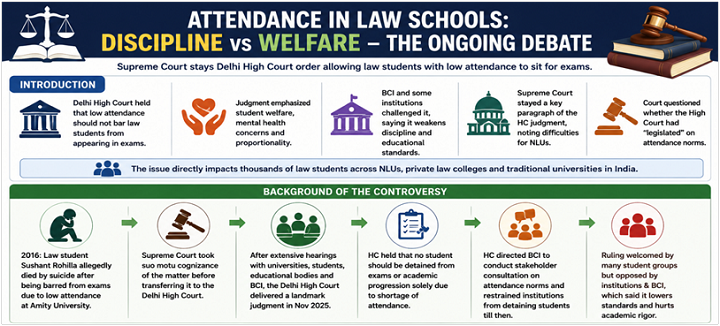
In India, the issue of discipline versus welfare of students has been a perennial problem in the legal education system. One of the most controversial points in this debate is whether attendance at law school should be mandatory and how much weight should be given to the issue of whether students should be allowed to miss exams because they are short of attendance at school. The issue resurfaced when a major Delhi High Court ruling that favoured law students against being barred from exams due to poor attendance was put on hold by the Supreme Court.
The interim order passed by the Supreme Court during the pendency of petitions challenging the Delhi High Court's order has again sparked debate across the country on the autonomy of educational institutions, the role of the Bar Council of India (BCI), standards of legal education and students' constitutional rights. This has become a very important topic as it has a direct impact on thousands of law students in National Law Universities (NLUs), Private Law Colleges and traditional Universities all across the country of India.
Earlier, the Delhi High Court had held that the absence of students in examinations should not be the reason for not allowing any student to appear before the court, especially in the context of law students. The judgment highlighted the importance of students' welfare, mental health issues and proportionality in academic management. But the Bar Council of India and some institutions questioned this judgment before the Supreme Court saying that it undermines discipline, the quality of education and statutory provisions for legal education.
The Supreme Court then put on hold a vital paragraph of the Delhi High Court verdict, noting that the judgment posed a challenge for the National Law Universities in the country. The Court also questioned whether the High Court had effectively “legislated” on the issue of attendance norms.
This issue brings up more fundamental questions about the role of law schools, the need for rigorous education and access, institutional accountability, and judicial involvement in educational policy. It also captures larger conflicts between students' rights and professionalism in the Indian higher education system.
BACKGROUND OF THE CONTROVERSY
The tussle can be traced to a tragic incident where law student Sushant Rohilla had allegedly died by suicide in 2016 after being barred from appearing in exams due to shortage of attendance at Amity University. The incident led to a judicial review of the inflexibility of attendance provision and the psychological effect on pupils. The Supreme Court had suo motu taken cognizance of the matter before transferring the matter to the Delhi High Court.
The Delhi High Court gave a landmark judgment in November 2025 after extensive hearings by the court involving the universities, students, educational bodies, and the Bar Council of India. The Court concluded that the absence of students from examinations or from academic progress should not be used as a reason for detaining any student attending a recognized law institution.
The High Court highlighted that the education rules should not be so strict that it has a negative impact on the mental well-being of students or create any imbalance. The Court further ordered the Bar Council of India to conduct a stakeholder consultation on attendance norms. Until the consultations, the High Court prohibited institutions from detaining students because of their poor attendance.
Many student groups welcomed the ruling while it was opposed by educational institutions and Bar Council of India. Critics have said that the decision hurt academic rigor and lowered standards in legal education.
Later, the BCI, NMIMS and other parties approached Supreme Court challenging directions of the Delhi High Court. The Supreme Court gave notice and stayed the functioning of paragraph 249 of the High Court judgement, which effectively prevented institutions from debarring students due to attendance shortages.
ATTENDANCE REQUIREMENTS IN LEGAL EDUCATION.
The Bar Council of India Rules on Legal Education, 2008 are the prime rules governing attendance in legal education.
The BCI Rules set the minimum attendance standards for law students in both three and five year courses. Attendance of 70% or above is the norm and only limited relaxation will be allowed under exceptional circumstances.
The intent of attendance requirements is:
- Ensuring regular academic engagement,
- Promoting classroom participation,
- Maintaining professional discipline,
- Encouraging interaction-based legal learning,
- Preventing commercialization of legal degrees, and
- Preserving standards of professional education.
In contrast to other fields, the education of lawyers is said to be highly reliant on classroom interaction, exercises, moot courts, seminars, and discussions. In this regard, the BCI has always believed that attendance is a fundamental part of the legal profession's training.
But the detractors of strict attendance have countered that contemporary legal education is no longer confined to the classroom with internships, research, legal competitions, the internet, and practical experience.
The issue thus represents a wider shift in educational approaches and expectations in the legal field.
THE DELHI HIGH COURT JUDGMENT
The Delhi HC took a student friendly stance in determining the issue.
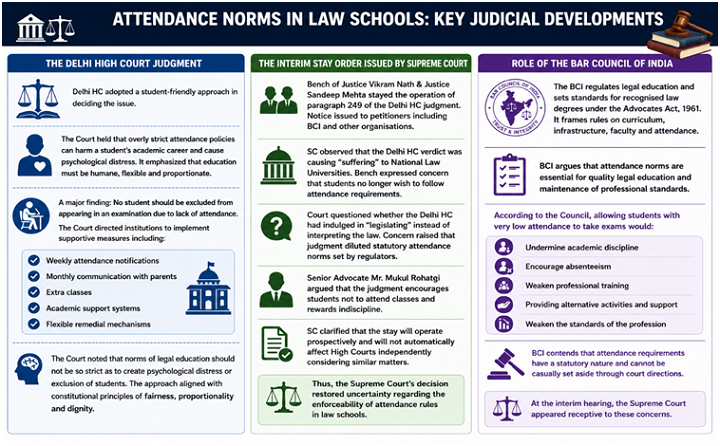
The Court pointed out that schools are not allowed to have overly strict policies when it comes to attendance, as it could be detrimental to the student's academic career or cause them a great deal of psychological hardship. It stressed the need for humane, flexible and proportionate education.
A major finding of the High Court was that no student should be excluded from appearing in an examination due to lack of attendance. The Court ordered the institutions to put in place supportive measures including:
- Weekly attendance notifications,
- Monthly communication with parents,
- Extra classes,
- Academic support systems, and
- Flexible remedial mechanisms.
The Court further noted that "the norms of legal education should not be so strict as to create psychological distress or exclusion of students. Most significantly, the court demonstrated an awareness of mental health issues among students, pressure of the school environment, and unequal discipline practices. The High Court's approach was consistent with the constitutional principles of fairness, proportionality, and dignity.
THE INTERIM STAY ORDER ISSUED BY SUPREME COURT.
The Bench of Justice Vikram Nath & Justice Sandeep Mehta allowed the stay of operation of paragraph 249 of the Delhi High Court judgement. The Court gave notice to the petitioners, including the Bar Council of India and other organizations, who opposed its decision.
The Supreme Court said that the Delhi High Court verdict was a cause of “suffering” of the National Law Universities. Following the judgment, the Bench expressed concerns that students no longer wanted to adhere to attendance mandates.
The Court, during the hearing, asked whether the Delhi High Court has indulged in “legislating” or interpreting the law. The Bench expressed concern that the judgement watered down the statutory attendance norms set by regulatory authorities.
Senior Advocate Mr. Mukul Rohatgi told the Court that the High Court's decision was an encouragement to the students that they would not have to attend schools and would only be held accountable for their indiscipline.
Meanwhile, the Supreme Court made it clear that the stay would have a prospective effect and would not automatically have any impact upon High Courts which were taking similar cases.
Thus, the Supreme Court's decision brought back doubt about the validity of the law school attendance rules.
ROLE OF THE BAR COUNCIL OF INDIA
The Bar Council of India is at the heart of the controversy. The BCI has the power to regulate legal education and to lay down the standards for recognised law degrees under the Advocates Act, 1961. The Council sets rules regarding curriculum, infrastructure, faculty and attendance.
The BCI presented the argument that norms are vital for quality in legal education and to ensure a level of professional standard.
The Council believes that permitting pupils who have very low attendance to take exams would:
- Undermine academic discipline,
- Encourage absenteeism,
- Weaken professional training,
- Providing alternative activities and support, and
- Weaken the standards of the profession.
The BCI also contended that the attendance requirements have a statutory nature, and therefore cannot be done lightly by issuing directions through the courts.
At the interim hearing, the Supreme Court seemed to be listening to these concerns.
STUDENT PERSPECTIVE AND MENTAL HEALTH CONCERNS.
Although institutional arguments for the requirements for attendance are important, so are students' concerns.
Many law students say that inflexible attendance policies don't consider:
- Internships,
- Competitive examination preparation,
- Moot court participation,
- Research projects,
- Health issues,
- Family emergencies, and
- Mental health struggles.
In contemporary law school training, sometimes hands-on experience is just as valuable as classroom instruction. Many students work in internships with law firms, advocates, NGOs, courts, and corporate entities, and sometimes these internships are in conflict with required attendance. This pragmatic view was reflected in the Delhi High Court's decision, which highlighted the importance of approaches that are balanced and student-friendly.
The discussion on mental health issues continues to be a key part of the debate. Very strict attendance rules can lead to high levels of academic stress and psychological stress, especially if there is a chance of losing a school year.
The Sushant Rohilla incident remains a reminder of the price that human beings pay for strict institutional processes. The debate between institutional autonomy and judicial intervention.The conflict between institutional autonomy and judicial intervention.
The controversy also poses fundamental constitutional and administrative law issues of institutional independence and judicial intervention. Schools have, in general, the power to set academic policies and disciplinary rules. The courts, in the past, have been hesitant to intervene in academic disputes.
In cases where institutional rules, however, do not allow for such action, intervention by the judiciary is required:
- Violate constitutional rights,
- Operate arbitrarily,
- Lack proportionality, or
- Cause manifest injustice.
The Delhi High Court took the issue of attendance of the students into the account of fairness and proportionality while the interim order given by the Supreme Court indicates more reliance on the statutory educational regulators.
This tension is indicative of broader constitutional conflicts over the role of courts in the governance of education.
COMPARATIVE JUDICIAL APPROACHES
Indian courts have issued different decisions concerning attendance requirements. In some instances, courts have enforced attendance rules explicitly, especially when standards explicitly set minimum percentages.
In recent times, the Uttarakhand High Court, for example, had declined to grant relief to a law student who attended class 11% of the time, stating that allowing such students to sit in exams will amount to “lawlessness” in the educational institutions. The Court noted that the attendance rules for BCI are “statutory in nature” and “must be followed on the sympathetic grounds.”
Meanwhile, other courts have, in exceptional circumstances, granted relief where there has been an administrative failure, disproportionate institutional action or a medical emergency.
The Delhi High Court judgment was thus one of the most sweeping in the students' favor in regard to attendance rules.
Constitutional Dimensions
Article 21 – Right to life and dignity.
Article 21 of the constitution was a significant factor in the reasoning of the Delhi High Court, and it has been interpreted as including dignity, fairness, mental well-being and reasonable treatment in institutional settings.
Strict attendance policies can run the risk of infringing on the principles of proportionality and fairness.
Equality and Non-arbitrariness (Article 14)
Attendance regulations must operate reasonably and uniformly. Denial of examination rights, without taking into account the particular circumstances of the case, may be subject to constitutional challenge.
Professional Regulation
Concurrently, the State has a legitimate interest in regulating professional education in the public interest.
The protection of the rights of the individual must, therefore, be weighed against the rights of the institutions and the rights of the profession.
BROADER CRISIS IN LEGAL EDUCATION
The attendance issue also sheds light on the underlying issues of legal education in India.
A large number of students miss classes because they feel that the classroom instruction is not relevant or updated, or is not related to legal practice.
At the same time, internships, placements, rankings, and extracurricular activities are becoming more important to law schools.
Such a contradiction in the structure is formed:
- Institutions require students to attend in person,
- Yet professional success increasingly depends upon external practical exposure.
The discussion thus mirrors the evolving nature of law schools. But if a law school doesn't modernize its pedagogy and develop something substantive that gets students engaged in class, attendance enforcement might not cure the issue.
POSSIBLE SOLUTIONS
The clash underscores the importance of reforming in a balanced manner, instead of extremes.
Possible reforms include:
Hybrid Attendance Models
Internships, moot courts, research work and legal aid activities may be considered as substitutes for part of the attendance requirements at law schools.
Academic Counseling Systems
Rather than exclusion, counseling and academic support systems can be implemented at the institution.
Flexible Relaxation Policies
If a student's absence is due to a legitimate situation, it can be dealt with via clear relaxation policies.
Technology-Based Monitoring
Sudden academic consequences may be mitigated with regular attendance updates and student-parent communication systems.
Curriculum Modernization
There is potential to boost attendance with improved classroom quality, if there is no need to forcefully enforce it.
CONCLUSION
The Supreme Court's stay of the Delhi High Court verdict has generated a fresh discussion on one of the most important issues in legal education in the country ; the nature of attendance in law schools, whether obligations or guidelines.
While the Delhi High Court has stressed on the welfare of the students, mental health and fairness, the Supreme Court's interim observations indicate a concern about the institutional discipline and deteriorating educational standards. Both sides have valid points.
Academic discipline and meaningful participation are essential to legal education. Academic discipline and participation are essential to legal education, on one hand. However, overly strict attendance policies can have a negative impact on students and fail to account for the changing nature of legal education.
Finally, the dispute proves that legal education cannot be prescriptively controlled or flexibly left to the discretion of the teacher. A balance is required: a framework which maintains professional standards and at the same time respects the dignity, mental health and practical learning requirements of the students.
The Supreme Court's final order in the case will not just impact the attendance policy but will also shape the future of educational autonomy, constitutional justice, and judicial supervision in the Indian legal education system.
Join LAWyersClubIndia's network for daily News Updates, Judgment Summaries, Articles, Forum Threads, Online Law Courses, and MUCH MORE!!"


Tags :Others