
One kind of legal point stands out clearly to seasoned courtroom lawyers. Not about the defendant's actions, but about an earlier step. Long before any court date, someone must start things correctly. If they fail here, everything else may collapse. The core issue? Whether the complainant held valid authority when filing. Cheque amount, default, notice - none matter if this piece breaks. Known as a Section 138 competence challenge, it lives quietly yet powerfully within India’s Negotiable Instruments law. For years, those fighting bounced cheque charges have leaned on it without flash or noise.
One morning in May 2026, a ruling from the Kerala High Court quietly reshaped how legal authority is questioned. Instead of beginning with familiar terms, picture this: in Kannan v. M/s. Adisiva Enterprises and Another, something subtle shifted. Justice G. Girish wrote it plainly - objections about a power of attorney’s validity must surface early.
Otherwise, they vanish. Imagine waiting too long to speak up during trial; by revision, silence becomes acceptance. Raised later? It drifts into irrelevance. What matters lies in timing, not intent. Delay buries doubt. That moment passes - the chance fades. Legal gaps close without warning.
One step at a time, the decision draws from Section 465 of the Code of Criminal Procedure, setting out how flaws in process are handled during criminal cases. Yet its reach goes much farther than just legal wording on paper.
With quiet force, it questions how procedural tools can be used - where lines blur between correct forms and real fairness in court battles. When guilt rests on solid ground, judges now signal they won’t allow minor rule gaps to unravel convictions simply because someone found a loophole.
The Background A Company A Cheque And A Delegated Complaint
When a cheque bounces, Section 138 of the Negotiable Instruments Act, 1881 turns it into a crime. Not quite like most crimes in India - here, blame sticks without needing intent. Payment fails? A legal notice lands at the drawer's door. Skip settling within fifteen days after that notice arrives, then someone can start criminal proceedings. That’s how the law treats bounced cheques.
Someone wondering about who gets to bring such a claim has led to many legal rulings piling up over time. Complaints need to come from the person receiving payment or someone holding the document properly under law. If that receiver happens to be a business, partnership, or group, it cannot show up in court itself. Instead, it acts using another individual standing in its place.
Through different cases across time, judges have looked closely at just how wide those acting roles can stretch - could one approved worker do it; might a director speak for a privately owned company; does having legal authority via power of attorney let someone fully replace the original recipient.
Someone holding a power of attorney submitted a legal complaint under Section 138 for a company that received a cheque. The case moved forward in court, witnesses gave statements, proof was presented, then the defendant found guilty. Not until later, during appeal at the higher court, did anyone question if the agent even had authority to file such a claim initially. That doubt became the basis for challenging the outcome reached earlier.
Out of the gate, Justice G. Girish turned it away. What comes after such a move needs close attention.
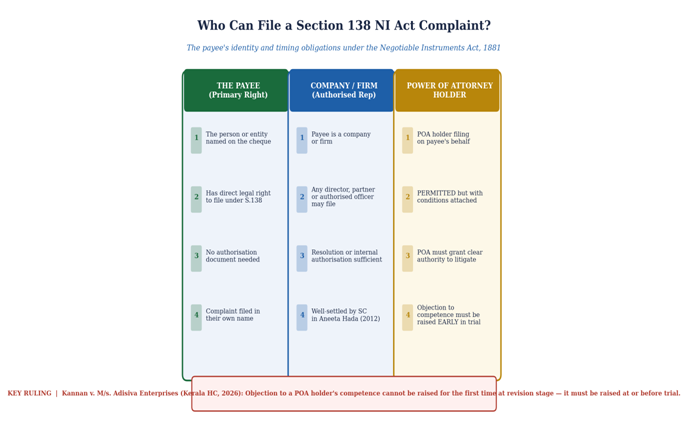
Figure 1: Who can file a Section 138 NI Act complaint — the three categories of complainant and the conditions attached to each
Section 465 CrPC How It Shapes Results
It happens like this. Section 465 of the CrPC from 1973 says an appeal won’t undo a court's decision just because there was a mistake in paperwork - maybe the complaint had something missing, the summons wasn't perfect, or the warrant carried flaws.
What matters instead is whether real injustice occurred. Even if procedures slipped up somewhere along the way, courts look at what truly played out. If fairness held firm despite those hiccups, changes won’t follow. The core idea sticks: process errors alone can’t shake valid outcomes. Justice needs to have genuinely failed before anything gets overturned. That’s how it stands.
This rule has been around for a while, its aim straightforward. Lengthy criminal cases demand significant effort and time. Decisions based on solid proof, challenged in court through questioning witnesses, then confirmed by judges shouldn’t collapse just because of filing errors at the start - especially when those slips didn’t hurt the defendant’s chance to fight their case. What matters is the difference: missing steps versus actions taken without legal authority. One misstep isn’t the same as stepping entirely outside lawful power.
Most times, how things are done matters less than whether fairness was kept. A misstep in process might look bad, maybe breaks protocol too. Still, if the person charged still grasps what they’re up against - can bring proof forward, challenge those testifying, speak their piece - then courts tend to overlook such slips. The law allows some room for error when rights stay intact. Even mistakes fade when trial integrity holds firm. Decisions survive these gaps unless real harm came from them.
A mistake about legal power isn’t just a small error. When the court hearing the case lacks any right to hear it - no matter the crime type, location, or nature - the flaw stays unfixable. Nothing said in court fixes that broken foundation. The whole process falls apart from within.
It falls clearly into the first group, not the second, when judging whether someone holding power of attorney can lodge a Section 138 complaint. Filed where it should be, using the right rule, on time - this one arrived at court through an individual saying they represented the payee. From here begins the inquiry: did their authorization paper meet every formality? That detail shapes process, nothing more. Not even close to undermining the court’s basic ability to take up such matters.
Timing of an objection matters beyond technicalities
Most times, when courts say objections during revision come too late, accused persons plus legal teams complain it feels like splitting hairs - focusing on rules instead of real issues. Yet such pushback misses what actually happens in Kannan, where the Kerala High Court stands firm not on narrow procedure but on deeper structure. How rights move through trial stages shapes fairness itself.
Process isn’t just paperwork. It’s the backbone holding up each chance to challenge evidence, call witnesses, or question rulings while time still allows. Delay weakens memory, scatters proof, tilts balance before appeals even start. That moment matters most - long before revision knocks on higher doors.
Imagine letting someone sit through an entire trial, stay silent on whether the accuser had legal standing, challenge each detail by questioning witnesses, argue their case completely, lose in court - only later claiming the accusation itself should not have qualified under strict rules.
That kind of late claim, if allowed, wipes out everything decided earlier. Back to square one they go, forcing the original complainant to gather correct paperwork. Whole years spent resolving matters undone, not due to innocence proven, just missing a narrow procedural stamp when starting.
It sits wrong, this result. Clear warning reached the accused long before trial began. From the start, chances to dispute the charge were there, open and unused. Rather than act early, the accused stepped into arguments on merit, keeping a technical defense hidden like backup. That move - exactly what Section 465 CrPC aims to stop - is now rewarded.
Nothing in the rule claims mistakes in process do not matter. What it states is timing counts - objections need to come up when they fit. When someone charged questions authority during trial, the judge has to look into it. Should the flaw be actual and harmful, there’s room for correction. A minor formality causing no harm to defense? That kind of issue may still be fixed. Yet timing shapes the outcome, since delaying shifts responsibility. Whoever waits until appeal bears different consequences than someone speaking up early.
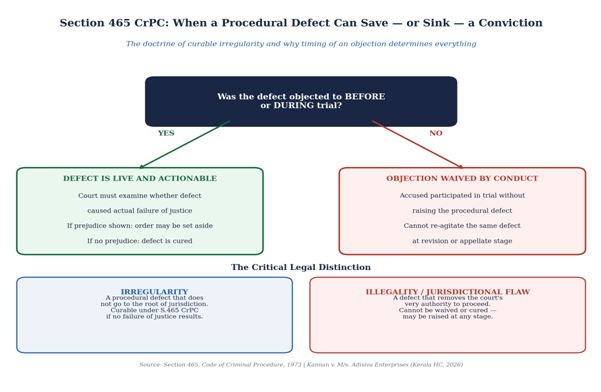
Figure 2: How Section 465 CrPC distinguishes curable irregularities from jurisdictional illegalities, and why the timing of an objection governs the outcome
The Big View on POA Users and Section 138 Cases
Nowhere is it clearly settled if someone holding a power of attorney may file a Section 138 case - judgments differ across courts. To see how the Kerala decision fits, you need to look at earlier rulings first.
One step at a time, the highest court shaped how agent authority works under Section 138 through several rulings. Starting with Shankar Finance and Investments against the State of Andhra Pradesh in 2008, clarity arrived: when a company receives a cheque, someone they officially name can bring legal action instead. Not every rule demands personal involvement - this one just needs approval from the receiving party. Even so, the law insists the move comes either from the payee directly or flows out from their clear instruction.
Later court rulings looked at whether someone using a power of attorney needs firsthand awareness when submitting a legal claim. Though the document comes through the agent, what matters is what the person who granted authority knew. Information rests with the original party receiving payment, even if another signs on their behalf. That individual may later testify during hearings. The role of the representative remains limited - more messenger than source.
One thing stands out from the Kerala High Court’s take in Kannan - it does not invent a fresh test on whether someone acting under power of attorney may lodge a complaint. Instead, quietly assumes such authority exists. The real shift comes in timing: should anyone challenge the legitimacy behind that appointment, the moment to raise it sits early, right at the start, nowhere near the finish line.
This matches the way judges handle similar issues in regular court cases. When someone questions whether another person can start a lawsuit, that concern usually needs to come up right away. Judges won’t let people join fully in a case only to reject it later if they do not like what happens.
What Failure of Justice Means Under Section 465
Should someone challenge their trial's fairness while proceedings are ongoing, overturning a guilty verdict demands more than pointing out flaws. Under section 465 CrPC, courts reviewing such cases must see clear proof the error warped the outcome. That threshold bites harder than one might expect.
Most courts agree. Simply skipping steps does not automatically mean justice failed. Something real had to change because of it. When a person files on behalf of another, their power must include starting criminal cases. A limited authorization might lack that reach. Yet later actions can fix the issue. Suppose the company behind the payment accepted what happened and backed the case in court. Imagine them sending people to speak under oath. Then claiming harm becomes hard. The result stays much like before. Filing directly would likely lead to the same place.
It was clear to the accused just who had brought the case. The specific deal under dispute? Fully understood. Every key paper sat within their reach. Questioning those who testified against them - this they could do. Even if the person starting things lacked full power, that didn’t stop anyone from protecting their position. Because of how it played out, rule 465 gives no reason to step in.
This analysis shows why objecting to jurisdiction after delays rarely works. Justice hardly fails when someone gets full chance to fight their case then actually does so. Any flaw in process, should one exist, lies buried in forms - never in access to defense.
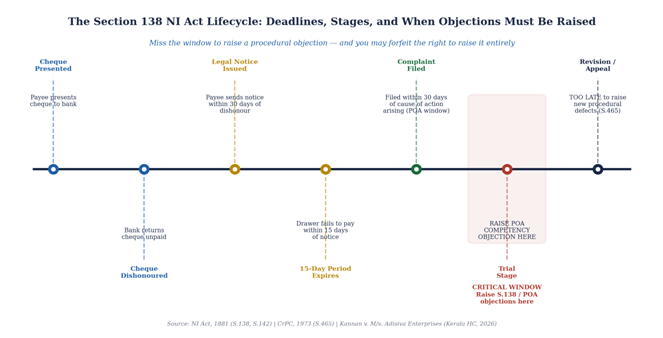
Figure 3: The Section 138 NI Act litigation lifecycle — statutory deadlines and the critical window within which procedural objections must be raised
The Defendant Sees Wrong Doing Or Just Moves?
Here’s something worth remembering. Sometimes doubts about a POA holder aren’t just clever courtroom moves - they’re legitimate. Picture a lone trader getting hit with a Section 138 notice. Right away, they might lack the means to check if the paperwork behind it holds up. So they hire a lawyer, fight the claims head-on, yet stumble upon an oversight much later - a deeper look shows the filer possibly had no right to act. That kind of thing happens. Not theory - actual cases play out this way.
Still, the law shows some understanding here - yet holds its ground. What matters under Section 465 CrPC isn’t timing alone. Missing the deadline doesn’t automatically kill the claim; proof of real harm does. Picture someone unaware of the flaw until later - one able to show it damaged their case in concrete ways. That person still gets to speak, though the path is steeper. Easier? Not at all compared to acting sooner. But closed? Never completely shut.
It shuts the door on walking away neatly when objections hit at the worst possible moment. Someone staying quiet during trial but later claiming incompetence can’t insist everything restart fresh. That move ignores whether real damage ever happened. The timing blocks pretending no consequences should follow.
How Payees Lawyers and Power of Attorney Wording Are Affected
Payees and lawyers using power of attorney agents in Section 138 cases should take note of what happened in Kannan. Even if someone challenges the agent’s authority late, that doesn’t mean courts will ignore weak POA wording. Just because a delay gets overlooked does not make sloppy paperwork safe. Careless drafting still carries risk, despite some flexibility shown by judges. How a document is written matters just as much when disputes arise later.
Starting off, a clearly written power of attorney for Section 138 cases must directly allow the appointed person to file criminal charges under the Negotiable Instruments Act. Instead of broad wording, it needs to state plainly that this individual can hire lawyers, show up in court, sign sworn statements, while handling every step tied to pushing forward these legal actions. Often, general business-related powers of attorney fall short since they only let someone run company matters using unclear phrases.
Because of that fuzziness, courts have questioned whether those documents truly permit starting criminal suits at all.
Should an accused bring up this point early, using a precise legal challenge focused on the limits of given authority, their standing improves noticeably compared to raising it later during revision.
When payees aim to lower chances of objections based on such grounds, clarity becomes key - the power of attorney must be written solely for initiating proceedings under Section 138. Uncertainty around granted powers risks weakening the case, so exact wording matters. Execution follows strict rules too; signing and witnessing must align fully with what the Power of Attorney Act, 1882 requires.
One thing stays clear after the Kerala High Court spoke: drafting still matters. Yet now, skipping early scrutiny means losing later leverage. Faults once saved for closing moves must surface sooner - timing shifts everything. Sharp writing holds value, just not as a trap delayed. Moments pass. Tactics fail when built on silence.
The Wider Pattern Courts Tiring of Late Technical Challenges
Lately, rulings like Kannan v. M/s. Adisiva Enterprises echo what's unfolding in courtrooms across India. After trials wrap up, higher courts tend to dismiss late-raised issues on procedure. Not because fairness takes a backseat. Their stance comes from weighing how rules serve the bigger picture in criminal cases.
Fairness in process comes down to clear steps being followed. Because people facing charges must understand what they’re up against, question proof brought forward, share their side, plus get decisions explained clearly afterwards. Once these things actually happen - once the person has gotten full chance to respond under fair terms - saying everything should collapse just due to a paperwork error needs stronger reasoning. Not only must the flaw be shown, but also how it changed the outcome. Only then does it matter.
Holding up this standard takes effort, yet judges follow it more steadily every year. What lies behind it? A grown-up view of fair process. Not a second chance for people who took part completely in court cases they later regret joining. Instead, think of clear guidelines so trials run exactly how laws require them to. Rules matter most when fairness is at stake.
One reason Section 138 matters so much? Cheque bounce cases flood criminal courts nationwide. To keep up, faster processes like summary hearings were brought in. Should accused persons start using competency challenges late in revisions, delays would multiply fast. Now the Kerala High Court has shut that path down. Its decision quietly tells lower judges where defences belong - and when they’ve waited too long.
Speaking to LCI, Advocate Abhimath (Nilima) Snehil
stated that “Look, here is the reality of the Kerala High Court's ruling in Kannan v. Adisiva Enterprises. We have all seen defense teams pull the same trick for years. They sit through a full Section 138 trial, cross-examine the witnesses, argue the merits of the debt, and then, only after the judge convicts their client, they run to the revision court crying that the person who signed the complaint did not have a proper power of attorney.”
He further said that “They treat that POA defect like a hidden ace up their sleeve. Well, Justice Girish just made it clear that the game is over. If you have an issue with the complainant's authority, you raise it at the start during the trial. If you stay silent and wait until the appeal or revision stage to spring it as a trap, the court will treat that objection as waived.”
Lastly he stated that “It is not about the law suddenly ignoring sloppy paperwork. It is about Section 465 of the CrPC. If the defect did not actually harm the defense or cause a failure of justice, you cannot use it to blow up a year of litigation just because you lost on the facts. The message to the Bar is simple. If you think the authorization is bad, bring it up when the trial starts. If you wait until you are already convicted to find technical excuses, do not expect the court to bail you out. Stop playing games with procedure and start focusing on the trial itself.”
Conclusion: Form in the Right Place, Substance at the Centre
The ruling in Kannan v. M/s. Adisiva Enterprises is, at its core, a ruling about when procedural arguments belong in litigation and when they do not. The question of whether a power of attorney holder was competent to file a Section 138 complaint is a legitimate one. It is a question that courts are equipped to answer, and it is a question that accused persons are entitled to raise. What they are not entitled to do is raise it for the first time after a full trial has run its course and produced a conviction.
Section 465 of the Code of Criminal Procedure exists to prevent the criminal justice system from being held hostage to procedural defects that caused no real harm. The Kerala High Court has applied that provision faithfully and in a way that is consistent with the purpose behind it. Defendants who have genuine concerns about the authority of a complainant to file proceedings against them have a clear remedy: raise the objection at the earliest opportunity. Courts will hear it. They will examine it. If the defect caused actual prejudice, it may succeed.
What courts will no longer indulge, if the reasoning in Kannan takes hold, is the calculated deployment of procedural objections as a last resort when the facts have gone against the accused. The law was never designed to accommodate that approach, and it is good that courts are saying so clearly.
For payees and their advisers, the message is equally clear. A well-drawn power of attorney, specific in its terms and properly executed, reduces the risk of this kind of challenge succeeding at any stage. The judgment does not diminish the importance of getting the documentation right. It simply resets the consequences for those who do not.
Join LAWyersClubIndia's network for daily News Updates, Judgment Summaries, Articles, Forum Threads, Online Law Courses, and MUCH MORE!!"


Tags :Others