
The Indian Contract Act, 1872 (ICA), serves as the foundational statute governing contracts in India, codifying principles of enforceable agreements that regulate private transactions across commercial, social, and personal domains. Enacted during colonial rule, it synthesizes English common law doctrines with adaptations suited to Indian societal norms, enduring with minimal legislative amendments while dynamically evolving through judicial interpretations. This comprehensive research paper meticulously follows the provided roadmap, delving into the Act's conceptual framework, historical trajectory, definitional nuances, classificatory schemes, inherent characteristics, economic significance, judicial contributions, and contemporary adaptations in a globalized digital landscape. By examining these facets, the paper underscores the ICA's pivotal role in fostering legal certainty, economic stability, and individual autonomy in modern India.
Concept and Scope
Contract law represents the systematic body of rules that govern voluntary promises intended to create legal obligations, distinguishing binding commitments from casual assurances. At its core, the meaning of contract law lies in its function as a mechanism for private ordering, where parties freely negotiate terms to allocate risks, benefits, and responsibilities. This legal discipline ensures that promises backed by consideration and consensus are enforceable, thereby upholding the sanctity of bargains in a market-driven economy.
The purpose and objectives of contract law are multifaceted: primarily, it aims to protect reasonable expectations by providing remedies such as damages under Section 73, specific performance under Section 39, or injunctions to prevent breaches. It promotes economic efficiency by reducing transaction costs, deterring opportunistic behaviour, and facilitating specialization through reliable exchanges. Additionally, it balances freedom of contract with protective interventions, voiding agreements opposed to public policy under Section 23 or those induced by fraud (Section 17). In essence, contract law transforms subjective intents into objective legal rights, fostering trust essential for commerce.
In regulating private rights, contract law operates on principles of privity, mutuality, and autonomy, intervening minimally unless vitiated by factors like undue influence (Section 16) or mistake (Sections 20-22). Unlike tort law's focus on unconsented harms or criminal law's punitive sanctions, it emphasizes remedial compensation to place the injured party in the position they would have occupied had the contract been performed. This targeted approach empowers individuals and corporations to craft bespoke relations, from simple sales to complex joint ventures, while courts act as neutral enforcers.
The scope and applicability of the Indian Contract Act, 1872, are expansive, extending to all of India following its enforcement on September 1, 1872. Sections 1-75 outline general contract principles, while subsequent parts address special contracts: indemnity and guarantee (Sections 124-147), bailment and pledge (Sections 148-181), and agency (Sections 182-238). Notably, provisions on the sale of goods and partnerships were repealed and re-enacted in separate statutes (Sale of Goods Act, 1930; Indian Partnership Act, 1932). The Act applies to all persons—natural or artificial—irrespective of religion or domicile, overriding personal laws only in non-matrimonial spheres. Post the Jammu & Kashmir Reorganisation Act, 2019, it uniformly governs the entire territory, underscoring its role in national economic integration amid federal diversity. Exemptions are narrow, such as for sovereign acts or wagering agreements (Section 30), ensuring broad coverage for everyday transactions.
Historical Evolution

The historical evolution of contract law in India reveals a seamless blend of indigenous traditions and colonial impositions, culminating in the codified ICA. Ancient Indian contractual practices, chronicled in Vedic literature like the Manusmriti, Arthashastra, and Yajnavalkya Smriti, emphasized relational and dharma-based enforcement over rigid formalism. Contracts manifested as oral promises (shabda), real delivery (karana), or innominate understandings (samaya), secured by sureties, pledges, or community panchayats. Remedies included fines, self-help restitution, or social ostracism, prioritizing harmony and moral obligation in agrarian societies where trade was nascent but vital for guilds (shrenis).
The influence of English Common Law intensified post-1600 with the East India Company's establishment of Mayor's Courts in 1726, applying writs like debt, covenant, and assumpsit. By 1833, the Charter Act mandated codification; High Courts post-1861 relied on English precedents such as Coggs v. Bernard (1703) for bailment duties. Sir James Fitzjames Stephen and Whitley Stokes shaped this hybrid, incorporating consideration doctrine while retaining Indian nuances like implied promises from conduct.
The enactment of the Indian Contract Act, 1872, on April 25, 1872—drafted by the Third Law Commission under Sir James Macpherson—marked a watershed, consolidating over 40 scattered regulations into 266 sections based on Sir Frederick Pollock's English framework and Wilson's 1866 draft. Effective from September 1, it excised sale and partnership for future legislation, embodying generalia specialibus non derogant.
Post-Independence developments witnessed judicial growth over legislative stasis: the Supreme Court expanded frustration under Section 56 (Satyabrata Ghose v. Mugneeram Bangur & Co., AIR 1954 SC 44), implied good faith, and e-contract validity via the Information Technology Act, 2000. Amendments like the 1996 deletion of civil imprisonment for debt and Specific Relief (Amendment) Act, 2018, enhanced enforceability, adapting the Act to liberalization-era commerce.
Meaning and Legal Definition of Contract
The statutory definition under Section 2(h) of the ICA concisely states: "An agreement enforceable by law is a contract." This hinges on Section 10, mandating lawful agreements with competent parties, free consent, consideration, and lawful objects. Judicially, it embodies consensus-ad-idem (meeting of minds, Section 13), voiding subjective intents mismatched objectively.
Essential elements of a valid contract include: (i) lawful offer and acceptance (Sections 3-9); (ii) consideration (Section 2(d), something of value exchanged); (iii) capacity (Section 11, excluding minors, lunatics); (iv) free consent (Section 14, free from coercion, undue influence, fraud, misrepresentation, mistake); (v) lawful object/consideration (Section 23); (vi) certainty/possibility of performance (Section 29); and (vii) not expressly declared void (e.g., wagering, Section 30). Gherulal Parakh v. Mahadeodas Maiya (AIR 1959 SC 781) affirmed wagering's voidness.
Nature of contractual obligations imposes primary duties to perform promises (Section 37) or pay compensation, dischargeable by actual performance, novation, accord, merger, or impossibility. Obligations are correlative: promisor's duty births promisee's right, enforceable via suit.
As a legal relationship, contract creates privity-bound rights/liabilities, distinct from unilateral donative promises. It signifies a dynamic bond, terminable by rescission, revocation, or breach, embodying pacta sunt servanda while allowing equity-infused remedies.
Agreement and Contract: A Conceptual Distinction
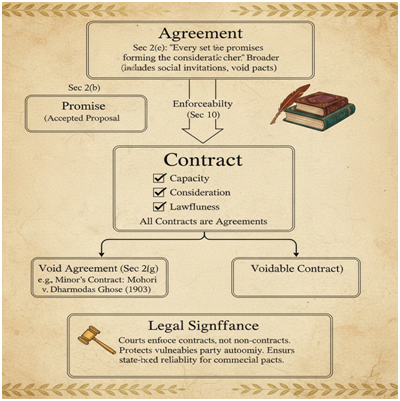
Section 2(e) defines agreement as "every set of promises forming the consideration for each other," a broader genus including void pacts like social invitations. Section 2(b) clarifies promise as accepted proposal, enabling bilateral exchanges.
The relationship is hierarchical: all contracts are agreements, but enforceability elevates per Section 10. An agreement becomes a contract upon satisfying capacity, consent, consideration, and lawfulness; absent these, it remains void (Section 2(g)) or voidable (Section 2(i)). Mohori Bibee v. Dharmodas Ghose (1903) 30 IA 114 voided a minor's mortgage for incapacity.
Legal significance: Courts refrain from enforcing non-contracts, filtering resource-intensive suits and protecting vulnerables, thus preserving party autonomy while ensuring state-backed reliability for commercial pacts.
Classification and Types of Contracts
Classification based on validity : void (Section 2(j), e.g., impossible acts); voidable (Section 2(i), e.g., coercion-ratifiable); valid; illegal (Section 23); unenforceable (stale limitation).
Based on formation: express (Section 9, verbal/written); implied-in-fact (conduct-inferred, Heera v. Basdeo, ILR 6 All 385); quasi-contracts (Sections 68-72, equitable restitution like minor's necessaries); e-contracts (IT Act, 2000, Section 10A).
Based on performance: executed (complete); executory (future obligations); unilateral (performance precedes); bilateral (mutual promises).
Based on obligation: absolute (Section 37); contingent (Sections 31-36, event-dependent).
| Basis | Types | Statutory Basis/Example |
| Validity | Void, Voidable, Illegal | S.2(j)/(i)/23; Wagering S.30 |
| Formation | Express, Implied, Quasi, E | S.9, 68-72; Trimex v. Vedanta (e-validity) |
| Performance | Executed, Executory, Unilateral | S.37; Carbolic Smoke Ball (unilateral) |
| Obligation | Absolute, Contingent | S.31; Insurance payouts |
Express contracts state terms explicitly; implied arise from circumstances; quasi impose obligations sans agreement for unjust enrichment; e-contracts thrive in digital commerce.
Nature and Characteristics of Contract Law
The voluntary nature underscores consensus without vitiation, preserving party freedom (nemo debet bis puniri). Enforceability by law per Section 2(h) elevates above moral duties. Mutuality of obligations (Section 2(f)) ensures reciprocity, voiding one-sided impositions.
Certainty mandates ascertainable terms (Section 29), lawfulness bars immorality (Section 23). Binding nature persists until discharged (Sections 37-67), fostering reliance interests vital for planning.
Importance of Contract Law in Commercial and Social Transactions
In business and trade, it standardizes exchanges, enabling supply chains and e-commerce booms. Corporate dealings integrate with SEBI regulations for SPAs, ESOPs.
It protects rights/expectations, curbing moral hazard; economic stability via certainty attracts FDI ($85B in 2025). Socially, governs rentals, adoptions.
Judicial Interpretation and Role of Courts
Judicial approach favors plain meaning, business efficacy (Ashok Leyland v. State of T.N., 2004 3 SCC 1) , good faith implication. Principles: mitigation, remoteness (Hadley v. Baxendale influence).
Landmark judgments : Bhagwandas v. Girdharilal (1966, telegram rule); Satyabrata (frustration); ONGC v. Saw Pipes (2003, Section 74 penalties); Nabha Power (force majeure).
| Case | Ratio | Contribution |
| Bhagwandas (1966) | Instantaneous acceptance | Postal rule exception |
| Satyabrata (1954) | S.56 supervening impossibility | Doctrine of frustration |
| ONGC v. Saw Pipes | Penalty without proof | Commercial realism |
Contemporary Relevance of Contract Law
Digital era validates online contracts (IT Act Section 4, e-records); Ambalal v. Union (2020) affirmed. Globalization aligns with CISG, arbitration.
Challenges: AI autonomy, smart contracts, GDPR conflicts; reforms for blockchain, data sovereignty needed.
Lawyer’s Bite (Pratham Kindra )
As a commercial lawyer with decades of handling contract disputes under the Indian Contract Act, 1872, my advice is straightforward: treat the ICA not as an academic relic but as your sharpest drafting and litigation weapon—focus relentlessly on Sections 10, 23, 56, and 73-75, which resolve 80% of real-world battles over validity, frustration, and remedies. Always embed explicit consideration via milestone payments to dodge "moral promise" traps under Section 2(d), layer in reps and warranties against fraud or undue influence (Sections 14-17), and for e-contracts—now ubiquitous in your digital economy—mandate Aadhaar e-signatures per the IT Act while nailing down jurisdiction clauses to crush forum-shopping. In court, wield ONGC v. Saw Pipes(2003) to claim liquidated damages sans loss proof, cabin frustration arguments tightly per Satyabrata Ghose (1954) against pandemic excuses, and push specific performance post-2018 Amendment for unique assets; counsel clients to cap liabilities, stack indemnity under Section 124, and opt for arbitration or mediation (Section 89 CPC) over bleeding in suits. For startups or NRIs like those in your transnational marriage research, harmonize with private international law, document every negotiation for mutuality proof, negotiate in good faith as courts now imply it post-Ashok Leyland (2004), and stay ahead of 2026 curveballs like AI/smart contracts under the DPDP Act—master this, and you'll turn paper promises into ironclad wins, whether in moots or boardrooms.
Conclusion
Summarizing, ICA's Section 2(h) core, classifications, judicial expansions sustain relevance. Fundamentals mastery aids practice; ongoing development counters tech disruptions.
Join LAWyersClubIndia's network for daily News Updates, Judgment Summaries, Articles, Forum Threads, Online Law Courses, and MUCH MORE!!"


Tags :Others