
Abstract
The collegium system for judicial appointments in India represents one of the most consequential and contested institutional arrangements in the nation's constitutional history. Emerging from the landmark judgment in S.P. Gupta v. Union of India (1981) and crystallised through a series of landmark 'Judges Cases,' the system has evolved over four decades from executive primacy toward near-complete judicial self-governance in appointments and transfers. This paper traces the full arc of that evolution — from the text of Articles 124 and 217 of the Constitution, through the pivotal First, Second, Third, and Fourth Judges Cases, to the 2015 invalidation of the National Judicial Appointments Commission (NJAC). The paper then turns to the most significant contemporary development: the promulgation of the Supreme Court (Number of Judges) Amendment Ordinance, 2026 by President Droupadi Murmu on 16 May 2026, raising the sanctioned strength of the Supreme Court from 34 to 38 judges (37 puisne judges + 1 Chief Justice of India). The paper critically examines whether numerical expansion can address the structural and procedural challenges — pending caseloads exceeding 93,000, a vacancy crisis in High Courts, opacity in the collegium's working, and the unresolved question of judicial accountability — that continue to afflict the Indian judiciary. The paper concludes by offering a reform roadmap that seeks to balance judicial independence with democratic legitimacy.
I. Introduction
The appointment of judges to superior courts is among the most sensitive exercises of constitutional power in any democracy. It determines not only who will interpret the law, but also the social, ideological, and professional character of the institution that holds the final word on the meaning of the Constitution itself. In India, this question has generated an extraordinary body of jurisprudence — the 'Judges Cases' — that has dramatically shifted the balance of power between the executive and the judiciary over the last five decades.
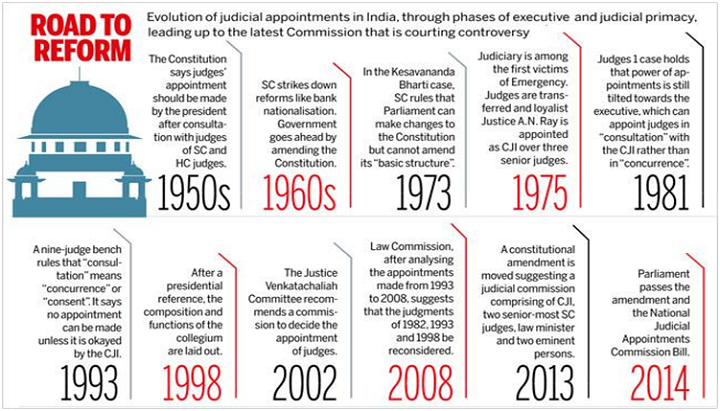
When India's Constitution came into force in 1950, it vested in the President the power to appoint Supreme Court and High Court judges, subject to consultation with the Chief Justice of India (CJI) and, in the case of High Courts, with the Governor and Chief Justice of the relevant High Court. For nearly three decades, the executive largely dominated this process. The appointment of Justice A.N. Ray as CJI in 1973, superseding three senior judges who had dissented in the Kesavananda Bharati case, and the arbitrary transfers and non-extensions of judges during the Emergency (1975-77) brought the question of judicial independence to a constitutional crisis.
It was against this backdrop that the litigation in S.P. Gupta v. Union of India (1981) arose, setting in motion a 44-year process of judicial self-assertion that reached its latest milestone in May 2026, when the President of India promulgated an ordinance raising the sanctioned strength of the Supreme Court from 34 to 38 — a development that intersects directly with the continuing debate about how those seats are to be filled.
II. Constitutional Framework: Articles 124, 217, and 222
The constitutional foundation for judicial appointments lies in three key articles. Article 124(1) established the Supreme Court of India, originally comprising a Chief Justice and not more than seven other judges — a number Parliament may increase by law. This provision became the basis for successive expansions: to 11 (1956), to 14 (1960), to 18 (1977), to 26 (1986), to 31 (2009), to 34 (2019), and most recently to 38 (Ordinance, 2026).
Article 124(2) provides that every Supreme Court judge shall be appointed by the President by warrant under his hand and seal after consultation with such of the judges of the Supreme Court and of the High Courts in the States as the President may deem necessary, and shall always be consulted in the appointment of a judge other than the Chief Justice. The deceptively simple word 'consultation' became the fulcrum of the entire judicial appointments debate.
Article 217 governs High Court appointments in analogous terms, requiring consultation with the CJI, the Governor, and the Chief Justice of the High Court concerned. Article 222 deals with the transfer of judges between High Courts, also requiring 'consultation' with the CJI. The constitutional text itself does not specify whether 'consultation' means that the President must obtain the agreement of the CJI, or merely seek his opinion — a distinction that proved momentous.
Master The Indian Constitution: Provisions, History, Practice, and More! by Dr. Ravishankar Mor. Enroll Now!
III. The First Judges Case: S.P. Gupta v. Union of India (1981)
3.1 Background and Facts
S.P. Gupta v. Union of India, AIR 1982 SC 149, is the foundational case in the evolution of India's judicial appointments jurisprudence. S.P. Gupta was a prominent advocate in the Allahabad High Court who had served twice as Advocate General of Uttar Pradesh. In 1981, a cluster of writ petitions was filed before various High Courts by lawyers and practitioners challenging two distinct but related practices of the Indira Gandhi government: first, the non-extension of the term of additional judges of certain High Courts; and second, the compulsory transfer of judges between High Courts without their consent.
The petitions also raised a broader challenge — they sought disclosure of government correspondence related to the appointment and transfer of judges, arguing that in a constitutional democracy citizens had a right to know how the executive exercised such sensitive powers. These petitions were consolidated and placed before a seven-judge Constitution Bench of the Supreme Court.
3.2 Issues Before the Court
The Constitution Bench addressed several interconnected issues:
- Whether the 'consultation' required by Articles 124(2) and 217(1) meant that the President was bound by the opinion of the CJI, or merely obligated to seek it.
- Whether the non-extension of an additional judge's term without the concurrence of the CJI was constitutionally valid.
- Whether the compulsory transfer of judges, without consent, violated judicial independence.
- Whether correspondence between the government and the judiciary relating to appointments and transfers was disclosable to the public under the right to information.
3.3 Judgment and Reasoning
The seven-judge bench delivered a fractured judgment, with Justice P.N. Bhagwati writing the majority opinion. On the central question of 'consultation,' the majority held — controversially — that consultation did not mean concurrence. The President was constitutionally obligated to consult the CJI, but was not bound by his recommendation. The executive retained the final authority to appoint or not appoint a judge. This was a decisive victory for executive primacy.
On the transfer question, the Court upheld the power of the government to transfer judges between High Courts under Article 222, but held that the CJI's opinion was an indispensable condition and must be given great weight. An arbitrary transfer made without any rational basis would be subject to judicial review. On the disclosure of documents, the Court made a landmark ruling: the correspondence between the CJI and the government regarding appointments was not protected by absolute privilege and could, in appropriate circumstances, be disclosed. This affirmation of transparency in judicial appointments was a significant doctrinal contribution, foreshadowing the Right to Information Act, 2005.
Critically, while the S.P. Gupta judgment upheld executive primacy in appointments, it simultaneously established that judicial independence was part of the Constitution's basic structure — a holding that would be turned against the executive in subsequent cases. The majority also expanded the doctrine of locus standi to recognise public interest litigation as a legitimate vehicle for enforcing constitutional rights, a contribution of enduring procedural significance.
3.4 Significance and Immediate Impact
Paradoxically, the S.P. Gupta judgment, while ruling in favour of the executive on appointments, laid the intellectual groundwork for the subsequent reversal. By establishing that judicial independence is basic structure, it gave the Supreme Court in the Second Judges Case a doctrinal basis to hold that any appointment process that undermined such independence was unconstitutional. The case also stimulated an intense public and academic debate on the relationship between judicial independence and democratic accountability — a debate that continues unresolved to this day.
IV. The Second Judges Case: Supreme Court Advocates-on-Record Association v. Union of India (1993)
The Second Judges Case, decided by a nine-judge Constitution Bench in 1993, was the transformative moment in the judicial appointments story. The case arose from disputes relating to the seniority of Supreme Court judges and the non-appointment of certain names recommended by the CJI. The bench overruled the S.P. Gupta majority on the central question of 'consultation,' holding — by a 7:2 majority — that consultation meant concurrence.
Justice J.S. Verma, writing for the majority, reasoned that because judicial independence was part of the Constitution's basic structure, any appointment process that gave the executive the final word over the judiciary's own nominees would undermine that independence. The majority held that in matters of appointment to the Supreme Court, the opinion of the CJI — formed in consultation with a collegium of the two senior-most judges of the Supreme Court — was binding on the government. The government could decline to appoint only if it had cogent reasons, and even then the matter reverted to the CJI for final decision.
The 1993 judgment formally inaugurated the collegium system. It transferred the primacy of appointment from the executive to the CJI and the two senior-most Supreme Court judges. While the President retained the formal power of appointment, the government was constitutionally obligated to accept the collegium's recommendation. This was a dramatic redistribution of constitutional power, achieved not through constitutional amendment but through judicial interpretation.
V. The Third Judges Case: In Re: Special Reference No. 1 of 1998
Following the 1993 judgment, ambiguities remained about the precise composition and procedure of the collegium, particularly for High Court appointments and transfers. President K.R. Narayanan made a Presidential Reference to the Supreme Court under Article 143 seeking clarification. In 1998, a nine-judge bench answered the Reference, expanding and refining the collegium system.
The 1998 opinion held that the collegium for Supreme Court appointments would consist of the CJI and the four (not two) senior-most judges of the Supreme Court. For High Court appointments and transfers, the collegium would consist of the CJI and the two senior-most Supreme Court judges. Crucially, the 1998 opinion held that a reiterated recommendation of the collegium — one made after the government had returned it for reconsideration — would be binding and the government would be constitutionally obligated to appoint the recommended person. The government's power of return was thus a one-time veto, not an absolute one.
The 1998 opinion also addressed the position of the CJI within the collegium, holding that the CJI is the 'first among equals' but does not have an individual veto — the collegium must act as a collective body. A recommendation over the dissent of a collegium member must disclose that dissent. These procedural nuances were intended to make the collegium more transparent and collectively accountable, though critics argued they fell far short of adequate external accountability.
VI. The Fourth Judges Case: NJAC and Its Invalidation (2015)
6.1 Genesis of the NJAC
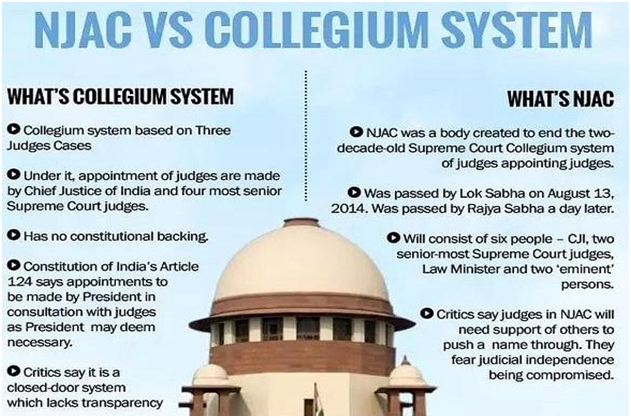
By 2014, cross-party political consensus had coalesced around the need to reform the collegium. The concerns were well-founded: the collegium operated without a publicly stated criteria for appointments; its deliberations were entirely secret; allegations of nepotism and favouritism persisted; and judges from certain High Courts and social backgrounds were systematically underrepresented in the Supreme Court. Parliament enacted the Constitution (99th Amendment) Act, 2014, and the National Judicial Appointments Commission Act, 2014 — both passed unanimously by both Houses and ratified by a majority of state legislatures — to replace the collegium with a six-member NJAC.
The NJAC would have comprised: the CJI (Chairperson), the two senior-most Supreme Court judges, the Union Law Minister, and two eminent persons nominated by a committee of the CJI, the Prime Minister, and the Leader of the Opposition in the Lok Sabha. Crucially, any two members of the NJAC could veto a recommendation, meaning the Law Minister — a representative of the executive — could effectively block a judicial appointment. The two eminent persons were required to include a member from Scheduled Castes, Scheduled Tribes, Other Backward Classes, minorities, or women.
6.2 The Supreme Court's Judgment
In October 2015, a five-judge Constitution Bench of the Supreme Court struck down the 99th Constitutional Amendment and the NJAC Act by a 4:1 majority in Supreme Court Advocates-on-Record Association v. Union of India. The majority held that the NJAC violated the basic structure of the Constitution — specifically the principle of judicial independence — by giving the executive (through the Law Minister and the two eminent persons) a role in, and effectively a veto over, judicial appointments.
Justice J.S. Khehar (later CJI) wrote the leading opinion. He argued that judicial independence required that the judiciary have the final and determinative say in who joins the judiciary. Any mechanism that allowed the executive to block a judicial appointment was inconsistent with the basic structure. The Court acknowledged that the collegium system was not perfect, but held that it was constitutionally preferable to a system that opened the door to executive influence.
Justice J. Chelameswar dissented powerfully. He argued that the collegium system had failed the twin tests of transparency and accountability, that the NJAC represented a democratic mandate for reform, and that the Court was being asked to strike down a constitutional amendment ratified by Parliament and the states on the ground that it violated a judicial doctrine (basic structure) that was itself a judicial creation. His dissent articulated the tension at the heart of the collegium system: the judiciary cannot be both the appointing body and the final judge of its own appointment process.
6.3 Critique of the Fourth Judges Case
The 2015 judgment was widely criticised across the political and academic spectrum. Critics pointed out that the NJAC was not an executive overreach: it was a product of near-universal democratic consensus, passed unanimously in both Houses of Parliament, ratified by most state legislatures, and supported by the Bar Council and many sections of civil society. By invalidating it, the Court appeared to place judicial self-governance beyond the reach of constitutional amendment — a position difficult to reconcile with the doctrine of parliamentary sovereignty and the democratic character of the Indian State.
Others argued that the NJAC created its own problems: the inclusion of the Law Minister on a commission with a veto power was an obvious point of executive leverage. The controversy around Justice Yashwant Varma in 2025 — when cash was reportedly discovered during a firefighting operation at his official residence — revived calls for an alternative to the collegium, with the Vice President and leaders across party lines publicly supporting a return to some form of NJAC.
VII. The Collegium in Practice: Strengths and Failures
7.1 Structural Features
As it operates today, the Supreme Court Collegium consists of the CJI and the four senior-most puisne judges. Recommendations for Supreme Court appointments, and for the appointment and transfer of High Court judges and chief justices, originate from this body. The collegium has no formal charter, no published criteria for selection, and holds no public hearings. Its decisions are conveyed to the government through letters, and reiterated recommendations are binding on the government.
Since 2017, the Supreme Court has begun uploading its recommendations on its official website — a significant step toward transparency. The government, however, retains a de facto delay power: it can sit on collegium recommendations indefinitely without formally returning them. This has led to significant vacancies across the judiciary. As of early 2025, High Courts across the country were functioning with nearly 33 per cent vacancies, severely impairing access to justice.
7.2 Accountability Deficits
The collegium's principal accountability deficit is the absence of any external check on its deliberations. Unlike legislative or executive appointments, collegium recommendations are not subject to parliamentary scrutiny, public hearings, or any independent vetting. Critics including the Law Commission of India, Parliamentary Standing Committees, and prominent senior advocates have repeatedly called for the collegium to publish its selection criteria, give reasons for appointments and rejections, and establish a secretariat to manage the process more professionally.
Concerns about nepotism — the appointment of relatives or associates of serving or retired judges — have also surfaced repeatedly. The collegium system, given its small and self-selecting membership, is structurally susceptible to informal networks and personal relationships influencing who is elevated. Diversity data also makes for uncomfortable reading: women, judges from lower socioeconomic backgrounds, and judges from non-English-medium educational institutions remain significantly underrepresented in the upper judiciary.
7.3 The Vacancy and Delay Crisis
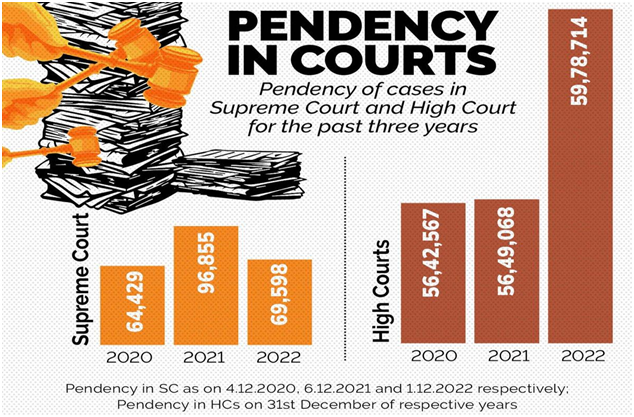
The appointments process — involving collegium recommendation, government clearance (including intelligence bureau vetting), and Presidential warrant — has been chronically slow. The government has at times returned collegium recommendations, sometimes for unstated reasons, causing delays of years in appointments. The collegium has occasionally persisted; at other times, names have been quietly dropped. This mutual standoff between the executive and the collegium has left the Supreme Court functioning below sanctioned strength for extended periods, exacerbating the pendency crisis.
VIII. The 2026 Expansion: From 33+1 to 37+1 Judges
8.1 Historical Context of Expansions
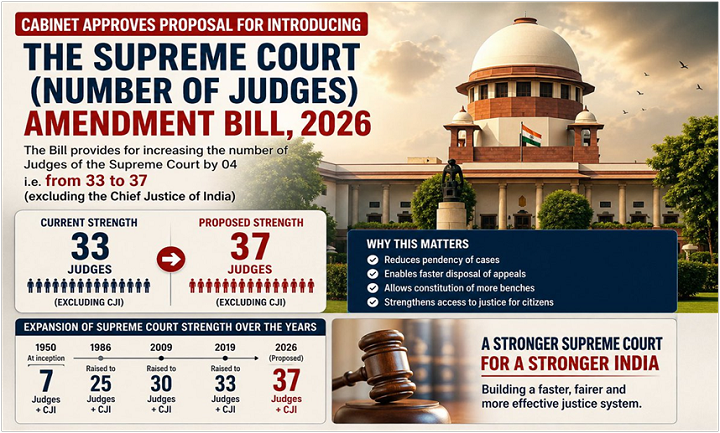
Since 1950, the sanctioned strength of the Supreme Court has been expanded eight times by Parliament amending the Supreme Court (Number of Judges) Act, 1956 — or, as in 2026, by Presidential Ordinance under Article 123. The chronology of expansions is as follows:
- 1950: 8 judges (1 CJI + 7 puisne) at Constitution's commencement
- 1956: Raised to 11 under the Supreme Court (Number of Judges) Act, 1956
- 1960: Raised to 14
- 1977: Raised to 18 (post-Emergency judicial reform era)
- 1986: Raised to 26
- 2009: Raised to 31 (1 CJI + 30 puisne)
- 2019: Raised to 34 (1 CJI + 33 puisne) following a letter from CJI Ranjan Gogoi to Prime Minister Modi citing mounting vacancies and case pendency
- 2026: Raised to 38 (1 CJI + 37 puisne) — the most recent and current expansion
8.2 The 2026 Ordinance: Facts and Process
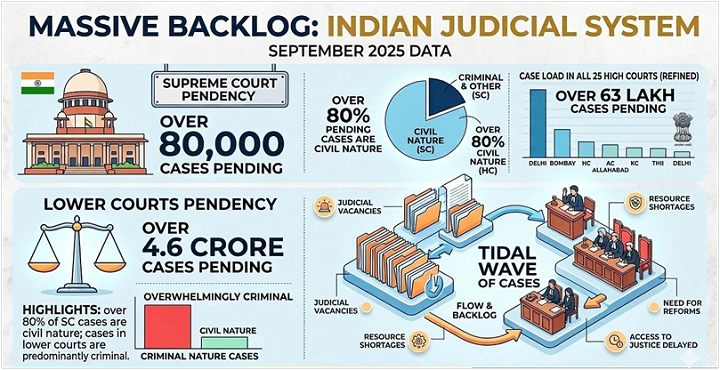
On 5 May 2026, the Union Cabinet chaired by Prime Minister Narendra Modi approved the Supreme Court (Number of Judges) Amendment Bill, 2026, proposing to increase the sanctioned strength from 33 to 37 (excluding the CJI), bringing the total to 38. The government justified the expansion on grounds of improving judicial efficiency, reducing pendency, and ensuring timely delivery of justice. As of 30 April 2026, total pendency in the Supreme Court alone stood at 92,823 cases according to the National Judicial Data Grid. Information and Broadcasting Minister Ashwini Vaishnaw confirmed that the legislation would amend the Supreme Court (Number of Judges) Act, 1956 to add four puisne judges.
Since Parliament was not in session at the time, the government invoked the President's ordinance-making power under Article 123 of the Constitution. On 16 May 2026, President Droupadi Murmu promulgated the Supreme Court (Number of Judges) Amendment Ordinance, 2026, which came into force immediately. The Ministry of Law and Justice notified the ordinance, amending the 1956 Act to raise the strength from 33 to 37 puisne judges (total: 38 including CJI). The Ordinance is required to be placed before Parliament when it next assembles and will lapse after six weeks unless converted into a regular Act — the Supreme Court (Number of Judges) Amendment Bill, 2026 will be the vehicle for this conversion.
8.3 Rationale and Immediate Context
As of May 2026, the working strength of the Supreme Court stood at 32 judges, leaving two existing vacancies and three forthcoming retirements — Justices J.K. Maheshwari, Pankaj Mithal, and Sanjay Karol — expected in the summer of 2026. The combination of existing vacancies, forthcoming retirements, and a pendency crisis exceeding 93,000 cases provided the immediate trigger for the expansion. Former CJI D.Y. Chandrachud had observed in 2024 that the Supreme Court 'simply needs more judges,' and had been in dialogue with the government on the issue.
CJI B.R. Gavai, who took office in May 2025 after administering the oath of office to Justices N.V. Anjaria, Vijay Bishnoi, and A.S. Chandurkar, announced the 'Special Clearance Months' initiative, under which the four new judicial slots would be dedicated to hearing 'after-notice' matters and decade-old criminal appeals — a tactical measure to ensure the expansion immediately translates into faster disposal of the oldest cases.
8.4 Critical Analysis: Will Numbers Solve the Problem?
The 2026 expansion has been welcomed by the legal fraternity, including the President of the Supreme Court Bar Association, Senior Advocate Vikas Singh, who described it as a long-overdue step. However, analysts at the Supreme Court Observer and legal commentators have cautioned that numbers alone will not solve the pendency crisis. Three structural concerns stand out.
First, the collegium-government tension over appointments means that the four new seats may remain vacant for extended periods. Historical experience after the 2009 and 2019 expansions showed that vacancies persisted long after sanctioned strength was increased, because the collegium-executive appointment pipeline was slow. The 2026 expansion does nothing to streamline this process.
Second, the expansion leaves untouched the systemic drivers of Supreme Court pendency: the volume of Special Leave Petitions (SLPs), which account for the bulk of filings; the listing and mentioning practices that make the docket unwieldy; and the absence of a filter mechanism to reduce the Court's role as a third or fourth appellate tier in routine matters.
Third — and most critically — the expansion does nothing to address the far larger crisis in the subordinate and High Court judiciary. As of December 2025, over 5.39 crore cases were pending across all levels of the Indian judiciary. High Courts were functioning with nearly 33 per cent vacancies; subordinate courts with 21 per cent vacancies and 4.8 crore pending cases. Adding four judges to the apex court while the lower judiciary remains chronically under-resourced is, as commentators have noted, addressing 'the visible tip of a much larger iceberg.'
IX. The Collegium-Government Interface: A Continuing Tension
The 2026 expansion must be understood within the broader context of the ongoing constitutional tension between the collegium and the government. The government's power to delay — by sitting on collegium recommendations without formally returning them — has been the most significant practical check on the collegium's authority. In 2022-23, this tension became highly visible when the government held back several collegium recommendations for months, prompting sharp public commentary from sitting Supreme Court judges, including CJI D.Y. Chandrachud.
The Supreme Court Observer's analysis of the 2026 expansion notes that whether the four additional seats 'translate into faster disposal will depend on how quickly the Collegium recommends names and the Union clears them.' This observation captures the structural problem: the expansion creates posts, but the appointments process remains as potentially sluggish as before. Until the collegium-executive interface is comprehensively reformed — either through a revised Memorandum of Procedure that imposes time limits on government action, or through some form of statutory framework — the gap between sanctioned and working strength will persist.
X. Comparative Perspectives: Judicial Appointments in Other Democracies
India's collegium system is a constitutional anomaly in comparative perspective. In the United Kingdom, judicial appointments are made by the Judicial Appointments Commission (JAC) — an independent statutory body — with the Lord Chancellor retaining a residual power to accept, reject, or request reconsideration of appointments. The JAC holds competitive selection through advertised vacancies, structured interviews, and merit-based assessments, with strong diversity commitments. Canada employs Independent Advisory Boards for Supreme Court appointments, with merit-based selection, transparent criteria, and parliamentary scrutiny of nominees.
In South Africa, the Judicial Service Commission — comprising judges, parliamentarians, legal practitioners, and eminent laypersons — conducts public interviews of candidates and makes transparent recommendations. The United States model involves Presidential nomination and Senate confirmation hearings, combining executive initiative with legislative accountability. While each model has its own limitations, what they share is some degree of external visibility and public participation that the Indian collegium entirely lacks.
These comparative models suggest that the binary framing of the Indian debate — collegium versus executive control — is a false dichotomy. Independent judicial commissions with mixed membership (judicial, legislative, civil society), transparent processes, published selection criteria, and diversity mandates have been successfully implemented across common law jurisdictions without compromising judicial independence.
XI. Lawyer’s Insight - Pratham Kindra
The evolution of the collegium system, traced with doctrinal precision through the four Judges Cases, looks markedly different when viewed from the other side of the Bar from the perspective of the advocate who files the vakalatnama, argues the matter, and then waits. The shift from executive primacy in 1981 to judicial self-governance in 1993 was, in constitutional theory, a victory for independence; in practice, it substituted one opacity for another. Where the pre-1993 regime at least located accountability in an elected government answerable to Parliament, the collegium concentrates appointments within a rotating group of five judges whose deliberations leave no public record, whose criteria remain uncodified, and whose decisions including the quiet dropping of a recommended name after government return are entirely unreviewable. The expansion of the collegium from the CJI and two judges to the CJI and four judges in 1998 added breadth without adding transparency, and the invalidation of the NJAC in 2015, however constitutionally defensible, removed the one structural intervention that might have introduced external accountability into a system that has consistently resisted it. The 2026 expansion to thirty-eight judges addresses a genuine crisis of capacity, but it does not address the crisis of process and it is the crisis of process, experienced daily in adjournment-laden dockets and decade-long trial timelines, that the practising bar considers the more urgent of the two.
XII. Reform Agenda: The Way Forward
The 2026 expansion — welcome as it is — does not resolve the structural challenges that the collegium system faces. The following reforms merit serious consideration by the government, Parliament, and the judiciary:
5.A Codified Memorandum of Procedure: The collegium's functioning should be governed by a publicly available, legally binding Memorandum of Procedure that specifies selection criteria (merit, integrity, diversity), timelines for government action on recommendations, and a mechanism for resolving disagreements. In 2015, the Supreme Court directed the government to revise the MoP to increase transparency; this direction has not been fully implemented.
6.Reasons for Appointments and Rejections: The collegium should be required to publish reasons for its recommendations and — where constitutionally permissible — for the return or rejection of names. This would deter nepotism, improve diversity, and enhance public trust.
7.Diversity Mandates: A private member's Bill recently introduced in Parliament proposes constitutional amendments to ensure greater representation of women, SC/ST/OBC, and minority communities in judicial appointments. Such mandates, if incorporated into the MoP or in a new constitutional provision, would help address the representational deficit in the higher judiciary.
8.A Collegium Secretariat: The collegium should be supported by a professional, permanent secretariat to manage the voluminous dossiers on candidates, conduct preliminary background checks, maintain records, and ensure institutional continuity across changes in collegium membership.
9.Lower Judiciary Investment: The 2026 ordinance must be accompanied by an emergency push to fill vacancies in High Courts and subordinate courts. The pendency crisis in the lower judiciary dwarfs that of the Supreme Court and cannot be addressed by expanding the apex court alone.
10.SLP Filtering and Institutional Reforms: The Supreme Court's docket is overwhelmed by Special Leave Petitions. A rigorous filtering mechanism — either through a dedicated SLP bench with strict admission criteria or through expanded High Court jurisdiction — is essential to prevent the expanded Supreme Court from being consumed by the same volume of routine appeals that currently clogs it.
XII. Conclusion
The story of India's collegium system is, at its core, a story about constitutional power — about who gets to decide who decides. From the executive primacy endorsed in S.P. Gupta (1981) to the judicial primacy established by the Second Judges Case (1993), from the procedural clarifications of the Third Judges Case (1998) to the defensive affirmation of the collegium in the Fourth Judges Case (2015), and now to the 2026 expansion that raises the court's sanctioned strength to 37+1 — each development has been a response to the failure of the previous arrangement to deliver both independence and accountability.
The S.P. Gupta case remains foundational not because its holding survived — it did not — but because it forged the constitutional vocabulary that later cases used: the basic structure doctrine, judicial independence, the public interest in transparent governance, and the expanded locus standi that empowered citizens to challenge opaque governmental action. These contributions outlasted the case's immediate ruling and shaped Indian constitutional law in enduring ways.
The 2026 expansion to 38 judges is a necessary acknowledgement of the Supreme Court's crushing workload and the urgency of judicial pendency. But it is, ultimately, a palliative measure rather than a structural cure. The deeper challenge — of making the collegium transparent, accountable, diverse, and swift — remains unaddressed. The ordinance route itself, bypassing Parliament, is symptomatic: it creates posts urgently, but leaves the question of how those posts will be filled through the same slow, opaque, and contested process that has characterised judicial appointments for decades.
For the 2026 expansion to be more than a number on paper, it must be accompanied by the broader structural reforms outlined in this paper — a codified MoP, transparency in collegium deliberations, diversity mandates, a professional secretariat, and a concerted effort to reduce the lower judiciary's structural deficit. India's judiciary does not merely need more judges. It needs a better system for choosing them, deploying them, and holding them accountable. The collegium, as presently constituted, delivers independence imperfectly and accountability barely at all. The task of the next constitutional moment is to do better — on both counts.
Join LAWyersClubIndia's network for daily News Updates, Judgment Summaries, Articles, Forum Threads, Online Law Courses, and MUCH MORE!!"


Tags :others