
SYNOPSIS
- Introduction to Tortious Liability in Motor Vehicle Accidents
- Legislative Background and Objectives of the Motor Vehicles Act, 1988
- Negligence as the Basis of Liability under the Motor Vehicles Act
- Concept and Application of No-Fault Liability
- Principles Governing Compensation in Motor Accident Cases
- Role and Functioning of Motor Accident Claims Tribunals (MACT)
- Judicial Interpretation through Leading Supreme Court Decisions
- Practical Challenges in Motor Accident Claims: A Practising Lawyer’s Perspective
- Conclusion: Evolution, Challenges, and the Way Forward
INTRODUCTION
Tortious liability implies that a person is held legally responsible when a civil wrong, other than a breach of contract, results in harm or injury to another person. In turn, the injured party is entitled to be compensated. The law of torts is based on the ideas of corrective justice and restitution, through which the victim is to be compensated, as much as possible, to the same situation that they would have been if the wrong hadn't happened. Criminal law is different, as it concentrates on punishment and deterrence, whereas tort law is mainly about compensation and civil accountability.
When motor vehicle accidents are caused by irresponsible or reckless behaviour, they constitute a breach of a civil law. Besides the physical injuries and loss of life which are the most apparent, such accidents also lead to victims and their families suffering emotionally and financially. Back in the day, victims could only get their damages under the tort law if they filed a case in a civil court, and in any event, they had to prove negligence, causation, and loss. Not only was this procedure very time-consuming and costly, but to the poor it was practically out of reach, thus, the law of torts lost its remedial face. It became clear that the shortfalls of the existing system could only be rectified by the legislature.
The Motor Vehicles Act, 1988 among others brought in a specialized statutory framework for the regulation of motor vehicles and the effective provision of compensation to motor accident victims. The Act still recognizes tort principles but it changes and adds to them by the introduction of concepts such as no-fault liability, compulsory third-party insurance, and Motor Accident Claims Tribunals (MACTs). The Act shows a deliberate move away from fault-based liability towards an approach which is welfare-oriented and based on social justice.
Even though there have been several legislative and judicial changes, the compensation scheme for motor vehicle accidents under the Motor Vehicles Act still faces several issues like long delays, inconsistent compensation amounts, and uncooperative behavior of insurance companies. The increasing number of road accidents and changing judicial interpretations make it necessary to thoroughly examine how the principles of tort law function within the statutory framework and whether the current system is effective in accommodating the interests of victims, insurers, and vehicle owners.
MOTOR VEHICHLES ACT,1988
The Motor Vehicles Act, 1988 is fundamentally a social welfare statute that was introduced to regulate road transport and to ensure the victims of motor vehicle accidents receive proper compensation. Although it is based on the classical tort concepts of negligence and fault, the Act goes a long way in providing increased protection for the victims through various means like no-fault liability, compulsory third-party insurance, and the creation of Motor Accident Claims Tribunals (MACTs). It recognises that road accidents are not simple private disputes but reoccurring social harms that call for immediate legal remedy. To this end, by cutting down on procedural formalities and giving precedence to compensation, the Act intends to recognise both the individual's liability and the social justice aspect with which accident victims and their families should be granted timely relief.
NEGLIGENCE UNDER THE MOTOR VEHICLES ACT, 1988
Plaintiffs in motor vehicle accident cases usually demonstrate negligence to hold a party accountable for the damages incurred through a vehicle accident under the MVA. Negligence, in tort law, is the failure to act with the care that a reasonably prudent person would have done in a similar situation. To prove negligence, the plaintiff must first establish that the defendant owed the plaintiff a duty of care, that the defendant violated this duty, and that this violation directly caused harm to the plaintiff.
A duty of care is imposed on drivers by the requirement that they drive vehicles in a safe manner, abide by the traffic rules, and make it safe for other road users. This duty is on the drivers not only towards the passengers in the vehicle but also towards the pedestrians, cyclists, and other drivers. Besides drivers, car owners are also under the obligation to ensure that their cars are in a good condition for the road, that they are well-maintained, and that the drivers are licensed, skilled, and competent. Non-compliance with these agreements may result in vicarious liability.
When a driver fails to act in a way that a reasonable driver would be expected to act, this is considered to be a breach of duty. In order for a person to be held liable for damages, there must be a link between the wrongdoing and the harm suffered. To address the practical problems of proving negligence, MACT cases have adopted an approach that is liberal and in tune with the welfare of the parties concerned.
Sometimes, the negligence of the victim himself may also cause the accident. A contributory negligence is understood to be the victim's part at fault which leads to a proportionate deduction in the compensation. Contributory negligence, conversely, refers to the combined negligence of two or more wrongdoers that leads to the accident, and thus, they are held jointly and severally liable.

NO-FAULT LIABILITY UNDER THE MOTOR VEHICLES ACT
No-fault liability is a clause that differs greatly from the traditional torts where the principle required that proof of negligence be established. Even if they fail to point out the person who caused the accident, the victims should not be denied compensation. The concept that is at the base of the Social Welfare Model of the Motor Vehicles Act is that road accidents are, sometimes, just a matter of bad luck and therefore victims need financial help straight away.
The mentioned section 140 grants fixed interim compensation in cases of death and permanent disablement, which are payable regardless of the party at fault. The compensation can later be set-off against the final damages of the fault-based claim. This act as a social security provision to give instant support to victims/dependents.
Section 163A provides a methodical prescribed formula that can be used to calculate compensation according to the victim's age and income. It can be an option to the fault-based claim under Section 166. It is especially helpful for a person with little income as it ensures timely and certain compensation without a lengthy process of litigation. At the same time, he relinquishes the right to sue for the fault.
The difference between fault-based and no-fault lies basically in the fact that the former requires the establishment of negligence. On the contrary, no-fault liability emphasizes the importance of speed, certainty, and accessibility.

PRINCIPLES GOVERNING COMPENSATION IN MOTOR ACCIDENT CASES
The fundamental rule for determining compensation in motor accident cases is that it should be "just, fair and reasonable". It is not the purpose of compensation to overcompensate the claimant or to punish the insurer or the vehicle owner, but to fairly compensate the loss caused by the accident. Indian courts have always emphasized that compensation should, as far as it is practicable, put the victim or the dependents in the place they would have been if the accident had not happened. While deciding the quantum of compensation, courts equally weigh the financial requirements of the victims and their families against the ability of the insurers to pay, thus ensuring that the amount fixed is neither so high as to be arbitrary nor so low as to negate the welfare purpose of the Motor Vehicles Act.
Compensation in motor accident claims is primarily divided into pecuniary and non-pecuniary damages.
Pecuniary damages refer to the actual financial loss incurred and cover medical expenses, loss of income during treatment, future loss of earning capacity and rehabilitation costs. These are determined based on documentary and oral evidence.
Non-pecuniary damages, however, are meant to compensate for the losses that are not quantifiable in money such as pain and suffering, loss of amenities of life, emotional trauma and loss of enjoyment of life. In cases of fatal accidents, these damages are extended to the emotional loss suffered by family members.
Such damages are a matter of judicial discretion but courts rely on established precedents to achieve consistency and fairness. In order to achieve uniformity and predictability in awarding compensation, the courts use the multiplier multiplicand method especially in cases of death or permanent disability. According to this method, the annual income of the deceased or the injured person is multiplied by the multiplier that is appropriate to the age and represents the period of expected financial contribution. Standardising this method by the Supreme Court has considerably minimized the arbitrariness and increased the transparency of the compensation assessment.
When it comes to permanent disability, courts give more importance to functional disability rather than medical disability. It is not just a medical condition but the degree to which the injury affects the victim's earning and normal life that is the focus. Besides, courts also consider future prospects since income is not fixed and usually increases over time owing to career progression and inflation. Such an approach is a rational and future-oriented evaluation of loss.
In fatal accident claims, the loss of dependency Compensation is a major component of the award. Courts also give compensation under the heads of consortium and loss of estate. Consortium, in fact, acknowledges the loss of companionship, care, and affection of the spouses, children, and parents while loss of estate compensates for the economic shortage caused by the premature death.
Through judicial evolution, compensation jurisprudence has become more and more humane and victim-centric, acknowledging that the effects of motor accidents are not limited only to the economic loss.

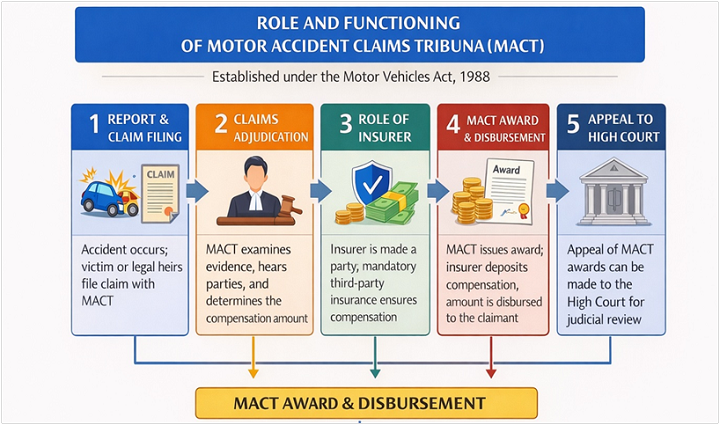
ROLE AND FUNCTIONING OF MOTOR ACCIDENT CLAIMS TRIBUNAL (MACT)
Motor Accident Claims Tribunals (MACTs) were set up under the Motor Vehicles Act, 1988 to give a specialised and speedy forum for hearing cases of compensation for motor accident injuries. MACTs have been given exclusive authority over such claims and therefore the ordinary civil courts have no jurisdiction over these cases. By setting up such tribunals, the legislature indicates its aim to simplify the procedures and provide relief quickly to victims of accidents.
MACTs have been given the power to use summary procedures and they are not tightly bound by the technical requirements of the Civil Procedure Code or the Indian Evidence Act. Such procedural flexibility allows tribunals to take a practical view that foregrounds substantive justice and not procedural formalism. The summary nature of the proceedings accords victims relief from long-drawn litigation and administration of unnecessary delays.
Insurers are an indispensable part of the MACT procedure since they are legally required to pay compensation under the compulsory third-party insurance cover. They, however, usually resile on grounds of policy breach related to whether the driving licence was valid, the policyholder had complied with all the statutory requirements, etc. Although such pleas are legally allowed, the over-reliance on these technical points has to a large extent led to a delay in the finalization of the claims.
A right of appeal is given by the Motor Vehicles Act against MACT awards to the High Courts thereby providing for judicial review and uniformity in the standards of compensation. Still, insurance companies' recurrent appeal practice extends litigation and postpones the compensation's disbursal. MACTs, despite being designed to work efficiently, are presently struggling with various issues such as a huge case backlog, lack of adequate infrastructure, shortage of judicial officers, and non-uniform practices across jurisdictions, thus calling for administrative and procedural reforms.
LEADING SUPREME COURT JUDGMENTS ON MOTOR ACCIDENT LIABILITY
The Supreme Court of India has been instrumental in defining the scope of laws relating to compensation for motor accident victims. The Court by interpreting the law, has managed to run the principle of tort liability side by side with the social goals of the Motor Vehicles Act, 1988. This has led to a victim-focused approach while at the same time, the Court has not ignored basic fairness and legal certainty the two elements always needed for a law to be stable and properly predictable.
In the case of Minu B. Mehta v. Balkrishna Ramchandra Nayan, the apex Court clearly laid down that negligence is the vital element in the fault-based claims arising out of motor accidents. The Court insisted that an accident alone cannot be the basis of imposing liability, thereby strengthening the classical tort principles. The strictness of the rule made it very hard for the victims to prove the fault in the absence of direct evidence, which in any case justified the need for statutory provisions that cater to welfare obligations and thus relieved victims of the burden of proof.
The judgment in Sarla Verma v. Delhi Transport Corporation has been a great landmark in the assessment of the quantum of compensation to be given to an injured person or his/her family. The Court laid down uniform rules for the determination of the amount by confirming the multiplier method and the deduction of personal expenses, thereby significantly reducing the inconsistencies and the arbitrariness of awards. The judgment has brought about a certain degree of predictability and a measure of transparency in the assessment of the compensation amount.
Through another important ruling, the National Insurance Co. Ltd. v. Pranay Sethi case, a Constitution Bench has made further refinements in the compensation jurisprudence. It has clarified that future prospects are to be included and also, the amounts under various heads like loss of consortium, loss of estate, and funeral expenses have now been standardised. The Court in this verdict has acknowledged that income varies and compensation must be in accordance with the present economic conditions.
Besides, courts have awarded a greater share of compensation to victims in the form of non-pecuniary damages. For instance, in Magma General Insurance Co. Ltd. v. Nanu Ram, the Court acknowledged the existence of parental and filial consortium along with spousal consortium. By this decision, the Court has given due recognition to the members of a family who have lost their comfort and companionship due to the injury of their near ones and hence, has lent a more humane touch to the law of compensation.
Furthermore, the Supreme Court in Pappu v. Vinod Kumar Lamba enhanced the protection of victims by holding that the requirement to give evidence of breaching policy conditions rest with the insurance companies. The Court ruled that simply on technical grounds, the insurers cannot refuse to compensate, thus it has been reaffirmed that third-party insurance or compulsory insurance under the Motor Vehicles Act is basically for the protection of third-party victims.
A PRACTISING LAWYER'S VIEW
From the lens of a practising lawyer at Patiala House Court, Delhi, involved in the practice says that motor accident law in India has undergone quite a change, however, its application still remains far from perfect. The statutory provisions and Supreme Court rulings heavily tilt the balance in favour of the victims, but the scenario at the Motor Accident Claims Tribunal (MACT) level is all about delay and the claimants getting tired of the process.
Furthermore, most of the claimants are not in a position to make ends meet when they approach the MACTs and yet, the cases run for years. The law specifies summary proceedings through which the matter should be disposed of quickly but in reality, there are multiple adjournments and the taking of evidence gets unnecessarily drawn-out. Though insurance companies should be a help in the compensation of the victim, in most cases, they take the line of negating a licence or raising a question that a policy condition has been breached and thereby, the litigation gets dragged on.
Other common issues that one hears about are the different compensation amounts being awarded for similar cases in different tribunals which is a matter that leads to the uncertainty in the law and as a result, people keep filing appeals which in turn, delays the giving of the relief. Looking at the matter from the point of practice, one can see that the compensation given is not an unexpected benefit but rather a matter of survival and dignity for the victims.
CONCLUSION
The law concerning motor vehicle accidents in India has undergone a notable change in spirit as well as in practice. Initially, it was a strict fault-based system derived from the classical tort principles; however, it has slowly been turning into a welfare-oriented compensation regime under the Motor Vehicles Act, 1988. Both through the intervention of the legislature and the continuous interpretation by the courts, the emphasis has shifted from just negligence to providing genuine help to victims of accidents and their families.
Court decisions have come very instrumental in this process. Standardizing the methods for calculating compensation, acknowledging the claimant's future, widening the category of non-pecuniary damages, and holding insurers more accountable are just some of the areas where courts have made efforts to eliminate the gap between law and society. These actions reflect the realization that motor accidents are not only isolated wrongs between individuals but also social tragedies that happen repeatedly and, therefore, need a law that responds both with kindness and practicality.
Nevertheless, the real measure of how effective the law on motor accidents is cannot merely be the progressive rulings or legal provisions. Deep-seated delay in the courts, unevenness in compensation awards, and insurers fighting each other are problems that still exist putting at risk the victims' right to have their case heard in a reasonable time. For a large number of victims, the legal proceedings become a second trauma, thus, compensation law loses its therapeutic element.
In light of this, the main concern of the legislation on motor accident compensation law should be around implementation, not anymore doctrinal elaboration. A more robust MACT system, procedural strictness, uniform compensation, and control over the behaviour of insurers are the prerequisites for bringing back the system's interest in providing welfare. It is only when the compensation is made quickly, reliably, and with empathy that the law will be able to achieve its primary goal offering a genuine come back to those, whose lives have been overturned by road accidents.
Join LAWyersClubIndia's network for daily News Updates, Judgment Summaries, Articles, Forum Threads, Online Law Courses, and MUCH MORE!!"


Tags :others