
Index
- Introduction
- Constitutional and Statutory Foundation: Article 21 and Section 41D of CrPC
- Understanding the Limits of Advocate Participation
- Judicial Interpretation and the Balance of Rights
- Case Study: The Jugal Kishore Samra Precedent
- Case Study: Vijay Sajnani and the Special Statute Dilemma
- Case Study: D.K. Basu and the Safeguards of Custodial Justice
- Ethical Boundaries: The Bar Council of India’s Perspective
- Modern Challenges: Digital Investigations and New Forms of Interrogation
- The Way Forward: Towards a Fairer Investigative Framework
- 11.Frequently Asked Questions (FAQs)
Introduction
A recent report by LiveLaw brought into focus an important observation made by the Supreme Court of India regarding the limits of advocate involvement in the process of criminal investigation. The Court had maintained that although lawyers are essential to ensure that the rights of the accused are not violated, yet still, their involvement in the investigation process should not encroach upon police independence.
This judicial remark has reignited a long-standing debate about how far an advocate’s role extends before a case reaches trial.
The appearance of the lawyer in the process of investigation presents protection as well as complexity. To the accused, counsel presents a protection against tyranny and abuse.
To the investigators, the same can seem like intrusion. To balance this tension, one must return to the legal provisions, case law, and changing judicial rationales that govern the contemporary interpretation of Section 41D of the CRPC and connected provisions under Articles 20 and 21 of the Constitution.
Master The Indian Penal Code: A to Z - In-Depth by Adv. Raghav Arora. Enroll Now!
Rights Under the CrPC and the Constitution
The main legislative foundation for advocate intervention is contained in Section 41D of the CrPC, introduced via the 2008 amendment. It provides that any individual who has been arrested is entitled to meet an advocate of choice at the time of interrogation, but not necessarily during it.
This provision was brought to align domestic law with constitutional protections of due procedure under Article 21. It acknowledges that interrogation is one of the weakest points in the criminal process where the right to counsel deters abuse of power and maintains the dignity of the person.
Section 303 of the CrPC supplements this right by ensuring that any person accused in a criminal court can be represented by a pleader of their choice. Yet, there is still a space between arrest and trial wherein coercion or procedural malpractice usually happens.
Judicial understanding has attempted to bridge this gap, acknowledging that fair investigation is an essential part of fair trial. The Supreme court has time and again held that the right to legal representation is not limited to trial proceedings but it extends to all those matters wherein the personal freedom is at stake.
Article 22(1) of the Constitution also ensures that no individual arrested shall be deprived of the right to consult and be defended by an advocate of choice. Construed with Article 20(3) that guards against self-incrimination, the constitutional framework forms a tripod of protection viz the right to counsel, the right to remain silent, and the right to fair procedure.
The courts have had to interpret these rights in conjunction with each other in order to decide how visible, active, or reticent a lawyer's role should be under police investigation.
How the Supreme Court Defined Custodial Safeguards
The groundwork for procedural protection in police inquiry was established in D.K. Basu v. State of West Bengal. The case started with letters received by the Supreme Court narrating cases of custodial deaths and torture in West Bengal and Punjab. In suo motu cognizance, the Court considered the letters as a writ petition under Article 32, thus becoming one of India's earliest instances of social justice litigation.
In paragraphs 35 to 37 of the judgment, the Court enumerated a line of guidelines which transformed custodial jurisprudence. One of these was the arrested individual's right to meet a lawyer while being interrogated, but not continuously.
The Court argued that though continuous presence of lawyers may inhibit investigation, outright denial would be against Article 21. It thus drew a thin line and held that the legal aid could not convert into supervision but had to be available. The judgment also insisted on the arresting officers showing identification, keeping arrest memos, and informing family members of the person under detention and all such precautions bind us today.
This case turned into the constitutional milestone of Section 41D CrPC. Its reading of "consultation" still affects each successive decision on advocate involvement in the course of investigation.
Limits of Lawyer Presence
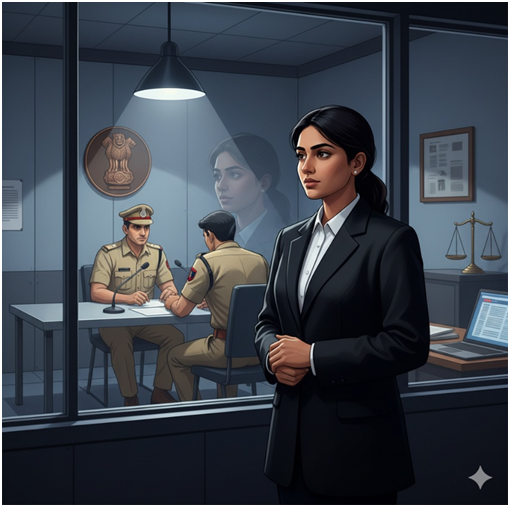
The ambit of an advocate was further elucidated in Senior Intelligence Officer v. Jugal Kishore Samra. The Supreme Court was asked to decide whether a person under interrogation by the Directorate of Revenue Intelligence was entitled to have a lawyer present inside the room of interrogation. The accused averred that his lawyer's exclusion contravened Article 21 and Section 41D CrPC.
The Supreme Court, in paragraph 14, ruled that the right to consult was not the right to be accompanied by legal counsel during questioning. Justice R.M. Lodha, delivering the verdict for the Bench, allowed "visible presence" of counsel at a distance, e.g., behind a glass wall, so that the rights of the accused were preserved without encroaching into the investigative process.
The ruling made it clear that inquiries cannot be translated into adversarial hearings prior to trial. The role of the lawyer was therefore preventive rather than participatory as in a system of monitoring without interference.
This case has come to be invariably quoted to demarcate the spatial as well as procedural limits of lawyer presence during questioning. It maintained the essence of D.K. Basu while reaffirming the independence of investigations.
Can Counsel Monitor Interrogations in Economic Offence Cases?
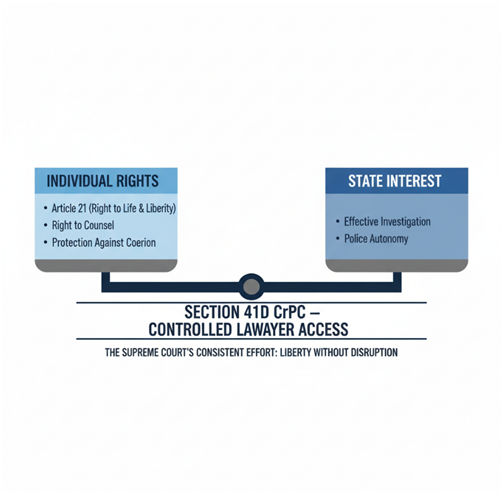
The principles regarding the balance between individual rights and state efficiency was revisited in the case of Vijay Sajnani v. Union of India, which dealt with interrogation in a customs-related economic offence. The petitioners contended that denial of counsel during questioning violated Article 21 and procedural fairness.
The Supreme Court in paragraphs 20 to 22, reiterated and maintained that the accused can have counsel in sight but not within hearing distance. The Court observed that inquiries under economic and fiscal legislations need confidentiality and cannot be compared with custodial interrogations under the CrPC.
Justice Altamas Kabir noted that the aim of interrogation in such cases is discovery of truth, rather than procurement of confession. Thus, although counsel can guarantee against coercive interrogation, they cannot control the process. This judgment clarified the earlier judgments by differentiating between various forms of investigations and establishing a context-sensitive standard with regard to presence of lawyers.
Fair Investigation as a Fundamental Right
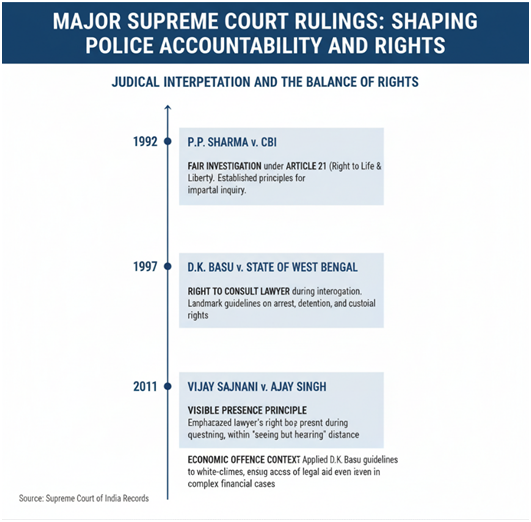
In State of Bihar v. P.P. Sharma, the Supreme Court enunciated a principle which has remained defining the legitimacy of police inquiry: fairness is an Article 21 requirement of the constitution.
The Court noted in paragraphs 47 to 51 that investigation is not solely a prerogative of the executive; it has to adhere to due process. It ruled that although the judiciary cannot instruct how an investigation should proceed, it can step in when procedure turns arbitrary or mala fide.
This case is pivotal in understanding why the presence of advocates is important. When attorneys ensure that investigation adheres to legal procedure, they support the rule of law and not hinder it. The ruling thus places advocates in the role of enabling fairness, not hindering state function.
Ethical Boundaries under the Bar Council of India Rules
The advocates have to work within specified ethical bounds at the investigative phase. The Bar Council of India Rules, Part VI, Chapter II, established the professional standards of conduct. Rule 24 forbids a lawyer from communicating with an opposing side who is counselled.
Moreover, Rule 36 prohibits any conduct that is likely to prejudice or interfere with the investigation, thereby ensuring that attorneys cannot control witnesses or dictate how statements can be taken. They can, however, advise clients on their rights under Sections 160 and 161 CrPC, advising them on how to answer legally while safeguarding against self-incrimination.
Violations of these principles have resulted in disciplinary actions before State Bar Councils. For example, in B. Mallaiah v. Bar Council of India, an advocate was censured for interfering directly with an investigating officer. The case reminded us that the role of the advocate is to serve justice and not to gain advantage by way of interference.
Lawyer Presence During Witness Examination
Talking about this subject with LawyersClubIndia, Advocate Siddharth Narang said that “Advocates should have a meaningful role in the investigative stage, not to interfere, but to ensure that fairness, due process, and the rights of the accused or the complainant are protected from the outset.”
This statement is inline with the The Kerala High Court's decision in C.P. Raju v. State of Kerala (para 31–34), which infused subtle clarity into the subject matter of the presence of advocates when witnesses are being examined under Sections 160 and 161 CrPC.
The Court held that while it is improper for a lawyer to be seated within the room during such examination, they can stay visibly present if the witness feels afraid or apprehensive. Further, Justice Mathew had clarified that the arrangement preserves the sanctity of the investigation without allowing witnesses to be intimidated.
This case is an important one in the sense that it broadens the scope of the discussion from accused individuals to witnesses and appreciates that legal protection at investigation is not just an entitlement of the accused but an integral component of a fair process for all participants.
Police Accountability and the Role of Lawyers
The ruling in Prakash Singh v. Union of India, although specifically on the issue of police reforms, presents a wider vision on the imperative of lawyers for investigations to be made accountable. The Supreme Court in paragraphs 20 to 23 called for the establishment of State Security Commissions and Police Complaints Authorities with the aim of keeping investigations free from political pressures.
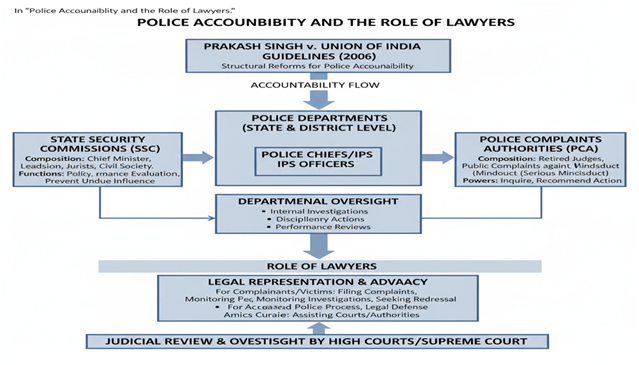
The Court's focus on institutional control finds harmony with the role of lawyers as individual custodians of procedural justice. When advocates ensure compliance with CrPC and constitutional protections, they affirm the accountability framework mandated in Prakash Singh.
This connection between institutional reform and individual watchfulness finds its justification in why lawyer engagement, within appropriate boundaries, enhances rather than undermines investigative integrity.
Lawyer's Role in Electronic Investigations
Current investigations now involve more computer searches, email seizure, and device imaging. Section 126 of the Evidence Act, safeguards lawyer-client confidential communications. The advent of electronic data has exposed this privilege to greater risk. Attorneys present during electronic evidence gathering can ensure privileged material is not accessed and copied inappropriately.
These problems were brought back to life in the case of Karti Chidambaram v. Directorate of Enforcement. The Delhi High Court and Supreme Court noted the inherent character of lawyer-client privilege in relation to digital evidence seizures.
The Delhi High Court, in adjudging on anticipatory bail and procedural justice, observed that the presence of lawyers at the time of seizure and inspection of computers was not simply a procedural nicety, but was also important for the protection of constitutional rights, particularly privacy and confidentiality under Article 21 of the Constitution.
Additionally, the Supreme Court, in its judgment, also elaborately talked about the risk posed by digital searches on privileged communications. In its final verdict, paragraphs 29-32 emphasize how investigation agencies should refrain from gaining access to privileged information while carrying out digital searches and device imaging.
In addition, the Court added that "no direct evidence was produced that the accused tried to influence witnesses," and reiterated ensuring the sanctity of the process by maintaining legal privilege and procedural safeguards.
Also, in the recent case of INX Media, the Delhi HC, while issuing orders for bail amendment and procedural safeguard, added further that advocates' presence during electronic evidence collection has a twofold purpose
- Preventing inadvertent or wilful violation of privileged content.
- Being a watchdog for procedural compliance through investigative agency probes.
While speaking to LCI, Advocate Siddharth Narang also mentioned that “Early legal involvement often prevents procedural lapses that later derail trials. Even limited participation such as observing evidence collection or ensuring lawful witness examination can make the process more transparent and balanced. “
Thus, in view of the impending adoption of the Digital Personal Data Protection Act, procedural protection would probably become more stringent to require more explicit protocols on the treatment of privileged digital information. This would place the advocate in an even more critical role as privacy watchman in the digital era of investigation.
The Way Forward
Supreme Court's observations illustrate that the judiciary is aware of both the need and the limitations of lawyer presence in investigations. There still is a statutory need for clarification.
So, the Parliament may enact legislation to refine Section 41D to more clearly define "consultation" and state conditions under which counsel can be seen to be present during interrogation. Police manuals must similarly formalize the operational details of this right so that officers in the field cannot arbitrarily refuse it.
The Bar Council of India, in turn, will have to design training modules on ethical advocacy while conducting investigations, particularly digital evidence handling, client counselling, and dealing with the police. This would institutionalize professionalism without compromising procedural integrity.
Conclusion
The scope of advocate participation in the investigation process embodies the tension between liberty and law enforcement, protection and procedure. From D.K. Basu to Jugal Kishore Samra and beyond, Indian jurisprudence has consistently recognised that advocates serve as guardians of constitutional rights. Their role during investigation, though restrained, remains vital in upholding Article 21 and ensuring fair treatment of every individual subject to state power.
Properly regulated and ethically guided, advocate participation enhances transparency, strengthens accountability, and reinforces public faith in criminal justice. As technology and investigative methods evolve, the advocate’s silent yet visible presence will continue to symbolise the balance between the might of the State and the rights of its citizens—a balance on which the very legitimacy of India’s legal system rests.
FAQS
Q1. When does an accused person have the right to meet an advocate during investigation?
The right to consult a lawyer arises as soon as a person is arrested or detained for questioning. Section 41D of the Code of Criminal Procedure, 1973, gives an arrested individual the right to meet an advocate of their choice during interrogation, though not continuously throughout it. This safeguard is rooted in the constitutional right to life and liberty under Article 21, which requires that every investigation be fair and just. The lawyer’s presence ensures that the accused understands the process and that no coercion or unlawful pressure is applied.
Q2. Can an advocate remain present inside the interrogation room during questioning?
Courts have consistently held that a lawyer may not be present inside the interrogation room itself. The right extends only to meeting the advocate at reasonable intervals or being within visible distance during questioning. This balance allows investigating officers to carry out their duties effectively while protecting the rights of the accused from undue influence or mistreatment.
Q3. Can a lawyer accompany a witness during the recording of statements under Sections 160 or 161 of the CrPC?
Ordinarily, witnesses do not have the right to be accompanied by lawyers when their statements are recorded under Sections 160 or 161. However, courts have occasionally allowed a lawyer to remain nearby if the witness fears intimidation or coercion. The purpose of this limited permission is to prevent abuse, not to let the advocate intervene in the investigative process.
Q4. Are these rights available during investigations under special statutes like customs, GST, or money-laundering laws?
Yes, the fundamental right to consult a lawyer still applies, but the manner in which it is exercised can vary under special statutes. For example, agencies such as the Directorate of Revenue Intelligence or the Enforcement Directorate often operate under separate laws that grant them wider powers of interrogation. In such cases, courts have permitted the lawyer to be within visible distance but not inside the interrogation room, maintaining a careful balance between investigation efficiency and constitutional protection.
Q5. Can a lawyer be summoned for questioning merely because they advised a client?
No. Advocates cannot be summoned for interrogation simply because they offered legal advice to a client under investigation. The professional duty of confidentiality between a lawyer and client is protected under law. A lawyer can be questioned only if there is evidence showing active participation in an illegal act, not merely for performing their professional role.
Q6. What safeguards exist to prevent abuse of power during investigation when a lawyer is not continuously present?
The Indian Constitution and criminal procedure law together create several layers of protection. Every arrested person must be informed of their rights, produced before a magistrate within twenty-four hours, and allowed access to legal counsel. Courts have also recognised that a fair investigation is part of the right to life and liberty. Lawyers reinforce these safeguards by advising clients, challenging illegal detention, and moving the courts whenever procedural fairness is compromised.
Q7. What role does a complainant’s lawyer play during the investigation?
A complainant or victim can engage a private lawyer, but the investigation itself remains under the control of the police or investigating agency. The lawyer may assist by providing documents, guiding the victim, or monitoring progress through appropriate applications, yet they cannot dictate the course of investigation. The real participation of such counsel begins once the matter moves into trial, though calls for greater victim participation continue to grow.
Q8. Can an advocate intervene if illegal search or seizure takes place?
If an illegal search or seizure is suspected, an advocate can advise the client to record objections, ensure that a proper panchanama or list of seized items is prepared, and later challenge the procedure before the magistrate or in a writ petition. While the lawyer cannot physically stop the search, their role is to ensure that procedural safeguards such as warrants, witnesses, and documentation are followed in letter and spirit.
Q9. How does the right to counsel intersect with protection against self-incrimination?
Article 20(3) of the Constitution protects every individual from being compelled to be a witness against themselves. The presence or consultation of a lawyer strengthens this right by ensuring that any confession or statement made during interrogation is voluntary. If an investigating officer obtains a statement through coercion or without legal awareness of rights, that statement can be challenged and excluded from evidence.
Q10. What remedies are available if an investigating officer denies access to a lawyer?
If the police prevent an accused from consulting an advocate, it amounts to a violation of both statutory and constitutional rights. The lawyer or the accused’s family can immediately approach the magistrate, the Superintendent of Police, or file a habeas corpus or writ petition before the High Court. Courts have taken such violations seriously, recognising that denial of legal access undermines the entire legitimacy of the investigation.
Q11. Can a lawyer advise a client during digital or online interrogation?
With the rise of digital investigations and online questioning by agencies, the same principles apply. The accused or witness has the right to consult their lawyer even if questioning occurs virtually. While the agency may restrict live participation, it cannot prevent private consultation before or after the session. Lawyers now routinely advise clients remotely to ensure that online procedures remain fair and lawful.
Q12. How does anticipatory bail interact with the right to counsel during investigation?
When a person fears arrest, anticipatory bail under Section 438 of the CrPC becomes an essential safeguard. Once bail is granted, the individual can participate in the investigation with legal assistance without fear of custody or coercion. The lawyer plays a vital role here by guiding the client on conditions imposed by the court and ensuring compliance to avoid cancellation of bail.
Q13. What happens if an advocate interferes with the investigation process?
While lawyers are protectors of rights, they must also respect boundaries set by law. If an advocate obstructs the investigation, tampers with evidence, or influences witnesses, disciplinary and criminal consequences may follow. The Bar Council of India Rules and professional ethics clearly prohibit any interference with lawful investigation. The system relies on advocates to balance advocacy with responsibility.
Q14. Can a lawyer’s advice to remain silent be held against the accused?
No. Advising a client to remain silent is a lawful exercise of the right against self-incrimination. Courts have recognised that silence cannot be treated as guilt. The advocate’s role is to ensure that any statement given is voluntary, accurate, and legally informed. This is an essential element of fair procedure under Article 21.
Q15. Why is the advocate’s participation in the investigation process important for justice?
The presence or guidance of a lawyer during investigation acts as a check against abuse of power. It ensures that confessions are voluntary, that arrests and searches follow due process, and that no one is deprived of liberty without legal justification. While the lawyer’s participation is limited, their influence is profound—they uphold the balance between state authority and individual freedom, which lies at the core of the rule of law in India.
Join LAWyersClubIndia's network for daily News Updates, Judgment Summaries, Articles, Forum Threads, Online Law Courses, and MUCH MORE!!"


Tags :others