
Abstract
Constitutional and statutory torts in India emerged as responses to the inadequacy of traditional private law remedies in addressing grave violations of rights by the State and its agents. Constitutional torts enable courts through Articles 32 and 226 to award public law compensation for violations of fundamental rights especially Article 21 thereby holding the State strictly and vicariously liable while statutory torts embed tort principles into legislation like the Consumer Protection Act, Motor Vehicles Act, environmental laws and human rights statutes. Landmark judgments such as Rudal Shah, Nilabati Behera, D.K. Basu and Bhim Singh have shaped this field by rejecting sovereign immunity in fundamental rights cases clarifying that constitutional compensation supplements rather than replaces civil or criminal remedies and affirming the judiciary’s role as primary guardian of fundamental rights.
Constitutional and statutory torts in India represent the convergence of public law and traditional tort principles to secure effective remedies especially compensation for violations of fundamental rights and other legal injuries caused by the State and its agents. Courts have transformed Articles 32 and 226 into powerful tools for public law compensation while gradually limiting sovereign immunity and expanding state liability through landmark judgments like Rudal Sah and Nilabati Behera.
Introduction
Tort law is the branch of civil law that deals with wrongful acts causing legal injury for which courts award unliquidated damages. Traditional tort remedies are private law remedies damages, injunctions, etc. enforced between private parties in ordinary civil courts whereas public law remedies operate through writ jurisdiction to enforce constitutional or statutory duties against the State.
In India, tort law evolved under strong influence of English common law, especially doctrines like negligence, vicarious liability, and strict liability. Over time, Indian courts shifted from a broad doctrine of sovereign immunity to greater state accountability particularly where fundamental rights under Part III are violated.
The need for constitutional and statutory torts arose because ordinary civil suits are often slow, expensive and procedurally cumbersome, failing to give timely relief for gross rights violations such as illegal detention or custodial death. To protect fundamental rights effectively courts resorted to judicial activism developing a doctrine of public law compensation as a distinct, additional remedy for constitutional wrongs.
Concept of constitutional torts
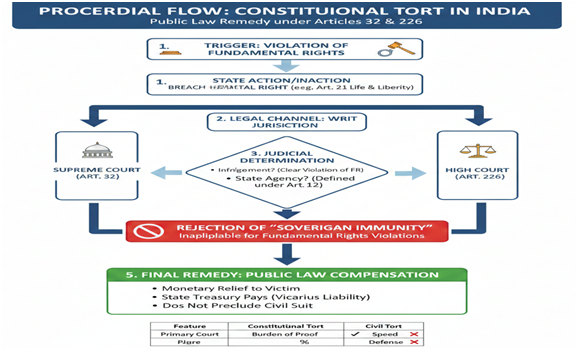
A constitutional tort may be described as a public wrong resulting from violation of a fundamental right by the State or its agents for which courts award compensation directly under the Constitution, mainly through Articles 32 or 226. It treats the State as vicariously liable for unconstitutional acts of its officials independent of traditional private law requirements like fault proved in a civil suit.
In India, the origin of constitutional torts is closely tied to the remedial power under Article 32 (Supreme Court) and Article 226 (High Courts) which allow courts to mould relief including monetary compensation for established violations of fundamental rights especially Article 21. The doctrine of public law compensation was articulated and consolidated in cases like Rudal Sah and Nilabati Behera where damages were granted within writ proceedings.
A constitutional tort differs from a civil tort in its source, purpose and forum: the former arises from breach of constitutional obligations and is enforced in writ jurisdiction as a public law remedy while the latter arises from common law or statute and is enforced through ordinary civil actions. Public law remedies focus on vindicating fundamental rights and deterrence of state abuse whereas private law remedies focus on individual loss and corrective justice between parties.
State liability for violation of fundamental rights
Article 12 defines State broadly to include the Government and Parliament of India, State Governments and legislatures and all authorities under their control thereby bringing governmental agencies and instrumentalities within the net of constitutional liability. The responsibility of such authorities extends not only to refraining from direct rights violations but also to positively protecting life and liberty under Article 21 when a person is in state custody or under state control.
In Kasturi Lal v. State of U.P., the Supreme Court accepted sovereign immunity for tortious acts of police officials in a traditional civil claim, limiting state liability for negligence in exercise of sovereign functions. Later constitutional jurisprudence especially in Rudul Sah and Nilabati Behera rejected sovereign immunity as a defence where there is violation of fundamental rights, holding that such immunity has no place in the scheme of Part III.
The nature of liability in constitutional tort cases is often characterized as strict in the sense that once a violation of a fundamental right (such as Article 21 by illegal detention or custodial violence) is established the State is liable without the need to prove traditional fault elements. Vicarious liability of the State is emphasised the government is liable for constitutional wrongs committed by its officials in the course of their public functions irrespective of individual officer’s personal liability.
Compensation under Articles 32 and 226 is treated as a constitutional remedy to redress breach of fundamental rights and to deter future violations. Courts consistently clarify that such public law compensation does not bar or substitute civil suits for damages or criminal prosecution of responsible officials, it is an additional remedy.
Misfeasance in public office
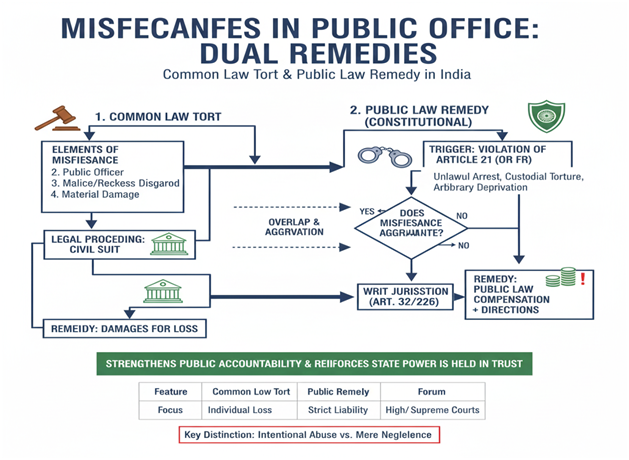
Misfeasance in public office is a tort involving abuse of power by a public official who acts maliciously or knowingly in excess of authority thereby causing injury to a person. It focuses on deliberate or consciously unlawful acts distinguishing it from mere negligence in performance of official duties.
The essential elements generally identified are the defendant must be a public officer, the act must involve exercise of public power, there must be malice, targeted ill-will or knowledge or reckless disregard that the act is unlawful and the claimant must suffer material damage as a result. This structure aligns misfeasance with a rights-based conception of public accountability not merely error in administration.
Misfeasance often implicates Article 21 when abuse of authority leads to unlawful arrests, custodial torture or arbitrary deprivation of life and personal liberty thereby engaging constitutional protections. Recognition of such abuse as actionable strengthens the accountability of public servants and reinforces that state power is held in trust for the people.
Indian courts increasingly acknowledge misfeasance in public office within constitutional litigation treating deliberate abuse of power as aggravating factor when awarding compensation or issuing directions under Articles 32 and 226. Scholarly and judicial commentary indicates that misfeasance is now seen as both a common law tort and a trigger for public law remedies in appropriate cases.
Landmark judicial decisions
Rudal Shah v. State of Bihar (1983)
Rudal Shah had been acquitted of criminal charges but remained in jail for about 14 years after his acquittal, amounting to grossly illegal detention by state authorities. The Supreme Court seized through a writ under Article 32, treated the continued incarceration as a violation of Article 21 and ordered his release along with monetary compensation.
The Court granted compensation directly in the writ proceedings despite absence of any explicit constitutional provision for damages and described it as necessary to make the guaranteed right to life meaningful. This judgment laid the foundation of the constitutional tort doctrine by recognising compensation as an appropriate public law remedy for fundamental rights violations.
Nilabati Behera v. State of Orissa (1993)
In Nilabati Behera, the petitioner’s 22 year old son died in suspicious circumstances shortly after being taken into police custody, and his body was later found on a railway track. Treating a letter petition as a writ under Article 32, the Supreme Court held the State liable for custodial death, a clear violation of Article 21.
The Court awarded compensation to the mother as a public law remedy and stressed that this did not bar a separate civil suit for damages or criminal action against the police officials. Crucially the Court distinguished Kasturi Lal confining sovereign immunity to ordinary tort claims and holding that such immunity is inapplicable where the claim is for contravention of fundamental rights under the Constitution.
Other important cases
In D.K. Basu v. State of West Bengal, the Supreme Court framed detailed guidelines to prevent custodial torture and deaths, treating such abuse as a violation of Articles 21 and 22 and linking non compliance to state liability including compensation. The case exemplifies how procedural safeguards and compensatory remedies together constitute constitutional tort responses to police excesses.
In Bhim Singh v. State of J&K, an MLA was unlawfully detained to prevent him from attending the Assembly, and the Court held that his fundamental rights were violated and awarded monetary compensation under Article 32. This decision reinforced that illegal arrest and detention by police constitute grounds for public law compensation against the State.
Tort principles in statutory enactments
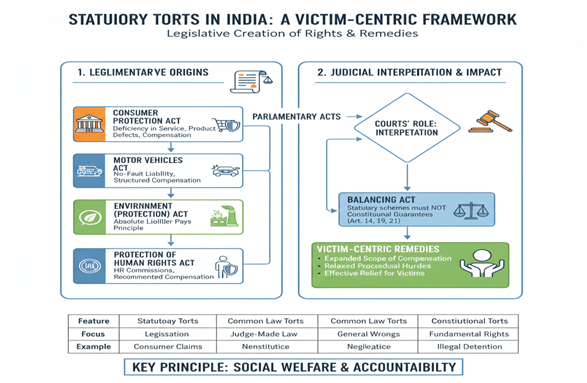
Statutory torts arise when legislation either creates new civil wrongs or codifies liability rules that closely resemble tort principles often providing for compensation and special forums. In India, tortious liability has been partially codified in specific areas such as motor vehicle accidents, consumer protection, workmen’s compensation, and environmental protection.
Under the Consumer Protection Act, deficiency in service and product defects allow consumers to claim compensation for harm reflecting negligence and product liability concepts in a statutory form. The Motor Vehicles Act provides for no fault and structured compensation for road accidents reducing the burden on victims to prove negligence and embedding tort-like liability in a social welfare framework.
Environmental jurisprudence under statutes like the Environment (Protection) Act has developed the doctrine of absolute liability for hazardous industries especially through cases like M.C. Mehta and subsequent decisions applying the polluter pays principle. The Protection of Human Rights Act, 1993 empowers Human Rights Commissions to recommend compensation for violations by public authorities blending statutory and tort-like mechanisms for redress.
Courts interpret statutory torts in a victim centric manner often expanding the scope of compensation and relaxing procedural hurdles to ensure effective relief. At the same time, they balance state functions and individual rights by insisting that statutory schemes do not dilute constitutional guarantees under Articles 14, 19, and 21.
Comparative analysis
Constitutional torts vs statutory torts
| Aspect | Constitutional torts | Statutory torts |
| Source of liability | Directly from Constitution, especially breach of fundamental rights under Part III. | From specific statutes that create or regulate civil liability, e.g., Consumer Protection Act, Motor Vehicles Act, environmental laws. |
| Nature of remedy | Public law remedy, usually compensation plus directions under Articles 32/226, aimed at vindicating rights and deterring abuse | Civil remedy structured by statute; may include compensation, penalties, or other relief before designated tribunals/courts. |
| Burden of proof | Often relaxed once violation of a fundamental right in state custody or control is shown; liability tends toward strict. | Generally follows statutory standards, sometimes no‑fault (e.g., motor accidents), sometimes negligence‑based (e.g., consumer cases). |
| Forum of enforcement | Supreme Court under Article 32 and High Courts under Article 226 through writ petitions. | Civil courts, special tribunals (consumer commissions, Motor Accident Claims Tribunals, NGT, Human Rights Commissions) as prescribed by statute. |
Critical analysis and challenges
A recurring debate concerns whether expansive use of public law compensation amounts to judicial overreach or is a necessary response to executive failure and procedural delays in civil and criminal justice systems. Many scholars argue that without this judicial creativity, fundamental rights especially Article 21 would remain largely declaratory in cases of gross abuse.
There is no comprehensive codified legislation on constitutional torts in India the doctrine remains judge made and case specific leading to doctrinal uncertainty. This lack of codification complicates questions like limitation periods measure of damages and the interface with parallel civil or criminal proceedings.
Compensation standards are often inconsistent across cases with courts relying on broad discretion rather than a structured framework resulting in wide variance for similar harms. Enforcement is another challenge securing actual payment from state authorities and ensuring disciplinary or criminal action against responsible officials is frequently slow and incomplete.
Suggestions and reforms
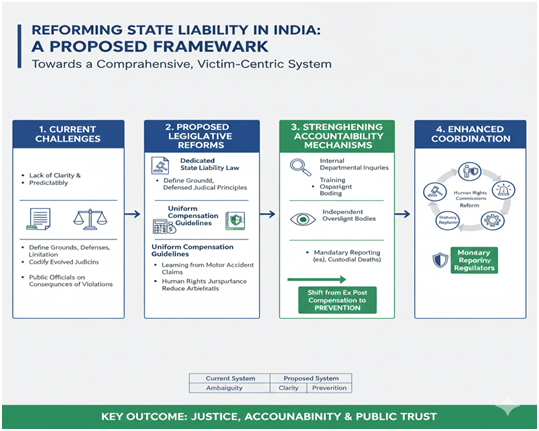
Many commentators suggest enacting a dedicated statute on state liability and constitutional torts, clearly defining grounds of liability, defences, limitation and relationship with other remedies. Such a law could incorporate principles already evolved by courts while providing clarity and predictability for victims and the State.
Uniform guidelines for assessment of compensation perhaps drawing on matrices used in motor accident claims and human rights jurisprudence could reduce arbitrariness and ensure proportionality. Parallel reforms should include systematic training of public officials on human rights standards and consequences of violations.
Strengthening accountability mechanisms such as internal departmental inquiries, independent oversight bodies and mandatory reporting of custodial deaths would complement judicial remedies and help shift focus from ex post compensation to prevention. Enhanced coordination between courts, Human Rights Commissions and statutory regulators can also ensure that findings of violations translate into both monetary redress and institutional reform.
Lawyer’s Insight ( Pratham Kindra)
Lawyers regard constitutional torts as a pragmatic judicial innovation under Articles 32 and 226 enabling rapid public law compensation for fundamental rights violations particularly Article 21 breaches like illegal detention or custodial deaths without the procedural delays of civil suits, as pioneered in Rudal Sah v. State of Bihar (1983) and solidified in Nilabati Behera v. State of Odisha (1993). In practice, we strategically frame petitions to invoke strict and vicarious state liability citing these precedents to dismantle sovereign immunity defenses and secure interim relief often quantifying damages via multipliers based on age, loss of earnings and trauma yielding awards from ₹5-50 lakhs in recent custodial cases enforceable through contempt if states delay payment.
For statutory torts, we favor specialized forums like Consumer Commissions for service deficiencies under the Consumer Protection Act, Motor Accident Claims Tribunals for no-fault accident compensation and the National Green Tribunal for absolute liability in environmental harms balancing efficiency with victim-centric remedies while avoiding overlaps with constitutional claims. Challenges include judicial discretion leading to inconsistent awards and enforcement hurdles prompting litigators to pair individual petitions with PILs for systemic directives and codification for uniform standards limitation periods and integrated tribunals to enhance predictability and deterrence against public official misconduct.
Conclusion
The evolution of constitutional torts in India reflects a judicial effort to make fundamental rights particularly Article 21 concretely enforceable through compensation and directions against the State. Statutory torts meanwhile demonstrate how legislatures incorporate tort principles into specific fields consumer protection, motor accidents, environment and human rights to provide structured remedies.
Landmark judgments such as Rudal Shah, Nilabati Behera, D.K. Basu and Bhim Singh have been pivotal in transforming writ jurisdiction into an effective vehicle for public law compensation and in dismantling sovereign immunity in the realm of fundamental rights. Despite challenges of non codification, inconsistent standards and enforcement gaps the judiciary continues to play a central role in using constitutional and statutory torts to protect individuals against abuse of public power.
Join LAWyersClubIndia's network for daily News Updates, Judgment Summaries, Articles, Forum Threads, Online Law Courses, and MUCH MORE!!"


Tags :Others