
Rape as an Offense
Under IPC
The word rape is derived from the Latin term rapio, which mean ‘to seize’. Thus rape literally means a forcible seizure. It signifies in common terminology, “as the ravishment of a woman without her consent, by force, fear, or fraud” or “the carnal knowledge of a woman by force against her will.” In other words, rape is violation with violence of the private person of a woman.
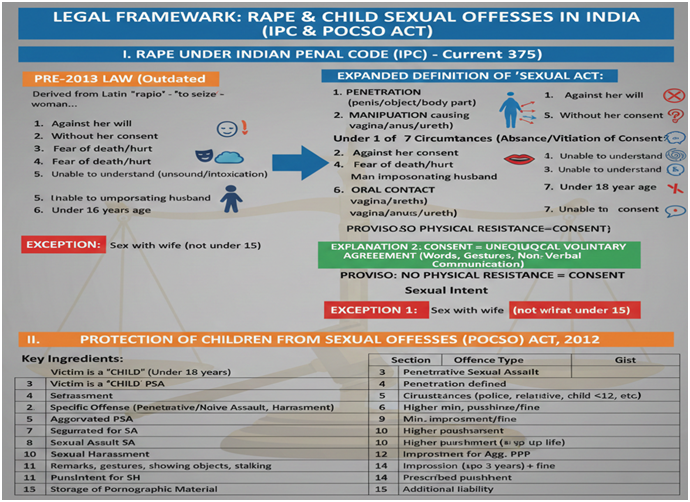
In the Indian Penal Code, Section 375 defines rape. A man is said to commit” rape” who, except in the case hereinafter excepted, has sexual intercourse with a woman under circumstances falling under any of the six following descriptions:-
First.- Against her will.
Secondly.- Without her consent.
Thirdly.- With her consent, when her consent has been obtained by putting her or any person in whom she is interested in fear of death or of hurt.
Fourthly.- With her consent, when the man knows that he is not her husband, and that her consent is given because she believes that he is another man to whom she is or believes herself to be lawfully married.
Fifthly.- With her consent, when, at the time of giving such consent, by reason of unsoundness of mind or intoxication or the administration by him personally or through another of any stupefying or unwholesome substance, she is unable to understand the nature and consequences of that to which she gives consent.
Sixthly.- With or without her consent, when she is under sixteen years of age.
Explanation.- Penetration is sufficient to constitute the sexual intercourse necessary to the offence of rape.
Exception.- Sexual intercourse by a man with his own wife, the wife not being under fifteen years of age, is not rape.”
Taking note of the inadequacy of law of rape and its failure to safeguard the rights of the innocent victims against the heinous crime, the Parliament in 1983 and 2013 extensively amended the law of rape so as to make the law more realistic.
After amendment
A man is said to commit “rape” if he-— penetrates his penis, to any extent, into the vagina, mouth, urethra or anus of a woman or makes her to do so with him or any other person; or inserts, to any extent, any object or a part of the body, not being the penis, into the vagina, the urethra or anus of a woman or makes her to do so with him or any other person; or manipulates any part of the body of a woman so as to cause penetration into the vagina, urethra, anus or any of body of such woman or makes her to do so with him or any other person; or applies his mouth to the vagina, anus, urethra of a woman or makes her to do so with him or any other person, under the circumstances falling under any of the following seven descriptions:—
First.—Against her will.
Secondly.—Without her consent.
Thirdly.—With her consent, when her consent has been obtained by putting her or any person in whom she is interested, in fear of death or of hurt.
Fourthly.—With her consent, when the man knows that he is not her husband and that her consent is given because she believes that he is another man to whom she is or believes herself to be lawfully married.
Fifthly.—With her consent when, at the time of giving such consent, by reason of unsoundness of mind or intoxication or the administration by him personally or through another of any stupefying or unwholesome Substance, she is unable to understand the nature and consequences of that to which she gives consent.
Sixthly.—With or without her consent, when she is under eighteen years of age.
Seventhly.—When she is unable to communicate consent.
Explanation I.—For the purposes of this section, “vagina” shall also include labia majora.
Explanation 2.—Consent means an unequivocal voluntary agreement when the woman by words, gestures or any form of verbal or non-verbal communication, communicates willingness to participate in the specific sexual act: Provided that a woman who does not physically resist to the act of penetration shall not by the reason only of that fact, be regarded as consenting to the sexual activity.
Exception I.—A medical procedure or intervention shall not constitute rape.
Exception 2.—Sexual intercourse or sexual acts by a man with his own wife, the wife not being under fifteen years of age, is not rape.’
Under POCSO
The Protection of Children from Sexual Offences Act, 2012 is a special statute dealing with sexual offences against children. It creates a graded scheme of penetrative sexual assault, aggravated penetrative sexual assault, sexual assault, aggravated sexual assault and sexual harassment.
The following table briefs about the sexual offences punishable under POCSO, 2012
| Section | Offence | Type Gist |
| 3 | Penetrative sexual assault | Defines penetrative sexual assault on a child (penis/object/body part/mouth causing penetration). |
| 4 | Punishment for penetrative sexual assault | Minimum imprisonment and fine for penetrative sexual assault. |
| 5 | Aggravated penetrative sexual assault | Lists aggravated circumstances (by police, relative, public servant, during communal violence, child below 12, etc.). |
| 6 | Punishment for aggravated penetrative sexual assault | Higher minimum imprisonment (up to life) and fine for aggravated penetrative sexual assault. |
| 7 | Sexual assault | Defines non‑penetrative sexual assault involving sexual intent and physical contact without penetration. |
| 8 | Punishment for sexual assault | Prescribes minimum imprisonment and fine for sexual assault. |
| 9 | Aggravated sexual assault | Defines aggravated forms of sexual assault in specified relationships/circumstances. |
| 10 | Punishment for aggravated sexual assault | Higher punishment for aggravated sexual assault. |
| 11 | Sexual harassment of a child | Enumerates acts amounting to sexual harassment (remarks, gestures, showing objects, stalking, etc.). |
| 12 | Punishment for sexual harassment | Imprisonment (up to three years) and fine for sexual harassment. |
| 13 | Use of child for pornographic purposes | Defines use of a child for pornography. |
| 14 | Punishment for use of child for pornographic purposes | Prescribes punishment for offences under section 13. |
| 15 | Storage of pornographic material involving child | Additional liability for storing child porn for commercial/other purposes |
Thus, for POCSO, the ingredients generally require:
- Victim is a “child” (under 18 years).
- Accused performs an act falling within the definition of penetrative or non penetrative sexual assault or sexual harassment.
- Presence of sexual intent. The Act employs presumptions of culpable mental state and presumption against the accused once foundational facts are proved.
Consent
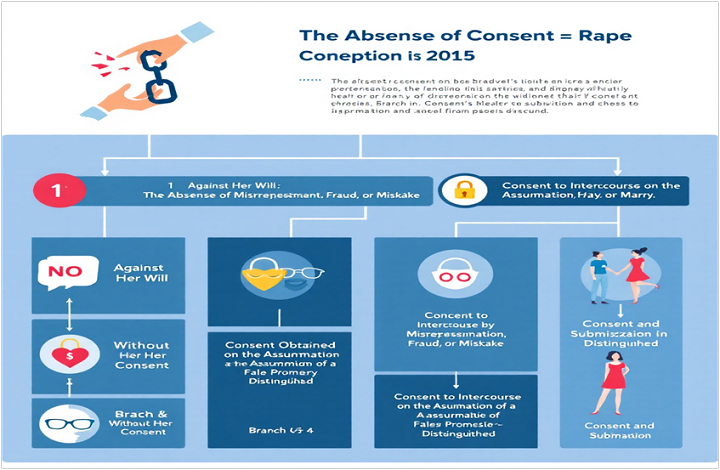
The essence of rape is the absence of consent. Consent means an intelligent, positive concurrence of the ‘will’ of the woman. The policy behind the exemption from liability in the case of consent is based on the principle that a man is the best judge of his or her own interest, and if a man (includes woman) decides to suffer harm voluntarily, he or she cannot complain of it when it comes about.
According to Explanation 2, consent means an unequivocal voluntary agreement when the person by words, gestures or any form of non-verbal communication, communicates a willingness to participate in the specific sexual act. Thus, to absolve a person of criminal liability, consent must be given freely and it must not be obtained by fraud or by mistake or under a misconception of fact. This clause operates where a woman is unresponsive whether because of the influence of drink or drugs or any other cause, or is so imbecile that she is incapable of giving any rational consent. Consent of the woman has to be obtained prior to the act. The burden of proof: In case of charge of rape the onus lies upon the prosecution to prove that the sexual intercourse was without the consent or against the will of the woman. It would not be necessary for the defence to prove that the sexual intercourse was with the consent of the woman.
1. Against her will:
The word ‘will’ implies the faculty of reasoning power of the mind that determines whether to do an act or not. There is a fine distinction between an act done ‘against the will’ and ‘an act done without consent.’ Every act done ‘against the will’ is obviously ‘without the consent.’ But every act ‘without the consent’ is not ‘against the will.’ Clause (1) of this section applies where the woman is in possession of her senses and therefore, capable of consenting. In State of Uttar Pradesh v. Chottey Lal , the Supreme Court explained that the expression ‘against her will’ would ordinarily mean that the intercourse was done by a man with a woman despite her resistance and opposition.
In State of Punjab v. Gurmit Singh , a young girl below the age of 16 years was abducted from her school by the three accused in a car, and she was threatened with death if she raised an alarm. Despite her refusal, she was made to drink liquor. Then she was raped by each one of them in turn under the threat of being killed if she persisted in raising an alarm. Due to the threat, she kept quiet. After repeatedly committing sexual assault on her, they left her the next morning near the place from where she had been abducted.
Surprisingly, the additional judge, Ludhiana acquitted all the accused on both counts of abduction and rape disbelieving the version of prosecutrix regarding rape and because of delay in FIR. Allowing the State appeal, and holding the accused persons liable for rape since at no point of time the prosecutrix willingly cooperated with the act, the Apex Court held that the sexual intercourse was against her will for which the accused are liable for committing rape under
Section 376, IPC.
In addition to this, the Apex Court laid down the following guidelines for trial in such cases:
- Delay in lodging FIR is not material when properly explained.
- Testimony of victim in cases of sexual assault is vital and unless there are compelling reasons which necessitate looking for corroboration of her statement, the Court should find no difficulty in convicting the accused on prosecutrix’s testimony alone.
- Trial of sexual offences should be in camera and invariably by a lady judge whenever available.
- Court must restrain making observations that probably the prosecutrix is a girl of loose moral character.
- Court is under an obligation to see that prosecutrix is not unnecessarily harassed and humiliated in cross-examination in case of rape trial.
2.Without her consent:
The essence of rape is the absence of consent. Consent means an intelligent positive concurrence of the ‘will’ of the woman. The policy behind the exemption from liability in the case of consent is based on the principle that a man is the best judge of his or her own interest, and if a man (includes woman) decides to suffer harm voluntarily, he or she cannot complain of it when it comes about.
According to Explanation 2, consent means an unequivocal voluntary agreement when the person by words, gestures or any form of non-verbal communication, communicates a willingness to participate in the specific sexual act. Thus, to absolve a person of criminal liability, consent must be given freely and it must not be obtained by fraud or by mistake or under a misconception of fact. This clause operates where a woman is unresponsive whether because of the influence of drink or drugs or any other cause, or is so imbecile that she is incapable of giving any rational consent. Consent of the woman has to be obtained prior to the
act.
The burden of proof: In case of charge of rape the onus lies upon the prosecution to prove that the sexual intercourse was without the consent or against the will of the woman. It would not be necessary for the defence to prove that the sexual intercourse was with the consent of the woman.
3.Consent obtained by misrepresentation, fraud or under mistake is no consent:
Consent obtained by misrepresentation, fraud or under mistake is no consent. In Queen v. Flattery , the accused was charged for rape upon a 19-year-old girl. The girl who had ill health and was subject to fits, visited the accused’s clinic along with her mother and sought his advice for treatment. The accused, after examining the girl, advised her to have a surgical operation, to which she consented, and under pretence of performing it, had sexual intercourse with the girl. It was held that the girl’s consent would not excuse the accused from conviction as it was given under a mistake of fact. There was a misconception as to the nature of the act and whatever consent was given by the girl was for the purposes of surgical operation and not for sexual intercourse.In Williams , the accused was a choirmaster who had sexual intercourse with his 16-yearold student making her believe that he is performing a surgical operation to improve her singing voice. Consent was vitiated by fraud and it was obtained under a misconception, thus, he was held guilty of rape. In these cases, it is the non-consent to sexual intercourse rather than the fraud of the doctor or the choirmaster that makes the offence rape.
Therefore, in Moti Ram and Linekar , it was held that if a woman were willing to have sexual intercourse for monetary consideration, the fact that the consideration was found to be fictitious would not vitiate the consent. Since there was consent on the part of the prosecutrix for sexual connection, the accused persons are not liable for rape. It would amount only to breach of contract.
4.Consent to intercourse on the assumption of a false promise to marry:
Where a woman consents to sexual intercourse under the assumption of a promise to marry, the falsity of the promise doesn’t ipso facto vitiate consent. It depends on whether the accused’s promise was false from its inception or not. In Dileep Singh v. State of Bihar , the appellant was charged and convicted under Section 376, IPC for committing rape of a minor girl. The victim alleged that the accused forcibly raped her and later consoled her that he would marry her. Accordingly, on account of the promise for marriage made by him, she agreed to have sexual relations with him. After she became pregnant, she revealed the matter to her parents but efforts made by the father to establish marital tie failed. She was then constrained to file the complaint. Although the trial court and High Court convicted the accused, the Supreme Court set it aside. It said: “Consent given by a woman believing the man’s promise to marry her would fall within the expression ‘without her consent’ vide clause (ii) to Section 375 IPC, only if it is established that from the very inception the man never really intended to marry her and the promise was a mere hoax. When prosecutrix had taken a conscious decision to participate in the sexual act only on being impressed by the accused’s promise to marry her and the accused’s promise was not false from its inception with the intention to seduce her to sexual act, clause (ii) to section 375, IPC is not attracted and established.” In Uday v. State of Karnataka , accused expressed love and promised to marry the prosecutrix on a later date. Prosecutrix was quite aware that they belonged to different castes and proposal of their marriage would be opposed by their family members. Yet the prosecutrix started cohabiting with the accused consciously and became pregnant. On the charge of rape, the Court held that the consent given by the prosecutrix for cohabitation cannot be said to be given under a misconception of fact. She had freely, voluntarily and consciously consented to have sexual intercourse with the appellant not only on behalf of the promise of marriage but because of their deep love for each other. Hence the appellant was not held liable to be convicted for an offence of rape under Section 376, IPC. However, these were earlier positions. The Supreme Court has taken different views on such situations now.
In Pradeep Kumar Verma v. State of Bihar , it was held that in case of a representation deliberately made by the accused with a view to eliciting the assent of the victim without having intention to marry her, will vitiate the consent given by the victim. It was also observed that if on the facts it is established that at the very inception of the making of the promise the accused did not really entertain the intention of marrying the victim and the promise to marry held out by him was a mere hoax, the consent ostensibly given by the victim will be of no avail to the accused to exculpate him from the ambit of Section 375 clause second. Such representation would only vitiate the consent.
5.Consent and submission- distinguished:
A woman is said to consent only when she freely agrees to submit herself, while in free and unconstrained possession of her physical and moral power to act in a manner she wanted.
Consent may be either expressed or implied depending upon the nature and circumstances of the case. However, there is a difference between consent and submission. An act of helpless resignation in the face of inevitable compulsions is not consent in law. In Rao Harnam Singh, Sheoji Singh v. State, Kalu Ram, tenant of the accused was required to provide his wife aged 19 years to satisfy the carnal lust of the accused Rao Harnam Singh and his guests on the eve of entertainment party arranged on the occasion of transfer of Ch. Mauji Ram, Dy. Superintendent, Jail, Gurgaon. The girl protested vehemently against this outrageous demand, but under pressure of her husband, was induced to surrender. Three accused persons- Rao Harnam Singh, Ch. Mauji Ram, and Balbir Singh ravished her during the night and she died almost immediately. Her shrieks were heard by some advocate living in the neighborhood. Refuting the defense contention, that the girl was a consenting party and she surrendered her body to the three persons willingly and with approval of her husband, the High Court while holding the accused liable for the offence of rape distinguished between ‘consent’ and ‘submission’:
- A mere act of helpless resignation in the face of inevitable compulsion, quiescence, non-resistance, passive giving in, when volitional faculty is either clouded by fear or vitiated by duress, cannot be deemed to be ‘consent’ as understood in law.
- Consent on the part of a woman as a defence to an allegation of rape, requires voluntary participation, not only after the exercise of intelligence, based on the knowledge, of the significance and moral quality of the act, but after having freely exercised a choice between resistance and assent.
- Submission of her body under the influence of fear or terror is no consent. Although each consent involves a submission, the converse does not follow and a mere act of submission does not involve consent.
- A woman is said to consent, only when she freely agrees to submit herself, while in free and unconstrained possession of her physical and moral power to act in the manner she wants. Consent implies the exercise of a free and unhampered right to forbid or withhold what is being consented to; it always is a voluntary and conscious acceptance of what is proposed to be done by another and concurred in by the former.
6. Consent procured by putting the woman under fear of death or hurt is no consent in law:
Clause (3) to Section 375 IPC asserts that consent of the woman in order to exonerate the accused of the charge of rape must be given freely and voluntarily without any fear of death or injury. In such a case the consent obtained will not be a valid consent. The scope of the clause has been widened by the Criminal Law (Amendment) Act 1983 by the insertion of the words “or any person in whom she is interested” after the words “putting her” in fear of death or hurt in the clause.
Now it reads “With the other person’s consent when such consent has been obtained by putting such other person or any person whom such other person is interested, in fear of death or of hurt.” So now, the fear of death or hurt could be towards her children, husband or parents also.
In State of Maharashtra v. Prakash , the Apex Court held that where a police constable and businessman had sexual intercourse with a rustic woman by beating her husband and threatening to put him in police remand, the act falls under clause (3) of section 375 IPC. The suggestion that the victim had consented to intercourse willingly is ruled out for the offence of rape. It is not necessary that there should be actual use of force; a threat to use of force is sufficient. A criticized judgment of the Supreme Court in this regard was Tukaram v. State of Maharashtra popularly known as Mathura rape case. Mathura, an 18- year-old Harijan orphan girl was called to the police station on an abduction report filed her brother at the police station- Desaui Ganj in Maharashtra on 26th March 1972. When they were about to leave the police station, Mathura was kept back at the police station in the late hours of the night by one of the constables, Ganpat, who was on duty. She was taken to a toilet and raped. After him, another constable Tukaram tried to rape her but being too heavily drunk, did not succeed. None of the two accused were held guilty for the following reasons:
- There were no marks of injury on her person which show that the whole affair was a peaceful one and that the story of stiff resistance having been put up by the girl is all false.
- The girl was not subject to any fear that must have led her to submit to the act.
- The girl was not alone when Ganpat ordered her to stay and she could have resisted and appealed to her brother. Her conduct in meekly following Ganpat and allowing him to have his way with her to the extent of satisfying his lust in full, made them feel that the consent in question was not a consent which could be brushed aside as passive submission. The judgment of the Supreme Court was widely criticised both inside and outside the Parliament as an extraordinary decision sacrificing human rights and a disgrace on women under the law and the Constitution. Subsequent decisions of the Supreme Court tried to atone for what it had decided in the Mathura case.
In Balwant Singh v. State of Punjab , the victim aged 19/20 years was forcibly taken in a car by the five accused persons and raped by each in a grove on the canal bank. She was found lying unconscious under a banana tree near the canal bridge by her father. She was medically examined and the report specified that she was raped by more than one person. It was held by the court that the absence of injuries on the back of prosecutrix does not make the prosecution case unbelievable. The accused were five in number and the prosecutrix was a girl of 19/20 years. She was not expected to offer such resistance as would cause injuries to her.
7.Consent accorded under a misconception that the person is the husband of the woman is not a valid consent:
Consent given by a woman to a person for intercourse believing the person to be her husband whereas in fact, he is not her husband, is no consent in law. In such a situation the person knows the fact of deception, and pretends to be the husband of the woman. In Bhupinder Singh v. Union Territory of Chandigarh , the complainant Manjit Kaur married the accused Bhupinder Singh, who she had met through work, in 1990 and started cohabiting with him in Chandigarh. She became pregnant but accused got the fetus aborted in 1991. When she was pregnant again in 1994, she met her husband’s two friends who told her that he was already married and had children from his first wife. On being confronted her husband left her on the pretence of work and did not turn up even after she gave birth to a daughter.
She made a complaint and he was held guilty of rape because prosecutrix married accused without knowledge of his first marriage. The consent for cohabitation was given under the belief that the accused was her husband. It was also held that delay in lodging complaint by prosecutrix couldn’t, in any event, wash away the offence because there was no consent. Therefore, the Supreme Court refused to interfere with the order of conviction passed by the High Court.
8.Consent procured by a woman of unsound mind or under the influence of intoxication etc.:
Clause (5) of section 375 IPC was added vide the Criminal Law (Amendment) Act of 1983. The object of the new clause was to protect and safeguard the interest of the woman who accords consent for sexual intercourse without knowing the nature and consequences of the act by reason of unsoundness of mind or under the influence of stupefying or unwholesome substance or intercourse with a defective. In such cases, it is presumed that the consent of the woman is not free and voluntary to exonerate the accused of the charge of rape. In Tulshidas Kanolkar v. State of Goa , the accused had sexual intercourse, repeatedly with a woman who was incapable of comprehending the vicissitudes of the act. Consequently, the girl became pregnant. The additional session judge, holding the accused liable for rape under section 376 imposed a sentence of ten years of rigorous imprisonment along with a fine of Rs. 10000. However, the High Court in appeal reduced the sentence to seven years and the appellant went
in appeal against his conviction. The Apex Court dismissed the appeal and held that for constituting consent there must be the exercise of intelligence based on knowledge of the significance and moral effect of the act and criticised the High Court for reducing the sentence to seven years where it should not have interfered.
9.Consent of a girl under 18 not valid in law:
Sexual intercourse with a woman with or without her consent when she is below 18 years of age amounts to rape. A woman under 18 is considered incapable of giving consent for sexual intercourse. The age of consent was raised from 16 to 18 by the Criminal Law (Amendment) Act of 2013. The Apex Court in Harpal Singh , held that even if the girl of 14 is a willing
party and invited the accused to have sexual intercourse with her, the accused would be liable for rape under this clause
In Mana Ramchandra Jadhav v. State of Maharashtra, the prosecutrix left her mother’s house and joined the accused because her mother had turned down the proposal of her marriage with the accused on the ground that she was too young. While she was with the accused he had sexual intercourse with her against her will. The act of intercourse with the prosecutrix will be covered under this clause.
Penetrative and Non-penetrative
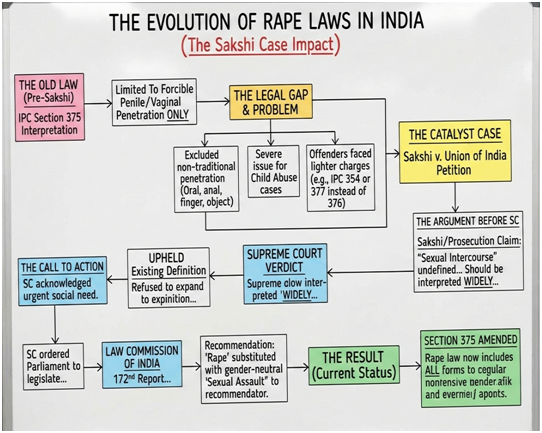
A very important case that led to definite amendments in the section is Sakshi v. Union of India and Ors. (the Union of India, the Ministry of Law and Justice and the New Delhi Commissioner of Police) . Sakshi, an NGO focusing on violence against women, petitioned the Supreme Court of India to declare that “rape” under India’s criminal rape law (Indian Penal Code, or “IPC”, section 375) includes all forms of forcible penetration. Sakshi claimed that the current interpretation of the law, limited rape to forcible penile/vaginal penetration only. The prosecution submitted that Section 375 IPC should be interpreted in the current scenario, especially in regard to the fact that child abuse has assumed an alarming proportion in recent times. The words ‘sexual intercourse’ in Section 375 IPC should be interpreted to mean all kinds of sexual penetration of any type of any orifice of the body and not the intercourse understood in the traditional sense. The words ‘sexual intercourse’ having not been defined in the Penal Code, there was no impediment in the way of the Court to give it a wider meaning so that the various types of child abuse may come within its ambit and the conviction of an offender may be possible under Section 376 IPC. Sexual abuse of children, particularly minor girl, children by means and manner other than penile/vaginal penetration is common and may take the form of penile/anal penetration, penile/oral penetration, finger/vaginal penetration or object/ vaginal penetration. It is submitted that by treating such forms of abuse as offenses falling under Section 354 IPC or 377 IPC, the very intent of the amendment of Section 376 IPC by incorporating Sub-section 2(f) therein is defeated. The said interpretation is also contrary to the contemporary understanding of sexual abuse and violence all over the world. The Court upheld the existing definition of rape as forcible penile/vaginal penetration only, refusing to include other forms of penetration within the ambit of rape as defined under IPC. The Court’s decision called on the Parliament of India to change the law, stating:
“The suggestions made by the petitioners [Sakshi] will advance the cause of justice and are in the larger interest of society. The cases of child abuse and rape are increasing at an alarming speed and appropriate legislation in this regard is, therefore, urgently required. We hope and trust that the Parliament will give serious attention to the points highlights by the petitioner and make appropriate legislation with all the promptness which it deserves.”
During the Sakshi case, the Court ordered the Law Commission of India to examine and respond to the issues that Sakshi raised. This exercise culminated in the 172nd Report of the
Law Commission of India (on a review of rape laws, March 2000). The Report suggested that the offence of “rape” be substituted by “sexual assault,” making the offence gender-neutral and applicable to a range of sexual offences other than forcible penile/vaginal penetration. As of today, the rape law in India under Section 375 stands amended and includes all forms of sexual assault and is not just limited to penile/vaginal intercourse or heterosexual intercourse.
Age Determination
Age Determination: Legal Framework And Methods
Age is critical under POCSO because “child” is defined as a person under 18 and many aggravated circumstances depend on the victim’s age (e.g., below 12 years). Age also matters for determining whether the accused is a juvenile under the Juvenile Justice law, affecting forum and sentence.
Documentary evidence
Courts give primacy to reliable documentary records:
- Birth certificates from municipal authorities.
- School admission registers and transfer certificates.
- Matriculation certificates and similar educational records.
Judicial interpretations (including in the context of the Juvenile Justice Act and POCSO) have held that:
- Where such documents exist and are not seriously challenged, they are preferred over medical estimates like bone ossification tests.
- Ossification or other medical tests should ordinarily be ordered only when documentary evidence is unavailable, doubtful or appears fabricated.
In decisions such as those discussed in academic and case note literature, courts have rejected requests for ossification tests where birth and school records clearly established age, including in the Nirbhaya case, where the juvenile’s age was accepted on documentary proof alone.
Bone ossification tests
Bone ossification is a radiological method estimating age based on the degree of fusion of epiphyses in long bones and other skeletal markers.
Key points about ossification tests in Indian criminal jurisprudence:
- It is not an exact science; there is typically a margin of error of about two years on either side of the assessed age.
- Courts treat ossification results as “advisory” or corroborative, not conclusive, especially when contradicting credible documentary evidence.
- In cases with no documents, ossification is often used with a benefit of doubt approach; for example, if the estimated age is 17–19, courts may adopt the lower end in favour of juvenile status or child status.
In Vishnu v. State of Maharashtra and similar cases, courts held that ossification reports cannot override positive documentary or ocular evidence of age. Conversely, where documentary evidence is found fabricated, courts have relied on ossification tests, as illustrated in discussions of decisions such as Ram Suresh Singh v. Prabhat Singh .
Dental examination and other medical indicators
Dental age estimation uses eruption and wear patterns of teeth to approximate chronological age. Courts and medico legal literature note that:
- Dental estimation, like ossification, is approximate and must be read with a margin of error.
- Environmental, nutritional, and genetic factors can affect tooth eruption and skeletal development, limiting precision.
Other indicators (e.g., secondary sexual characteristics, height, weight) may be considered, but they are even less precise and are rarely relied upon without supporting documentary or radiological evidence.
Contradictions and conflict of evidence
When age evidence conflicts, courts apply a structured approach:
- First, examine authenticity and reliability of documents (municipal records, school registers).
- Second, check whether there is any fabrication or manipulation; if so, discard those documents and move to medical opinion.
- Third, interpret ossification and dental reports with acknowledged margins of error, generally preferring an age range beneficial to the accused in juvenile status questions, or beneficial to the child in POCSO victim status determinations, depending on statutory policy.
Scholarly work argues for harmonising juvenile justice rules and POCSO by applying consistent age assessment standards and giving structured primacy to documentary evidence, with medical tests as secondary tools.
Lawyer’s Insight
Explaining to a client that legal ‘consent’ frequently has little to do with how consensual something felt to them at the time is one of the most difficult conversations in practice. A woman may claim to have ‘agreed’ to the sexual intercourse but the law views this as no consent at all if it was coerced from her through coercion, fraud, fear or even a false promise to marry. However, regardless of how ‘mature’ a minor thinks she is, any sexual act with a girl under the age of 18 is considered rape under the current framework, so a minor's apparent willingness is simply irrelevant. The real craft of a trial lawyer in these cases is to bridge this gap between lived experience and statutory language by patiently unpacking how choice, power and capacity actually played out in that specific incident.
Conclusion
Indian rape law and POCSO together mark a clear shift from a narrow, penetration centric, adult oriented framework to a broader, consent centric, child protective regime. The law now treats genuine, informed and voluntary consent as the rejects submission, fraud, fear or incapacity as valid bases for consent and through POCSO which presumes protection for all persons under 18 while using structured age determination methods that prioritize reliable documents over imprecise medical estimates.
Join LAWyersClubIndia's network for daily News Updates, Judgment Summaries, Articles, Forum Threads, Online Law Courses, and MUCH MORE!!"


Tags :others