


Nature of Proceeding: Civil Suit for Permanent Injunction Trademark Infringement and Passing Off in the Context of Keyword Advertising on Search Engines and Application-Based Search Platforms
Subject Matter: The suit concerns the unauthorized use of the plaintiff's registered trademarks 'A23' and 'Ace2three' as keywords and adwords by the defendant on the Apple Application Store, resulting in the defendant's competing application 'WinZO Games' appearing prominently in the advertisement section when users searched for the plaintiff's marks. The legal questions arising from the suit touch upon the scope of trademark protection in the digital advertising space, the legal equivalence between keyword use on conventional search engines and app store search mechanisms, and the rights of a registered trademark proprietor against invisible or backend exploitation of its marks by a commercial competitor.
2.Bench and Quorum
Presiding Judge: Hon'ble Justice Pratibha M. Singh Court: Single Judge Bench, High Court of Delhi
Nature of Order: Interim directions issued during the pendency of the suit for permanent injunction; the matter has been listed for further hearing on August 22.
Hon'ble Justice Pratibha M. Singh is widely regarded as one of the foremost judicial authorities on intellectual property law in India. Over the course of her tenure on the Delhi High Court Bench, Justice Singh has presided over a substantial body of landmark decisions spanning trademark infringement, passing off, domain name disputes, copyright protection, and the rapidly evolving domain of digital and online intellectual property. Her court has
been at the forefront of developing Indian IP jurisprudence to meet the challenges posed by e-commerce, digital advertising, keyword bidding, and online brand exploitation areas where legislative frameworks have often lagged behind technological realities. The present case, involving the invisible use of a registered trademark as a keyword on the Apple App Store, falls squarely within this body of jurisprudence that Justice Singh has shaped over the years. Her earlier ruling in the MakeMyTrip matter, which dealt with the use of trademarks as adwords on search engines, is one of the foundational precedents upon which the present judgment builds. The Single Bench format is appropriate for the present proceedings, as suits of this nature civil trademark actions are ordinarily heard by a Single Judge of the Delhi High Court acting as a court of original jurisdiction. The Delhi High Court exercises original civil jurisdiction in intellectual property matters by virtue of its designation as a High Court with such jurisdiction, and trademark infringement suits of the present nature are routinely instituted and tried before its Single Benches.
3.Procedural History of the Case
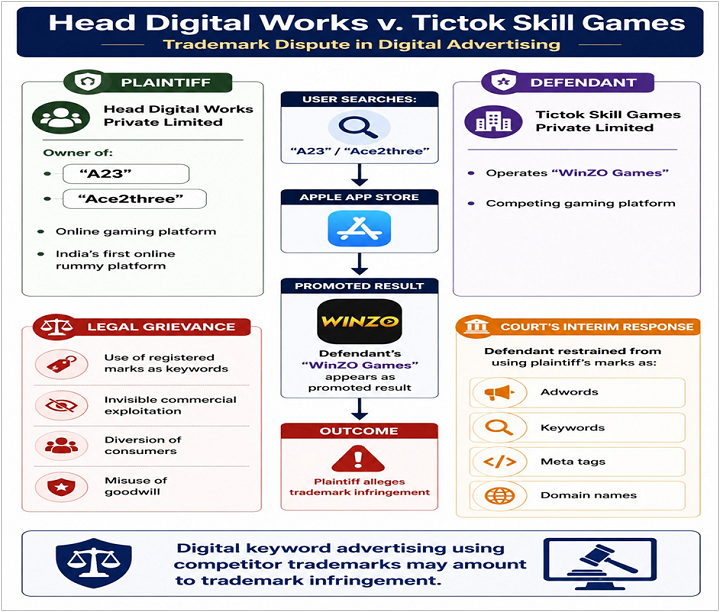
The present proceedings have their origin in a dispute between two prominent and competing online gaming platforms operating in the Indian market. Head Digital Works Private Limited, the plaintiff, is the operator of 'A23 Games' stated to be India's first ever online rummy platform and holds registered trademarks for the marks 'Ace2three' and 'A23,' with registrations dating from 2006 and 2020 respectively across different trademark classes. The defendant, Tictok Skill Games Private Limited, is the operator of 'WinZO Games,' a competing skill-based online gaming application.
The plaintiff discovered in February 2022 that the defendant was using the marks 'A23' and 'Ace2three' as keywords on the Apple Application Store. The practical effect of this was that whenever a user searched for 'A23' or 'Ace2three' on the App Store, the first result displayed in the advertisement section was the defendant's competing app 'WinZO Games' rather than the plaintiff's own application. The plaintiff treated this as a direct infringement of its registered marks and filed the present suit before the Delhi High Court seeking a permanent injunction to restrain the defendant from such use. It is to be noted that the available source material does not specify the exact date on which the suit was formally instituted before the Court, and this detail remains unverified from the material presently on record.
The present litigation does not exist in isolation. The very same parties are involved in a prior proceeding before the Delhi High Court in which Tictok Skill Games Private Limited had filed a case against Head Digital Works for the plaintiff's use of the marks 'WinZO' and 'WinZO Games' as a meta tag or title tag on the plaintiff's website and web advertisements. In that earlier matter, the Court had already granted an injunction restraining Head Digital Works from using the marks 'WinZO'/'WinZO Games' or their variants on its website and in web advertisements. The existence of this prior injunction operating in the opposite direction between the very same parties formed an important and directly relevant part of the backdrop against which the present application for interim relief came to be considered by the Court.
When the present suit came up for hearing before Hon'ble Justice Pratibha M. Singh, the defendant stated on record that it was not using and did not intend to use the plaintiff's marks as adwords or keywords on any platform. The Court, taking into account this concession on record, the prior litigation history between the parties, and the legal principles established in the MakeMyTrip matter, directed the defendant to adhere to its stated position. Interim directions were accordingly issued restraining the defendant from using the marks 'A23,' 'Ace2three,' or any of their variants or formative marks as adwords, keywords, meta tags, or domain names with or without spaces on any online search engine or application-based search platform, including the Apple Application Store and all other similar platforms. The case has been listed for further hearing on August 22, with the question of grant of permanent injunction remaining to be finally adjudicated on merits.
4.Facts of the Case
Head Digital Works Private Limited is a company engaged in the business of designing, developing, and deploying software for skill-based games, operating an online gaming website and internet-based mobile application. The plaintiff offers its services through its website www.a23.com and its mobile application 'A23.' The plaintiff holds registered trademarks for 'Ace2three' and 'A23' in different classes, with these registrations dating back to 2006 and 2020 respectively. The plaintiff's gaming platform is stated to be India's first-ever online rummy platform, and the marks 'Ace2three' and 'A23' are well-recognised identifiers within the online gaming ecosystem.
The defendant, Tictok Skill Games Private Limited, operates a competing online gaming platform under the brand name 'WinZO Games.' The plaintiff's grievance was that the defendant had been using the marks 'A23' and 'Ace2three' as keywords on the Apple Application Store. The practical consequence of this was that whenever a user searched for 'A23' or 'Ace2three' on the App Store, the first result displayed in the advertisement section was the defendant's app 'WinZO Games,' rather than the plaintiff's own application. The plaintiff submitted that this amounted to invisible use of its registered marks to divert potential consumers who were specifically searching for the plaintiff's products towards the defendant's competing platform.
The defendant, upon being confronted with the allegation, stated before the Court that it was not utilising and did not intend to utilise the plaintiff's marks as adwords or keywords on any platform. On this basis, the defendant was directed to follow through on its stated position and was restrained from using the marks 'A23,' 'Ace2three,' or any of their variants and formative marks as an adword, keyword, meta tag, or domain name with or without spaces on any online search engines or application-based search platforms, including the Apple Application Store.
5.Issues
The following questions arose for determination before the Delhi High Court:
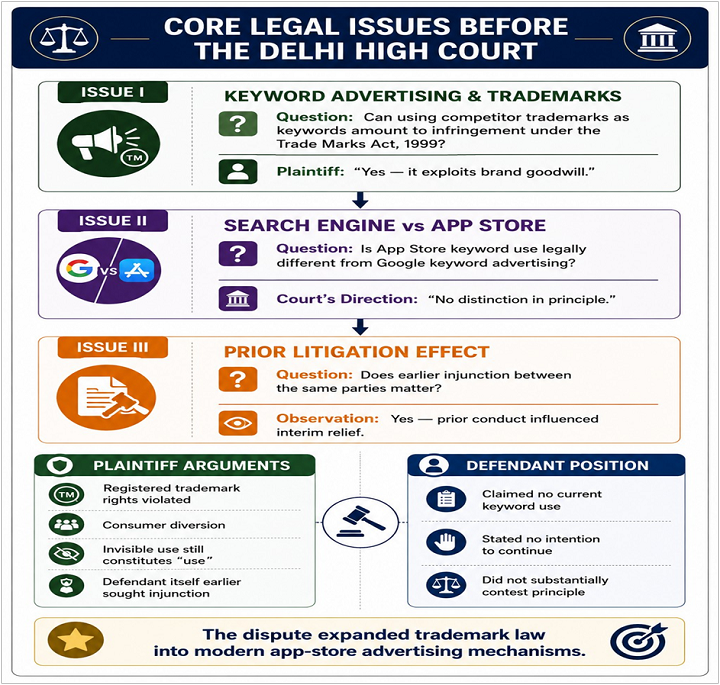
Issue I: Whether the use of a competitor's registered trademark as a keyword or adword on online search engines or application-based search platforms such as the Apple App Store, so as to cause a competing product to appear in response to searches for the trademark owner's brand, constitutes an infringement of the trademark owner's rights under the Trade Marks Act, 1999.
Issue II: Whether there is any material distinction in law between the use of a trademark as a keyword on conventional search engines (such as Google) and the use of a trademark as a keyword on app store search mechanisms, such that the former may constitute infringement while the latter does not.
Issue III: Whether the prior litigation history between the parties, and in particular the injunction previously obtained against the plaintiff for using the defendant's marks, has any bearing on the interim relief to be granted in the present proceedings.
6.Arguments
On behalf of the Plaintiff (Head Digital Works Private Limited), it was submitted that the defendant's use of the marks 'A23' and 'Ace2three' as keywords on the Apple App Store constituted a clear and direct infringement of the plaintiff's registered trademarks. The plaintiff argued that when a user searches for 'A23' or 'Ace2three' both being the plaintiff's proprietary and registered marks the appearance of the defendant's app 'WinZO Games' as the first advertised result amounts to using the plaintiff's goodwill and brand recognition to promote and advance the defendant's competing product. This, the plaintiff contended, is impermissible under the Trade Marks Act, 1999. The plaintiff also urged that the use of a trademark as a keyword is not limited to visible display; even the invisible deployment of a mark to trigger advertisements of a competitor's product constitutes use under trademark law, and such use violates the exclusive rights of the registered proprietor. The plaintiff further relied on the existing litigation between the parties, noting that the defendant had itself obtained an injunction against the plaintiff for the analogous act of using the defendant's marks as meta tags and title tags, thus reinforcing the principle that both parties acknowledge that such invisible use amounts to trademark infringement.
On behalf of the Defendant (Tictok Skill Games Private Limited), the defendant did not contest the court's jurisdiction or the underlying legal principle. Instead, the defendant made a concession on the facts, stating that it was not using and did not intend to use the plaintiff's marks as adwords or keywords. By making this statement on record, the defendant effectively defused the immediate controversy without conceding legal liability, while simultaneously enabling the court to issue directions based on the defendant's own expressed stand.
7.Court's Analysis
The Delhi High Court, speaking through Hon'ble Justice Pratibha M. Singh, delivered a ruling that is both doctrinally clear and practically significant for the digital trademark landscape in India.
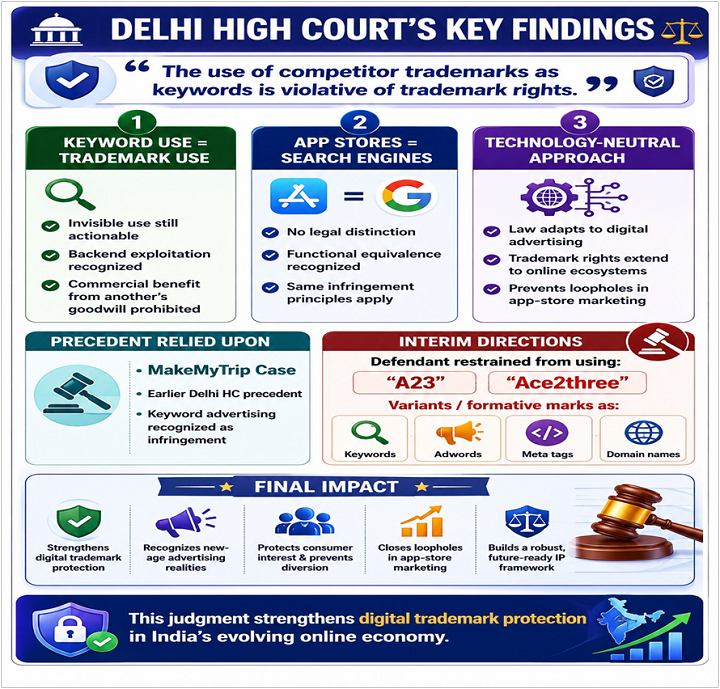
On the core legal question of whether the use of a competitor's trademark as a keyword on a search engine or an app store constitutes a violation of the trademark owner's rights, the Court answered in the affirmative without equivocation. The Court held that so long as keywords are being used for promoting a business using a competitor's trademark, such use is violative of the rights of the trademark owner. This ruling is significant because it squarely applies traditional trademark infringement principles to the context of keyword advertising, a domain that has been subject to considerable legal debate globally.
On the question of parity between search engine keyword use and app store keyword use, the Court took a decisive and technologically neutral position. Justice Pratibha M. Singh held that there is no difference between using a trademark as a keyword on search engines as opposed to using it as a keyword on app store searches. This observation is of considerable importance for the digital advertising industry in India, as it closes a potential loophole that could have allowed businesses to argue that app store keyword advertising operates on a fundamentally different legal footing from conventional search engine advertising. The Court's reasoning is grounded in the functional equivalence of the two mechanisms in both cases, a user searching for the trademark owner's brand is confronted with a competitor's advertisement triggered by the use of that very brand name as a paid keyword.
The Court also took into account the prior litigation history between the parties. It noted that in an earlier proceeding, the plaintiff had been injuncted from using the defendant's marks 'WinZO' and 'WinZO Games' as meta tags or title tags on the plaintiff's website and web advertisements. Citing this background and the principles laid down in the MakeMyTrip matter (referred to as MakeMyTrip supra), the Court observed that the invisible use of the plaintiff's mark as an adword or keyword on any online platform by the defendant would be violative of the plaintiff's rights in the marks. The reference to the MakeMyTrip precedent is instructive, as that case also dealt with the use of trademarks as invisible keywords in the digital advertising context and is a recognized marker in Delhi High Court jurisprudence on this subject.
The practical outcome before the Court was that the defendant, having stated it was not using and did not intend to use the plaintiff's marks in the manner alleged, was directed to adhere to that position. Accordingly, the defendant was restrained from using the marks 'A23' and 'Ace2three,' or any variants or formative marks thereof, as adwords, keywords, meta tags, or domain names with or without spaces on any online search engine or application-based search platform, including but not limited to the Apple Application Store.
8.Precedents Relied Upon
MakeMyTrip (supra) The Court referenced this prior Delhi High Court ruling dealing with the invisible use of trademarks as keywords and adwords in the digital environment. The MakeMyTrip precedent had established that such invisible use constitutes infringement of the trademark owner's rights, and the present ruling applies and reinforces that principle in the context of app store platforms specifically.
Prior litigation between the parties The Court also drew upon the injunction already in force against the plaintiff (restraining it from using the defendant's marks as meta tags and title tags), treating the logical parity of that situation as reinforcing the relief to be granted against the defendant in the present proceedings.
9.Conclusion
The Delhi High Court's interim ruling in Head Digital Works Private Limited v. Tictok Skill Games Private Limited is a landmark development in Indian trademark law as applied to the digital advertising ecosystem. The judgment authoritatively settles that the use of a competitor's registered trademark as a keyword whether on conventional search engines or on app store search platforms such as the Apple App Store constitutes a violation of the trademark owner's rights under Indian law. By rejecting any distinction between the two digital environments, the Court has articulated a technologically neutral principle that is likely to have wide-ranging implications for how businesses structure their digital marketing campaigns and keyword bidding strategies.
For practitioners and businesses operating in the online space, the ruling makes clear that the invisible or backend use of a competitor's registered mark as a trigger for paid advertisements is no different in legal effect from more overt forms of trademark use. The judgment also underscores the importance of the prior litigation history between parties in trademark matters, especially in the same court, where established patterns of reciprocal infringement may inform the court's approach to interim relief. The matter remains pending final adjudication, with the next date of hearing scheduled for August 22, and the definitive ruling on the permanent injunction sought by the plaintiff is awaited. Nevertheless, the interim directions and legal observations made by Justice Pratibha M. Singh already carry significant precedential weight and are expected to serve as a reference point for courts dealing with similar disputes involving keyword advertising, app store promotions, and the invisible use of trademarks in the digital environment going forward.
Join LAWyersClubIndia's network for daily News Updates, Judgment Summaries, Articles, Forum Threads, Online Law Courses, and MUCH MORE!!"


Tags :others


