Bench
Justice J.B. Pardiwala and Justice K.V. Viswanathan
Date of Judgment
5 January 2026
Subject Matter of the Case
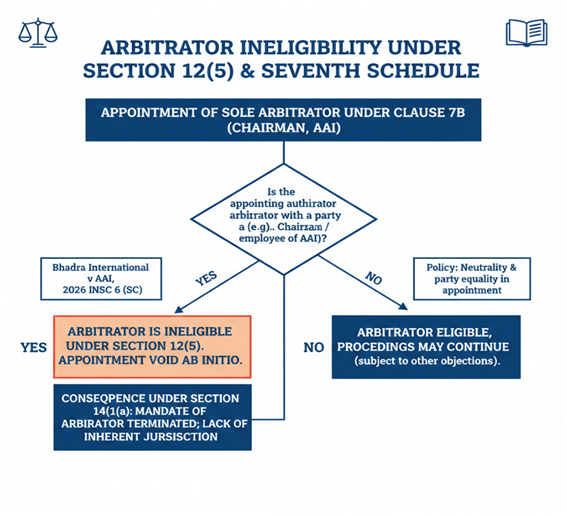
The case centers on the legality of the appointment of a sole arbitrator under Clause 78 of the licence agreements between Bhadra International and the Airports Authority of India after the 2015 amendment to the Arbitration and Conciliation Act. The real controversy is not about the underlying commercial claims, but about whether an arbitrator appointed by the Chairman of a party to the dispute is valid when Section 12(5) and the Seventh Schedule render certain categories of persons ineligible. The case examines ineligibility, waiver, unilateral appointment, and whether participation in arbitration can cure a jurisdictional defect in constitution of the tribunal.
Master Arbitration: Theory and Practice by Adv. Firdouse Wani. Enroll Now!
Facts of the Case
Bhadra International (India) Pvt. Ltd., along with Novia International Consulting Aps, makes up the group appealing. While one is based in India, the other operates out of Denmark. Their partnership began when they signed terms to work together on airport ground operations across Indian cities. Forming that alliance led them to act as a single unit during legal proceedings. That shared identity took the place of individual claims once court matters started. One morning, the Airports Authority of India put out tenders looking for companies to handle ground operations at several airports.
A group of firms came together, placed their offers, then got picked as the top choice and as a result of the same both sides signed individual licensing deals on November 29, 2010. Each contract laid down how they would work together, spelled out duties, payment terms, service standards, and ways to settle disagreements if any arose.
What sparked debate later on was Clause 78 in the licensing deal. Found within it was a rule: whenever conflict emerged around the contract, one individual would handle everything through private arbitration. That person? Chosen only by the head of India's Airports Authority. Even if that chosen figure worked for the agency, had prior involvement with the matter, or shared opinions before - none of that could count as grounds to challenge their role. Their decision stood as absolute, unchangeable, with no room for appeal. All proceedings were set to take place in New Delhi. The court paper includes every word of this section - it became the core point lawyers built their reasoning upon.
Trouble started between them in 2015. Around then, something shifted under the law. On October 23 that year, a new rule took effect. It changed how arbitration worked by adding part (5) to Section 12 of the older 1996 Act. That update came along with a list - called the Seventh Schedule - naming people who could not serve as arbitrators under certain conditions. Facing these legal conditions, the appellants sent a letter on 27 November 2015 using the arbitration option and asked the Chairman of Airports Authority of India to name one arbitrator as stated in Clause 78. This message mentioned another path - going to court under Section 11(6) - if no decision came through after a fair wait.
Right after this came up, the head of India's airport board picked one person to handle arbitration alone. Back on 22 March 2016, that individual released the first procedural directive, noting neither side raised concerns about their role. With clarity, they stated having no ties to either party nor stake in what was being disputed. From there, the process moved forward step by step.
Because both sides asked together, requests went in under Section 29A of the Arbitration and Conciliation Act, asking for more time to finish everything. One day, the High Court said yes to those requests, giving extra time twice. Later that year, on July 30, the person deciding the dispute gave out results - both parties lost everything they asked for, ending up with nothing, just empty hands.
Filing out of discontent with the outcome, the parties moved to challenge the rulings via Section 34 at the Delhi High Court. Since the arbitrator got picked solely by the head of the Airports Authority, who was also involved in the conflict - one key argument claimed the selection broke Section 12(5). Still, the bench dismissed the said plead and the decision remained standing. Furthermore, an appeal was filed under Section 37 and the same was dismissed by a two-judge panel. When those rejections stung too much, the matter climbed up to the Supreme Court through these current civil pleas.
Issues Raised
Looking at paragraph 29, the Supreme Court points out three matters needing attention. One question sits around if the single arbitrator involved lost eligibility under Section 12(5) of the Arbitration and Conciliation Act, 1996. Then there's the matter of whether actions by both sides - spoken or silent, meant they gave up relying on that rule. Another point checks if those appealing had a right to challenge the pick only later, through a Section 34 request. Each of these shapes how the court builds its thinking ahead. What follows in the ruling turns closely around these disputes.
Arguments from both sides
Appellants' Arguments
From the moment the amended Arbitration and Conciliation Act took effect, the appellants insisted the basis for appointing the sole arbitrator had fallen apart legally. Because of Section 12(5), combined with the Seventh Schedule, they argued that specific individuals were now barred by statute from serving as arbitrators. Law creates this disqualification - it does not depend on opinion or preference. When someone ineligible under these rules takes up the role, the appointment holds no validity at all. Any process flowing from such a flawed start carries the same defect. What results cannot stand, since legality vanishes at the point of origin.
Right from the start, they pointed out how Clause 78 allowed the Chairman of the Airports Authority of India to name an arbitrator - someone even tied to the Authority through employment or affiliation. Following this logic, once changes were introduced, the provision lost practical effect since one side could pick a decision-maker alone. Since the Chairman led an organization involved in the matter, his role created unavoidable bias in appointments he might make. With the new legal version active, anyone selected under those terms automatically failed to qualify.
Moving forward, the appellants argued that being ineligible under Section 12(5) automatically ends an arbitrator’s authority under Section 14(1)(a), since legally he cannot carry out duties. Because of this, they stressed it amounts to a fundamental flaw in jurisdiction - one untouched by silent acceptance or involvement in the process.
Participation, submission of arguments, or requests for more time do not fix the underlying issue: absence of valid authority. Contrary to what others may claim, they never gave up this safeguard willingly. Emphasis came back to the condition in the proviso to Section 12(5) - written consent must exist, clearly made after conflict emergence. As far as their position goes, nothing matching that description was ever signed.
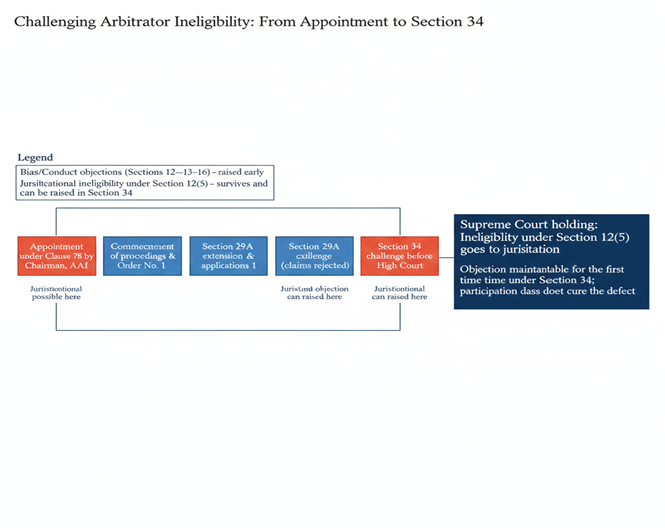
One point made was that challenges over disqualification may still emerge during Section 34 hearings, since they go directly to the foundation of the tribunal's authority. Notably, a distinction exists - on one hand lies bias judged through conduct; on the other, automatic exclusion set by legislation. This kind of bar does not rely on proof but stems from statutory restriction alone. Their view held that timing should not block such claims, given that awards from unfit arbitrators lack validity even if both sides took part fully. What mattered most was the court overlooking this principle while dismissing the plea as untimely.
Respondent Arguments
The picture looked otherwise through the eyes of the Airports Authority of India. Though claims were made about one-sided selection, they pointed out that the process began only when the appellants turned to Clause 78 and directly asked the Chairman to name a sole arbitrator. Since that request came from the other party, it signaled clear acceptance of how appointments should unfold under the contract. From their standpoint, shared intent shaped the choice - no imposition took place.
What stood out to the respondent was how the appellants acted throughout the arbitration process. Right from the start, the arbitrator made Procedural Order No. 1, stating clearly that both sides agreed to his role and that he held no stake in the outcome. Despite this, the appellants took part actively - submitting their claim and additional legal documents - while raising no concerns about the panel's composition.
In fact, they moved forward alongside the other party, jointly requesting more time under Section 29A to finish proceedings. According to the respondent, such sustained involvement signaled clear acceptance of the tribunal’s authority - an attitude hard to reconcile with later objections once unfavourable decisions were rendered.
When it came to waiver, the respondent argued that even without a distinct formal paper, what the appellants did showed they had given up their rights under Section 12(5). Because party independence matters most in arbitration, requiring a standalone signed waiver seemed too rigid, almost against how business actually works. Having used the appointment provision and taken part in proceedings over many years, the appellants later challenging the procedure - only once they faced an unfavourable outcome - appeared inconsistent.
The person responding argued that any concerns about the selection needed to come up early, right when the arbitrator was involved. Waiting too long - especially skipping chances under Sections 13, 14, or 16 while the process unfolded - meant losing the option to oppose it later through Section 34. In their view, raising issues now felt like a delayed tactic, one shaped more by regret than timely objection. It looked less like principle and more like an effort to unsettle decisions already settled.
Court’s Analysis
When tackling the initial question about disqualification under Section 12(5), attention shifted early to Section 18 of the Arbitration and Conciliation Act - this part insists on impartiality between sides, ensuring each can fully argue their position. It was clarified that fair treatment doesn’t only apply during hearings; it also shapes how arbitration panels are formed.
Due to this, choosing arbitrators demands adherence to principles of equity and balanced involvement. From there, scrutiny moved toward Section 12(5), altered by the 2015 Amendment Act, along with the provisions listed in the Seventh Schedule. A court found that meeting one condition listed in the Seventh Schedule blocks someone from serving as an arbitrator. Being barred by legal effect means naming such a person fails at first glance.
Looking at how things stood here, the judge saw Clause 78 gave full control over appointments to the head of India's airport body, allowing even active staff members to be picked. Since Section 12(5) came into force, clauses like that one cannot legally back someone who fits any banned type listed in the Seventh Schedule. Because of this shift, the person chosen could not act under law - his position lacked legal standing from the start. Past rulings were brought up, including one involving HRD Corporation versus. When situations like this arise, the role of the arbitrator ends by itself, as shown in GAIL versus Chennai Metro Rail Ltd., alongside Transtonnelstroy Afcons (joint venture), under subsection 14(1)(a).
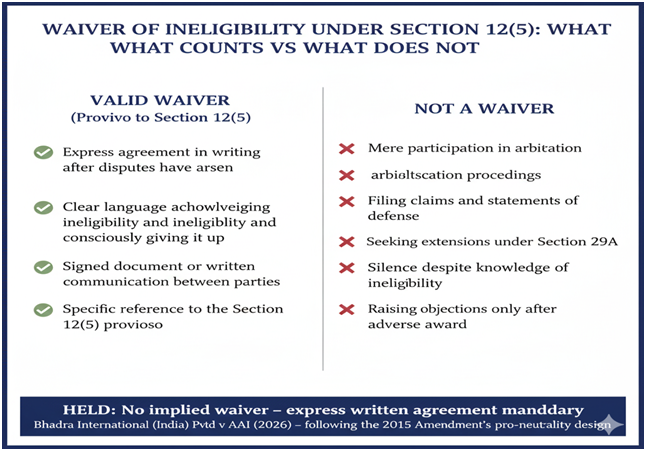
When it came to waiving rights, the court looked closely at the clause in Section 12(5) allowing parties to set aside its rules once a conflict begins - if they put such an agreement in writing. Emphasis fell on the words "express agreement in writing," treated narrowly rather than broadly. Silence or actions during legal steps could not count as giving up those protections. Written clarity was seen as essential so individuals would not unknowingly lose their legal entitlement to impartial handling.
Examples brought forward by the respondent - like filing claims, showing up at hearings, or co-filing requests under Section 29A - were examined. Each instance failed to meet the standard of a clear, documented surrender of rights under Section 12(5). Recently cited rulings, such as Hindustan Construction Co. Ltd. v. Bihar Rajya Pul Nirman Nigam Ltd., were invoked by the Court to clarify one point: allowing a time extension via Section 29A cannot erase ineligibility set by Section 12(5). Though procedural latitude exists, it does not override statutory bars. The distinction matters when timelines stretch but disqualifications remain fixed. What counts is not delay, rather the persistence of legal limits. Even adjusted mandates leave those conditions untouched.
When it came to the third point - whether someone could raise an objection for the first time under Section 34 - the Court separated issues tied to reasonable concerns about bias from those rooted in legal disqualification. While questions over neutrality usually demand prompt response before the arbitration panel itself, different logic applies where eligibility is barred outright by Section 12(5). Under such conditions, authority to serve never properly exists. Because absence of jurisdiction strikes at the foundation, the chance to challenge remains open even during Section 34 actions aimed at overturning awards. Even if both sides took part fully - or stayed silent earlier - that fact alone does not uphold decisions reached by someone legally unfit for role.
Industry Perspective
Speaking to LCI’s Head Of Content Department, Sankalp Tiwari, Advocate Yuvraj Singh stated that , “It is important for the readers to know that for years, parties, especially government bodies, were comfortable appointing their own officers as arbitrators and calling it ‘party autonomy’. The Supreme Court has now made it absolutely plain that neutrality is not a courtesy, it is a legal requirement.”
He further stated that “What I particularly appreciate is the Court’s recognition that participation in the proceedings does not magically cure an illegal appointment. Many clients worry that if they cooperate in arbitration, they are somehow forever bound by whatever happens. The Court has clarified that when the arbitrator is ineligible under Section 12(5), the defect goes to jurisdiction. If the judge has no authority to sit, it does not matter how politely everyone behaved during the hearing.”
Concluding his perspective on the judgement, Mr Singh said that “This judgment should also push public authorities to rethink boilerplate arbitration clauses. Those old clauses where the chairman, managing director or departmental head appoints the arbitrator now carry serious legal risk. If they continue using them, they are inviting future awards to be set aside. It is better to move toward neutral institutions or genuinely independent appointment mechanisms.”
Conclusion
The Court concluded its reasoning in paragraphs 124 to 126 of the judgment. It held that the High Court had committed a serious error in dismissing the objections of the appellants. It set aside the impugned judgment of the Division Bench of the Delhi High Court as well as the arbitral awards dated 30 July 2018 passed by the sole arbitrator. The Court declared that the arbitrator was ineligible under Section 12(5) read with the Seventh Schedule of the Arbitration and Conciliation Act and that there had been no valid waiver of this ineligibility by an express agreement in writing. It also confirmed that the objection was maintainable in Section 34 proceedings and was not defeated by participation in arbitration. The Court permitted the parties to initiate fresh arbitration proceedings in accordance with law and allowed the appeals.
The judgment therefore reinforces the policy behind the 2015 amendments to the Arbitration and Conciliation Act, which seek to ensure neutrality of arbitral tribunals and prevent unilateral control over the appointment process, particularly in contracts involving public authorities. By insisting on express written waiver and recognising ineligibility as a matter going to jurisdiction, the Supreme Court has strengthened the framework of fairness in arbitration and provided clarity to both commercial actors and practitioners on how Section 12(5) operates in practice.