Case title:
L.K. Prabhu @ L. Krishna Prabhu v. K.T. Mathew @ Thampan Thomas and Others
Date of Order:
28 November 2025
Bench:
Justice B.R. Gavai and Justice P.S. Narasimha
Parties:
Appellant – L.K. Prabhu (purchaser)
Respondents – K.T. Mathew (decree-holder) and others
SUBJECT
Whether a registered sale deed executed before the filing of the suit and before attachment can be invalidated based solely on suspicion of fraud under Section 53 of the Transfer of Property Act, and whether attachment before judgment can freeze rights that the debtor had already parted with prior to the date of suit.

IMPORTANT PROVISIONS
Order XXXVIII Rules 5 to 10 CPC (attachment before judgment), Order XXI Rule 58 CPC (claims to attached property), Section 53 Transfer of Property Act (fraudulent transfers voidable at creditor’s instance), and Section 64 CPC (effect of attachment on private transfers).
FACTUAL OVERVIEW
The dispute arose out of a familiar yet legally dense triangle involving a decreeholder attempting to secure satisfaction of a monetary decree, a debtor who had transferred his property before the litigation commenced, and a purchaser who claims to be bona fide. The property in question was sold under a registered sale deed. The respondent-decreeholder filed a money suit and obtained attachment.
The central chronological truth that the Supreme Court places at the heart of the case appears in para 12 of the judgment is that the transfer of ownership indisputably occurred before the suit was instituted. That single factual position should have guided both lower courts, because attachment before judgment only arrests a debtor’s existing rights and cannot reach an interest that the debtor did not possess on the date of the suit.
However, both the executing court and the High Court ignored this chronological anchor and instead rested their reasoning on a broad presumption that the sale was a sham designed to defeat creditors. The Supreme Court observes in para 15 that these findings were built not on evidence but on conjecture.
Fraud under Section 53 TPA was presumed without proof. The courts below seemed to be swayed by the debtor's financial distress and the timing of the transaction, but the Supreme Court clarifies thereby that financial distress alone does not amount to fraudulent intent. Fraud requires deliberative design, conscious participation, and factual proof. In absence of such elements, the transfer cannot be voided.
This oversight from the courts below becomes more apparent when the Supreme Court traces the statutory function of attachment before judgment. Para 11 provides the conceptual foundation that involves the attachment does not create any proprietary interest in favour of the creditor. It is purely preventive, meant to ensure the availability of the property in case a money decree eventually requires satisfaction.
As the attachment is not a conveyance and cannot overwrite legally vested rights, it cannot reach assets that have already parted from the debtor’s estate. Therefore, if a sale is executed before the suit is filed, the attaching creditor cannot gain any advantage over the bona fide purchaser unless independent proof of fraud exists.
This reasoning is strengthened by the Supreme Court through an integration of numerous binding precedents. For instance, when the Court in para 12 stresses the primacy of the pre-suit sale deed, it naturally brings into play Hamda Ammal v. Avadiappa Pathar, a leading case wherein the Court held in paras 5 to 8 that a sale deed executed before attachment retains full legal effect even if registration occurs thereafter.
The doctrine presented in Hamda Ammal states that execution of the sale is the transfer and the registration is a formality that does not affect operative chronology. By linking this reasoning seamlessly to the facts of the present case, the Court shows that the appellant’s sale deed executed in June 2004 remained fully valid notwithstanding the occurrence of later events. This is not stated as a separate precedent but presented as an organic part of the Court’s reasoning on why the debtor had no attachable interest left on the date of suit.
Similarly, in paragraph 13, when the Supreme Court analyzes the nature of obligations arising from pre-suit transfers, it integrates the decision in Vannarakkal K. Sreedharan v. Chandramaath Balakrishnan, where the Court held in paragraphs 8-11 that even an agreement for sale imposes an equitable encumbrance binding on the attaching creditor.
The analysis deppened when the Court, in para 15, addresses the charge of fraud under Section 53 TPA. It is here that C. Abdul Shukoor Saheb v. Arji Papa Rao case is put to use. The Supreme Court observes that Abdul Shukoor does allow courts to investigate fraudulent transfers, but its paras 10 to 12 make it clear that fraud must be proved and cannot be assumed.
As the Supreme Court moves to its conclusion in paras 19 and 20, it deploys Rajender Singh v. Ramdhar Singh to contextualize the nature of attachment. In paras 13 to 16 of Rajender Singh, the Court held that attachment freezes only the debtor’s residual interest and cannot revive interests already transferred. The present Court links this directly to the facts explaining that since the debtor in this case had no residual interest in the property on the date of suit, attachment could not have been effective.
ISSUES RAISED
Whether an attaching creditor can invalidate a pre-suit transfer by alleging fraud without proof, and whether attachment before judgment applies to assets no longer owned by the debtor.
CONTENTIONS BY THE APPELLANT
The appellant began by placing considerable reliance on the sale deed, arguing that the sine qua non of any claim in attachment proceedings is the state of the debtor’s interest on the date the suit was instituted.
Since the creditor filed the suit almost six months after the sale, no attachable interest of the debtor remained in the property. The appellant emphasized that ownership had already vested in him through a validly executed and duly registered instrument, and therefore the respondent could not attach a property that no longer formed part of the debtor’s estate.
From here, the appellant developed the argument that attachment before judgment is a procedural safeguard and not a substantive claim to the property. He contended that attachment under Order XXXVIII Rule 5 cannot enlarge the rights of a decree-holder beyond what the debtor possessed.
He supported this submission with the reasoning presented in the Hamda Ammal v. Avadiappa Pathar, where the Supreme Court held that a transfer executed prior to attachment cannot be overridden by attachment thereafter.
He surmised that the case on hand went even further than Hamda Ammal because, whereas in the latter it was only the execution, here, even the filing of the entire suit itself had been done subsequent to the transfer. This, so the appellant explained, was fatal to the respondent’s claim.
He further relied on Vannarakkal K. Sreedharan v. Chandramaath Balakrishnan, underlining that if even an agreement of sale creates an equitable obligation binding on attaching creditors, then a fully executed sale deed transfers far stronger rights which cannot be displaced except by proof of fraud. The appellant explained that his transaction involved actual transfer of possession, payment of full consideration, mutation of revenue records in his favour, and continuous possession thereafter, thus fulling all the elements that demonstrated bona fide conduct rather than collusion.
The appellant also answered the fraud issue under Section 53 TPA by weaving a probabilistic scenario, which showed that there was no hidden agreement. He stated that he was not aware of the respondent’s intended suit and that no demand or notice, pre-litigation, ever existed against the debtor on the basis of which he could reasonably have been alerted to some sort of claim.
He stated that he had paid market-compatible consideration, had taken physical possession, and had completed all the public formalities that were required to perfect his title. These elements, he argued, were wholly inconsistent with any suggestion of a fraudulent design to defeat creditors.
The appellant referred to C. Abdul Shukoor Saheb v. Arji Papa Rao, underlining that while the judgment opens the doors for courts to delve into issues of fraud, it also lays the burden of proving fraud squarely on the creditor. He pointed out that there was no documentary evidence of collusion produced by the respondent, no evidence of undervaluation, no suspicious pattern of payment, and no contemporaneous correspondence between the debtor and purchaser showing common intent. He said the lower courts have literally speculated by substituting financial distress for fraudulent intent. In point of law, as held in Abdul Shukoor, no such reasoning is permissible.
The appellant rounded off his submissions by drawing strength from Rajender Singh v. Ramdhar Singh , which clarified that attachment freezes only the debtor’s existing rights and cannot resurrect interests already transferred. He argued that since he had acquired absolute rights in June 2004, the respondent could not extend the attachment to his property by retroactively asserting allegations of fraud without proof. The appellant submitted that attaching the property would destroy a lawful vested right and create an impermissible windfall for the decree-holder at the expense of a bona fide purchaser, a result that this Court has consistently rejected.
ARGUMENTS ADVANCED BY THE RESPONDENT
The respondent, decree-holder, rested his case on the plea that the sale in appellant's favour was not a real commercial transaction but a collusive device with the object of defeating and delaying the creditors of the vendee. He contended that the debtor was saddled with various liabilities both before and after the date of sale, and the alienation in favour of respondent shortly before the creditor's attempt to recover the dues was suspect.
He stated that, so far as he knew, the debtor did not have any considerable assets after the said transaction and from this circumstance, an inference could be drawn that there was an deliberate attempt to put the properties beyond the reach of lawful recovery proceedings.
The respondent, in support of his contention, relied on Section 53 of the Transfer of Property Act, which provides that transfers shall be voidable at the option of the creditors if made with intent to defeat the creditors.
He tried to bring the present case within the ambit of Section 53 by contending that the cumulative effect of the circumstances-such as proximity in time between the sale and the debtor’s worsening financial condition, absence of any apparent necessity for disposal of the property, and the continuance of liability of the debtor-amounted to showing an underlying fraudulent intent in such transaction. He thus contended that such circumstances have traditionally been held to be suspicious and deserving of close scrutiny by courts.
The respondent thus placed strong reliance on the decision of the Supreme Court in C. Abdul Shukoor Saheb v. Arji Papa Rao to argue that the decision allows courts to go behind not only the form but also the substance of a transaction if an allegation of fraud is raised. Abdul Shukoor, according to him, allows the courts to lift the veil of the sale deed and analyze whether a transfer was designed to frustrate the creditors.
He thus argued that the executing court had rightly drawn adverse inferences against the respondents from the timing of the sale vis-à-vis the various financial liabilities of the debtor and that the High Court had rightly confirmed these findings.
The respondent, on the other hand, tried to undermine the appellant's plea of bona fide purchase by contending that the appellant ought to have made reasonable enquiries into the financial state of the debtor, particularly as the debtor was known in the locality to be dealing with a number of creditors. He sought to establish that what the appellant did was not sufficient due diligence and that any purchaser who disregards such fundamental enquiries cannot seek protection as a bona fide purchaser.
He contended that lack of enquiry should amount to constructive notice and deprive the protection which a bona fide purchaser usually gets. He further contended that though the sale deed was executed before the filing of the suit, the total conduct of the parties gave a clear indication of the transfer having been made in the knowledge that the creditors were likely to pursue their recovery.
He contended that when the cumulative circumstances bespeak of an attempt at defeating the legitimate rights of the creditors, the courts are not obliged to give full weight to documentary regularity. The respondent thus contended that the cumulative circumstances justified the inference of fraudulent intent.
The respondent thus summed up his argument by stating that the attachment before judgment was essential in preserving the ultimate fruits of the decree and that the property, notwithstanding the sale, should remain available for satisfaction of the decree on account of the suspicious character of the transaction. He contended that the executing court and the High Court took a correct view of the matter in treating the sale as a device to shield assets and that their findings should not be interfered with.
JUDGEMENT ANALYSIS
The Supreme Court begins its judicial reasoning by explaining in para 11 what attachment before judgment is. It says that the attachment is not a substantive right to property but only one more procedural device devised to preserve the potential fruits of a money decree. The conceptualization of this is necessary because such attachment cannot confer upon a creditor a greater interest than the interest possessed by the debtor at the time of attachment. This becomes the backbone of the entire judgment, which is further strengthened through those cases that the Court has woven into the reasoning.

As the Court moves to para 12, it lays out the sequence of events and identifies the sale deed as the critical determinant of the legal rights at stake. The Court points out that the suit was filed only on 18 December 2004 and attachment before judgment was ordered. This temporal ordering invokes the application of the doctrine in Hamda Ammal v. Avadiappa Pathar.
Instead of treating this as an extraneous citation, the Court weaves it right into its analytical reasoning by explaining how Hamda Ammal, specifically paras 5 to 8, had held that even if registration of the sale deed occurs after attachment, the transfer remains protected if the execution of the sale deed predates the attachment.
The doctrinal alignment is not abstract as it is embedded directly into the factual matrix. The Court employs Hamda Ammal to show that the appellant's rights had crystallised well before the respondent had any legally cognisable claim that could bind the property.
The narrative goes through to para 13 with an in-depth examination of the nature of the rights which a pre-suit sale deed creates. It is here that the Court makes an integrated incorporation of the ratio in Vannarakkal K. Sreedharan v. Chandramaath Balakrishnan. Not breaking its analytical thread, the Court adds that Vannarakkal, particularly paras 8 to 11, had crystallized the proposition that an agreement to sell itself creates an equitable obligation sufficient to bind attaching creditors.
Thus, what the Court emphasizes is that attachment cannot have a retrospective effect to divest rights which accrued long before the attaching creditor reached the court.
When the Supreme Court moves, in para 15, to consider allegations of fraud under Section 53 TPA, it incorporates C. Abdul Shukoor Saheb v. Arji Papa Rao to explain the appropriate legal test. The Court remarks that even though Abdul Shukoor enables the courts to investigate whether a transfer had been made with fraudulent intent, paras 10 to 12 of that judgment lay down unmistakably that fraud cannot be presumed but has to be proved by clear evidence.
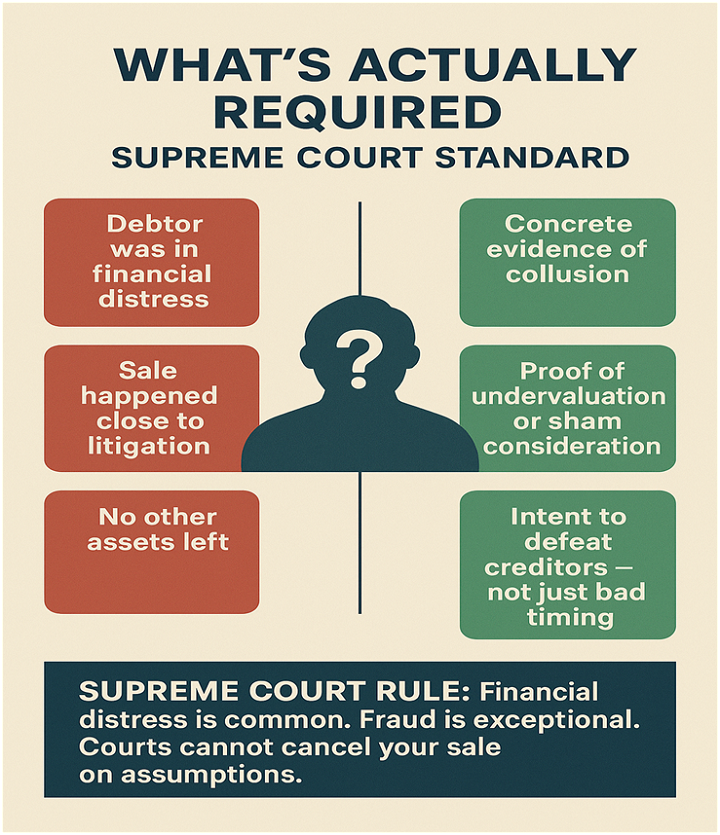
This incorporation enables the Court to dismiss the respondent's reliance on Abdul Shukoor by observing that no evidence was led on the part of the respondent regarding collusion, under-valuation, timing discrepancies, or benefit flowing back to the debtor.
The Court views the respondent's attempt to use Abdul Shukoor as an attempt to establish a presumption when the judgment requires proof. The incorporation thus serves both to spell out the legal threshold and also to destroy the respondent's argument.
In para 16, the Court further fortifies its reasoning by explaining that mere financial distress or multiple debts themselves do not show fraudulent intent. This leads logically from the ratio in Rajender Singh v. Ramdhar Singh, to which the Court introduces into its discussion on the nature of residual interest. Rajender Singh, in paras 13 to 16, had held that attachment can only freeze the existing rights of the debtor and cannot revive any interest that has been transferred.
The Supreme Court incorporates this decision into its reasoning without ever having to step outside the narrative, explaining that since the debtor did not have any interest in the property on the date of suit, the attachment order did not extend to the appellant's property right.
By the time the Court reaches para 19, the doctrinal landscape is fully clear. The Court does not summarise the earlier decisions separately; it integrates them into a single coherent reasoning structure. Hamda Ammal provides emphasis on the finality of pre-attachment transfers. The case of Vannarakkal stresses upon the binding nature of antecedent obligations. Abdul Shukoor states the onus of proving fraud. Rajender Singh interprets the exact legal scope of attachment. The Court fuses all four strands together to produce a single doctrinal conclusion: a transfer prior to attachment of property before judgment cannot be displaced except upon proof of fraud.
In para 20, the Court criticises both the trial court and the High Court for failing to appreciate this doctrinal matrix. It explains that both courts substituted suspicion for evidence. They acted on an assumption that because the debtor was financially distressed, the sale had to be fraudulent. The Supreme Court rejects this inference, explaining that financial distress is common but fraud is exceptional and requires proof.
The Court then concludes, in paragraph 21, by allowing the appeal and setting aside both the orders of the Courts below and directing that the property in question be released from attachment. The reasoning is presented as a natural consequence of the combined factual timeline and doctrinal principles. There is no citation in isolation; every precedent is integrated into the reasoning itself.
The analysis shows that the Supreme Court's approach is not merely corrective but didactic. It reiterates the well-settled law that attachment before judgment is a protective device and cannot override rights already vested. It also articulates the high evidentiary burden under Section 53 TPA and cautions the courts against relying on suspicion. The judgment consolidates predictability in property law and enforces the sanctity of bona fide transactions.
The Process of Attachment
While speaking to the chief of content writing at LawyersClubIndia, Adv Surbhi Saumya said that “So, wrt to attachment, its fairly simple. You go to court when you genuinely believe the defendant is about to move the property or do something that will make the decree worthless later.
When asked about the usual process of the same, she said that “Usually, what happens is that you file the suit, you realise the defendant is getting restless, and you put in an application which basically says that "they’re trying to sell this place” or “there’s movement on the ground.” The court wants to know exactly what that movement is and the counsel is expected to state just the facts. Maybe you heard from a broker, maybe there’s a notice on the gate, maybe the defendant suddenly rushed to change revenue records. Something specific. If you walk in with general lines like “they might dispose of the property,” the judge doesn’t even look up.”
Emphasising upon the procedural integrity of the courts, the advocate opined that “Half the battle is the affidavit. If it looks copied from some old draft, the court ignores it. If it looks like you’ve actually followed what’s happening outside the courtroom, then the judge takes it seriously.
And when you ask for an ex parte order, the judge usually pauses. They don’t like passing orders behind someone’s back unless you give them a very clear reason why waiting even two or three days will cause damage. If the attachment is granted, then comes the usual scene wherein the defendant appears, gets upset, and accuses you of exaggerating. That’s where your homework shows. If your facts hold up, the attachment stays. If not, the judge lifts it in two minutes.”
CONCLUSION
The Supreme Court’s judgment restores doctrinal clarity by reinforcing that a pre-suit transfer cannot be undone by later attachment unless fraud is proven with strict evidence. The Court integrates precedents like Hamda Ammal, Vannarakkal, Abdul Shukoor, and Rajender Singh into a single chain of reasoning, demonstrating that attachment does not create rights but merely preserves what remains. The decision protects bona fide purchasers and ensures that creditor actions do not retroactively destroy lawful transfers. By rejecting suspicion and requiring proof, the Court strengthens the integrity of Section 53 TPA and provides a clear interpretive framework for future attachment disputes.