Bench
Justice J.K. Maheshwari and Justice Vijay Bishnoi
Date of Judgment
10 December 2025
Parties
The appellant, Dr. Sohail Malik, a 2010-batch Indian Revenue Service officer serving in the Central Board of Direct Taxes, was challenged before an Internal Complaints Committee under the Sexual Harassment of Women at Workplace (Prevention, Prohibition and Redressal) Act, 2013 (“POSH Act”) by an aggrieved woman who worked in a different government department. The respondent in the Supreme Court appeal was the Union of India, defending the High Court and CAT rulings that upheld the ICC’s jurisdiction.
Subject Matter of the Case
This case concerns the jurisdiction of an Internal Complaints Committee constituted under Section 4 of the POSH Act 2013 to entertain a complaint filed by an aggrieved woman against a respondent who was working in a different department or workplace. Specifically, the Supreme Court addressed whether an ICC constituted at the complainant’s workplace could validly proceed with an inquiry under Section 11 of the POSH Act against an employee of a different department, or whether jurisdiction was restricted to the ICC of the respondent’s own department.
The appeal therefore tested the meaning of “workplace” under Section 2(o), the legislative purpose of the POSH Act (including its object of ensuring accessible, preventive mechanisms for addressing sexual harassment), and the scope of Sections 9, 11 and 13 of the Act.
Facts of the Case
The aggrieved woman, an IAS officer serving as Joint Secretary in the Department of Food and Public Distribution, contended that on 15 May 2023, the complainant sexually wearied her at her plant located in Krishi Bhawan, New Delhi. She instantly registered an FIR on 16 May 2023 under Sections 354, 354- D, 506, and 509 of the Indian Penal Code, and a chargesheet has ago been filed adding Sections 201, 204 of the IPC and Section 67 of the Information Technology Act, with the felonious proceedings pending.
On 24 May 2023, the displeased woman filed a complaint under Section 9 of the POSH Act before the ICC constituted by her department the Department of Food and Public Distribution. Section 9 provides that “any displeased woman may make, in jotting, a complaint of sexual importunity at plant to the Internal Committee within a period of three months from the date of incident.”
Pursuant to the POSH complaint, the ICC issued a notice dated 13 June 2023 directing the complainant to appear before it on 22 June 2023 with his response. The complainant filed OA No. 1838/2023 before the Central Administrative Tribunal(“ CAT ”), star Bench, New Delhi, seeking to quash that notice, contending that the ICC demanded governance because his department of employment was different from that of the plaintiff. The CAT dismissed the challenge, holding that the ICC’s governance wasn't so defined. The High Court of Delhi upheld the CAT’s ruling.
The complainant also approached the Supreme Court by way of special leave solicitation challenging the High Court order. The Supreme Court permitted the ICC inquiry to continue but directed that the final outgrowth should be kept in sealed cover pending the appeal. The Court was informed that the ICC inquiry is complete and a report exists in sealed cover.
Issues Raised
The Supreme Court linked three core issues for determination first, whether the ICC of the displeased woman’s plant could exercise governance under the POSH Act to entertain a complaint against a replier working in a different department; second, whether vittles of Section 11( 1) of the POSH Act, when read with the description of “plant” and “hand”, circumscribe similar governance; and third, what consequences follow from the POSH Act’s scheme for the sequence of inquiry and correctional action when the replier isn't employed in the same plant as the displeased.
Arguments on Behalf of the Appellant
The appellant’s primary submission was embedded in a textual and formalist reading of Section 11(1) of the POSH Act. He argued that the governance of an ICC to interrogate into a sexual importunity complaint is touched off only “where the replier is an hand” of the plant in which the ICC is constituted.
This, according to the complainant, meant that the ICC constituted under the Department of Food and Public Distribution demanded governance to entertain sexual importunity complaints against an functionary working under the Department of profit. In his view, the expression “where the replier is an hand ” in Section 11(1) must be understood as a jurisdictional condition the replier must be employed in the same plant where the complaint is filed for the ICC to do.
Counsel for the complainant also reckoned on Section 19( h) of the POSH Act, which imposes a duty on employers to “ give backing to the woman if she so chooses to file a complaint in relation to the offence under the Indian Penal Code where the perpetrator is n't an hand in the plant at which the incident of sexual importunity took place. ”
He contended that this provision suggests that where the perpetrator is from another plant, the proper course is for the employer to grease felonious proceedings rather than the ICC inquiry. The complainant further submitted that, for civil retainers, the CCS (Conduct) Rules constitute a complete law for dealing with sexual importunity and affiliated correctional proceedings, and thus an ICC constituted in his own department should be the proper forum for any similar complaint.
The complainant placed heavy reliance on the textual demand that service rules applicable to the replier must be followed in the inquiry, which he argued reinforces that the ICC at his place of advertisement is the jurisdictionally competent body for the inquiry. This interpretation, he contended, saved the council’s scheme by aligning the POSH inquiry with departmental correctional rules and avoided clashing examinations by ICCs of different departments.
Arguments on Behalf of the Respondent
On the other side, the Union of India, defending the function of POSH ICCs, emphasised the broad purpose and social weal object of the Act. It was argued that the Act was legislated to apply Vishaka guidelines and to give an accessible, effective, and preventative medium for addressing sexual importunity complaints at the plant.
The replier’s counsel submitted that a restrictive interpretation, which confined ICC governance to only the ICC of the replier’s department, would frustrate the object of the enactment by erecting procedural walls that could discourage or inhibit displeased women from seeking redressal.
The replier underlined the extensive delineations of crucial terms like “ plant, ” “ hand, ” and “ replier ” under Sections 2(o), 2(f), and 2(m) of the POSH Act, arguing that these do n't confine the governance to same- plant situations and thus permit an displeased woman to file a complaint before the ICC of her own plant, indeed against someone employed away. In this view, the core inquiry is permitted wherever the complaint arises, and the ICC’s fact- chancing function is distinct from any correctional proceedings that may follow, which remain within the replier’s employer’s sphere.
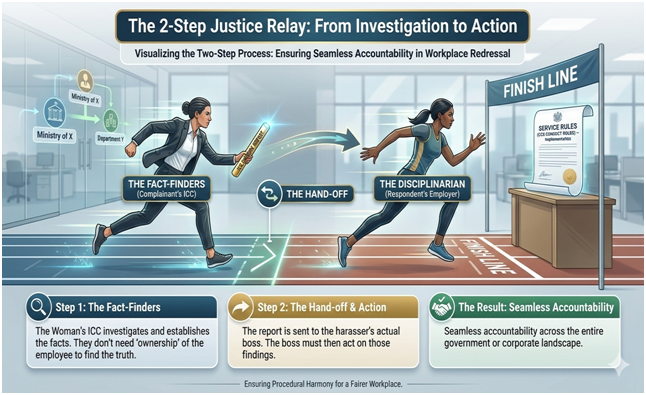
It was also emphasised that Section 13 of the POSH Act contemplates that the ICC’s findings are to be communicated to the employer of the replier for action according to applicable service rules, which means that original governance is n't elided by employership. Rather, the correctional authority to act on the ICC’s findings resides with the replier’s employer, and this sequencing preserves both access to inquiry and procedural harmony with service rules. The replier’s counsel argued that Section 19(h) doesn't oust ICC governance, but simply obliges employers to help in felonious proceedings if initiated
Court’s Analysis
The Supreme Court began its analysis by sticking the POSH Act within its literal and indigenous environment, noting its birth in the Vishaka judgment and its part in guarding the abecedarian rights of women under Articles 14, 15, and 21 of the Constitution.
The Court described the POSH Act as a social weal legislation drafted to help sexual importunity and insure that women can pursue careers in safe surroundings. It emphasised that the enactment not only punishes sexual importunity but laboriously imposes duties on employers to help and requital similar conduct.
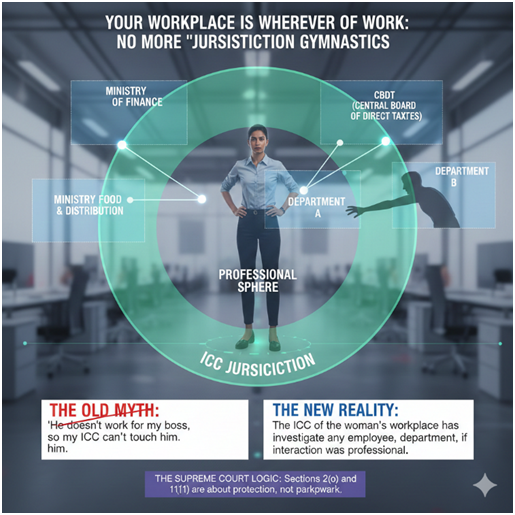
The Court also methodically set out the statutory delineations of “aggrieved woman”, “hand,” “employer,” “replier” and “plant”. It noted that the description of “plant” under Section 2(o) is veritably broad, expressly including any department, organisation, or unit, as well as “any place visited by the hand arising out of or during the course of employment including transportation.” This extensive description, the Court observed, can not be read to circumscribe an ICC’s governance to only one department; rather, it contemplates situations where workers interact across settings, which the council intended to capture within the POSH medium.
Importantly, the Court analysed Section 11(1) precisely. It agreed with the CAT and the High Court that the use of the expression “where the replier is an hand ” in Section 11( 1) does n't indicate a demand that the replier be employed at the same plant as the plaintiff.
Rather, this expression affects the procedure for conducting the inquiry (for case, engagement with applicable service rules when the replier is an hand) and doesn't define jurisdictional limits. The Court emphasised that none of the statutory delineations suggests that the ICC’s governance is confined to cases where both displeased and replier work in the same department or plant.
In rejecting the complainant’s argument grounded on Section 19( h), the Court held that this provision, which obliges employers to help in easing felonious action if requested by the displeased woman, does n't count or derogate from the ICC’s governance under the POSH Act. Section 19( h) imposes duties on employers but does n't dock the separate and distinct remedy of a plant inquiry. therefore, reliance on Section 19( h) to circumscribe ICC governance was lost.
The Court also described the legislative scheme of Section 13, which requires that the ICC’s findings be communicated to the employer of the replier to take action harmonious with service rules. In this respect, the Supreme Court held that the ICC proceedings at the plaintiff’s plant constitute the first fact- finding stage, after which the replier’s employer — the authority responsible for discipline — may initiate applicable action. This sequencing ensures that the ICC’s inquiry is n't simply a procedural formality but a meaningful stage in the redressal process, with the employer needed to act on those findings in agreement with service rules.
Court’s Conclusion and Directions
On the base of its analysis, the Supreme Court rejected the complainant’s narrow interpretation. It held that the ICC constituted at the displeased woman’s plant can exercise governance to hear and interrogate into a complaint under the POSH Act against a replier employed in a different plant.
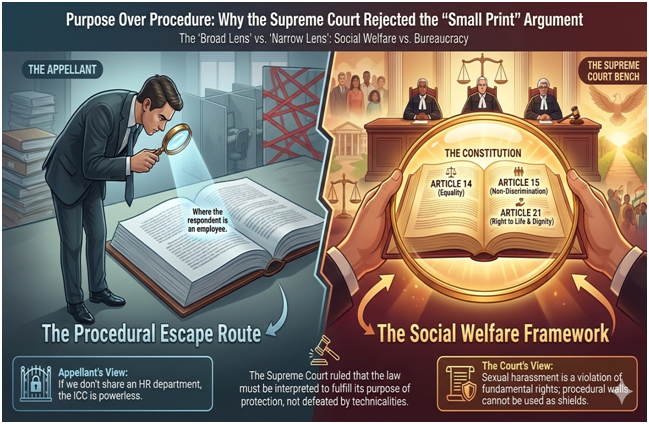
In reaching this conclusion, the Court underlined that the words used in the POSH Act and its broader statutory purpose favor a construction that facilitates access to justice and forestallment of plant importunity rather than assessing specialized walls grounded on departmental cooperation.
The Court clarified that, in the environment of civil retainers belonging to different departments, the ICC’s part at the displeased woman’s plant is to conduct a primary or fact- chancing inquiry. Following this inquiry, the ICC’s report and recommendations must be communicated to the employer of the replier, who may initiate correctional proceedings under the applicable service rules or the CCS (Conduct) Rules as specified.
While correctional proceedings may bear the ICC of the replier’s plant to act as the inquiry authority during formal correctional proceedings, this does n't abstract from the original governance of the plaintiff’s ICC to interrogate and prepare a report.
Importantly, the Supreme Court upheld the CAT and High Court’s conclusions, chancing that the ICC of the plaintiff’s plant had acted within its powers, and any prejudice to the replier was unsubstantiated either on record or in law. The request for jurisdictional restriction was, thus, dismissed. The Court directed that the ICC report be transmitted to the applicable department of the complainant( his employer) for farther action in agreement with applicable service rules, in keeping with Section 13(3) of the POSH Act.
The appeal was dismissed, and all pending operations were disposed of in light of these findings.
Industry Perspective
Speaking to LCI’s Content Chief Sankalp Tiwari, Advocate Yuvraj Singh said that “I’ll be honest, this judgment fixes a problem that never should have existed in the first place. POSH complaints were getting stuck not because facts were unclear, but because institutions kept asking the wrong question, i.e., which ICC owns this case? The Supreme Court basically says stop doing that.
He further elaborate that “What the Court does very simply is read the POSH Act the way it was meant to be read. ‘Workplace’ is not a departmental boundary or a posting order. It’s where professional interaction happens. If harassment takes place in the course of work, then the ICC of the woman’s workplace can look into it. Full stop.”
The argument that only the respondent’s department can inquire always sounded convenient rather than logical. In real life, officers interact across ministries, departments, committees, conferences, field postings. The law recognises that reality. The judgment just forces institutions to stop pretending otherwise.
Adding to this, Mr Singh mentioned that “I also appreciate what the Court avoids doing. It doesn’t moralise. It doesn’t assume guilt. It doesn’t dilute safeguards for the respondent. It only shuts down a procedural escape route that was being used to delay inquiries endlessly. The message is clear: fight the case on facts, not on jurisdiction gymnastics.
This ruling will change how ICCs function. Committees can no longer refuse complaints just because the respondent works elsewhere. And complainants won’t be sent on a bureaucratic scavenger hunt to find the ‘correct’ committee.”