Bench
Justice P. S. Narasimha
Justice Pankaj Mithal
Date of Judgment
7 January 2026
Parties Involved
The appellant, Jan De Nul Dredging India Private Limited, is an Indian subsidiary of a globally recognised dredging contractor, engaged in large-scale maritime and port infrastructure projects.
The respondent, Tuticorin Port Trust, is a statutory body constituted under the Major Port Trusts Act, 1963, responsible for development, maintenance and regulation of Tuticorin Port.
Subject Matter of the Case
The judgment examines the scope and limits of judicial interference with arbitral awards under Sections 34 and 37 of the Arbitration and Conciliation Act, 1996. The immediate dispute concerns whether idle time compensation awarded by an arbitral tribunal for a Backhoe Dredger deployed during a port deepening project was contractually permissible. At a deeper level, the case addresses whether an appellate court can reassess contractual interpretation and factual appreciation by an arbitral tribunal after the award has already been upheld under Section 34, and whether alleged misapplication of contractual clauses constitutes “patent illegality” justifying appellate intervention.
Facts of the Case
Tuticorin Port Trust initiated a design named “ heightening of the Channel and Basin to feed to 12.80 Metre Draught Vessels at Tuticorin Port ” to enable berthing of larger vessels. A Notice Inviting Tender was issued on 15 July 2009. Jan De Nul surfaced as the successful endeavor and a Letter of Acceptance was issued on 28 October 2010. A License Agreement was executed on 27 December 2010, valuing the contract at over Rs. 465 crores with a completion period of fourteen months.
The contractual documents specified certain reflective dredging outfit, including Cutter Suction Dredgers and a Backhoe Dredger, but expressly allowed the contractor discretion to emplace outfit beyond the minimal conditions. The agreement also contained vittles dealing with possession of point, detention attributable to the employer, idle time compensation, and claims arising from interference to prosecution.
Jan De Nul mobilised resources instantly and commenced dredging on 28 December 2010. In addition to the minimum needed outfit, it stationed two Cutter Suction Dredgers and a Backhoe Dredger. During prosecution, access to portions of the dredging area was delayed due to reasons attributable to the Port Trust, including issues relating to junking of obstructions and collaboration with harborage operations. These detainments, according to the contractor, redounded in certain outfit remaining idle.
Despite such problems, the said dredging was completed before the deadline. A common check involving the National Institute of Oceanography verified completion in agreement with specifications. The harborage was commissioned at the enhanced depth on 19 November 2011 and a completion instrument was issued on 2 April 2012.
Controversies arose when the Port Trust didn't release the contractor’s final pretenses . Jan De Nul invoked arbitration. An arbitral bench of three members was constituted. Eleven claims were raised, of which Claim No. 7 related to idle time charges arising from delayed possession of the point, including idle time of the Backhoe Dredger.
The arbitral bench allowed Claim No. 7. The Port Trust challenged the award under Section 34 before the Madras High Court. The Single Judge dismissed the challenge. On appeal under Section 37, the Division Bench incompletely obtruded with the award, disallowing idle time compensation for the Backhoe Dredger. This led to the appeal before the Supreme Court.
Issues Raised
The Supreme Court was needed to determine whether the Division Bench exceeded its powers under Section 37 by interfering with a reasoned arbitral award that had formerly been upheld under Section 34. Subsidiary issues included whether the arbitral bench misapplied contractual clauses relating to idle time compensation, whether the Backhoe Dredger fell outside the order of outfit eligible for compensation, whether the occasion between detention and footling was adequately established, and whether any similar alleged crimes rose to the level of patent illegality.
Arguments on Behalf of the Appellant
The appellant’s cessions were multi-layered and not confined to a narrow jurisdictional plea. Jan De Nul argued that the Division Bench unnaturally misknew both the contract and the arbitral logic. It was submitted that the arbitral bench didn't mechanically award idle time compensation but shouldered a detailed analysis of the sequence of events, substantiation on point vacuity, and the part played by the Backhoe Dredger in the prosecution of the design.
The complainant emphasised that the contract didn't draw a rigid distinction between “major” and “minor ” dredgers for the purpose of compensation. Clause 38, which dealt with idle time compensation, did n't contain an express rejection of the Backhoe Dredger. The bench had interpreted the clause in confluence with other vittles and concluded that outfit stationed with the knowledge and concurrence of the Port Trust, and rendered idle due to employer- attributable detainments, could legitimately attract compensation.
Jan De Nul also argued that the replier’s attempt to compartmentalise the contract by segregating Clauses 41.1 and 41.2 was bloodied. According to the complainant, Clause 51.1 worked as a residuary provision dealing with claims arising from interference, and the bench was justified in invoking it when the factual matrix showed inhibition and detention in point handover.
Crucially, the complainant stressed that indeed if an indispensable interpretation of the contract were possible, that alone could n't justify hindrance. The arbitral bench’s interpretation was, at the veritably least, a presumptive bone.
The Single Judge had applied the correct standard under Section 34 and set up no irritability or patent illegality. The Division Bench, by reassessing contractual interpretation and reappreciating the award, acted as a court of appeal on graces, which Section 37 doesn't permit.
Arguments on Behalf of the Respondent
The replier Port Trust advanced a more specialized and clause- centric argument. It contended that the arbitral bench had committed a patent illegality by awarding idle time compensation for a Backhoe Dredger, which according to the replier did n't qualify as a “ major dredger ” under the contractual scheme. The Port Trust reckoned heavily on Clause 38, arguing that it was intended to apply only to major dredging outfit and that extending its benefit to other ministry distorted the contractual allocation of threat.
The replier further argued that detainments in handing over the point were completely governed by Clauses 41.1 and 41.2, which handed specific remedies and consequences. The
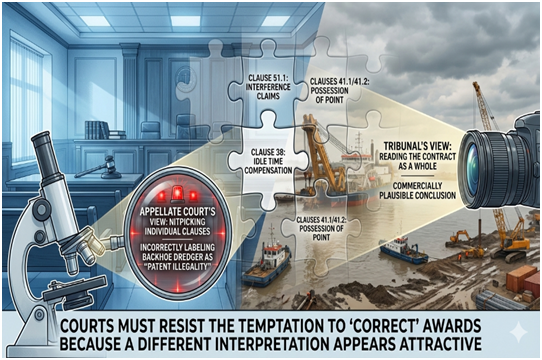
bench, according to the Port Trust, erred by bypassing these clauses and awarding compensation under Clause 51.1, which was n't meant to cover similar situations.
Another beachfront of the replier’s argument concentrated on occasion. It was submitted that the bench failed to establish a direct causal link between the alleged detention in point handover and the footling of the Backhoe Dredger. The Port Trust argued that the contractor had stationed fresh outfit of its own volition and could n't shift the fiscal consequences of similar deployment onto the employer.
On this base, the replier maintained that the Division Bench was justified in correcting a clear contractual and legal error, and that the hindrance did n't amount to reappreciation of substantiation but correction of patent illegality.
Court’s Analysis
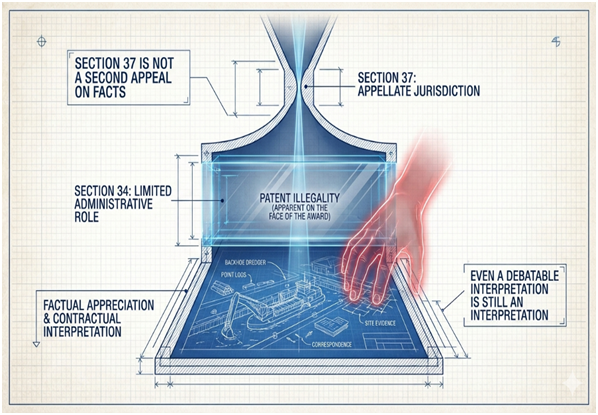
The Supreme Court’s analysis proceeds in a structured and regular manner, addressing each beachfront of argument rather than issuing a mask countersign of arbitral autonomy. The Court begins by rephrasing the statutory frame. It reiterates that Section 34 provides a limited administrative part and that Section 37 doesn't enlarge this compass. Appellate governance under Section 37 is narrower still, and can not be used to renew the graces of the disagreement.
The Court also turns to the nature of contractual interpretation by arbitral bars. It observes that interpretation of a marketable contract, particularly in structure systems, frequently involves assessment of specialized environment, marketable practice, and the conduct of parties. similar interpretation, if reasoned and coherent, commands judicial compliance.
Applying these principles, the Court examines the arbitral bench’s logic on Claim No. 7. It notes that the bench didn't do on a simplistic supposition but analysed point logs, correspondence, and the sequence of hindrances. The bench set up that detainments attributable to the Port Trust redounded in outfit remaining idle, including the Backhoe Dredger, which was stationed with the replier’s knowledge.
On the replier’s argument regarding Clause 38, the Court finds that the clause does n't contain an express prohibition against compensation for outfit other than major dredgers. The bench’s reading of the clause in confluence with other vittles was thus not inconceivable. The Court cautions against judicial analysis of contracts in a manner disassociated from their marketable environment.
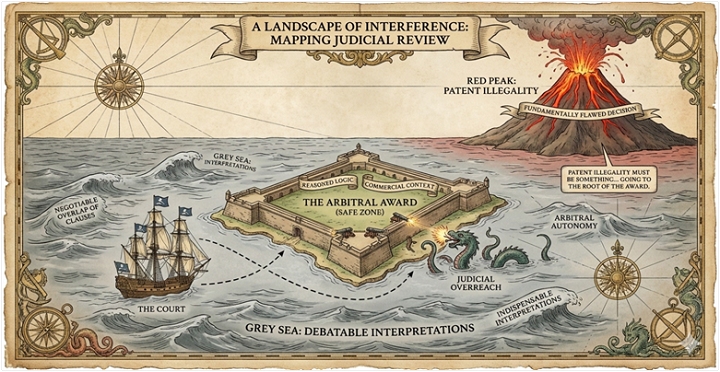
Regarding the incantation of Clause 51.1, the Court holds that indeed if another clause could arguably apply, that by itself does n't render the bench’s approach patently illegal. Patent illegality, the Court reiterates, must be commodity apparent on the face of the award and going to its root. A debatable interpretation or an negotiable imbrication of clauses does n't meet this threshold.
The Court also rejects the occasion argument, observing that the bench had recorded findings linking detention in point vacuity to idle time similar factual findings, grounded on substantiation, are vulnerable from reappreciation under Sections 34 and 37.
Eventually, the Court finds that the Division Bench transgressed the limits of Section 37 by reassessing the graces and substituting its own interpretation of the contract. This, the Court warns, undermines the futurity of arbitration and defeats the legislative intent behind minimum judicial hindrance.
Industry Perspective
Speaking to Sankalp Tiwari, Content Chief at LCI, Advocate Ayushi Khetan said that “From a practitioner’s point of view, the Court has drawn a very sensible line. If an arbitral tribunal has taken the trouble to read the contract as a whole, looked at the facts, and reached a commercially plausible conclusion, courts have no business stepping in. Even a debatable interpretation is still an interpretation. It does not automatically become patent illegality.
I also think the judgment quietly protects contractors in large infrastructure projects. These contracts are messy and equipment decisions are taken on the ground. Expecting arbitral tribunals to be second-guessed clause by clause, years later, by appellate courts sitting in air-conditioned courtrooms defeats the purpose of arbitration.”
She further added that “Most importantly, the Court has sent a cleared its stance on Section 37. It is not a second appeal on facts. It is not a chance to re-argue the contract. If this discipline is followed consistently, arbitration in India will finally start looking like arbitration and not just civil litigation in a different format”
Conclusion
The Supreme Court sets aside the judgment of the Division Bench and restores the arbitral award in respect of Claim No. 7 as upheld by the Single Judge. In doing so, it delivers a clear and nuanced reaffirmation that appellate courts must resist the temptation to “correct” arbitral awards merely because a different contractual interpretation appears attractive.
The judgment reinforces that arbitration is not an invitation to endless judicial review, and that courts must respect the autonomy of arbitral tribunals unless their decisions are fundamentally flawed. By carefully addressing each argument rather than issuing a broad pronouncement, the Court strengthens doctrinal clarity on Sections 34 and 37 and provides valuable guidance for future arbitration disputes involving complex commercial contracts.