Case Title
Krishna Kumar Gupta v. Priti Gupta
Date of Order
27 May 2025
Bench
Hon’ble Justice Arindam Sinha
Hon’ble Justice Avnish Saxena
Parties
The appellant, Krishna Kumar Gupta, was the husband who challenged the judgment of the Family Court directing him to pay a quantified sum in lieu of alleged streedhan articles. The respondent, Priti Gupta, was the wife who sought recovery of her streedhan through an application invoking Section 27 of the Hindu Marriage Act, 1955.
SUBJECT
The judgment concerns the scope, interpretation, and procedural application of Section 27 of the Hindu Marriage Act, 1955, particularly whether the provision permits an independent proceeding for recovery of streedhan, and the evidentiary standards required to establish ownership, possession, and wrongful deprivation of such property.
IMPORTANT PROVISIONS
The principal statutory provision under consideration was Section 27 of the Hindu Marriage Act, 1955. The Court also examined Section 25 of the Hindu Marriage Act relating to permanent alimony, Section 125 of the Code of Criminal Procedure, 1973 governing maintenance proceedings, and procedural provisions under the Code of Civil Procedure, 1908, including Order XLI Rule 33, Section 47, Section 96, Section 114, and Order XLVII. References were additionally made to Sections 498A and 326B of the Indian Penal Code, 1860 and Sections 3 and 4 of the Dowry Prohibition Act, 1961 as part of the factual background.

Factual Matrix
The disagreement in Krishna Kumar Gupta v. Priti Gupta arose from marital disharmony that latterly expanded into multiple legal proceedings across civil, criminal, and family law jurisdictions. The respondent had contended that the substantial streedhan objects or materials, particularly gold jewellery given at the time of marriage, were forcefully taken from her when she was expelled from the marital home on 24 November 2014.
On such basis, she initiated an filed an application under Section 27 of the Hindu Marriage Act, 1955 before the Family Court, seeking either return of the papers or financial compensation fellow to their value. The Family Court, by judgment dated 31 March 2022, allowed the said application and directed the appellant husband to pay ₹10,54,364 in lieu of the contended streedhan.
Crucially, the impugned order was passed as an independent adjudication and not as part of any substantial marital proceeding culminating in a decree. latterly, by judgment dated 1 May 2023, the Family Court dissolved the marriage between the parties.
The decree of dissolution didn't contain any direction regarding streedhan, common property, or fiscal agreement apart from the maintenance. Parallelly, the respondent had formerly attained an order of conservation under Section 125 of the Code of Criminal Procedure dated 11 August 2017.
During the pendency of the appeal before the High Court, the complainant had paid ₹ 6 lakhs pursuant to the impugned judgment and proffered an fresh ₹ 1 lakh by demand draft, while the respondent had recovered ₹ through partial prosecution proceedings.
The appeal therefore presented not simply a challenge to a financial direction but raised abecedarian questions regarding governance, statutory interpretation, evidentiary norms, and the legal consequences of orders passed without authority of law.
Issues Raised
The central issue before the High Court was whether Section 27 of the Hindu Marriage Act permits an independent proceeding for recovery of streedhan, or whether relief under the provision can only be granted as part of a decree passed in substantial marital proceedings under the Act. This issue went to the root of the Family Court’s governance and the legitimacy of the impugned judgment.
A affiliated issue concerned whether a court could quantify and award financial compensation in lieu of streedhan through a standalone order when the posterior decree dissolving the marriage contained no similar direction. The matter therefore needed interpretation of the structural scheme of the Hindu Marriage Act.
Further issues arose regarding the evidentiary foundation of the Family Court’s findings, particularly the admissibility and supportive value of photocopies of jewellery bills and whether non-objection by the complainant could be treated as admission sufficient to establish annuity and possession.
The Court was also needed to consider the effect of the respondent’s admission during cross-examination that the complainant wasn't present at the time of the contended acquisition, and whether the Family Court’s failure to deal with this admission vitiated its conclusions.
Eventually, the High Court examined whether redundancy of a review application and failure to challenge prosecution proceedings estopped the complainant from maintaining the appeal, and how amounts formerly paid or recovered were to be treated if the impugned judgment was set up to be without governance.
Contentions of the Complainant
The complainant contended that the impugned judgment was void for want of governance. It was argued that Section 27 of the Hindu Marriage Act doesn't produce an independent cause of action and simply enables the court passing a decree under the Act to make suitable provisions regarding property presented at or about the time of marriage.
Since the respondent’s application wasn't part of any substantial marital proceeding climaxing in a decree, the Family Court demanded authority to entertain and decide the claim.
Reliance was placed on the Division Bench decision of the Chhattisgarh High Court in Babita@ Gayatri v. Mod Prasad@ Pintu, which held that Section 27 isn't a separate marital proceeding but a procedural medium intended to avoid multifariousness of action by consolidating property controversies within marital adjudication.
On data, the complainant challenged the Family Court’s acceptance of the allegation that he'd forcefully taken the respondent’s jewellery on 24 November 2014. Emphasis was placed on the respondent’s admission during cross-examination that the complainant wasn't present in Karwi on the applicable date and was employed in Bombay. According to the complainant, this admission destroyed the factual foundation of the claim.
The complainant further argued that the jewellery bills reckoned upon by the respondent were bare photocopies and hadn't been proved in agreement with the law of substantiation. Non-refutation, it was submitted, couldn't amount to admission, particularly when the alleged purchases weren't within the complainant’s knowledge.
It was further argued that evidence of purchase didn't establish possession or unlawful retention, both of which were essential for sustaining a claim for return or compensation.
Contentions of the Respondent
The respondent contended that she had properly proved her annuity to streedhan through talkie and oral substantiation demonstrating that the jewellery was given to her at the time of marriage and that she was expelled from the marital home without her things. The pendency of criminal proceedings under dowry- related offences was reckoned upon to advance credibility to her allegations.
The respondent also raised procedural expostulations, arguing that the complainant, having unsuccessfully sought review of the impugned judgment and having failed to challenge prosecution proceedings through which partial recovery had passed, was estopped from executing the appeal. It was submitted that the complainant’s conduct amounted to compliance in the Family Court’s order.
Equitable considerations were invoked to argue that setting aside the impugned judgment would beget overdue difficulty to a vacated partner who had formerly been impelled to litigate across multiple forums.
Judgement Analysis
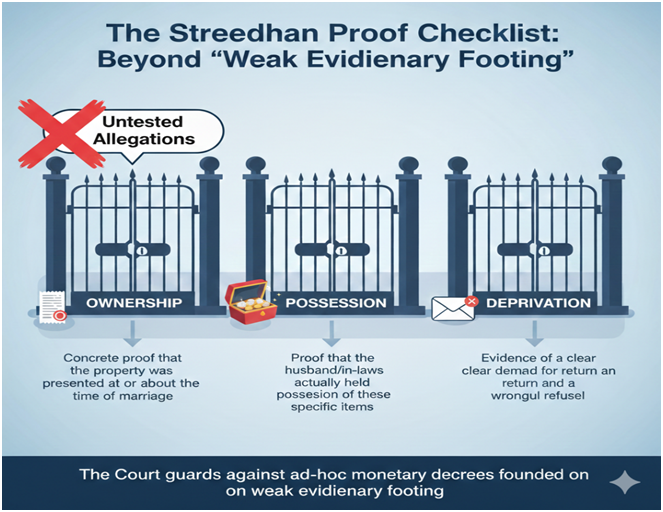
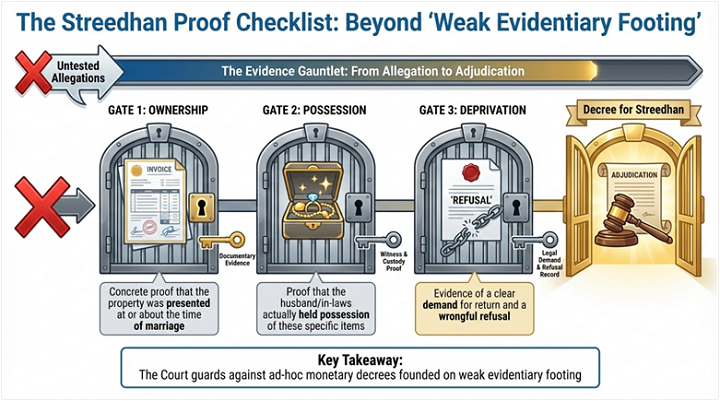
The Division Bench did a detailed examination of both the factual matrix and the governing law and set up the impugned judgment to be unsustainable. At the evidentiary position, the Court noted that the jewellery bills reckoned upon by the respondent were photocopies and that the Family Court had failed to record any reason for admitting secondary substantiation.
Reiterating settled principles, the High Court held that factual substantiation must be proved by the maker or a competent substantiation, and that bare marking of a document or absence of expostulation doesn't apportion with the demand of evidence.
The Court further observed that indeed assuming the bills established purchase, they didn't prove possession of the jewellery by the complainant at the applicable time. The distinction between power and possession was emphasised, with the Court holding that liability for return or compensation presupposes evidence of unlawful retention or privation, which wasn't established.
The High Court was particularly critical of the Family Court’s failure to deal with the respondent’s admission that the complainant wasn't present at the time of the contended incident.
While the Family Court recorded the complainant’s argument grounded on this admission, it failed to engage with it in its logic and rather appeared to calculate on the pendency of criminal proceedings. The Division Bench held that such an approach was fairly taboo , as civil adjudication cannot be superseded by unproven criminal allegations.
On the core question of law, the High Court unequivocally held that Section 27 of the Hindu Marriage Act doesn't permit an independent proceeding. championing the logic of the Chhattisgarh High Court and counting on the Supreme Court’s decision in Balkrishna Ramchandra Kadam v. Sangeeta Balkrishna Kadam, the Court clarified that Section 27 is an enabling provision allowing the marital court to make comprehensive property- related directions at the time of passing a decree. The expression “the court passing the decree ” was held to be determinative of legislative intent.
The Court further differentiated between Section 27 with Section 25 of the Act, which expressly permits post-decree applications for conservation. The absence of analogous language in Section 27 was treated as a conscious legislative choice. Since the decree dated 1 May 2023 dissolving the marriage contained no direction regarding streedhan, the before standalone order was held to be without governance.
Addressing procedural expostulations, the Court clarified that redundancy of a review application does n't bar a statutory appeal and that prosecution proceedings innovated on an order passed without governance can not survive. Exercising powers under Order XLI Rule 33 of the Code of Civil Procedure, the Court directed adaptation of quantities formerly paid or recovered against the respondent’s conservation annuity under Section 125 CrPC, thereby precluding unjust enrichment while correcting the jurisdictional error.
Industry Perspective And Conclusion
Speaking to LCI, Advocate Sarah Haque stated that “What the judgment ultimately reinforces is a discipline that Family Courts often drift away from and that is ‘jurisdiction cannot be assumed merely because a claim appears equitable.”
She further said that “Section 27 was never meant to operate as a free-standing remedy for recovery of streedhan, and allowing it to do so collapses the carefully structured scheme of the Hindu Marriage Act. By insisting that property claims be decided only within substantive matrimonial proceedings, the Court restores procedural coherence and guards against ad-hoc monetary decrees founded on untested allegations and weak evidentiary footing”.
Thus, the judgment of the Allahabad High Court provides a clear and authoritative exposition of the scope of Section 27 of the Hindu Marriage Act. By holding that streedhan claims cannot be adjudicated through independent applications, the Court reinforces jurisdictional discipline and affirms the legislative scheme of the Act. The decision also underscores the necessity of strict adherence to evidentiary principles and reasoned adjudication, particularly in family law disputes where civil, criminal, and matrimonial proceedings often overlap.
At the same time, the Court’s equitable adjustment of amounts already paid reflects a balanced approach that corrects legal error without disregarding the respondent’s legitimate maintenance rights. The judgment thus stands as an important precedent in matrimonial jurisprudence, harmonising statutory interpretation, procedural propriety, and substantive justice.