

Case title:
Mohammadhanif Mohammadibrahim Patel and Others v. Pallaviben Rajendra Kumar Patel and Others.
Date of Order:
18 November 2025.
Bench:
Justice J. B. Pardiwala and Justice K. V. Viswanathan.
Parties:
Appellants: Mohammadhanif Mohammadibrahim Patel and others. Respondents: Pallaviben Rajendra Kumar Patel and others. The respondents were served but did not appear before the Supreme Court.
Master The Transfer of Property Law: Theory, Practice and Procedure by Adv. Roma Bhagat. Enroll Now!
SUBJECT
This judgment poses a narrow procedural question with broad practical consequences. The Court was required to decide whether a first appellate court may grant interlocutory relief in the form of status quo when the trial court has already dismissed the plaintiff’s suit. The matter turns upon the nature and scope of appellate jurisdiction, the function of interim relief as protective and preservative rather than merely remedial, and the correct application of statutory provisions governing stay of execution and appellate powers.
The Supreme Court’s answer was categorical and doctrinal: dismissal of the suit by itself does not deprive the appellate court of the power to grant interim relief where on the facts the classical criteria for such relief are established.
The order is corrective: it condemns an approach adopted by both the first appellate court and the High Court which treated dismissal as an automatic bar to interlocutory relief in appeal and redirects the law to its functional purpose of preserving the substantive efficacy of appellate review. The Court’s own order expressly sets out the terms on which the lower courts were held to be in error and remits the interim application for fresh consideration, while continuing the status quo direction issued by this Court pending reconsideration. See paras 13–29 of the order.
IMPORTANT PROVISIONS
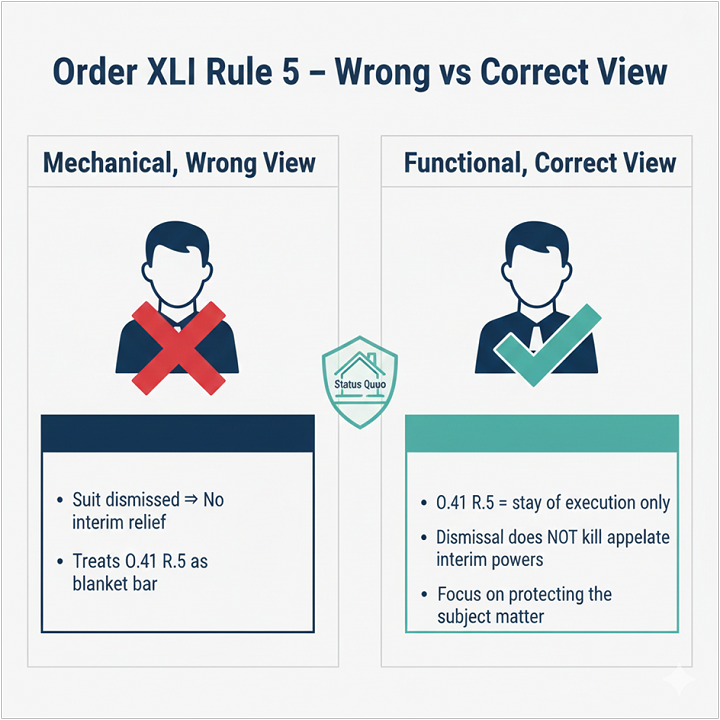
The single statutory provision referenced by the lower courts and specifically discussed by the Supreme Court is Order XLI Rule 5 of the Code of Civil Procedure. The appellate courts below relied on Order XLI Rule 5 to conclude that because the suit had been dismissed there was no executable decree and therefore no scope for stay or other protective interim relief. The Supreme Court rejected that mechanical application and clarified the narrow reach of Order XLI
Rule 5: it is concerned with stay of execution of decrees and associated considerations of substantial loss in that specific context, but it is not an omnibus exclusionary rule against any interlocutory relief in appeal after dismissal.
The order emphasises that appellate courts have co-extensive powers with the trial court to grant interim relief when needed to prevent irreparable injury or make the appeal effective.
In short, Order XLI Rule 5 is a tool in the limited context of execution stay; it is not an instrument to deny the core protective powers of an appellate court. The Supreme Court’s analysis of Order XLI Rule 5 and the appellate powers appears in paras 16–21 of the order.
OVERVIEW
The factual matrix behind the brief Supreme Court order is simple but legally significant. The appellants filed two civil suits challenging different consent decrees on the ground of fraud. The trial courts rendered conflicting decisions and stated that the consent decree in one of the Suits was set aside, but the other suit was dismissed.
The appellants, against the dismissal of the latter and filed Regular Civil Appeal in the court of the District Judge at Vadodara and filed simultaneously an Exhibit 5 application seeking an interlocutory order maintaining status quo over the suit property pending the appeal.
The appellate court refused to entertain the Exhibit 5 application on the ground that since the suit had been dismissed there was no executable decree, and hence no scope for interim relief. The reasoning invoked Order XLI Rule 5 CPC and treated dismissal as fatal to the interim request. The appellants then invoked the supervisory jurisdiction of the Gujarat High Court under Article 227, which upheld the view of the appellate court in a terse order.
Feeling aggrieved by the High Court's dismissal, the appellants obtained special leave and approached the Supreme Court. The Supreme Court found both the appellate court and the High Court to have erred in law by treating dismissal as an automatic bar to interlocutory protection.
On that basis, the Court set aside the impugned orders and remitted the Exhibit 5 application to the District Court for fresh consideration within a fixed timeframe, while continuing the operative status quo protection issued by the Supreme Court itself. The operative directions and the reasoned correction occur primarily in paras 13 through 30 of the Supreme Court order.
ISSUES RAISED
At the very least, two concentric questions arise from the order. The narrow, procedural one is whether a suit having been dismissed by the trial court extinguishes the power of the appellate court to grant interlocutory relief, including but not limited to an order maintaining status quo and in the pending appeal.
The broader, doctrinal question is how Order XLI, Rule 5 is to be understood and applied: does it operate as a general exclusionary rule displacing the ordinary interim powers of the appellate court whenever a suit is dismissed or is its ambit more limited, focused on stays of execution where a decree exists?
Intertwined with both is the recurring issue of appellate function, whether an appeal is only supervisory or a true continuation of the original suit such that the appellate court retains necessary powers to protect the subject matter pending adjudication. These issues are canvassed and answered in paras 13 through 22 of the order.
ARGUMENTS ADVANCED BY THE APPELLANT
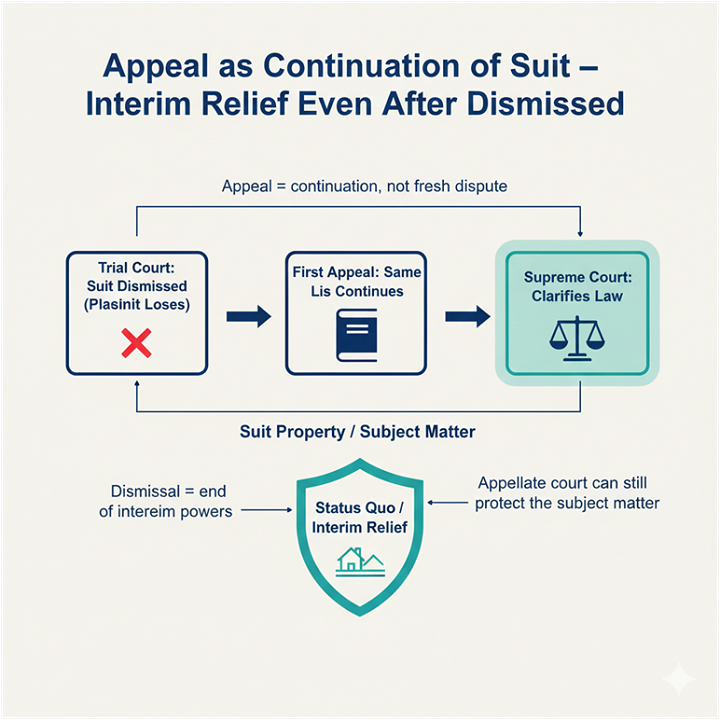
The appellants made a principled and pragmatic submission which rested on the basic characterisation of appeal as a continuation of the suit. Their contention is that an appeal does not inaugurate a fresh private law dispute but carries forward the lis, and with that continuation there is an inherent need for the appellate forum to retain the protective powers necessary to prevent irreparable prejudice which would render eventual success on appeal nugatory.
The Exhibit 5 application sought maintenance of the status quo and did not seek an execution stay and it was therefore incorrect to import the conditions for execution stay under Order XLI Rule 5 into the question whether the appellate court could protect the subject matter until the appeal was heard. The appellants also pointed to the practical consequence that if interim protection is refused on the ground of dismissal, the respondent can immediately alienate or alter the property, thereby rendering any future favorable appellate decision futile.
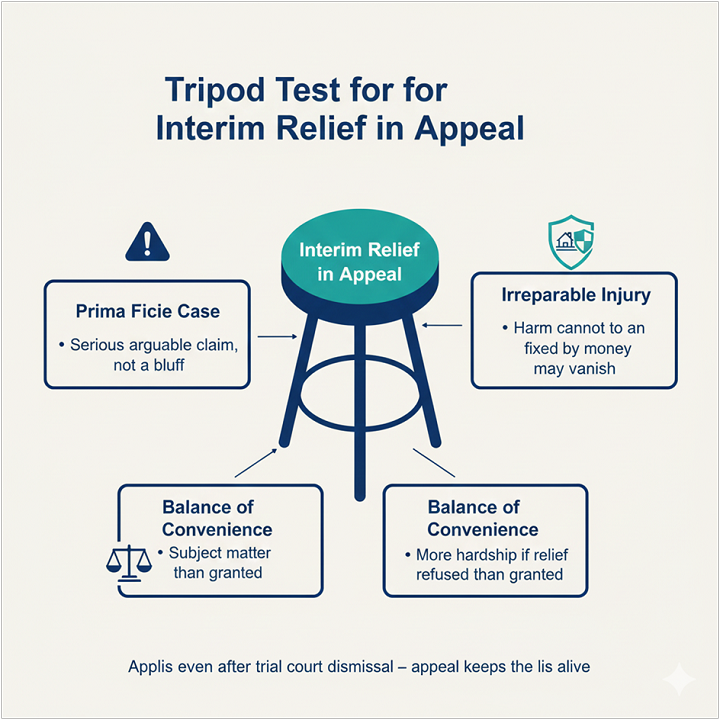
The appellants emphasised that the standard tripartite test for interim relief, i.e. prima facie case, irreparable injury, and balance of convenience, all remains applicable in the appellate context and must be assessed on its own merits by the appellate forum. These submissions were set out in the appellants’ filings and summarized in paras 7–9 and 14–21 of the Supreme Court order.
ARGUMENTS ADVANCED BY THE RESPONDENT
The respondents did not appear before the Supreme Court despite service of notice. The record therefore contains no active counter-submission addressed to the Supreme Court. The appellate court and the High Court had justified the refusal of interim relief by pointing to the dismissal and by invoking Order XLI Rule 5 CPC and said that those are the only recorded positions of the respondents’ side as reflected in the impugned orders.
The Supreme Court’s order notes the respondents’ absence at para 3 and proceeds to decide the legal questions on the record and on submissions advanced by the appellants and their counsel at the hearing. As no responsive argument was advanced from the respondents’ side before the Supreme Court, its correction is based on principle and statutory construction rather than a detailed adversarial refutation.
JUDGMENT ANALYSIS
The judgment is short but tightly reasoned. It proceeds in a sequence that is methodologically instructive: identification of error, doctrinal restatement, example to illustrate practical impact, and remedial directions. The Court began by identifying the central mistake of both the first appellate court and the High Court.
Those courts had taken the view that because the plaintiff had lost at the trial stage, no question of granting injunction or status quo could arise in the pending appeal unless the judgment was first set aside.
The Supreme Court characterised that approach as legally unsustainable and said so plainly in para 13: “With all humility at our command, we are of the view that both the first appellate court and the High Court are not right in taking such a view.”
The doctrinal correction by the Court is twofold. The first limb is a restatement of appellate character: the appeal is a continuation of the original suit and the appellate court has co-extensive power to grant appropriate interim relief to prevent irreparable injury and preserve the status quo pending final disposal of the appeal.
The second is a statutory clarification that Order XLI Rule 5 deals fundamentally with stay of execution of decrees and attendant considerations; it cannot be invoked to deny interim protection in an appeal where execution is not the issue. The Court addresses this squarely at paras 16 and 21.
In so doing, it repositions the analytical focus on the foundational judicial discretion that governs interlocutory relief, that prima facie case, irreparable injury, and balance of convenience. These remain the operative tools of appellate discretion even when the trial court has entered an adverse judgment. See paras 14–21.
Another enlightening aspect of the order is the use of an illustrative hypothetical by the Court. Without getting into unnecessary doctrinal complication, the judges employ the example of a suit for specific performance of an immovable property contract.
The thought experiment is simple and effective, imagine if a trial court dismisses an action for specific performance and the appellate court refuses status quo merely because the suit was dismissed, the defendant may transfer the property before the appeal is decided.
Even if the appeal ultimately succeeds, the plaintiff would be deprived of equitable relief because the subject matter would no longer be available. The illustration enlivens the functional rationale for interlocutory protection: protection preserves the efficacy of appellate review, and the law should not be administered in a way that renders appeals theoretically meaningful but practically worthless. The example appears at para 15 and is central to the Court’s practical reasoning.
The Court also addresses the appropriate use of Order XLI Rule 5. It observes that factors listed in Rule 5, such as substantial loss, pertain to the context of a stay of execution rather than the protective privileges accorded to an appellate court which is tasked with disposing of an interlocutory application on an issue of preservation of the subject matter of litigation.
The judges said that on the facts of this case, the appellate court reliance on Order XLI Rule 5 was “grossly misplaced” since the legal consequences which Rule 5 governs did not arise upon the proven absence of any executable decree. This is found in para 16 and forms the statutory pivot of the Court’s corrective direction.
After setting doctrinal boundaries, the Court gives a clear remedial direction and said that the impugned orders of the District Court and the High Court are set aside, and the Exhibit 5 application filed in the Regular Civil Appeal is remitted to the District Court for a fresh hearing and decision on merits within two months.
The Supreme Court remitted the matter to the appellate court for fresh consideration rather than deciding the Exhibit 5 application itself. This approach preserves the appellate structure and ensures that the district appellate court, which will eventually decide the appeal on merits, is the forum to exercise its discretion afresh with attention to the correct legal tests.
The Court further preserved status quo in the interim, continued its own earlier interim direction, and directed the parties to appear before the District Court on a given day so that the matter proceeds without delay. These procedural directions are contained in paras 23–29 and are designed to make the appellate remedy effective in practice rather than merely theoretical.
The Supreme Court did not expound a new doctrine or purport to take any comprehensive survey of prior jurisprudence at the appellate level on the topic. It did not rely on any precedent or issue an extensive bench opinion. Rather, the Court identified an error of law in discreet terms and remitted with directions for fresh consideration, all while preserving relief in the interim. This restraint may be a function of the narrowness of the issue, the sufficiency of the corrective remedy, and the wish that lower courts exercise the appellate discretion that the Supreme Court has now correctly articulated.
Implications And Do's and Dont's
From a practical litigation standpoint the order has several implications. First, litigants who face dismissal at trial may seek interlocutory preservation in the appellate forum; the fact of dismissal alone is not a bar.
Secondly, appellate courts must not mechanically transplant the tests for stay of execution under Order XLI Rule 5 into all interlocutory contexts and they must instead analyse the real risk of irreparable loss and the need to preserve the subject matter of litigation.
Thirdly, the order underscores judicial economy and expedition, that the Supreme Court fixed a two-month timeline for fresh consideration and required the district appellate court to fix a date and hear the Exhibit 5 application.
In doing so the Court sought to prevent further delay that could defeat effective relief. Finally, the Court's decision restores the functional integrity of appeals as more than abstract points of law by ensuring appellate discretion remains capable of preserving potential remedies. These practical points flow from paras 24–29.
Speaking regarding do's and dont's of asking for interim or urgent reliefs, Advocate Animesh Tripathi said "People walk into court thinking urgency alone gets them an injunction, but judges don’t buy panic. They buy logic, evidence and clarity. If you want the court to stop someone from doing something tomorrow morning, you better show what will go wrong today because afterall a judge wants to see an imminent threat
Advising the lawyers and law student, Mr Tripathi said that "A lawyer asking for interim protection should always remember that the court wants to see two things upfront: one, the facts are not speculative, and two, waiting will cause irreversible damage.
If what you’re trying to prevent can be compensated with money later, or if your entire urgency is self-created because you slept on your rights for months, you’re not getting relief." He further said that "A delay of even a few days can kill the claim unless you have a very good explanation. And nothing irritates a judge more than a party who wakes up only after the other side starts construction or demolition and then screams “urgent”."
He also opined that "On the flip side, a well prepared interim application feels like a controlled argument, not a desperate one. Don’t hide facts that will inevitably surface, because credibility is half the injunction. If you can show that the other side wants to beat the appeal by changing the nature of the property before the court can decide, that’s when the judge starts listening closely."
CONCLUSION
This Supreme Court order reinforces a simple but vital rule of appellate process: the appellate forum exists to continue and, when necessary, protect the litigation, not merely to police procedural correctness. Dismissal at trial is the outcome of a stage in litigation but it does not sterilize the remedies available in the appellate forum.
The order gives lower courts a clear corrective: when confronted with an interlocutory application in appeal, judges must evaluate the application on traditional interim relief criteria and on the particular facts of the case rather than allowing dismissal to operate as an absolute bar.
The Court’s remedial course — setting aside the impugned orders, remitting for fresh consideration, and preserving status quo in the meanwhile — is proportionate and practical. Because no precedent was cited in the order, I have confined references to the order’s paragraph numbers and to the statutory provision engaged by the lower courts.


