Bench
Hon’ble Mr. Justice Navin Chawla
Hon’ble Mr. Justice Anup Jairam Bhambhani
Hon’ble Ms. Justice Renu Bhatnagar
Date of Judgment
Judgment reserved on 19 September 2025
Judgment delivered on 17 December 2025
Facts
The case at hand originated in the context of the matrimonial proceedings between the appellant wife, Shiksha Kumari, and the respondent husband, Santosh Kumar. The marriage between the couple had failed, and both parties sought the dissolution of the marriage by mutual consent as per Section 13B of the HMA.
Nevertheless, certain procedural challenges arose as a result of the statutory requirement under Section 13B(1), which requires that the couple has to be living separately for a period of one year or more before the joint application for the divorce by mutual consent can be moved.
The matter was brought before the Division Bench of the Delhi High Court, before which the Bench found itself in conflict with its earlier decision in Sankalp Singh v. Prarthana Chandra. In this matter, Sankalp Singh had filed their first motion for divorce within one year of separation using the proviso to Section 14(1), however, their divorce can only be granted after one year of separation.
The referring Division Bench had doubts regarding the correctness of this view, in view of the subsequent decisions of the Supreme Court which had loosened up thestrict timelines set under Section 13B, including the six month period mentioned in Section 13B(2). Considering the institutional importance of clarifying conflicting views within the High Courts, this case was also referred to a Full Bench.
Issues
The Full Bench was required to determine the following questions of law, namely:
Firstly, whether the petition for divorce by mutual consent under Section 13B(1) of the Hindu Marriage Act can be filed and maintained before one year of separation between the parties.
Second, in the event a petition for divorce can be entertained, can the six month requirement under Section 13B(2) from the filing of the first motion for the second motion under Section 13B(2) be waived even in the event the parties involved haven't completed one year of separation on the date of such relief from the requirement?
Contention On Behalf of the Appellant
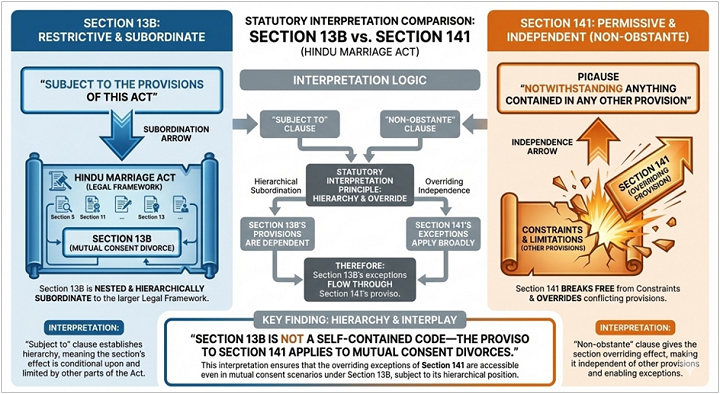
On behalf of the appellants, it was argued that Section 13B(1) has to be read consistently with Section 14(1) of the Hindu Marriage Act. Since Section 13B(1) starts with the words ‘subject to the provisions of this Act’, it was argued that the proviso to Section 14(1), which allows the court to permit divorce petitions prior to the filing of one year where there was exceptional hardship and/or depravity, would also be applicable to mutual consent divorces.
The appellant also argued that to compel persons who are ad idem to wait mechanically for the completion of statutory periods in cases of dissolution is neither having any rehabilitative value nor is it in respect for their dignity, autonomy, and decisional privacy, as guaranteed under Article 21 of the Constitution. The grounds were backed by the developing jurisprudence of the Supreme Court in the cases of Amardeep Singh vs Harveen Kaur and Amit Kumar vs Suman Beniwal, which held that the waiting periods under Section 13B are only directory and not mandatory.
It was also contended that the case of Sankalp Singh incorrectly held that the one year separation is a substantive requirement that needs to be fulfilled at the stage of passing the decree, even if waived at the filing stage.
According to the appellant, if the court feels satisfied on the issue of free consent and exceptional circumstances, there is no judicial reason for withholding the decree for fulfilling the timeline that is remote from the realities of life.
Contentions on behalf of the Respondent
The respondent was inclined towards the more conservative interpretation of Section 13B and upheld the reasoning applied in the case of Sankalp Singh. It was submitted that the period of a year that Section 13B(1) specifies between the couple, prior to the dissolution of marriage, acts as a substantive legislative shield against the impulse to dissolve marriages. Thus, the respondent submitted that even if procedural simplicity were allowed, the dilution of the period of separation would affect the sanctity of marriage.
It was also submitted that Section 13B is itself a self-contained code regarding divorce by mutual consent, which will result in judicial legislation if the proviso to Section 14(1) is read into Section 13B. The respondent warned that unwarranted discretion on this issue may result in anomalies in decision-making.
The Court's Analysis and Reasoning
The Full Bench performed an exhaustive analysis of the statute itself and the judicial developments on the concept of mutual consent for divorce. The Court first reiterated the essential ratio decidendi of the case of Sureshta Devi v. Om Prakash, which held that one year of separation, under Section 13B(1), is a necessary prerequisite for divorce, as established by the Supreme Court. Nevertheless, the Court made it clear that such jurisprudence has over the years gradually shifted from the literal rule of interpretation.
The second major plank of reasoning of the Court begins with the interpretation of the relevant provision of Section 13B(1) of the Code. This provision clearly states that “It shall come into force subject to the provisions of this Act.” The Bench was able to contrast this position with Section 14(1) of the Code. The latter provision starts with a non-obstante provision. The Court relied on the principles of interpretation of statutes to reach a finding that the word “subject to” inherently means subordination to other provisions of the Code. This rebuts any interpretation of Section 13B as a complete code.
The Court proceeded to examine the legal implications of the proviso to Section 14(1). Although Section 14 was originally intended for fault divorce, the inclusion of Section 13B into the Act in 1976 and the contemporaneous reduction of the minimum statutory period required for the operation of Section 14 from three years to one year evidenced the legislative shift in favour of recognizing the concept of marital breakdown and the principles of personal autonomy. In so far as consent divorce was concerned, the proviso to Section 14 would be nonsensical.
The Full Bench appraisingly considered the case of Sankalp Singh and admitted that the judgment has to be read in its temporal context. Indeed, at the time Sankalp Singh was pronounced, the courts did not have the authority to waive the six-month cooling off period under Section 13B(2).

Notably, this scenario changed with the case of Amardeep Singh, wherein the Supreme Court of India held the cooling off period to be directory. Therefore, the reason given in Sankalp Singh, that the decree of divorce shall only be operative with the completion of the first year of separation, lost sanctity.
Significantly, the Court repelled the argument that timelines are the essence of Section 13B. Conversely, the Court expressed the true essence of Section 13B to be the free, voluntary, and informed consent of the parties.
If this is given, and if the court is satisfied that the marriage is beyond salvage and that there will be exceptional hardship if the marriage is forced to continue, timelines cannot be preferred to the cause of justice.
The Bench also cleared the scope of the discretion exercised by the proviso in Section 14(1). The waiving of the requirement of one-year separation must not be done arbitrarily. The courts must ensure the maturity of the parties, the absence of duress, the impossibility of a reconciliation, and the authenticity of the consent, echoing the earlier pronouncement in the case of Amardeep Singh Vs Harveen Kaur.
Finally, the Court asserted categorically that the waiver of the one-year separation period under Section 13B(1) does not necessarily preclude the waiver of the six months’ period under Section 13B(2).
Both are independent of each other, and more importantly, all of these are merely instruments of testing consent, not of extending suffering. Provided that the court is satisfied on this aspect, then it can certainly decree a divorce with prospective operation, without waiving its execution until one year.
Decision and Legal Position
The Full Bench answered both the questions in the affirmative. It held that under Section 13-B(1), the petition can be moved prior to the completion of one year of separation on the basis of the proviso to Section 14(1), and that courts are also empowered to waive the requirement of the six-month period under Section 13-B(2) even prior to the completion of one year of separation. In so far as Sankalp Singh case was requiring the deferment of the divorce decree until completion of one year, it was squarely overruled.