Case Title
Union of India & Others v. Larsen & Toubro Limited
Bench
Justice Sanjay Karol
Justice Vipul M. Pancholi
Date of Judgment
27 February 2026
Petitioner / Appellant
Union of India & Others (North Central Railway Administration)
Respondent
Larsen & Toubro Limited (L&T)
Relevant Sections
Section 28(3), Arbitration and Conciliation Act, 1996
Section 31(7)(a), Arbitration and Conciliation Act, 1996
Section 31(7)(b), Arbitration and Conciliation Act, 1996
Section 73, Indian Contract Act, 1872
Related Contractual Clauses
Clause 16(3) of the General Conditions of Contract (GCC)
Clause 64(5) of the General Conditions of Contract (GCC)
BACKGROUND OF THE DISPUTE
Arbitration in India is essentially mediated by the principle of party autonomy, which gives the contracting parties the ability to establish the framework under which they will resolve their disputes. The arbitration entails consent unlike conventional litigation and authorities of the arbitral tribunal are directly out of the contract between the parties. In turn, arbitrators should not go beyond the contract provisions that govern the relations between the parties in dispute.
A common problem in the jurisprudence of arbitration has been the authority to impose interest on monetary claims, especially in cases where the contract upon which the claim is based forbids the award of interest. This was considered by the Supreme Court of India in the case Union of India and Ors. v/s Larsen and Toubro Limited (2026 INSC 203). The Court had to interpret the case by fixing on whether or not an award of interest could be granted by an arbitral tribunal in spite of the fact that there were contractual provisions limiting the award of interest.
It was also in this case that the Court needed to interpret the contractual terms and the statutory terms in the case under the Arbitration and Conciliation Act, 1996 especially under Section 28(3) and 31(7) of the Act. Although Section 31(7) gives arbitral tribunals the ability to award interest, it also acknowledges the fact that such power is limited to the agreement between the parties.
In deciding the case, the Supreme Court made one significant distinction between pre-award interest (with pendente lite interest) and post-award interest. The Court concluded that although a contractual provision could bar pre-award interest, it need not bar post-award interest except where the contract stated otherwise.
The Court reinstated the main principle that the arbitral tribunals cannot go beyond the restrictions set in the contract by recharacterizing the interest as compensation by partially setting aside the arbitral award and amending the rate of post-award interest. Meanwhile, it has been observed that the judgment guarantees that post-award interest can be used as a statutory tool to make sure that the award in arbitration is complied with.
FACTS OF THE CASE
The conflict was occasioned by a turnkey contract that was signed on 27 January 2011 between the Union of India, on behalf of North Central Railway Administration, and Larsen and Toubro Limited (L&T). The contract was about modernization of the Jhansi Workshop of North Central Railways and a total estimated project was Rs 93 crore.
The contractor had, according to the agreement, 18 months to get the modernization work done and the proposed completion date was 18 July 2012. In the process of implementation, however, the project suffered some delays on the way as a result of the operational and administrative issues.
The consequence is that the railway administration awarded extensions for ten times until the project reached its completion date on 30 November 2015. This implied that the project was being done more than 40 months late into the initial contractual schedule.
This prolonged time was met with disagreements between the parties on financial modifications in the contract. Larsen and Toubro contended that it had incurred losses as a result of poor payments, failure to make some elements of the contract and the long-time taken to execute the project.
In accordance with the General Conditions of Contract (GCC) that were used to regulate the agreement, any dispute between the two parties was to be settled by arbitration. On this basis, L&T resorted to the arbitration clause wherein a three-member Arbitral Tribunal was formed under Clause 64 of the GCC to settle the dispute.
CLAIMS BEFORE THE ARBITRAL TRIBUNAL
Larsen and Toubro had several claims before the Arbitral Tribunal on the issue of financial losses incurred because of delays and the contractual breach by the railway authorities. These claims included:
- •Interest and commission on late payments of running account bills.
- Arguments involving fluctuations in the components of foreign exchange currency.
- Failure to pay the Price Variation Component (PVC) on the contract.
- The indirect costs are as a result of the lengthy time taken on the project.
- Liquidated damages that were recovered by the railway administration are refunded.
- Owes on the final bill of extra work done.
- The interest on the claim is in the amount of.
- Arbitration proceedings expenses.
The Union of India dismissed a counterclaim, stating that the refusal to start building the project on time had cost the railway administration losses.
In court of the evidence and submissions of both parties, the Arbitral Tribunal decided its award, on 25 December 2018, the tribunal accepted some of the claims of L&T and granted a net amount of about Rs 5.53 crore in favour of contractor.
It was also ordered by the tribunal that the award value would be subjected to post-award interest of 12% per annum unless paid within 60 days and then would bear interest to the time of payment.
CHALLENGE BEFORE THE COURTS
The Union of India appealed against the arbitral award by submitting an application under Section 34 of Arbitration and Conciliation act 1996, in Commercial court Jhansi.
The government contended that the arbitral tribunal had been guilty of contravening the contractual provisions by awarding interest given that there was an express prohibition of interest payments in the contract.
Nonetheless, the Commercial Court quashed the appeal by considering that the arbitral award was not covered by the few reasons to interfere with it under Section 34.
An appeal in this case was subsequently made by the Union of India under Section 37 of Arbitration Act before the Allahabad High Court. The High Court supported the ruling of the Commercial Court and affirmed the arbitral decision.
The Union of India took the matter to the Supreme Court of India, which decided on the current judgment because of the grievances over these rulings.
LEGAL ISSUES BEFORE THE SUPREME COURT
The Supreme Court has taken into account three major issues:
- 1.Whether the arbitral tribunal was correct in awarding pre-award or pendente lite interest even though the contractual prohibition existed.
- Whether the tribunal was correct in granting post-award interest.
- Whether the Commercial Court and Allahabad High Court was wrong in affirming the arbitral award under Sections 34 and 37 of the Arbitration Act.
CONTRACTUAL CLAUSES IN DISPUTE
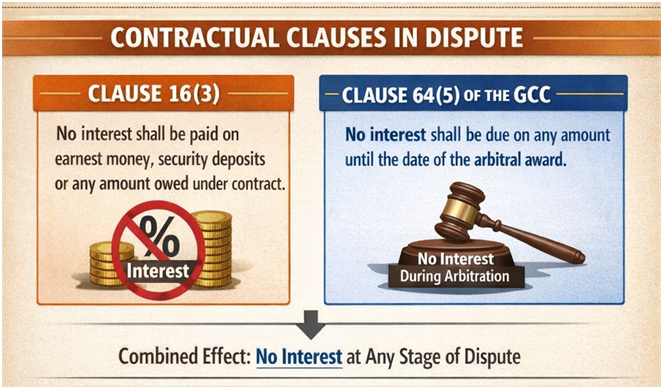
In clause 16(3) it was stipulated that there should not be any interest that will be paid on the earnest money, security deposits, or sums that were to be paid to the contractor under the contract. The clause was also general in nature and could seem that it limited the contractor to the right to earn an interest on any amounts owed under the contract.
This was further reinforced by clause 64(5) of the GCC that stipulated that there will be no interest due on any amount within any duration until the date of arbitral award. This was a particular provision that was linked to arbitration and concerned interest in the course of disputes.
The Union of India claimed that the combination of Clause 16(3) and Clause 64(5) shows that the parties intended to avoid any interest at all, both in the course of the contractual process and the arbitration course. That is, the government argued that the collective effect of these clauses was to prohibit the award of interest in any form, either pre-award, pendente lite or otherwise.
These clauses were thus construed to be at the centre of scrutinizing whether the arbitral tribunal had been acting within its jurisdiction.
STATUTORY FRAMEWORK
The Supreme Court also looked into the statutory provisions in the Arbitral awards in the Arbitration and Conciliation Act, 1996 in determining the dispute. These clauses outline the limits of the authority of the arbitral tribunal, and how the contractual terms relate to statutory remedies.
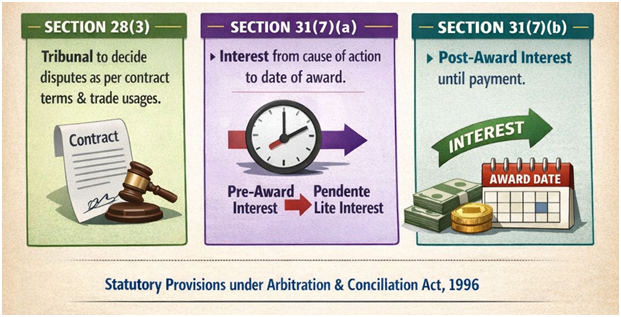
Section 28(3) states that a tribunal of arbitral settlement is required to resolve disputes concerning the contract terms, and should also consider trade usages. This is a basic guideline of the fact that arbitration is contractual and that the contractual framework agreed upon by the parties should inform the decision-making process by the tribunal.
The section 31(7)(a) gives the arbitral tribunal powers to grant interest on the time between the date of cause of action and the time the award of the arbitral award was given. This time normally encompasses pre-reference interest and pendente lite interest.
Section 31(7)(b) addresses the post award interests, which states that the amount to be paid by an award of an arbitration will accrue interest on the award date until payment unless the award specifies otherwise.
This is a contrast to Section 31(7)(a) in which it is expressly subservient to the contractual agreement between the parties. Rather, it defines a statutory impact which guarantees the efficiency and enforceability of arbitral awards.
SUPREME COURT'S ANALYSIS
Preference of Contractual Terms
The Supreme Court started its deliberations by reaffirming a basic principle of arbitration law, which states that arbitration derives its power in the agreement between the parties. Arbitration being a consensual process, the authority of the arbitral tribunal is spelt out and restricted by the contractual terms.
In reference to the provisions of Section 28(3) in the Arbitration and Conciliation Act, the Court has underlined that arbitral tribunals must determine the disputes based on the provisions made in the contract signed by the parties. This implies that the tribunal is not at liberty to disregard the spelled out contractual limitations in ascertaining the rights and liabilities of the parties.
The Court also noted that permitting arbitrators to contravene any terms of contract under the guise of fairness or equity would harm to the principle of party autonomy and would bring uncertainty in business dealings. The contracts especially those with big infrastructure projects may include well negotiated terms of monetary obligations and compensation.
Thus, in cases where the parties have negotiated the restriction or exclusion of some of the remedies, including interest, the arbitral tribunal should accept such a choice.
Interpretation of Clause 16(3)
One of the matters before the Court concerned whether the Clause 16(3) was broad based covering all contractual payments or just certain deposits like the earnest money and security deposits.
Larsen and Toubro contended that the clause was to be construed narrowly by application of the principle of ejusdem generis that implied that general words that come after particular words must be construed as to belong to the same category as the particular words.
The contractor says that this clause mainly meant earnest money and security deposits and thus the term amounts payable to the contractor must have the understanding that it meant similar amounts as deposits and not all the payments under the contract.
This argument was unsuccessful in the Supreme Court. The Court was of the view that the term amounts payable to the contractor under the contract is wide and free-standing. The clause includes the word or between the sentences earnest money, security deposit and amount of payable to the contractor, which means that it is not one category but three independent ones.
In that regard, the Court held that Clause 16(3) should be given a plain meaning interpretation and that it bans the payment of interest on any sum to be paid to the contractor out of the contract.
Pre-Award and Pendente Lite interest
The Court then considered whether the pre-award and pendente lite interest awarded by the arbitral tribunal was reasonable. The Court noted that this kind of interest is covered by Section 31(7)(a) of the Arbitration Act. Nevertheless, this clause is categorical that interest can be granted unless otherwise between parties.
This implies that when the parties have mutually agreed not to take interest in the form of contractual provisions, the arbitral tribunal is barred to grant the interest.
In the case at hand, the tribunal had granted some sums by the arbitral tribunal that were in effect with interest since they were termed compensation of lost payments. The Supreme Court said that such a method was not acceptable as it would override the contractual forbidding the interest.
The Court highlighted that arbitrators cannot avoid clauses to a contract by simply altering the name to a payment. When the payment is a real compensation of the loss of the money during its use, it is an interest even though it was called otherwise. As such, the Court found that the arbitral tribunal had made a grave legal mistake in granting interest on pre-award and on pendente lite.
Importance of Case Laws Been Relied upon
Alexander and Lee v. Newman, 166 U.S. 55 (1987). Railway Administration (2010)
Here, the Supreme Court ruled that where the contract spells out the ban on interest, the arbitrator cannot award the interest on the pre-award basis. The ruling supported the fact that the contractual agreements that omit interest should be strictly followed.
Union of India v. Bright Power Projects (2015)
This decision elucidated that the awarding of interest by an arbitrator under Section 31(7)(a) of the Arbitration Act is under the agreement of the parties and is secondary to the agreement. The Court ruled that after the parties have already accepted that the interest will be excluded, the arbitrator cannot grant it.
Union of India v. Manraj Enterprises (2022)
The Court reiterated that where a contract has a clause that does not allow interest, the arbitrator is not able to award interest on the pre-reference or pendente lite interest. This case reinforced the issue that the contractual restrictions should be observed in the arbitration.
Chittaranjan Maity v. Union of India (2017)
The decision recalled that contractual provisions that do not contain interest are binding to the arbitral tribunal and that arbitrators cannot disregard such provisions in the course of awarding.
Difference between Pre-Award and Post Award interest
One of the major contributions of this judgment is that it has made the line very clear between pre-award interest and post-award interest.
The Supreme Court determined that the pre-award interest falls under the regimes of Section 31(7)(a) and is liable to the contract agreement between the parties. Hence, in case the contract itself precludes any interest, the arbitrator cannot give an interest on the pre-award period.
Post award interest, however, is under Section 31(7)(b) which is a statutory mechanism that seeks to provide that the successful party is paid the award in a timely manner.
This is why the Court concluded that despite the exclusion of pre-award interest by a contract, post-award interest could still be awarded provided that the contract does not expressly prohibit it.

Post-Award Interest Modification
Even though the Supreme Court supported the award of post-award interest, it determined that the rate of 12 percent per annum was too high given the situation of the case.
The Court used the previous ruling by the Court in Gayatri Balasamy v. The rate of post-award interest can be adjusted by courts to create fairness, and ISG Novasoft Technologies Ltd. (2025) acknowledged that.
Considering the current economic environment and lack of motivation to rectify such an elevated rate, the Court lowered interest rate by 12 to 8 percent per annum.
Final Decision
In part the appeal submitted by the Union of India was permitted by the Supreme Court.
The Court held that:
- The arbitral tribunal has misused the pre-award and pendente lite interest award since the contract had clearly forbidden this.
- The post-award interest was valid on the part of award, but the rate of interest was to be adjusted.
- The Allahabad High Court and the Commercial Court had not taken into consideration the contractual ban on interest in order.
In this regard, the Supreme Court remanded the arbitral award to the level that it awarded pre-award interest and lowered the post-award interest rate to 8 percent per annum.
SIGNIFICANCE OF THE JUDGMENT
The Judgment is important as it determines the role of the Supreme Court in the protection of the human rights.
This ruling has significant consequences on the arbitration law in India.
First, it reaffirms that arbitration is essentially contractual and arbitral tribunals have to strictly follow the terms, which were agreed upon by parties.
Second, it explains that indirect award of interest as compensation is not possible where the contract does not allow it.
Third, the ruling provides a strict separation of doctrine between pre-award and post-award interest and will help in future arbitration cases.
Lastly, the fact that the Court did not set the award aside, but merely modified it, is an indication of a more expansive judicial method of the Court to maintain the efficiency and finality of arbitration.
CONCLUSION
The case of Union of India v. Supreme Court. Larsen and Toubro Ltd. constitute a significant clarification in the Indian jurisprudence of arbitration. The judgment reinforces the legal framework on the arbitral awards through the reassertion of the primacy of the contract terms and the boundaries of the arbitral order.
It is held that the clauses in the contract that banish the interest must be taken seriously, the arbitrators should not avoid such clauses by describing the interest as compensation, and the interest after the award is a statutory cost unless it is stated otherwise.
By so doing, the Supreme Court has left a meaningful legacy to the arbitrators, courts and parties to contracts, as arbitration has become more certain and predictable in resolving commercial disputes, which was the intended aim of the Supreme Court.